Hoard

‘You’re a funny little biscuit’

Few films are this sensory and results in such a visceral film experience. The story of a teenage girl (Saura Lightfoot-Leon), her childhood with her hoarding mother (Hayley Squires) and her problematic entanglement with an older man (Joseph Quinn) in the present day, evokes all of the senses – from the tactile touch of another person to the accidentally groped slime from under a stack of rubbish to the prevailing smell of waste that hovers of the film itself. Every sense is called upon to convey the sense of grief that weighs upon Maria, the loneliness that prevails within her and that, upon meeting Quinn’s binman Michael, is no longer something she can ignore and repress.

Within Michael, a previous resident of her foster mother (Samantha Spiro, who is fantastic and wonderful to watch as a positive representation of foster parenting), there is a similar darkness and their meeting is something alike kindred spirts. But what follows isn’t a love story, it’s a consumption rooted in the animalistic – of no-holes-bared feeling, where the act of finally being perceived results in an omnipresent feeling of danger & uncertainty. It’s extraordinarily depicted due to the performances, with Lightfoot-Leon’s Maria being unknowable to the point of almost mythical – physically present but emotionally distant to all but an appointed few. Michael is almost twice Maria’s age, which could have been depicted in a certain near-expected way in terms of power dynamics. Instead Quinn’s Michael is a multitude of grey, part-hero and part-distress. A soon-to-be father, there’s a sense that he’s torn between rescuing Maria and wanting to be rescued from the parental role that shortly awaits him.

Writer-director Luna Carmoon’s script depicts their dynamics with such tender brutality, it’s somehow both matter-of-fact yet ultimately incomprehensible. Like the film overall, a blend of British realism with a strain of either sublime or surreal that is apparent within both Charlotte Wells’ Aftersun (currently available on BBC iPlayer) and Charlotte Regan’s Scrapper (BFI Player). The trio of films not only share white-boy-of-the-month (Paul Mescal and Harris Dickinson respectively) but they are also bittersweet reflections of parental relationships, of figures who clearly love their children but have an internalised barrier that distorts their relationship with their child and, quite possibly, the adult they will become.

A hauntingly vivid mediation on love, loss and longing.

[4/5 stars]

Hoard is in UK cinemas now.

Saltburn

‘This place, you know, it’s not for you.’

In the vein of Talented Mr Ripley, The Secret History and The Go-Between, writer-director Emerald Fennell‘s sophomore feature is a captivating satire as we follow an outcast student, Oliver (Barry Keoghan), become drawn into the world of his charming aristocratic classmate Felix (Jacob Elordi).

2006. Oliver arrives at Oxford on his own, knowing no-one there and with next-to-no support networks out of his new university. Felix is his exact opposite, a beloved friend to all, whose attention is electrifying that Oliver craves it. When Oliver helps Felix in a moment of need, a deep friendship forms between the pair. So much so that, that summer, Oliver joins Felix at his sprawling family estate. At Saltburn he will meet Felix’s mother, Elspeth (Rosamund Pike), father Sir James (Richard E. Grant), sister Venetia (Alison Oliver) and cousin Farleigh (Archie Madekwe) – experiencing a summer he will never forget.

At 127 minutes long, Saltburn is able to take it’s time in building the anticipation, imitating Oliver and Felix infiltrating each other’s lives. Oliver is our entry point, and Keoghan’s performance is eerie and bewitching. Although we pity his circumstances, we also understand the wariness with which his classmates view him, dubious about his nature and uncertain of his motivations. To cast Elordi as his parallel is an act of casting genius, he is a Golden Adonis – a role we’ve not seen as magnetically depicted since Jude Law in Ripley. Linus Sandgren‘s extraordinary cinematography emphasises his massiveness and delights in his beauty.

He is everything that is considered ideal – tall, broad, breathtakingly handsome and so entrenched in his privilege he is seemingly oblivious to it. Everyone vies for his attention, to be perceived and wanted by him. The exact opposite of Jacob, which is like a drug for him – he is someone people chose to not see, he craves Felix’s affections within their quasi-platonic dynamic and desires nothing else to be perceived by him. To no longer be invisible.

Watching their dynamic play out, languidly and with unclear intent, is delicious and given all the more flavour by the excellent supporting performances. Every single line uttered by Pike is nothing sort of captivating and beholden of such depths, a blend of scathing & boredom with an undisclosed level of obliviousness – to what extent is she creation or curator.

The film stumbles in it’s final act, it’s deliberate and knowing pace becomes something more rushed and hurried. Development with some plot points would have made for greater impact. Instead of further teasing out and exploring both class conflict & psychosexuality, there’s a frustration at what could have been. Perhaps apt considering the focus of the film…

All in all, though, Saltburn is a wickedly mischievous good time.

[4/5 stars]

Saltburn is in UK cinemas from November 17th.

Chasing Chasing Amy

‘Life’s not about finding your heroes, it’s about finding yourself.’

Nearly everyone has a film that they consider their lifeboat film. They saw it at a crucial time in their lives and it made an inedible impression, it could have been life-saving in one way or another. Sometimes, however, with time, that film may not have aged as well as the person who loves it so much. That film may have become increasingly problematic, maybe having already been so from the outset, and that adoration face challenges from a complex legacy.

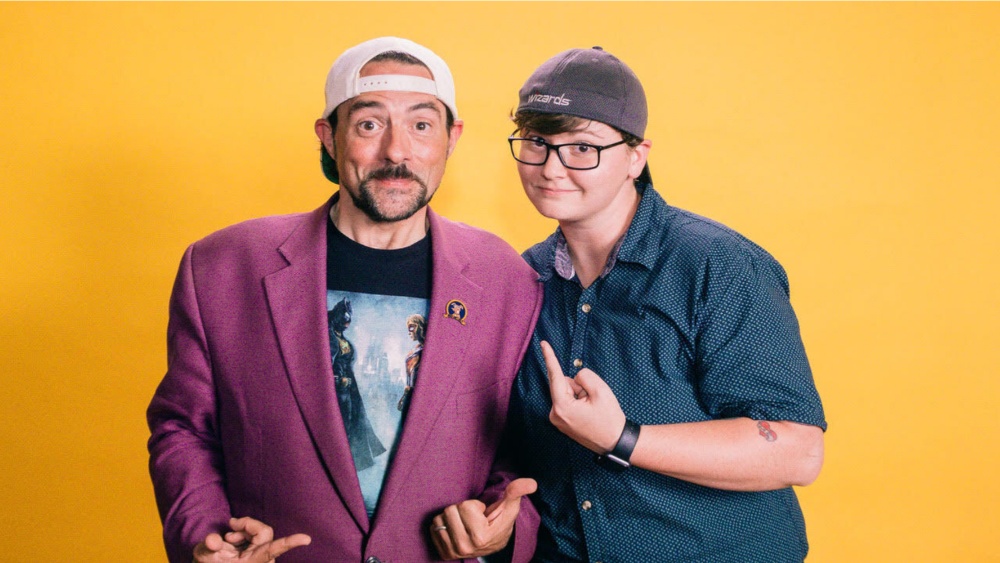
That’s the situation the writer-director-star of Chasing Chasing Amy faces. Sav Rodgers credits Kevin Smith’s 1997 film Chasing Amy with saving his life. It’s not hyperbole, as he explains in his 2018 TED Talk. Growing up in Kansas, as a queer person, Sav struggled with representation and limited positive LGBTQ+ role models. Having struggled with feeling isolated, facing abuse from his peers and fearing that these bleak feelings would be ever-permanent, a chance encounter with Chasing Amy changed his life and gave him hope.

Now, depending on how well you know that movie will impact your reaction to this declaration. For the story of Chasing Amy is a semi-biographical tale of Holden (played by Ben Affleck) who falls Alyssa (Joey Lauren Adams) but finds his hopes for romance crushed when he finds out she’s a lesbian. The film was reasonably well received on release, with Roger Ebert praising the film for being ‘moving and yet written with the skill of a screwball comedy’. And yet, in the 27 years since it’s release, it feels increasingly icky as a film concept and, as demonstrated by some of the talking heads in this documentary, feels like an unlikely film to warrant as much adoration and esteem as Rodgers holds it in. So, now older, wiser and happily partnered up, he’s finally ready to look into the legacy of Kevin Smith’s indie hit.

What follows is a documentary of discovery, of how cinema can be entwined with sense of self and identity. It’s also a story of two halves, with Rodgers getting to fanboy over both the film and getting to the confidences of Kevin Smith. But, after an interview with a member of the film’s cast (to name them would be a spoiler) goes off the wheels, Rodgers is forced to confront their purpose for the film and revaluate what loving it so unconditionally really means.

There’s a lot to like here, as the making of Chasing Amy and it’s aftermath – both at point of release and over time – get explored. Rodgers is a wonderful person to follow – open, honest, warm and endearingly earnest in every emotion they experience throughout this journey. At times, however, it does get frustrating at how superficial and unquestioning some of the peeling back of layers really is. Huge points of contention are identified but never fully investigated, with Rodger’s awe and hesitancy – a state most of the voices within the documentary seem to reside in – resulting in a lack of nuance in confronting the very issues they are there to discuss.

The final product is a personal essay on how important one film can be to someone. What it may lack in a critical voice, it makes up for in abundance with the passion and joy it feels over its subject matter.

[3.5/5 stars]

Chasing Chasing Amy had it’s UK premiere at London Film Festival on October 14th.