The Secret Life of Pets

Answering that eternal question: What do our pets get up to when we’re at work?

The answer is lots of adventures that are slightly too reminiscent of Toy Story. This film has been constantly  advertised for the past year, with the first few minutes of the film making up the teaser trailer (https://www.youtube.com/watch?v=i-80SGWfEjM). It all looks so promising at first, hilarious even, then the trailer appeared again. And again. And again. The gags in the trailer that were hilarious at first became funny to kinda funny to slightly overdone. In some ways that sets up the tone for the entire movie – an excellent premise that becomes an overdone caper movie.

Max (Louis C.K.) loves his life. He loves his motley crew of friends – made up of two dogs, Buddy (Hannibal Buress) and Mel (Bobby Moynihan),  a cat called Chloe (Lake Bell) and a budgie named Sweet Pea. He loves his spoiled life. But most of all he loves his owner Katie (Ellie Kemper). When Katie brings home a dog from the pound called Duke (Eric Stonestreet) Max is resentful at having to share Katie. Duke is determined to make a good impression; if it doesn’t work out with Katie he’ll have to go back to pound who will quickly get rid of him – permanently. Max uses this knowledge over Duke to blackmail him until Duke gets so sick of things he tries to make Max learn his lesson. However teaching Max a lesson results in the pair of them on the run from Animal Control and under the care of  “The Flushed Pets”, a gang of abandoned pets. Max and Duke will have to put aside their quarrels if they want to get back home and back to Katie. 

Writing the above plot summary confirmed my initial suspicion I had when watching the film. Substitute some of the above names  – replace Katie with Andy, swap Max & Duke for Woody & Buzz and the various pet names for Mr Potato Head, Slinky, Rex and Hamm – and you’ve essentially got the plot of Toy Story (1995). One is about what toys get up to whilst humans are away, the latter film is about what pets get up to whilst humans are away.The love-hate dynamics of the central duo were not necessarily invented by Pixar (there’s about 100 years of cinema prior that utilises the trope at various points!) but there are lots of similarities between Max & Woody and Duke & Buzz. Both Max & Woody have spoiled lifestyles being the centre of attention of their owners. Duke & Buzz are both the invaders of the aforementioned comfortable lifestyle. There’s a class between resident and newcomer which leads to them being far from home, they are kidnapped by an evil-doer and must unite to get back home.

This wouldn’t be too problematic if The Secret Life of Pets put a fresh take on it, but it doesn’t. Some of the gags and plot-points are overly familiar, with the film drifting from scene to scene without any sense of urgency. The film opens well, if with a sequence that has become far too familiar, yet becomes worn-out rather quickly. The film has a weird blend of realistic and pantomime, the later accelerates as the film rushes to its climax, never finding the balance and never sitting quite right. I laughed a few times but the jokes failed to elicit a belly laugh, many of the jokes prompted only a tight smile. I wasn’t alone in this reaction – few laughs were emitted by anyone in the 50% capacity screening. The two ten-year olds sat near me, who I used as a sort of human barometer were decidedly quiet throughout.

This is not to say the film is without charm. The animation is truly exquisite – a whole new level of depth in terms of animated cityscapes.  New York has never looked this good. I loved how the character were cute but not too cute – each character having a difference about added to the charm of both character and film. The stand out character had to be Snowball the villainous rabbit (Kevin Hart), a character who proved yet again that the villains are always the best character. I also appreciated how dark the film became at times, although considering the film has a U rating there were some themes present that were somewhat surprising.

The film looks brilliant, has some funny moments and some lovely characters. It’s not particularly original but will more than entertain most of the family.

 stars

Angry Birds

The first throwaway kids film of the Summer

Most of the Western world will have played, or at least heard of, the Angry Birds franchise which flew its way into our lives in 2009. Since then the download figures of the app have entered the billions category. Endless merchandise has successfully infiltrated the shops and the production of a movie is not that surprising, with that kind of pre-sold audience it makes business sense, although a degree of universal dubiousness was held over the prospect of 90 minutes of screentime being generated from a mobile phone app. The end result? Well, it’s not offensive or massively memorable…

Red (Jason Sudeikis) is the loner of Bird island. An orphan who has always been treated with a degree of suspicion and amusement  by his fellow citizens  he’s never really fitted in. Since childhood he has been quick to anger, something that is ill-regarded by everyone else, and when a new incident occurs which leads him to lose his temper once more he is sentences to anger management classes. The classes are run by Matilda (Maya Rudolph) and are attended by regulars Chuck (Josh Gad), Bomb (Danny McBride) and Terence (Sean Penn). The four of them want to help Red and offer friendship, which he refuses.  When a pig explorer, called Leonard (Bill Hader), comes to island Red is quick to voice his suspicions. When disaster strikes there is only one person Red thinks he can turn to, the Mighty Eagle (Peter Dinklage) who has been missing for years, and he’s going to need the help from those he just tried to reject.

By all rights Angry Birds is better than any app turned film deserves to be. It’s frequently entertaining and induces enough laughs whilst watching to earn its ticket price. However it’s a cinema watching experience that is resolutely hollow. Only 15 hours on from watching and I’m hard pressed to name a favourite sequence from the film – it lacks the substance we now come to expect from animated movies. The characters are silly and fun enough, the jokes deliver frequently and occasionally crudely amusing. The audience favourite character will probably be Chuck, but that will most likely be his resemblance to characters such Quicksilver or Deadpool – just U-rated versions! Also it needs to be said that is a mighty fine cast-list! It’s a shame there talent’s are pretty underused here.

Considering Angry Birds started just after an advert for the very long awaited Finding Dory and the Angry Birds villain also voiced a character (Fear) in Inside out , well a comparison between this and Pixar is an obvious thing to make. Angry Birds is not Pixar or Zootropolis, it does not have the warmth or wit nor anything occurring that is anywhere near as memorable as the aforementioned movies. But with Half Term on the horizon there’s enough here to distract the children for 90 minutes with more than enough amuse the parents too.

2 stars

Zootropolis/Zootopia

We may be evolved, but deep down we are still animals.”

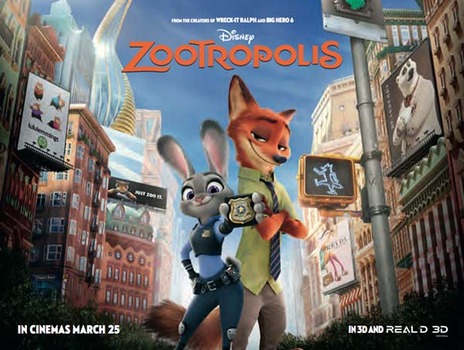
Anthropomorphism, Disney and animation have a long history. As early as Walt Disney’s first feature film Snow White (1937), in which all the woodland creatures appeared to have various personality quirks, attributing human characteristics to cartoon animals has been a way of enhancing a story. Then, with numerous Disney classics, it became the way to tell a story. In 1995, with Toy Story, Pixar began to add to the Disney magic by giving characteristics along with pathos to the inanimate objects and animals. Now, in 2016, with Zootropolis (released nearly everywhere else as Zootopia) we see this enhanced to the max with an animated film that features anthropomorphism whilst also serving multiple layers about diversity and racism, all told by Disney with just a smidge of Pixar wit. It’s funny, sweet and far deeper than it first appears.

During a school play in front of her parents, her peers and their parents, a young bunny called Judy Hopps (Ginnifer Goodwin) declares that when she grows up she wants to be a police officer. Many people laugh at her, one person even beats her up for the audacity of saying it and both her parents are a blend of supportive-but-unsure. But Judy proves them all wrong.  She’s the first bunny first to enter the police academy and the first bunny to actually join the police force. Her first posting is Zootropolis, a nearby metropolitan city. Her parents can’t believe it and neither can her new boss, an African buffalo by the name of Chief Bogo (Idris Elba), who assigns her the role of parking duty. Day one on the job seems to be going well, until she is tricked by con artist fox Nick Wilde (Jason Bateman). However the two are soon forced to work together by Mayor Lionheart (J.K. Simmons) and assistant-mayor Bellwether (Jenny Slate) to help solve a case involving a series of missing animals. Can what were once predator and prey ever work together, possibly even become friends, or is nature stronger that nurture?

It may be slightly too early to say, but Zootropolis has all the potential to be as-well regarded both critically and commercially as last year’s Inside Out. The jokes are really really funny and the drama is really really emotional. My personal favourite joke from the film has to be when fellow police officer Clawhauser (Nate Torrence) first meets Judy Hopps and calls her ‘cute’. Judy winces then carefully explains that “only a bunny can call another bunny cute”. Cue many belly laughs from the cinema screen. That gag is also an example of the kind of humour that has become prevalent in animation since Shrek (2001). The humour of these animations is almost two-layered. To explain on a very basic level, there’s the slapstick jokes for kids and the jokes for their parents that go way over their heads. It makes taking a child to the cinema a far more enjoyable experience for their parents, as opposed to having to endure some brain-dead-only-aimed-at-children romp.

The animals are very well characterised, both matching their animal types whilst also being well-rounded. Judy is fierce, dedicated and ambitious – a solid role model. Nick the fox is sly and alarmingly charming for a fox, though that may just be my personal feelings for Jason Batemen having an effect here… Idris Elba is hilarious as the imposing yet ultimately caring chief who just happens to be a buffalo. Shakira even appears as Zootropolis’ biggest star, Gazelle.

Then there’s the story itself, well-told with a solid twist. There are some fantastically inventive set pieces, be that the sloths working at the DMV or the practically word-for-word Godfather tribute. The story also has a lot you can sink your teeth into (sorry, pardon the pun!) Though the two groups of predator and prey may appear united in the metropolitan city of Zootropolis, it is a delicate union. One which is weighed down by tension and borderline-hostility. Although prey and predator may be neighbours very few are actually friends and few would choose even to be nice to each other. Some restaurants even refuse to serve certain types of customers. When it becomes clear that all the missing animals in the case are in fact predators it looks set to force the bubbling undercurrent of tension to the surface. The film is far from subtle in reflecting our own society’s tensions and forcing a degree of reassessment, yet that is no criticism. Considering the current global climate, with regards to refugees and a certain toupee-wearing president wanna-be whose delusions of grandeur reveal the current state of institutional racism, Zootropolis is perfectly-timed and well in need of watching.

This is ‘proper’ Disney with the beating heart and talking mouth of Pixar. Witty, warm and well worth seeing. A fable for 2016.

Anomalisa


‘What is it to be human?’

Anomalisa is a masterpiece of cinema – a tale about the human condition told by puppets that is the most real movie in years.  We’ve all had awkward encounters – be that with ex-partners, conversations with strangers in a lift or the force-fed wisdom of a brusque taxi driver. We’ve all (hopefully) had a moment where you meet someone who, somehow and somewhere deep inside of yourself, you innately know that ‘this person is important to my future’. Now imagine a film that has the later as its main storyline but is layered with lots and lots of the former. That’s Anomalisa. It’s hilarious and sad at the same time, just like life, whilst reflecting on how bitterly lonely existence can be. Artistic greatness channelled through stop-motion puppetry.

It’s 2005. Michael Stone (David Thewlis), customer service consultant extraordinaire, is travelling to Cincinnati for a convention at which he is due to speak. To Michael everyone else on the planet appears to have the identical voices and faces. He is just spending one night at the hotel before travelling back home to his wife (Tom Noonan) and child (Tom Noonan. He decides that, as he’s in the area and plagued by self-hate, he’ll call up his old flame Bella (Tom Noonan) in the hope that Bella will help him find out what is wrong with him. Things do not go well, but upon retreating to his hotel room he hears a voice that is different from everyone else. He searches desperately and finds Lisa Hesselman (Jennifer Jason Leigh. Michael is instantly enraptured by her different voice and face, desperately hoping that she will cure his crippling loneliness.

This film, written and co-directed by Charlie Kaufman, does not have to try hard to be strange. Everything about it is strange, but that’s not criticism when you really reflect on how strange life often is. The most obvious ‘strange’ aspect is the fact the entire world is only voiced by three people – Thewlis as our lead, Jason Leigh supporting and Noonan as everyone else. Have one actor voicing 98% of this world has the most wondrously bleak effect, allowing for everyone else to blur in the background. They are unimportant therefore there characters are not defined, which is how our protagonist Michael Stone views the world. Few central characters are this self-hating, haunted by guilt and bad memories. Did the voices always sound the same, or has life for Michael etched away its beautiful nuances?

The interactions with both strangers and those who are supposedly the closed to him are all so affecting in there believability – many of them of the concealing-your-eyes-as-you-watch variety. But it is Michael’s interactions with Lisa that are the most beautiful and the most heart-breaking. Lisa is the exact opposite of Michael, Lisa is insecure and desperately lacking in confidence, yet is just as lonely as he is. Lisa is a great admirer or Michael’s and an obsessive reader of his book which helped her increase work ‘productivity by 90%’!  The beginning of their courtship is so tenderly handled, and perhaps the most human we’ll see on the big screen this year. Lisa’s serenading Michael with a cover of ‘Girls Just Wanna Have Fun’ will fill your eyes with tears. The film’s title stems from this point of the movie, when Lisa reveals she has always felt like an ‘anomaly’ which Michael then teams with ‘Lisa’ to form her self-appointed nickname ‘Anomalisa’. This conversation alone personifies their relationship, Michael and the film itself. Is he laughing at her by giving her this name, or showing just how much he understands?

Watching Anomalisa is almost like watching an autopsy or listening to a psychiatrist’s evaluation –   cutting apart our very psychology, our brains and being, then showing us how they work. Like The Matrix it’s up to you whether you take the blue or red pill.

Breathtakingly beautiful and bitter in equal measure; dare you see it?

Goosebumps

“Viewer beware, you’re in for a scare!”

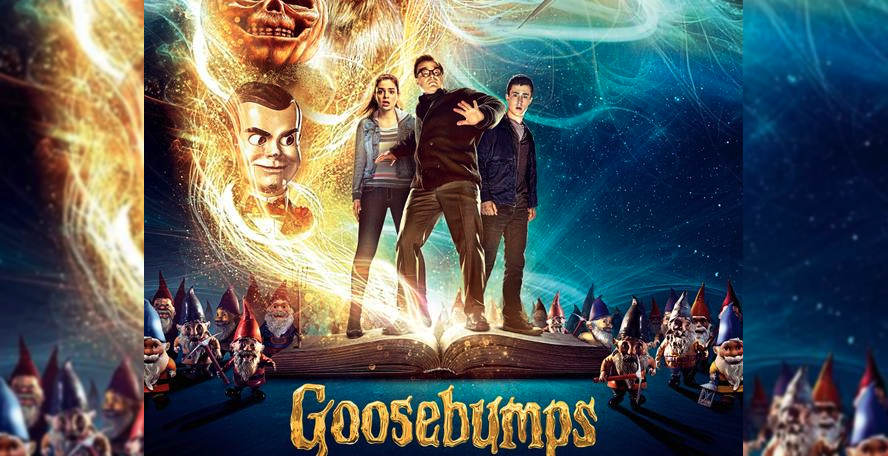
It’s easy to be a book snob. It’s easy to tell children which books are good to read and which books are bad to read. What constitutes a bad book for children? If it inspires just one child’s imagination,  gives them fears and feels in equal measure,  then surely a book can’t be bad? I’ve read Wilde, Dickens and both Poe. But I’ve also read Rowling, Wilson and Stein. Those six authors, along with countless authors, formulated my literary past and thus set the foundations for books to be read in the present and the future. J.K.Rowling may have figuratively taken me to Hogwarts and made me lament not receiving my letter when I was 11 (obviously during that period the ministry of magic was busy with other matters…), but it was R.L Stein that gave me a taste for ghouls, goblins and gore. Watching ‘Goosebumps’ felt like a risk, either prompting rage from my inner adolescent or transformative nostalgia. I’m very happy to report it’s the latter. Through a blend of live-action and animation the film manages to capture the goosebump-inducing fear of the books whilst also being rather light-hearted and funny.

A year after his dad has died, Zach Cooper (Dylan Minnette) and his vice-principal mother (Amy Ryan) move from New York to Madison, Delware. Though frustrated at his new small-town surroundings he knows that his mother’s new job will good for her, and the change in scenery may be good for both of them. When moving in, and having a box fall apart on him, he meets his new home-schooled neighbour (Odeya Rush). But their brief introduction is halted by Hannah’s grumpy and rather scary father, a man who may or may not be R.L. Stein (Jack Black). Hannah manages to sneak out and spend a day with Zach, but upon getting caught by her father she is punished. When Zach goes to rescue her, bringing along loveable loser sidekick (Ryan Lee), he stumbles across a bookshelf filled with what appear to be manuscripts for every Goosebumps story every written. However, after opening the manuscript of ‘The Abominable Snowman of Pasadena’ [side note: it is in my top ten Goosebumps] the Abominable Snowman itself comes out of the book. After a series of exciting events, manufactured by the Dummy of ‘Night of the Living Dummy [side note: definite top five contender] all of the manuscripts are opened, bringing all the monsters that Stein has ever written to live and bringing havoc among their town. Stein, Zach, Hannah and Champ must get all of them back in their books, where they belong. But things won’t be easy, and not everything is as it appears…

I really like this movie for numerous reasons, and in fact have a rather big soft spot for it. First of all, it brings all the monsters that once haunted my imagination to life. During the big crowd sequences I desperately searched the crowd for the familiar faces of the guests who overstayed their welcome in my nightmares. Going back to my opening point, I think it’s important that child can read books that scare them, and then show them how to defeat these fears. For children, and adults of a nervous disposition, this film does have rather spooky moments. There are one or two jumpy moments, and few monsters that are rather unsettling, but these are well contained moments and are more fun than fearful.

This leads me onto my second point, how surprisingly funny the film is. There are jokes for the children, and then there are jokes that will go over their heads and will crack up the adults in the audience. My three personal favourite jokes, which led to the emittance of loud laughter from many at the screening I attended, were a gag about the suffix –phile, a discussion about Stein verses Stephen King and a joke about domestic sales of books. Those three jokes (which I have intentionally poorly paraphrased) were well written, as are many others within the film.

The characterisation is good, with each character being more than likeable. In quite a nice shift, Hannah is the braver one whereas Zach and Champ are both rather jumpy in comparison. The animation is well-placed, never jarring with how it fits into the live-action, which is rather laudable. The music is never interfering, subtlety and successfully building the tension and fear. The pacing is also good, the 1hr 40mins never dragging and filled with more than enough twists and turns. This film is what family cinema should be. It shouldn’t patronise the younger members of the audience, or pander the humour towards them. It should engage them, spook them a little and excite them, just as Stein’s books did for me all those years ago.

If you’re looking for a light-hearted movie with a bit of bite, or something to entertain your children that won’t melt your brain, this is it. A very pleasant surprise.

The Good Dinosaur

‘Mummy, why is that lady sat over there crying so much?’

2015. The year Pixar granted us with two movies. After years and years of development hell The Good Dinosaur emerged in cinemas almost 4 months after Inside Out. The close to cinematic perfection that is Inside Out. With those two pressures alone the bar was set high – whilst The Good Dinosaur doesn’t get a place on the podium for best movies of 2015 it certainly deserves a rosette for good effort.  The main idea is so Pixar in its originality, the central characters so endearing that it’s truly unfortunate how ill-served it is by the underdeveloped storyline. Yet, even with such a shallow storyline, the pathos is still being created. Which is why I was the ‘lady’ in the question above that was uttered by a small child sat near me in the cinema on Sunday. The question is, will children really understand how truly depressing much of the film is?

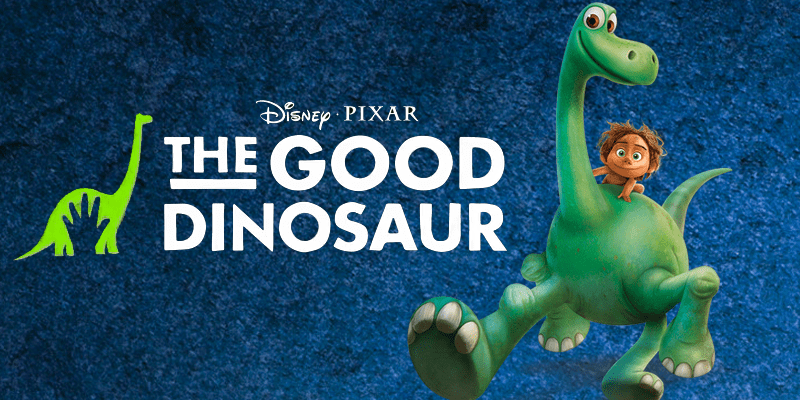
65 million years ago a meteor did not hit Earth. The dinosaurs were not made extinct. Two Apatosaurus farmers are watching in awe as their three eggs hatch. Their children are about to be born. There’s Libby, Buck and finally Arlo. As the three children grow up the differences between them quickly become apparent to their parents, specifically how different Arlo is two his older siblings. Libby and Buck swiftly adjust to life on the farm and perfect their chores, so much so that they are rewarded with a muddy foot-print on the family tree. Arlo does not. Arlo is shy and timid, terrified by most things including the  chickens he has to feed everyday. Arlo’s father gives him some extra attention and finds him a purpose, to get rid off the pest that has been eating their food supply. They set a trap and Arlo waits in excited nervousness for the pest to be caught. When Arlo next checks the trap he find a feral cave-child. When Arlo finds himself unable to kill the pest his father rebukes him, and forces him to chase the pest through a ravine. On the way tragedy strikes and Arlo soon awakens to find himself far away from home and desperate to get back. 

The majority of the film is of Arlo’s journey home. After slowly befriending the pest, even naming him Spot, the pair work together to get Arlo home. Their friendship is portrayed in such a beautiful way, so heart-warming and joyus. Both Arlo and Spot are really lovely characters who you find yourself truly rooting for and willing for their survival. This is the main success of the film and the main reason to stay engaged with it through its rather facile storyline. Arlo and Spot drift from one misadventure to next, meeting some ‘interesting’ characters and frequently running into danger. It’s at this point in the film when it becomes…strange. There’s a sequence which proceeds Arlo and Spot’s ingesting hallucinogenic berries that rivals that sequence in Dumbo. Other strange, occasionally wonderful, set pieces occur. Their joining up with a family of T-rex’s is wonderful. Thunderclap and the pterodactyls are not.

Overall, however, there is enough here to make it worthy of watching. It has the best of intentions, some gorgeous landscapes and two truly lovely leads. Their friendship is one of the studio’s best.

It’s not Pixar’s worst (Cars) or its best (Inside Out or Toy Story) but comfortably in-between.

Sanjays Super Team Pixar Post

Sanjay’s Super Team

The 7 minute short which precedes The Good Dinosaur is absolutely delightful and hopefully ground-breaking in terms of representation. Without dialogue, as most of the Pixar shorts are, we watch a young boy called Sanjay be torn between wanting to watch his cartoon (representing the modern world) and his father’s want for his son to pray with him (representing tradition). The film starts with a card stating ‘This is a (mostly) true story’ and it really comes across throughout. For Sanjay realises that the superhero’s adventures that he watches on tv share a lot with the stories of the Hindu gods. His mini-journey of discovery, attempting to align the two parts of his life, is fantastically done.  The fact Pixar have made a film which diverts from their usual representation is crucial. Long may it continue!