The Jungle Book

It’s really a Bare Necessity that you see it!

For reasons somewhat unknown and potentially puzzling for many fans, Disney has decided to make a series of live-action versions of their animated classics. Apparently there are even 15 currently being planned. If they are all even half as good as this one then it’s not something to worry over. The Jungle Book (2016) is a marvelously wonderful adaptation that is both true to the original 1968 film yet with enough of its own nuances for a fresh-feel.

Mowgli was only a baby when he was found alone in the jungle by Bagheera the black panther (Ben Kingsley). Bagheera took Mowgli to the group of animals in the jungle who would best be able to care for him and protect him – the wolf pack. Raised by surrogate mother Raksha (Lupita Nyong’o) and pack leader Akela (Giancarlo Esposito) and bought up alongside their wolf cubs Mowgli learns the ways of the wolves, but as he is getting older Mowgli’s (Neel Sethi) progress is starting to lag behind his wolf siblings. One day, during the dry season, all the animals of the jungle are gathered to drink what remains of The Water Truce when Bengal tiger Shere Khan (Idris Elba) makes a reappearance after years away. Shere Khan smells Mowgli’s scent and warns the wolfpack to get rid of him or face the consequences. Bagheera offers to escort Mowgli back to the land of the man but the pair get separated on the journey. A close encounter with an enormous Indian python called Kaa (Scarlett Johansson) leads to Mowgli meeting Baloo the bear (Bill Murray). A true friendship begins to form between them but how long can it last with Shere Khan still desperate to hunt and kill Mowgli?

There are three key things that have been perfected to make this film as good as it is. Hopefully one of the things you noticed as you read the above plot summary is the cast. Firstly, how good is that cast!?! Look at the incredible group of actors that were brought together. Then look individually at each actor and the character they play. It’s not often you get to say that every casting choice is perfect within a movie and it’s something that you can say applies to this film. Kingsley provides the necessary paternal warmth hidden under layers of no-nonsense concern. Nyong’o as Raksha is a wolf fiercely protective and not afraid to speak out when it’s needed. Elba is fantastic, a properly scary villain, who growls around the land. Johansson’s Kaa is suitably seductive and hypnotic. But the award for most outstanding vocal contribution has to go to Bill Murray providing a performance that is un-bear-ably endearing and amusing in equal measure. How young newcomer Neel Sethi manages to hold his own is an incredible feat which he appears to do with ease. Let alone the fact he spends the film acting alongside CGI animals…

Leading to the second area in which this film excels – the visuals. I’m on the fence about 3D usually. After seeing too many films which claim 3d status yet do little to warrant it I tend not to be overly excited when having to choose between 2d and 3d showings.The Jungle Book is the first film in an age where I’ve been so glad I booked that 3d ticket. The depth of the frame, the landscape, the animals fur, the movement of the water and the curse of the red flower. All of these aspects are superbly enhanced by the 3d. Whilst aware of the cost it can add to a cinema visit I would firmly recommend seeing this film in 3d to access the added textures and wondrous depths it provides. The animals themselves are beautiful and almost life-like in how they look and move.I now desperately want to cuddle a baby wolf and sit upon a giant bears stomach as we float through the river.

Thirdly there’s the direction.Director Jon Favreau ensure first and foremost that this is a children’s movie whilst avoiding any pandering or talking down to the children. The film has enough darkness to give it bite – mildly frightening as opposed to truly scary. There’s even a lesson or two to be learned along the way. Unlike the original animation this film is not a musical but two of the classic songs are included – ‘The Bare Necessities’ is sung by Mowgli and Baloo during the aforementioned river floating sequences and Christopher Walken talk-sings his way through ‘Wanna Be Like You’ in such a wonderfully charming yet ultimately threatening manner – that feel like a natural fit as opposed to being shoe-horned in.

This may just be the most enchanting film of the year so far. It’s a marvellous visual spectacle told with wit and warmth. A treat for the eyes, ears and heart.

4 stars


Victoria

A true feat of film-making. Truly extraordinary.

To put it simply, a ‘take’ refers to the period between a director saying ‘action’ and ‘cut’. It’s up to them or the cinematographer how long this period is. Typically the longer the take the more difficult the film-making process is as it requires actors to be in the right place, saying the right lines, nothing else interrupting the shot etc. Alfred Hitchcock experimented with this in 1948 making Rope which clocked in at 80 minutes and comprised of only 10 takes, the majority of which were shot in such a way to make the cuts seem seamless. It was an ambitious project which paid of in most regards, the murder and the main characters fear of being caught out in only heightened by the prolonged takes. The character cannot escape and neither can the audience. 68 years later we have Victoria which was filmed two years ago and rejected by many of Europe’s film festivals as they believed the filmmakers were lying on the submission sheet. What lie did they think the filmmakers were proclaiming? Well the film-makers claimed that Victoria, which is 2 hours and 18 minutes long, was shoot using only one take. The most unbelievable thing about this? It’s the truth.

Victoria (Laia Costa) moved from her hometown of Madrid to Berlin three months ago. She works in a coffee shop for less than minimum wage and doesn’t really know anyone in her new city. In the hours before her early morning shift she decides to go clubbing and dances alone quite happily. On her way out of the club she bumps into a group of four men – informal group leader Sonne (Frederick Lau) who Victoria feels an instant spark with, Boxer (Franz Rogowski), Blinker (Burak Yigit) and Fuß (Max Mauff) – who promise to show her ‘real Berlin’. Victoria agrees and what first follows is a fun night for Victoria, seeing parts of Berlin she had never seen before and connecting quickly with Sonne. When Boxer receives a phone call and claims that the group need Victoria’s help.  It is her connection with Sonne that prompts her to make the first in a series of bad decisions and things take a dark turn before spiralling out of control.

I repeat. The entire film is only one take long. It cannot be overemphasised how incredible this is, what a triumph of filmmaking it is and what an astounding experience of film-watching it creates as a result. It’s breath-taking, wondrous, exhilarating and utterly compelling. As it is shot though one-take it is shot in real-time. This is important to note as it adds to the authenticity, we watched events play out and escalate. We cannot question how we got from the first frame to the last as we witnessed very moment and decision which lead the characters there. And these moments don’t just take place in one room – the characters travel all over the city, up ladders, jammed into cars and lifts, dancing across the street and running across it too – and the camera is always there watching and following. Incredibly this also manages to feel gimmick-free. Instead we feel like we’ve tagged along for a night out, been immersed in the spontaneity and intensity of this world, then kicked out of the club  and ditched at the end of the film. There is a reason that the cinematographer Sturla Brandth Grøvlen receives first credit ahead of director and writer Sebastian Schipper as Victoria is an example of true technical mastery. The camerawork is dazzling ambitious, pulsating and gripping.

The performances are mostly improvised, which only adds to the feeling of authenticity and believability. This is next level realism as we get to experience this world as it happens. It’s a huge credit to the relatively inexperienced cast that they only had to shoot the film three times, this being version two. It’s only after seeing the film, when you see what they had to achieve and endure, that you can truly appreciate the level of skill being utilised here.

It’s divine. A sensational watch. It needs to be seen.


10 Cloverfield Lane

The low budget “spiritual successor” to Cloverfield

Cloverfield was a serviceable found footage horror film that did well at the box office predominately due to its marketing strategy which featured things that took the burgeoning viral marketing to a whole new level. MySpace accounts were created for each of the characters, websites for the fictional companies that featured in the film could be trawled through for clues and the film itself was announced only as a series of numbers which formed clues that were eventually revealed to the release date. Cloverfield appeared in a few films of the year lists and that was about it. Producer J.J. Abrams would regularly be hounded for details of a possible sequel but appeared not to be able to give a definitive answer. When the upcoming release of 10 Cloverfield Lane was announced early this year there was real surprise as no-one had known that it was even filming let alone finished. This was due to the fact 10 Cloverfield Lane had not been filmed – originally based on a script called ‘The Cellar‘ it was adapted and linked to Cloverfield it was filmed under the codename ‘Valencia’. Here we are in March 2016 and 10 Cloverfield Lane has been released and it bares little resemblance either in tone or story to its predecessor. And it’s good. Very good indeed. So good that it’s definitely in the running for my end of the year top ten list.

Fleeing New Orleans and her fiance, intentionally leaving her engagement ring behind in the process, Michelle (Mary Elizabeth Winstead) drives far away from the city. In the process she ends up in a nasty car accident. Next thing she knows she wakes up in a basement, her injured leg is handcuffed to the wall. She desperately does all she can to escape but all attempts are futile. The locked door opens and she is greeted by Howard (John Goodman) who explains that he saved her life and yes he is keeping her trapped down in the basement but it’s for her own good. His rather menacing nature and pointing out of how much Michelle owes him hugely unsettle Michelle who is desperate to leave. She also meets the other resident of the bunker, Emmett (John Gallagher Jr.), who has known Howard for most of his life and is certain that Howard is a conspiracy nut but fundamentally a good guy. Time passes before the pair admit to Michelle why she cannot leave the bunker, a chemical attack has taken place in the outside world contaminating  the air and killing the world’s population in the process. The unknown assailants have made the outside world unlivable and the trio’s only hope to stay alive is to remain in the bunker. All of life’s comforts are there, as Howard has spent most of life preparing for such a situation, but Howard’s increasingly controlling and menacing behaviour makes Michelle desperate to leave. Taking matters into her own hands Michelle soon realises the truth of what has happened.

What is truly impressive about this film is how cleverly it terrifies the audience. Considering it is a 12a (something I have an issue with concerning the themes and some of the moments of the film) it manages to do so much with so few of the big violent scares of other horror films. Two of the film’s tensest moments are when Michelle crawls through the ventilation shaft, twice. Through a brilliant combination of editing, camera work, sound and acting they were both sequences I had to watch through my fingers whilst desperately hoping for the best possible outcome. There are a few moments of big and jumpy scares, many of them coming from loud noises that have never sounded so scary, but most of the moments are slow-building subtle fears that build to genuine terror. This is through the fantastic storytelling and narrative. Information is so carefully withheld then slowly realised to the audience. Every new revelation requires a reassessment of what we know and what we expect will happen next.

We know little about what has actually happened outside and we have little reason to trust our primary source for that information. John Goodman is truly terrifying as mysterious Howard whose character gains murkier and murkier added depths with each conversation. He’s a dangerous blend of menace and deluded altruism with every sequence in which he appears forcing us to eye him dubiously, wondering how much he says is actually the truth and how big a threat he plays towards Michelle. The slow revelations that follow only complicate our distrust and unease of his character. Gallagher Jr.’s Emmett is a much-needed comic foil into the tense mix, when tension hits sky-high level it is masterfully lowered with  a dose black humour. Winstead’s performance as Michelle is the best of her career, making a character who is truly sympathetic and one which we are desperate to succeed. I’d even argue that, in a year which saw Brie Larson win an Oscar from Room in which she played a woman held in captivity, that Winstead’s performance rivals Larson’s. Winstead’s blend of determination to leave and her struggling to accept the awareness of its possible futility may have resulted in one of the finest acting performances of the year.

If you’re looking for a film that clocks in at one hour and a half, that will drain you of every emotion possible, make you jump out of your seat and shield your eyes in concern, then you’ve come to the right place. Well worth seeing, if you dare…

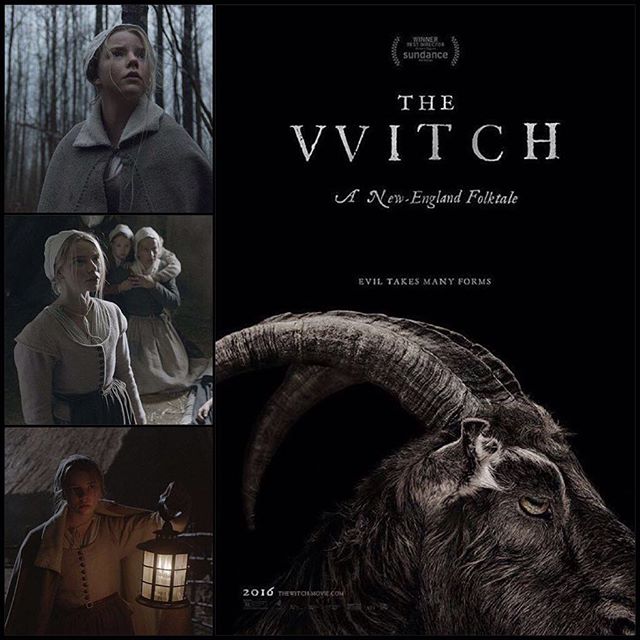
The Witch

Moral of my story: Don’t go see this on your own in an empty cinema.

What makes a horror film a horror film? In the past week or so I’ve heard both praise for this film and a good degree of backlash. Many felt that it wasn’t a horror film, that it wasn’t scary enough and that it was too slow. As a dedicated Wittertainee I’d heard Mark Kermode champion the film stating that ‘the greatest strength of The Witch –that the audience will see in what they want to see, or believe’  So, when a bit of free time opened up in my schedule I thought ‘why not?’ Even after three nights where by sleep has been haunted by a goat called Black Phillip I do not regret my decision, as The Witch is an immensely rich watch and an outstanding debut from its director and writer Robert Eggers.

In 1630 a farmer called William (Ralph Ineson) and his family are excommunicated from their New England community due to the crime of “prideful conceit”. He and wife Katherine (Kate Dickie) must raise their children away from the community they came with when they left England and now live in exile in a forest. They have five children – teenage daughter Thomasin (Anya Taylor-Joy), on the cusp of adolescence Caleb (Harvey Scrimshaw), fraternal twins Mercy (Ellie Grainger) and Jonas (Lucas Dawson) and new-born Samuel.  One day, when Thomasin is looking after ber youngest sibling and playing a round of peek-a-boo, Samuel disappears. The family is utterly devastated and grief takes its toll, bringing tensions to the surface and testing both the love and loyalty of each of the family members. Is a supernatural force of evil haunting them or is it all imagined?

The greatest choice, of many, that this film makes is to show Samuel’s disappearance to the audience. The audience gets to see a witch, possibly the witch of the title or possibly not, drag poor little baby Samuel into the forest with her. The characters, however, do not get to see this. It’s a classic case of dramatic tension that is oh so effective – this comparatively small piece of information alters how we view the characters and makes us assess then repeatedly reassess what we are seeing. The knowing what actually happened to Samuel lets us watch the consequences with a layer of cynicism, as the family falls apart at the seams. How the dynamics of the family shift and tear creates a deeper level of both atmosphere and tension as we know something they do not. When the blame shifts to teenager Thomasin we automatically defend her. For her family she is the obvious target of blame, after all she was watching him when he disappeared, yet we know that she isn’t. Or is she? As the film plays out the audience is forced to question what they actually know, or if what they actually know is not the whole story.

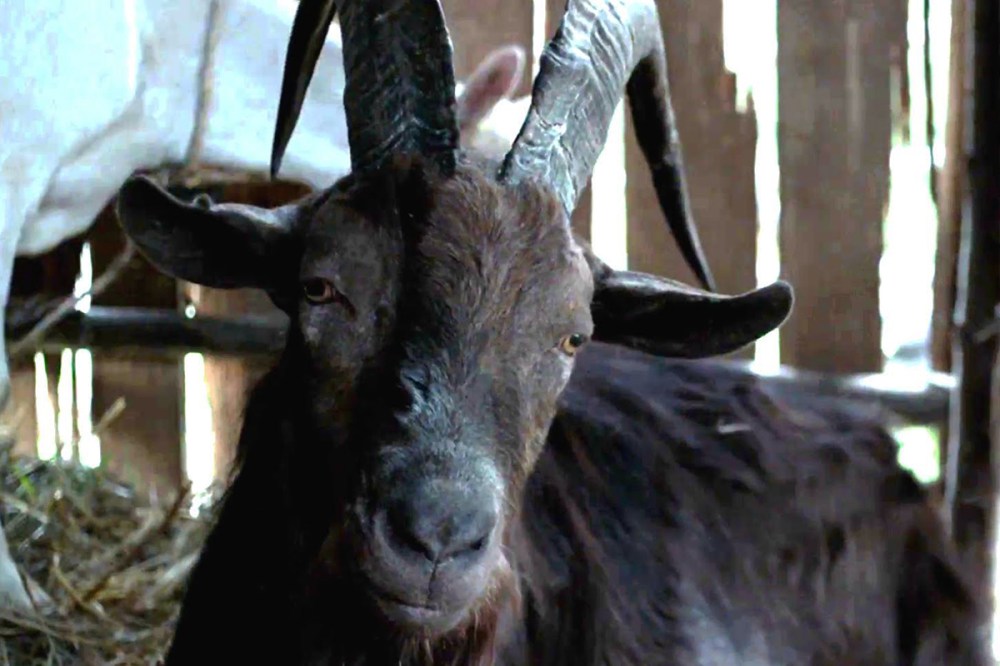
All of the cast are fantastic, not a single weak link. Ineson is solid as the righteous father who may have let his ego take his family onto a path of destruction. Dickie is wonderful as the grieving mother who doesn’t know where to turn. Taylor-Joy is an extraordinary presence as a girl who has come of age, and how this very fact will change her life. The Witch is rich for cinematic analysis, most obviously the treatment young women which is seemingly reflective of how life would have been for someone of her age in 1630. Scrimshaw possess the kind of face and aura of someone who has lived a thousand lives, a real one-to-watch. The twins are as creepy as you would expect from a film of this sort. That just leaves us with the aforementioned Black Phillip. I’m even going to add a picture here of the beast, just to prove my point.

BlackPhillip

Look at him. Just look at him! I genuinely believe there should be a category added to the award ceremonies next year for, ‘scariest performance by an animal’ as Black Phillip would be a solid contender. At this point I’m not even going to tell you what he does, nor will I hint. I don’t think I could even describe it in a manner that would reflect in a  succinct enough manner the terror this beast is capable of. Just like the rest of the film, he gets under-your-skin and into-your-brain.

The Witch is a spooky, slow-release terror that is well worth seeing. Few newcomers could create a film with this depth of atmosphere and tension. I already look forward to what Robert Eggers has to offer us next.

Anomalisa


‘What is it to be human?’

Anomalisa is a masterpiece of cinema – a tale about the human condition told by puppets that is the most real movie in years.  We’ve all had awkward encounters – be that with ex-partners, conversations with strangers in a lift or the force-fed wisdom of a brusque taxi driver. We’ve all (hopefully) had a moment where you meet someone who, somehow and somewhere deep inside of yourself, you innately know that ‘this person is important to my future’. Now imagine a film that has the later as its main storyline but is layered with lots and lots of the former. That’s Anomalisa. It’s hilarious and sad at the same time, just like life, whilst reflecting on how bitterly lonely existence can be. Artistic greatness channelled through stop-motion puppetry.

It’s 2005. Michael Stone (David Thewlis), customer service consultant extraordinaire, is travelling to Cincinnati for a convention at which he is due to speak. To Michael everyone else on the planet appears to have the identical voices and faces. He is just spending one night at the hotel before travelling back home to his wife (Tom Noonan) and child (Tom Noonan. He decides that, as he’s in the area and plagued by self-hate, he’ll call up his old flame Bella (Tom Noonan) in the hope that Bella will help him find out what is wrong with him. Things do not go well, but upon retreating to his hotel room he hears a voice that is different from everyone else. He searches desperately and finds Lisa Hesselman (Jennifer Jason Leigh. Michael is instantly enraptured by her different voice and face, desperately hoping that she will cure his crippling loneliness.

This film, written and co-directed by Charlie Kaufman, does not have to try hard to be strange. Everything about it is strange, but that’s not criticism when you really reflect on how strange life often is. The most obvious ‘strange’ aspect is the fact the entire world is only voiced by three people – Thewlis as our lead, Jason Leigh supporting and Noonan as everyone else. Have one actor voicing 98% of this world has the most wondrously bleak effect, allowing for everyone else to blur in the background. They are unimportant therefore there characters are not defined, which is how our protagonist Michael Stone views the world. Few central characters are this self-hating, haunted by guilt and bad memories. Did the voices always sound the same, or has life for Michael etched away its beautiful nuances?

The interactions with both strangers and those who are supposedly the closed to him are all so affecting in there believability – many of them of the concealing-your-eyes-as-you-watch variety. But it is Michael’s interactions with Lisa that are the most beautiful and the most heart-breaking. Lisa is the exact opposite of Michael, Lisa is insecure and desperately lacking in confidence, yet is just as lonely as he is. Lisa is a great admirer or Michael’s and an obsessive reader of his book which helped her increase work ‘productivity by 90%’!  The beginning of their courtship is so tenderly handled, and perhaps the most human we’ll see on the big screen this year. Lisa’s serenading Michael with a cover of ‘Girls Just Wanna Have Fun’ will fill your eyes with tears. The film’s title stems from this point of the movie, when Lisa reveals she has always felt like an ‘anomaly’ which Michael then teams with ‘Lisa’ to form her self-appointed nickname ‘Anomalisa’. This conversation alone personifies their relationship, Michael and the film itself. Is he laughing at her by giving her this name, or showing just how much he understands?

Watching Anomalisa is almost like watching an autopsy or listening to a psychiatrist’s evaluation –   cutting apart our very psychology, our brains and being, then showing us how they work. Like The Matrix it’s up to you whether you take the blue or red pill.

Breathtakingly beautiful and bitter in equal measure; dare you see it?

High-Rise

‘Where are those happy days, they seem so hard to find.”

41 years after its publication, J. G. Ballad’s High-Rise proves itself to be scarily accurate in its predictions of the then-future and our now-present. The film adaptation is equally brutal and dark, tinted with the blackest of humours. Deciding to set it in the time period in which it was written, director Ben Wheatley succeeds in using Ballad’s bleak hypothesises of societal hierarchy to transform the big screen into a mirror reflecting our darkest innermost fears. This review comes from the preview screening and Q&A session I attended at the British Library (Hello to Galia, Alison and Alex…)

London. 1975. Dr Robert Laing (Tom Hiddleston), a psychologist, movies into a high-rise building having been seduced by the lifestyle it would bring with it. The building itself is isolated from the rest of London and is so self-contained with a supermarket, gym and swimming pool that, aside from work, there is little reason for the residents to leave. They are cut off from the rest of society in their luxury tower block. The higher your floor the higher your status – Laing takes up residence on floor 25, his new friend Charlotte Melville (Sienna Miller) is on floor 26 and the architect of the building, Anthony Royal (Jeremy Irons) and his wife Ann (Keeley Hawes), take up the entire top floor. Laing also comes into contact with a family relegated to the second floor, BBC documentary-maker Richard Wilder (Luke Evans), his heavily pregnant wife Helen (Elisabeth Moss) and their two children. When Wilder becomes so embittered by the social hierarchy he decides it will be the focus of his next project. A dangerous situation develops causing a domino effect which leads to the fragmentation of the residents and formulation of violent tribes.

Where to start when reviewing this film? It’s excellent, terrific and truly haunting in equal measures. Like many of Ben Wheatley’s films High-Rise is of the ‘well-that-escalated-quickly’ genre. However, this film does not require a suspension of belief for the dissention into madness. Whilst accelerated the resulting horrors stems from social resentment that has been apparent since time immemorial. History showcases time and time again society’s that form then self-destruct that little exposition is required in High-Rise to explain why things get so bad so quickly (not that I can really imagine Wheatley wanting to spoon-feed us in this way). The script is bitterly funny, laden with comments that are iceberg-en in terms of depth. Social commentary is rarely this sharp-tongued, appalling yet absurdly funny.

Wheatley doesn’t waste a shot in the telling of this story; countless viewings would be required to access even half of the detail and imagery it possesses. And practically every shot could be printed out as a still and put on a wall, for the cinematography and mise-en-scene is otherworldly in its beauty. There’s the generic, unbranded supermarket made of quadrilaterals in primary colours, the kaleidoscopic parties of the various factions, the riding of a white house across the luminescent greenery of the rooftop garden and the seemingly innocent shades of grey of a certain floor 25.The blend of lighting and framing makes for sequences that are fraught, depraved and agitating. This is only exasperated by the incredible soundtrack, with two appearances of ABBA’s ‘S.O.S’ (hence the subheading of this review) that bring chills in way that one would never have though possible. At one point the BAFTA award makes a cameo, which Wheatley later explained he chose to include as it ‘would be the closest he’d ever get to an actual BAFTA’. It would be an utter travesty if for visuals and soundtrack alone High-Rise is not recognised and justifiably awarded.

Speaking of awards, there’s then the performances of the cast. Hiddelston as Dr.Laing, a self-contained possessor of wide-eyed optimism and underlying volcanic rage, is a match made in heaven. Wheatley spoke of his having Hiddelston’s ‘photo on the fridge’ during pre-production and casting as they (they being Wheatley and wife Amy Jump who wrote the script) viewed him as the perfect candidate. But, whilst Moss, Miller, Hawes and Irons are all good in equal measure it is Luke Evans performance that is stand-out to that of Hiddelston’s. If Laing is untapped rage cloaked in a suit, then Evans as Wilder is the untamed man. Evans must have come close to the edge in making this film, for his character is a powerhouse of bitterness and injustice whose raging against the machine is awash with inevitable destruction.

With so many reasons to see High-Rise; the performances, the script, the visuals are just three broad reasons which should justify you’re purchasing a ticket upon the film’s release next week.

Go see it and be haunted for days afterwards.

A Bigger Splash

A rockstar, a record producer, a documentary-maker and a recently discovered illegitimate daughter go on holiday…

The hardest thing I suspect I will find about writing this review is overusing the adjective ‘beautiful’ and its various synonyms, because that is what A Bigger Splash is. Beautiful. Beautiful cast in beautiful scenery that is beautifully shot and with a story that is beautifully told.

Marianne Lane (Tilda Swinton) is a rockstar of arena-like proportions. After surgery on her throat and vocal chords renders her mute for several weeks (as part of her post-operative recovery) she decides to go into reclusion with her partner Paul (Matthias Schoenaerts). They are staying on the remote Italian island of Pantelleria when their weeks of nudity and nookie are interrupted by the arrival of her ex-producer and ex-lover Harry (Ralph Fiennes), who has brought with him Penelope (Dakota Johnson) who recently discovered that Harry is her father. What follows will test the ties of fraternity, paternity and sexuality with catastrophic consequences.

The events of the film play out in a way that is unpredictable, sweaty and bitterly humorous. This is Swindon and Fiennes at the top of their respective games. Due to her character’s temporary muteness Swindon has little dialogue; the few lines she does say are husky and barely audible. Instead she says entire monologues on matters of the heart with her facial expressions – bitter rage, frustration, mortification, adoration and admiration shown through looks. A less-skilled actress would be constricted by her characters damaged vocal chords; instead what could be a limitation showcases the true skill Swindon possesses. The grace and manner of her movements and expressions, along her facial expressions, bring Marianne Lake: Rock Star to life. Both when painted in David Bowie-esque costume and make-up and when wearing nothing at all, it feels like you are watching the life of a real, if fatally flawed, person.

At 52, with countless film and theatre credits which demonstrate his mastery, it is incredibly impressive that Fiennes can still surprise. His Harry Hawkes is a bundle of raw energy, a magnetic charisma who dominates each scene. Along with providing the funniest moments of the film (and a dance sequence to The Rolling Stones that I challenge you to be able to watch without averting your eyes in bewildered embarrassment) he demonstrates the mythical fine line between comedy and tragedy. Harry Hawkes is a man who uses his charisma, uniqueness, nerve and talent to mask much inner-darkness. His self-destructive descent into hedonism is (dance sequence aside) utterly enthralling.

It’s a pleasure to see Schoenaerts on the big screen again, roughly 10 months since the release of Far from the Madding Crowd and his enamouring take on loyal and noble Gabriel Oak. His character here, Paul, is one who initially appears to have fewer layers than his romantic partner and love rival, but this proves that appearances can be deceptive. He is currently one of the most interesting and underappreciated supporting actors in cinema at the moment, and I greatly look forward to seeing more of his (admittedly rather beautiful) self.

And then there’s Dakota Johnson, of 50 Shades of Grey infamy. What A Bigger Splash succeeds in doing is adding another reason for why Shades is such a mediocre movie, as A Bigger Splash proves that not only can Johnson act but she is mighty fine at it. In fact, she well and truly holds her on with her fellow leads. Penelope is an intriguing character, made even more so by Johnson’s acting ability. Penelope is a character who almost defies description (in a complimentary way), suffice to say she is a product of her father in the best/worst of ways.

 There is one more crucial player in A Bigger SplashPantelleria itself. Located 100km southwest of Sicily (fact found courtesy of Google) it is a place I had not heard of prior to the film and is of such unrivalled beauty that I cannot escape mentally from the mysticism of it. Few places, when on the screen, are displayed in such heart-stopping and breath-taking beauty. The events of A Bigger Splash, when splayed out in a review such as this could seem almost borderline-soap opera. It’s the scenery, and the skill through which it is shown, that prevents this. Yes some sequences possess a degree of melodrama, but setting it in such a beautiful (alluring, dazzling, exquisite, stunning, and wonderful) landscape only elevates the emotional response of the subsequent events. However, it’s the slightly oddball, quirky tone of these events that makes the film truly memorable. Though the pacing is slightly stilled on minor occasions, with one or two plot points that drag, there is a humour tinged by darkness that makes the plot haunting and ultimately cataclysmic.

A sun-kissed soap opera told with class and comedy with an abundance of tragedy. A must-see.