Zootropolis/Zootopia

We may be evolved, but deep down we are still animals.”

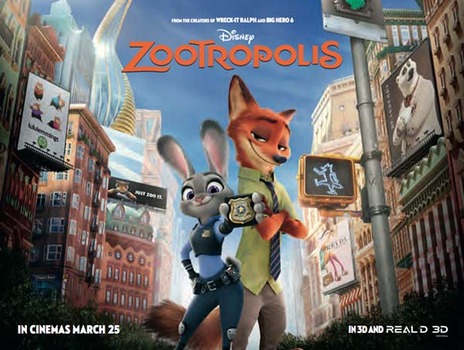
Anthropomorphism, Disney and animation have a long history. As early as Walt Disney’s first feature film Snow White (1937), in which all the woodland creatures appeared to have various personality quirks, attributing human characteristics to cartoon animals has been a way of enhancing a story. Then, with numerous Disney classics, it became the way to tell a story. In 1995, with Toy Story, Pixar began to add to the Disney magic by giving characteristics along with pathos to the inanimate objects and animals. Now, in 2016, with Zootropolis (released nearly everywhere else as Zootopia) we see this enhanced to the max with an animated film that features anthropomorphism whilst also serving multiple layers about diversity and racism, all told by Disney with just a smidge of Pixar wit. It’s funny, sweet and far deeper than it first appears.

During a school play in front of her parents, her peers and their parents, a young bunny called Judy Hopps (Ginnifer Goodwin) declares that when she grows up she wants to be a police officer. Many people laugh at her, one person even beats her up for the audacity of saying it and both her parents are a blend of supportive-but-unsure. But Judy proves them all wrong.  She’s the first bunny first to enter the police academy and the first bunny to actually join the police force. Her first posting is Zootropolis, a nearby metropolitan city. Her parents can’t believe it and neither can her new boss, an African buffalo by the name of Chief Bogo (Idris Elba), who assigns her the role of parking duty. Day one on the job seems to be going well, until she is tricked by con artist fox Nick Wilde (Jason Bateman). However the two are soon forced to work together by Mayor Lionheart (J.K. Simmons) and assistant-mayor Bellwether (Jenny Slate) to help solve a case involving a series of missing animals. Can what were once predator and prey ever work together, possibly even become friends, or is nature stronger that nurture?

It may be slightly too early to say, but Zootropolis has all the potential to be as-well regarded both critically and commercially as last year’s Inside Out. The jokes are really really funny and the drama is really really emotional. My personal favourite joke from the film has to be when fellow police officer Clawhauser (Nate Torrence) first meets Judy Hopps and calls her ‘cute’. Judy winces then carefully explains that “only a bunny can call another bunny cute”. Cue many belly laughs from the cinema screen. That gag is also an example of the kind of humour that has become prevalent in animation since Shrek (2001). The humour of these animations is almost two-layered. To explain on a very basic level, there’s the slapstick jokes for kids and the jokes for their parents that go way over their heads. It makes taking a child to the cinema a far more enjoyable experience for their parents, as opposed to having to endure some brain-dead-only-aimed-at-children romp.

The animals are very well characterised, both matching their animal types whilst also being well-rounded. Judy is fierce, dedicated and ambitious – a solid role model. Nick the fox is sly and alarmingly charming for a fox, though that may just be my personal feelings for Jason Batemen having an effect here… Idris Elba is hilarious as the imposing yet ultimately caring chief who just happens to be a buffalo. Shakira even appears as Zootropolis’ biggest star, Gazelle.

Then there’s the story itself, well-told with a solid twist. There are some fantastically inventive set pieces, be that the sloths working at the DMV or the practically word-for-word Godfather tribute. The story also has a lot you can sink your teeth into (sorry, pardon the pun!) Though the two groups of predator and prey may appear united in the metropolitan city of Zootropolis, it is a delicate union. One which is weighed down by tension and borderline-hostility. Although prey and predator may be neighbours very few are actually friends and few would choose even to be nice to each other. Some restaurants even refuse to serve certain types of customers. When it becomes clear that all the missing animals in the case are in fact predators it looks set to force the bubbling undercurrent of tension to the surface. The film is far from subtle in reflecting our own society’s tensions and forcing a degree of reassessment, yet that is no criticism. Considering the current global climate, with regards to refugees and a certain toupee-wearing president wanna-be whose delusions of grandeur reveal the current state of institutional racism, Zootropolis is perfectly-timed and well in need of watching.

This is ‘proper’ Disney with the beating heart and talking mouth of Pixar. Witty, warm and well worth seeing. A fable for 2016.

Anomalisa


‘What is it to be human?’

Anomalisa is a masterpiece of cinema – a tale about the human condition told by puppets that is the most real movie in years.  We’ve all had awkward encounters – be that with ex-partners, conversations with strangers in a lift or the force-fed wisdom of a brusque taxi driver. We’ve all (hopefully) had a moment where you meet someone who, somehow and somewhere deep inside of yourself, you innately know that ‘this person is important to my future’. Now imagine a film that has the later as its main storyline but is layered with lots and lots of the former. That’s Anomalisa. It’s hilarious and sad at the same time, just like life, whilst reflecting on how bitterly lonely existence can be. Artistic greatness channelled through stop-motion puppetry.

It’s 2005. Michael Stone (David Thewlis), customer service consultant extraordinaire, is travelling to Cincinnati for a convention at which he is due to speak. To Michael everyone else on the planet appears to have the identical voices and faces. He is just spending one night at the hotel before travelling back home to his wife (Tom Noonan) and child (Tom Noonan. He decides that, as he’s in the area and plagued by self-hate, he’ll call up his old flame Bella (Tom Noonan) in the hope that Bella will help him find out what is wrong with him. Things do not go well, but upon retreating to his hotel room he hears a voice that is different from everyone else. He searches desperately and finds Lisa Hesselman (Jennifer Jason Leigh. Michael is instantly enraptured by her different voice and face, desperately hoping that she will cure his crippling loneliness.

This film, written and co-directed by Charlie Kaufman, does not have to try hard to be strange. Everything about it is strange, but that’s not criticism when you really reflect on how strange life often is. The most obvious ‘strange’ aspect is the fact the entire world is only voiced by three people – Thewlis as our lead, Jason Leigh supporting and Noonan as everyone else. Have one actor voicing 98% of this world has the most wondrously bleak effect, allowing for everyone else to blur in the background. They are unimportant therefore there characters are not defined, which is how our protagonist Michael Stone views the world. Few central characters are this self-hating, haunted by guilt and bad memories. Did the voices always sound the same, or has life for Michael etched away its beautiful nuances?

The interactions with both strangers and those who are supposedly the closed to him are all so affecting in there believability – many of them of the concealing-your-eyes-as-you-watch variety. But it is Michael’s interactions with Lisa that are the most beautiful and the most heart-breaking. Lisa is the exact opposite of Michael, Lisa is insecure and desperately lacking in confidence, yet is just as lonely as he is. Lisa is a great admirer or Michael’s and an obsessive reader of his book which helped her increase work ‘productivity by 90%’!  The beginning of their courtship is so tenderly handled, and perhaps the most human we’ll see on the big screen this year. Lisa’s serenading Michael with a cover of ‘Girls Just Wanna Have Fun’ will fill your eyes with tears. The film’s title stems from this point of the movie, when Lisa reveals she has always felt like an ‘anomaly’ which Michael then teams with ‘Lisa’ to form her self-appointed nickname ‘Anomalisa’. This conversation alone personifies their relationship, Michael and the film itself. Is he laughing at her by giving her this name, or showing just how much he understands?

Watching Anomalisa is almost like watching an autopsy or listening to a psychiatrist’s evaluation –   cutting apart our very psychology, our brains and being, then showing us how they work. Like The Matrix it’s up to you whether you take the blue or red pill.

Breathtakingly beautiful and bitter in equal measure; dare you see it?

High-Rise

‘Where are those happy days, they seem so hard to find.”

41 years after its publication, J. G. Ballad’s High-Rise proves itself to be scarily accurate in its predictions of the then-future and our now-present. The film adaptation is equally brutal and dark, tinted with the blackest of humours. Deciding to set it in the time period in which it was written, director Ben Wheatley succeeds in using Ballad’s bleak hypothesises of societal hierarchy to transform the big screen into a mirror reflecting our darkest innermost fears. This review comes from the preview screening and Q&A session I attended at the British Library (Hello to Galia, Alison and Alex…)

London. 1975. Dr Robert Laing (Tom Hiddleston), a psychologist, movies into a high-rise building having been seduced by the lifestyle it would bring with it. The building itself is isolated from the rest of London and is so self-contained with a supermarket, gym and swimming pool that, aside from work, there is little reason for the residents to leave. They are cut off from the rest of society in their luxury tower block. The higher your floor the higher your status – Laing takes up residence on floor 25, his new friend Charlotte Melville (Sienna Miller) is on floor 26 and the architect of the building, Anthony Royal (Jeremy Irons) and his wife Ann (Keeley Hawes), take up the entire top floor. Laing also comes into contact with a family relegated to the second floor, BBC documentary-maker Richard Wilder (Luke Evans), his heavily pregnant wife Helen (Elisabeth Moss) and their two children. When Wilder becomes so embittered by the social hierarchy he decides it will be the focus of his next project. A dangerous situation develops causing a domino effect which leads to the fragmentation of the residents and formulation of violent tribes.

Where to start when reviewing this film? It’s excellent, terrific and truly haunting in equal measures. Like many of Ben Wheatley’s films High-Rise is of the ‘well-that-escalated-quickly’ genre. However, this film does not require a suspension of belief for the dissention into madness. Whilst accelerated the resulting horrors stems from social resentment that has been apparent since time immemorial. History showcases time and time again society’s that form then self-destruct that little exposition is required in High-Rise to explain why things get so bad so quickly (not that I can really imagine Wheatley wanting to spoon-feed us in this way). The script is bitterly funny, laden with comments that are iceberg-en in terms of depth. Social commentary is rarely this sharp-tongued, appalling yet absurdly funny.

Wheatley doesn’t waste a shot in the telling of this story; countless viewings would be required to access even half of the detail and imagery it possesses. And practically every shot could be printed out as a still and put on a wall, for the cinematography and mise-en-scene is otherworldly in its beauty. There’s the generic, unbranded supermarket made of quadrilaterals in primary colours, the kaleidoscopic parties of the various factions, the riding of a white house across the luminescent greenery of the rooftop garden and the seemingly innocent shades of grey of a certain floor 25.The blend of lighting and framing makes for sequences that are fraught, depraved and agitating. This is only exasperated by the incredible soundtrack, with two appearances of ABBA’s ‘S.O.S’ (hence the subheading of this review) that bring chills in way that one would never have though possible. At one point the BAFTA award makes a cameo, which Wheatley later explained he chose to include as it ‘would be the closest he’d ever get to an actual BAFTA’. It would be an utter travesty if for visuals and soundtrack alone High-Rise is not recognised and justifiably awarded.

Speaking of awards, there’s then the performances of the cast. Hiddelston as Dr.Laing, a self-contained possessor of wide-eyed optimism and underlying volcanic rage, is a match made in heaven. Wheatley spoke of his having Hiddelston’s ‘photo on the fridge’ during pre-production and casting as they (they being Wheatley and wife Amy Jump who wrote the script) viewed him as the perfect candidate. But, whilst Moss, Miller, Hawes and Irons are all good in equal measure it is Luke Evans performance that is stand-out to that of Hiddelston’s. If Laing is untapped rage cloaked in a suit, then Evans as Wilder is the untamed man. Evans must have come close to the edge in making this film, for his character is a powerhouse of bitterness and injustice whose raging against the machine is awash with inevitable destruction.

With so many reasons to see High-Rise; the performances, the script, the visuals are just three broad reasons which should justify you’re purchasing a ticket upon the film’s release next week.

Go see it and be haunted for days afterwards.

Hail, Caesar!

All Hail Hollywood!  And, all Hail the Coen Brothers!

1951 was a bit of strange time for Hollywood. The studio system was starting to shift and the oligarchic owners were starting to lose power. Rather understandably its stars were getting fed up of being owned by the studios. The studios got to decide what they would be starring in, who they would be working with, what they looked like and even who they were dating. The post-world war two boom had begun to grow to a standstill and film-makers weren’t quite sure what the people wanted. Some classic films were made that year (A Street Car Named Desire, Alice In Wonderland and The African Queen, to name but three) as were a lot of terrible movies from every genre and hybrid-genre you could possibly think of. If the people don’t know what they want, adopt a ‘throw-everything-at-them-and-see-what-sticks policy’. It’s these issues that make the era a perfect setting for a movie. It’s also the reason that the Coen brothers are the perfect men for the job.

The life of the head of production at Capitol Pictures is not an easy one. In 27 hours Eddie Mannix (Josh Brolin) must handle one drama after another. First there’s the lead of his series of synchronised swimming epics (Scarlett Johansson) who’s both pregnant and unmarried. Then there’s the all-singing and little-talking cowboy(Alden Ehrenreich) who is forcibly being made to transition from Westerns into thespian drama, much to the bitter frustration of his new luvvie director (Ralph Fiennes) followed up by a check-in on the latest musical starring multi-talented (Channing Tatum), dodging the four preying eyes of gossip columnist twins (both played by Tilda Swinton) and most importantly finding his A-list star (George Clooney) who has disappeared from set. Maybe his job offer from the aviation industry isn’t that unappealing after all…

First I want to state that this is not a perfect movie. Its pacing is off, and the entire film feels like a series of rather delightful misadventures as opposed to one overarching narrative. That fact will put some people off (although that doesn’t really explain/justify the 16 people who walked out of the screening I attended). But for others, including myself, this fundamental flaw is in fact another reason to cherish the movie as surely that rhythm or tone of chaotic mayhem is how life working in the dwindling studio system would have been. What is also allows the Coen brothers to do is duel-handily poke fun at the farce-like-ness of this period of time, and also lovingly embrace it.

Each set-piece is beyond stunning. Every single costume is stunning, with every single character feeling like a tribute to a by-gone era. The synchronised swimming sequence featuring a giant, mechanical whale reinforces the notion that this is THE Dream Factory. The loving pastiche theme continues with Channing Tatum’s ludicrously inventive tap dance and singing number, where he and a dozen sailor lament their going on door as ‘We Ain’t Gonna See No Dames.” However, speaking from personal preference, it’s Alden Ehrenreich as Hobie Doyle the Cowboy-turned-actor who totally steals the show. When considering the talent (ahem, Brolin, Johansson, Finnes and Cloonney!) this is truly no mean feat. Doyle is the perfect blend of dim but charming. His attempts at ‘serious’ acting are utterly charming but it’s his date with Carlotta Valdez (cheeky nod to Hitchcock’s ‘Vertigo’ there!) , an up-and-coming Latina actress that will win the hearts of the nation. His accidental wooing of her is pinch-his-cheeks and say ‘nawww’ levels of adorability. He is definitely one to watch.

Although the ‘star of the show’ may not actually steal the spotlight (as hopefully outlined and justified above) it’s Clooney’s storyline that solidifies the fact that this film is not throughway fluff. His ‘journey’ whilst held hostage provides much reflection on the nature of Hollywood ideology, a subliminal critique of the industry by reflecting on the very nature of entertainment, the ugly work that goes into creating what we view as such beauty…but that’s a discussion for another day, (ideally in a pub, with a drink in hand!)

For now, I’ll leave you with this. For those of us who are nostalgic for a time we never lived (I’m including myself in this category) there’s escapism and incredible tributes to the past. For cinephilles there’s subtle reflection on the ugly/beautiful process of cinema-making. There’s also romance, lots of humour and Channing Tatum signing (who knew he had the voice of an angel!?!)

If you’ve got a spare hour and forty minutes this is a film well-worth your money. Enjoy!


A Bigger Splash

A rockstar, a record producer, a documentary-maker and a recently discovered illegitimate daughter go on holiday…

The hardest thing I suspect I will find about writing this review is overusing the adjective ‘beautiful’ and its various synonyms, because that is what A Bigger Splash is. Beautiful. Beautiful cast in beautiful scenery that is beautifully shot and with a story that is beautifully told.

Marianne Lane (Tilda Swinton) is a rockstar of arena-like proportions. After surgery on her throat and vocal chords renders her mute for several weeks (as part of her post-operative recovery) she decides to go into reclusion with her partner Paul (Matthias Schoenaerts). They are staying on the remote Italian island of Pantelleria when their weeks of nudity and nookie are interrupted by the arrival of her ex-producer and ex-lover Harry (Ralph Fiennes), who has brought with him Penelope (Dakota Johnson) who recently discovered that Harry is her father. What follows will test the ties of fraternity, paternity and sexuality with catastrophic consequences.

The events of the film play out in a way that is unpredictable, sweaty and bitterly humorous. This is Swindon and Fiennes at the top of their respective games. Due to her character’s temporary muteness Swindon has little dialogue; the few lines she does say are husky and barely audible. Instead she says entire monologues on matters of the heart with her facial expressions – bitter rage, frustration, mortification, adoration and admiration shown through looks. A less-skilled actress would be constricted by her characters damaged vocal chords; instead what could be a limitation showcases the true skill Swindon possesses. The grace and manner of her movements and expressions, along her facial expressions, bring Marianne Lake: Rock Star to life. Both when painted in David Bowie-esque costume and make-up and when wearing nothing at all, it feels like you are watching the life of a real, if fatally flawed, person.

At 52, with countless film and theatre credits which demonstrate his mastery, it is incredibly impressive that Fiennes can still surprise. His Harry Hawkes is a bundle of raw energy, a magnetic charisma who dominates each scene. Along with providing the funniest moments of the film (and a dance sequence to The Rolling Stones that I challenge you to be able to watch without averting your eyes in bewildered embarrassment) he demonstrates the mythical fine line between comedy and tragedy. Harry Hawkes is a man who uses his charisma, uniqueness, nerve and talent to mask much inner-darkness. His self-destructive descent into hedonism is (dance sequence aside) utterly enthralling.

It’s a pleasure to see Schoenaerts on the big screen again, roughly 10 months since the release of Far from the Madding Crowd and his enamouring take on loyal and noble Gabriel Oak. His character here, Paul, is one who initially appears to have fewer layers than his romantic partner and love rival, but this proves that appearances can be deceptive. He is currently one of the most interesting and underappreciated supporting actors in cinema at the moment, and I greatly look forward to seeing more of his (admittedly rather beautiful) self.

And then there’s Dakota Johnson, of 50 Shades of Grey infamy. What A Bigger Splash succeeds in doing is adding another reason for why Shades is such a mediocre movie, as A Bigger Splash proves that not only can Johnson act but she is mighty fine at it. In fact, she well and truly holds her on with her fellow leads. Penelope is an intriguing character, made even more so by Johnson’s acting ability. Penelope is a character who almost defies description (in a complimentary way), suffice to say she is a product of her father in the best/worst of ways.

 There is one more crucial player in A Bigger SplashPantelleria itself. Located 100km southwest of Sicily (fact found courtesy of Google) it is a place I had not heard of prior to the film and is of such unrivalled beauty that I cannot escape mentally from the mysticism of it. Few places, when on the screen, are displayed in such heart-stopping and breath-taking beauty. The events of A Bigger Splash, when splayed out in a review such as this could seem almost borderline-soap opera. It’s the scenery, and the skill through which it is shown, that prevents this. Yes some sequences possess a degree of melodrama, but setting it in such a beautiful (alluring, dazzling, exquisite, stunning, and wonderful) landscape only elevates the emotional response of the subsequent events. However, it’s the slightly oddball, quirky tone of these events that makes the film truly memorable. Though the pacing is slightly stilled on minor occasions, with one or two plot points that drag, there is a humour tinged by darkness that makes the plot haunting and ultimately cataclysmic.

A sun-kissed soap opera told with class and comedy with an abundance of tragedy. A must-see.


Pride and Prejudice and Zombies

45% Pride and 45% Prejudice and 10% Zombies

In 2004 Simon Pegg, Nick Frost and Edgar Wright created a new hybrid genre called Zombie-Romantic-Comedy (ZomRomCom) with Shaun of the Dead. In 2007 an American author took this one step further and wrote a parody novel of Jane Austen’s classic Pride and Prejudice by adding in zombies. Nearly 10 years later, after years of development hell (heh, that term has rarely been so apt) we have the film adaptation.  It may not be the most haunting (heh) Austen adaptation, nor will it give others a run for their money (heh, running from zombies) but it is more than entertaining and worth a watch. My main criticism, as you may have noticed from the subtitle is that the zombies make up a small proportion of the film, a too small proportion to really make the most of the high concept.

It is a truth universally acknowledged that a zombie in possession of brains must be in want of more brains. – Elizabeth Bennett. In a world that has been overrun by zombies for almost a hundred years, young women have more than enough to worry about than finding a husband. At least that is what Elizabeth Bennett (Lily James) thinks, and her four sisters agree to varying extents. Their mother Mrs Bennett (Sally Phillips), however, believes otherwise. Mr Bennett (Charles Dance) disagrees with his wife wholeheartedly, which is why he had his girls spend much of their childhood in China, training in the arts of killing zombies, moulding them into fearsome zombie-killing army. When Mr Bingley (Douglas Booth) reopens a residence nearby, he hosts an introductory ball to which the Bennetts are invited. It’s there that Elizabeth meets Colonel Fitzwilliam Darcy (Sam Riley) , a haughty monster-hunter renowned and feared for his zombie-killing skills. When the ball is invaded by zombies the Bennett sisters dazzle Darcy and Bingley with their skills, affection and admiration begins. But will the course of love ever run smooth whilst the undead stalk the Earth?

Overall, the film really succeeds for the first fifteen minutes. The concept feels fresh and funny, the zombie/romance balance is level (something I fear I will never get to write again…) and it’s a pleasurable novelty to see the key events of Austen’s novel enhanced by zombie tropes. There’s also a truly beautiful animated story-book style opening sequence, voiced by the legend that is Charles Dance, that informs us of how the zombies came to be. Unfortunately, the remaining 80-odd minutes of the film are not as pleasurable. The ZomRom balance (I’m going to copyright that phrase) does not really warrant the ‘and’ of the title. Maybe it should be Pride and Prejudice and a few zombies and lots of talking about zombies  (though perhaps that is not as catchy). When the zombies are actually on-screen it provides some of the best moments, producing a couple of jumps and a fair few laughs. But there is too much talking about strategies for dealing with zombies as opposed to fighting them.

However, it’s not all bad. The cast for this film is so good, and so well suited for their roles, that you actually wish this was just a straight-forward adaptation of Pride and Prejudice. Lily James, who shone in War & Peace last year’s Cinderella, is superb as a feisty and witty Elizabeth. She manages to make Elizabeth’s progression into a trained warrior seem almost plausible. She has great chemistry with Sam Riley’s Darcy, providing a degree of sexual tension previously unseen in adaptations of this work. Austen would have approved I suspect. However, as Parson Collins, Matt Smith steals every scene he is in. It’s great to see Smith in another comedic role (aside from his marmite take as The Doctor). Here his timing is brilliant and his ability to make a relatively small role stand out speaks volumes about his ability. Another wonderful surprise is Lena Headey as the one-eyed-eye-patch-wearing Lady Catherine de Bourgh, who snarls her way through her too-few-scenes. 

To conclude, this is a more than fine way to while away two hours. The cast is superb, the script has enough charm, and the novelty just great enough to entertain. Whilst easy to bemoan the minimal zombie presence, this is an excellent attempt at a twist on a classic with a fantastic cast who prevent it from being a forgettable B-movie.

Action, romance and zombies. Something for everyone with this film.

Deadpool

The Merc with a Mouth has a big heart, and an excellent first film.

Few films produce the level of antici…pation that Deadpool had prior to release. Even fewer films meet, let alone exceed, the eager expectation of its future audience. Deadpool is, thankfully, on of those films. It even led to a reshuffle of my top five Marvel-related films (as of 14/02/16: 1) Guardians of the Galaxy, 2) Deadpool, 3) Winter Soldier, 4) Ant Man and 5) Thor). The film is filthy, frantic and feverish. I can see (if I squint and put on my reflective hat) that those three reasons for why I love it so much are the same three reasons why a small minority may hate it (if you are in the later category I will *try* not to judge). However, the film is exactly my kind of humour and, heck, it’s my name in the blog title (chica chica!) Even my overuse of brackets in this paragraph (sorry, no sorry!) would indicate the fourth wall breaks/sidebars of the film. Anyway, I’ve rambled on enough here… let’s get cracking!

The film opens with a truly hilarious montage of Deadpool (Ryan Reynolds) in an overturned car with some villains (soundtracked to ‘Angel Of The Morning’ by Juice Newton). Through an array of flashbacks and flashforwards we learn about the past and present of the man behind the mask. Wade Wilson was a bad guy who was paid to hurt even badder guys. He was definitely *not* a hero. One night, after a successful job, he meets Vanessa (Morena Baccarin). They have simillar senses of humour and the connection between them is electric. One date leds to one year of happiness – a year than ends with Wade being diagnosed with terminal cancer. He’s offered a solution: to join a secret program that will get rid of his cancer and grant him superpowers. Ajax/Francis (Ed Skrein) is the man running the program and injects Wade with a secret serum, teaming up with Angel Dust (Gina Carano) to torture Wade for weeks on end in an effort to trigger a mutation. One torture in successful in triggering the mutation, providing with the power of healing that is so great he is essentially immortal,  but in the process leads to Wade being totally disfigured. Once escaped Wade seeks out the man who destroyed his life, desperate for revenge and a cure. 

Where to begin with reasons for why I love this film so greatly, without turning this review into a stream of consciousness? Ryan Reynolds is utterly fantastic in this role, creating a character who is nuanced and full of depth whilst also making cock jokes. Reynolds has not been given the opportunity to  show of his funny bone for so long, and having spent ten years getting this show on the road, the fact it is a clear passion product for him really illuminates just how good he is.

Often with superhero films the mask is a barrier between the ‘hero’ and the audience. In this case the barrier is shattered literally by having Deadpool talk directly to the audience (just like in the comic books)  and through his use of facial expressions. Even with the red mask on we can see the facial expressions, the eyebrow raises, glaring, moments of surprise and amusement. With regards the jokes, not every joke lands but there are so many that when one does fall flat there will be two more in the next 30 seconds to get you laughing again.

His take on Deadpool is also the required level of sexy. I don’t just mean fanciable (though, yes.) But his interactions with Vanessa are sparky, sweet yet erotic. When you really think about it, how many superheros in film adaptations are given that side to their character? Batman is rather caste and crippled by his past, Superman looks great but is too noble for that, Captain America too innocent and Ironman is implied – all talk and no action (though admittedly Stark’s conquests occur in films rated 12/12A). Wade Wilson has a fully-functioning relationship with Vanessa , raunchy  yet founded-in love. Which sums up the whole films ethos really – it may parody the entire genre but is done so with love and thus still honouring it. One way of doing this is with the treatment of its big baddie.

Skrein makes a fantastic villain, reaching towards (though no equal to) the heights of Tom Hiddleston’s Loki. Ajax/Francis is a nasty man, who ‘enjoys’ causing others man and misery yet he’s so charming in the process. We want Wade to get the vengeance he is so desperately wants, which means we get to see more Ajax/Francis in the process (a total win-win). His cool, calm borderline-psychopath-at-the-core sit he perfect contrast to the maniac ‘talker’ that is Wade Wilson. Their onscreen rapport brings the best out of both characters.

Baccarin is good, if slightly underused, as Wilson’s girlfriend. Brianna Hildebrand is awesome as Negasonic Teenage Warhead, the X-Men trainee who is shadowing Stefan Kapicic‘s Colossous. Using such little-known and under-valued X-men was a great idea, bringing out the best from Wade Wilson. Including some of the films stand-out gags… 

This may be the perfect Valentine’s Day film. There’s romance, sex, dirty jokes, lots and lots of killing (think Kick-Ass or Kingsmen level violence) and more dirty jokes.

I’m seeing it for the third time this week. Go see it!

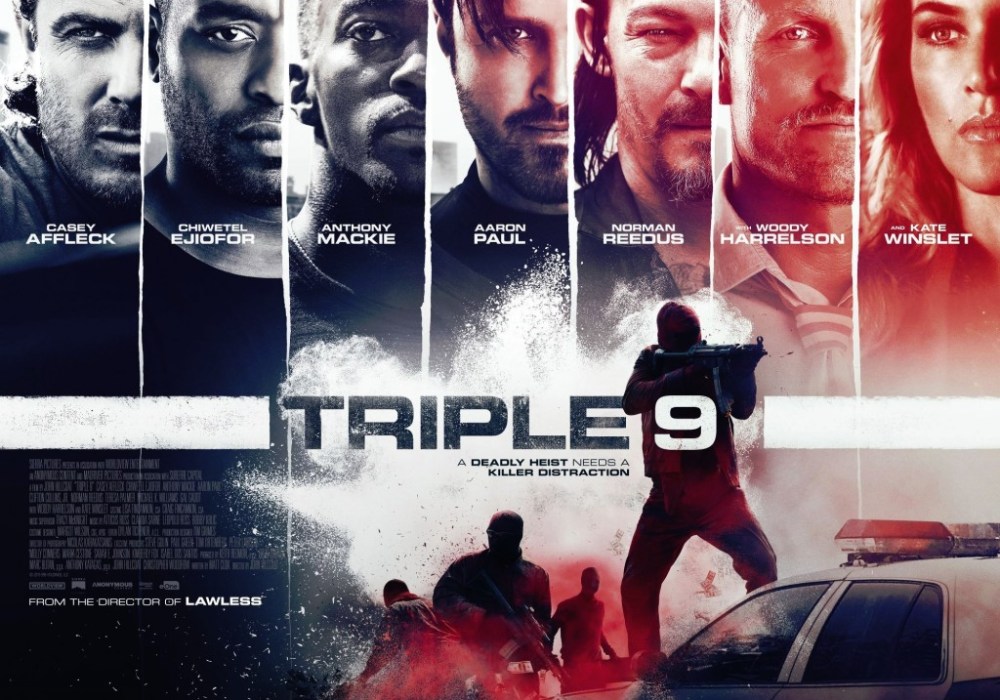
Triple 9

A.K.A what happens when bad movies happen to good actors

Sometimes you will go the cinema and see a film for one actor you particularly like. Occasionally, you are lucky enough to see a film that for two or three of actors who like. It’s rare to find a film that has an entire lead cast that you truly admire. Triple 9 has a cast made up of some truly talented actors (listed with my favourite of their works):

The trailer for the film looked engaging enough, full of twists and deceit. Then, last night at Cineworld’s Unlimited Secret Screening, I got to see Triple 9. The film is a flawed, convoluted and bitterly depressing 116-minute journey. In all honesty, I would have walked out at about 30 minutes in, if it were not for wanting to find out what happened to the characters played by the above actors along with the fact that I wanted to write a fully-informed review about it. My main hope from writing this review is to discover why I instinctively and vehemently did not like this movie.

Michael (Ejiofor) is the head of a criminal crew that is formed of cops and criminals. The film opens with Michael and his crew (Reedus, Mackie, Paul and Clifton Collins Jr.) undertaking a bank robbery. The men are vicious, with an arsenal of tools to threaten. These include guns, explosives and even a portfolio of information about the bank manager’s personal life to adequately blackmail. The crew get what they came for and leave, but their escape is made messy by greed, which leads to the accidental opening of a dye pack which marks all of them. This mistake aside, all appears well and they hand over the item they stole for gangster Irina Vlasov (Winslet). She withholds their payment however, as she wants them to commit an even more high-profile robbery. A robbery that the men think would be impossible. That’s when one of them realises that it would be possible if the gang splits into two. One half would commit the robbery itself, whilst the other half would provide the police with a distraction. The only crime that would distract an entire police force would be  a Triple 9 – the shooting of a fellow officer. The new partner of Marcus (Mackie) would be the ideal target. However Chris (Affleck) is the Sergeant Detective’s (Harleston) nephew, and both men are highly suspicious as to the identities of the crew.  

First and foremost, it is not the cast who are at fault with this movie.Each of the actors brings a great deal to role, not one of them phones in their performance. Each actor uses what little they have been given to great effect. It’s practically everything else that is a problem. The opening sequence is comprised of tight-framing, minimal lighting and dialogue that poses more questions than answers. By starting in media res (mid action) the film trying to engage you what is going on, but does not provide any reason to actually care about the characters who are participating in these events. This is true of the entire film, we are given little-to-no reason to care about any of the characters. The crew are not charismatic or conflicted enough to be anti-heroes, and the ‘heroes’ are too flawed to side with.

The story that then plays out appears cleverer than it actually is, often leaving the audience unsure what is going on but not motivated enough to figure it out. There is little connection between each scene, jumping around between different characters at different times, without any clarity of how much time has passed. It drifts between place, people and time without giving the viewer anything to anchor on. If a point is trying to be created through this technique, some attempt at social-cultural-political commentary, it does not succeed.

Then there’s the music which accompanies each sequence. The entire soundtrack is a lesson on how not-to-be-subtle, and how-to-bulldoze-your-audience. A soundtrack which is effective at building tension should be a mix of soft and loud to truly emphasize the points of tension. It should not be turned up to eleven for Each. And. Every. Single. Dramatic. Moment.

The cinematography is another example of how the film tried to be clever, but instead isolated the audience.  There’s shaky cam, fast-paced editing with a camera that moves too fast to allow the viewer to actually focus on anything. On the Sky Superscreen at the o2 Arena the effect was rather nauseating instead of tension-building.

Finally, for a cast of this skill and range, a director who could reign them in would be key- a key requirement that was clearly forgotten or ignored. At times many of the cast mumble their lines, making dialogue frequently incomprehensible. Perhaps this was a choice of tone, but frustrated audience is perhaps not really a tone. Many of the actors chew the scenery with over-acting and flailing about, always looking so bitter or impassive at what is going on. Then there’s Casey Affleck, not chewing the scenery but chewing gum in every single scene. His manner of chewing gum in this film rivals the mastication skills of a cow, imposing on his dialogue and stealing every scene he’s in just because it is so aggravating. Someone seems to have told him that his character must be channelled through his chewing gum habit, because Affleck seems to put every once of his acting skill into they way he chews that gum. I’ve never seen chewing gum chewed so aggressively or arrogantly outside of the secondary school I work out. He uses it to show the mood of his character, clearly using that instead of acting to provide any semblance of characterisation.

For a film that wants to be the next The Usual Suspects, L.A Confidential or Training Day Triple 9 is a film that is far too hurried (a remarkable feat at two hours long) and far-fetched to be so. For an account of corrupt cops that is completely true, and is far more powerful and gripping, watch Precinct Seven Five.

Spotlight

A subtle masterpiece of an exposé cinema

This film is proof, were it truly needed, that to invoke emotion from a viewer you do not needed to forcibly bulldoze them emotionally. You do not need people screaming at each other about how they really care about something and think it’s important; you do not need violence to prove someone’s inner rage; you don’t need monologues that reflect on social injustice. This film will grab you and drain you entirely. You will experience burning anger for those who used their positions for powers for unimaginable crimes; hopelessness at how dire at how things have and continue to still be; and cheeks so sodden with tears even when you hadn’t realised you were crying. All of these responses were generated without needless melodrama. Instead the absence of overwrought sentimentality  puts the events of the movie and the subsequent emotional response in bold, underlined and italics. A truly crucial and powerful movie. The fact that these are true events is the ultimate sucker punch.

In 2001 Marty Baron (Liev Schreiber) joined the Boston Globe as its new editor. The fact he is Jewish was viewed as something of a notable scandal, considering the influence of the Catholic church. In his early introductory meetings with his new staff he meets Walter ‘Roddy’ Robinson (Michael Keaton) who is head of  the Spotlight team, a small group of journalists who undertake investigative projects that take months to research and publish.  The rest of the team is made up of Mike Rezendes (Mark Ruffalo), Matt Carroll (Brian d’Arcy James) and Sacha Pfeiffer (Rachel McAdams).  In his new editorial role Baron urges the Spotlight team to follow a lead, a lead which suggests that the Archbishop of Boston knew of a priest who was sexually abusing children and doing nothing about it. A small-time lawyer called Micheal Garabedian (Stanley Tucciis seemingly the only person doing something about it. However Garabedian is on his own against the entire Catholic church, so after his initial reluctance and a lot of persuading he agrees to work along with Spotlight. A terrifying prospect soon becomes clear, this is not just about one priest but is instead about a huge cover-up of far more and dating back longer than can be imagined. But these secrets have been hidden for so long,  and with so many desperate to keep them,  it will be far from an easy journey.

Within all of that, and the remaining 3/4 of the movie, there is only one scene of loud, embittered shouting. Only one scene where one character, haunted by the true horror of what has gone on, lets rip at the hoops he will have to continue to jump and dive through. That one scene is made all the more climatic and devastating as a consequence, packing more potency than the entirety of Joy. The storytelling here is superb, the way each revelation unfolds is shown not told. The information is not forcible spoon-fed, instead delivered with little fanfare or fabrication, and is all the more absorbing for it. The suspense created is unlike much of recent cinema, with an awful sense of inevitability and foreboding that doesn’t take away any viscerality from watching the character’s gradual comprehension of their story’s terrible breadth.

However, the emotional impact of the script would be nowhere near as traumatising were it not for the performances of the cast. ‘Ensemble cast’ is a phrase too easily banded-about, but the cast of Spotlight is a true ensemble. Every actor gives the role their all. ‘All’ does not mean flapping your arms about and saying how angry you are. ‘All’ is, and perhaps should be, a simple look at another person that reveals unobjectionable horror. A gaze into the distance with eyes that expose a haunting that will never be forgotten. The ‘heroes’ of this story are not embellished, nor martyred or hero-worshipped. They are real human beings, forced to comprehend and expose systematic abuse from an institution that had such an intrinsic role in all of their lives.

Though it may have only been released in the first month of the year, this will be one of the greatest films of 2016. A fact-based thriller with a beating heart.

Goosebumps

“Viewer beware, you’re in for a scare!”

It’s easy to be a book snob. It’s easy to tell children which books are good to read and which books are bad to read. What constitutes a bad book for children? If it inspires just one child’s imagination,  gives them fears and feels in equal measure,  then surely a book can’t be bad? I’ve read Wilde, Dickens and both Poe. But I’ve also read Rowling, Wilson and Stein. Those six authors, along with countless authors, formulated my literary past and thus set the foundations for books to be read in the present and the future. J.K.Rowling may have figuratively taken me to Hogwarts and made me lament not receiving my letter when I was 11 (obviously during that period the ministry of magic was busy with other matters…), but it was R.L Stein that gave me a taste for ghouls, goblins and gore. Watching ‘Goosebumps’ felt like a risk, either prompting rage from my inner adolescent or transformative nostalgia. I’m very happy to report it’s the latter. Through a blend of live-action and animation the film manages to capture the goosebump-inducing fear of the books whilst also being rather light-hearted and funny.

A year after his dad has died, Zach Cooper (Dylan Minnette) and his vice-principal mother (Amy Ryan) move from New York to Madison, Delware. Though frustrated at his new small-town surroundings he knows that his mother’s new job will good for her, and the change in scenery may be good for both of them. When moving in, and having a box fall apart on him, he meets his new home-schooled neighbour (Odeya Rush). But their brief introduction is halted by Hannah’s grumpy and rather scary father, a man who may or may not be R.L. Stein (Jack Black). Hannah manages to sneak out and spend a day with Zach, but upon getting caught by her father she is punished. When Zach goes to rescue her, bringing along loveable loser sidekick (Ryan Lee), he stumbles across a bookshelf filled with what appear to be manuscripts for every Goosebumps story every written. However, after opening the manuscript of ‘The Abominable Snowman of Pasadena’ [side note: it is in my top ten Goosebumps] the Abominable Snowman itself comes out of the book. After a series of exciting events, manufactured by the Dummy of ‘Night of the Living Dummy [side note: definite top five contender] all of the manuscripts are opened, bringing all the monsters that Stein has ever written to live and bringing havoc among their town. Stein, Zach, Hannah and Champ must get all of them back in their books, where they belong. But things won’t be easy, and not everything is as it appears…

I really like this movie for numerous reasons, and in fact have a rather big soft spot for it. First of all, it brings all the monsters that once haunted my imagination to life. During the big crowd sequences I desperately searched the crowd for the familiar faces of the guests who overstayed their welcome in my nightmares. Going back to my opening point, I think it’s important that child can read books that scare them, and then show them how to defeat these fears. For children, and adults of a nervous disposition, this film does have rather spooky moments. There are one or two jumpy moments, and few monsters that are rather unsettling, but these are well contained moments and are more fun than fearful.

This leads me onto my second point, how surprisingly funny the film is. There are jokes for the children, and then there are jokes that will go over their heads and will crack up the adults in the audience. My three personal favourite jokes, which led to the emittance of loud laughter from many at the screening I attended, were a gag about the suffix –phile, a discussion about Stein verses Stephen King and a joke about domestic sales of books. Those three jokes (which I have intentionally poorly paraphrased) were well written, as are many others within the film.

The characterisation is good, with each character being more than likeable. In quite a nice shift, Hannah is the braver one whereas Zach and Champ are both rather jumpy in comparison. The animation is well-placed, never jarring with how it fits into the live-action, which is rather laudable. The music is never interfering, subtlety and successfully building the tension and fear. The pacing is also good, the 1hr 40mins never dragging and filled with more than enough twists and turns. This film is what family cinema should be. It shouldn’t patronise the younger members of the audience, or pander the humour towards them. It should engage them, spook them a little and excite them, just as Stein’s books did for me all those years ago.

If you’re looking for a light-hearted movie with a bit of bite, or something to entertain your children that won’t melt your brain, this is it. A very pleasant surprise.