Elvis & Nixon

Yep. Actually a true, and very funny, story.

Upon seeing the trailer you may have felt a ‘Woah, that’s weirdly brilliant!’ feeling. That feeling lasts the entirety of watching the film itself.  The meeting of two of America’s then most famous/infamous men did actually occur in 1970. In many ways the men were actually quite simillar, seemingly rooted by their conservative values and working class upbringing. Yes, Elvis was the hip-swinging, gyrating King of Rock’n’Roll and Nixon was, well, Richard Nixon. but they did have some shared interests. Or, at least, Elvis thought they did and desperately pursued a meeting with the then President of the United States. The film follows Elvis on his quest and the subsequent meeting, to much audience amusement.

1970, Graceland.  Elvis Presley (Michael Shannon) is watching television on his three television screens. He isn’t happy at what he sees. He sees lots of drugs, lots of protest and lots of unnecessary deaths. He decides that he can do something about it, using his celebrity for good and decides to become an undercover agent in the Bureau of Narcotics and Dangerous Drugs. He just needs to meet with President Nixon (Kevin Spacey) first to get it all organised. Luckily he’s got friends Jerry (Alex Pettyfer) and Sonny (Johnny Knoxville) to do that. Nixon’s underlings Krogh (Colin Hanks) and Chapin (Evan Peters) are more than keen, but it looks like their boss will need a lot of persuading. 

The film uses the seemingly unlikeliness of the situation/s to advantage. Quite often (arguably too often) the laughs arise from the ‘No way! I don’t believe it.’ school of comedy. Yet that isn’t such a bad thing when you look at just how good the source material and it’s adaptation to screen is. The gags are good, well written and paced and told with great delivery.

I am a huge fan of Michael Shannon (Midnight Special was an underrated gem, click here of review) and he soars in this comedic-yet-not-really-comedic role. At times I had to remind myself I wasn’t actually watching Elvis Presley, not necessarily due to his look but due to his personality, exuding the aura and charisma of one of music’s true greats.

What helps is the film’s moments where he interacts with us mere mortals. The expressions of those he comes across, the mystification and disbelief, do not get old or less funny. His foe-turned-friend Nixon, as played by Kevin Spacey, also creates a truly memorable and hilarious persona, behaving in a way that certainly seems Nixon-esque. Shannon does steal the show though with the best lines and the fact he can truly pull of huge medallions and a massive gold belt.

The film also utilizes its supporting cast to great effect. I loved both Peters and Hanks as the acting-older-than-their-age young suits, their scenes with Spacey were standout. I also rather enjoyed an unrecognisable Knoxville in his brief but memorable role as Elvis’s close friend. Pettyfer, as Elvis’s BFF, was the only disappointment. He should have been a character played with warmth and wit. Instead he was a bit of a charisma vacuum.

All in all, Elvis & Nixon is fun to watch based on a true story movie that is more than a little bit amusing. Worth a watch.

stars

Tale Of Tales

A twisted take on twisted tales

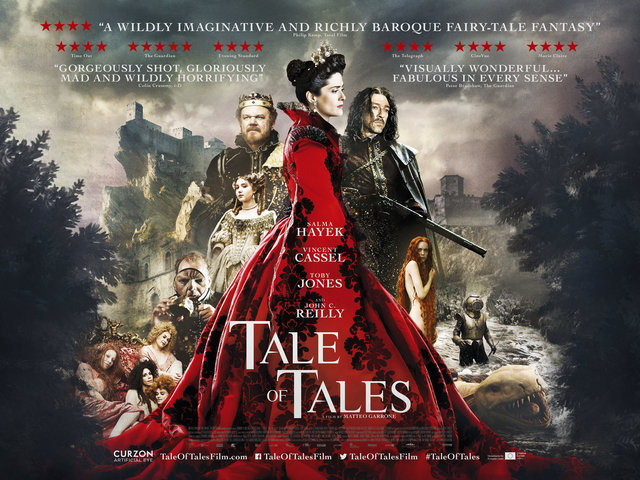
I bloody loved this film. It has everything I love in one place- fairytale s (the dark kind), kings & queens, tricks & spells, deals & plots, oaths & secrets, love & betrayal and tales of the unexpected. It’s all told so well, with so much love and care, with everything looking absolutely gorgeous. Last week I criticized Alice Through The Looking Glass for many things (see my review here)  but the main one was for being a ‘film which feels like it was made by people who read a book called ‘Pretending To Be Weird For Dummies”. Those ‘people’ need to go see this because this is how you do it. If you’re looking for strange, dark and morbidly entertaining tales then look no more!

The Queen of Longtrellis (Salma Hayek) is desperate to have a child but everything she and her husband (John C. Reilly) try fails to work. When a mysterious stranger, a necromancer (Franco Pistoni), visits the castle he offers a risky solution. They need to find a sea monster, kill it and then have its heart cooked by a virgin which the Queen must eat. She will fall instantly pregnant. The necromancer warning that this will be at the cost of a life – a warning the Queen ignores. 

The King of Highhills (Toby Jones) befriends a flea that appears to be able to follow instructions. A friendship soon blossoms and the flea grows and grows. When the now extremely and unbelievably large flea dies the King uses  the flea’s skin as part of a game – whoever can guess the what animal the skin belonged to will get to marry his only daughter. Such a shame for Princess Violet (Bebe Cave) that it’s an ogre who guesses correctly. 

The sex-obsessed King of Strongcliff (Vincent Cassel) hears the voice of an angel whilst prowling his kingdom. He pursues the voice and demands to seduce her, not knowing the voice belong to an elderly woman Dora (Hayley Carmichael) who lives with her equally elderly sister Imma (Shirley Henderson). Dora intends to lead the King along, knowing that she is putting her’s and her sister’s life in danger. A chance meeting with a witch provides her heart’s greatest desire – but is it too good to be true?

That’s only the beginning of each tale. There’s so much more for you to see – so much of which is unexpected, some of which is slightly scary, and all of which is a true pleasure to watch. It’s a feast for the eyes, the brain and the heart. The performances are all solid and utterly believable. There’s depth within each character, a reason and motivation rooted in their decisions. Hayek is stand-out, as is Toby Jones as a man who shifts from arrogance (‘ha ha they’ll never guess what animal it is and I’ll keep my daughter forever’) to devastation (‘Now my son-in-law is an ogre!’) in truly sympathetic manner. Even Cassel’s lustful pursuit manages to be bizarrely sympathetic for all parties involved.

The three tales are interwoven, tentatively linked within the story but fully linked in terms of message. The three tales are based on stories from a 17th Century anthology, they are La Cerva Fatata (The Enchanted Doe), La Pulce (The Flea), La Vecchia Scorticata (The Flayed Old Lady)- but they have been freely adapted with elements of other tales by Giambattista Basile, as well as a touch of artistic license. Although set in a medieval Italy it does feel that their are messages being targeted the audiences today – about consequences of decisions and the nature of family.

The costumes are jaw-dropping, the monsters Kafkaesque, the settings breath-taking, the soundtrack haunting yet never overwhelming and the performances totally memorable. Films like this don’t come around very often so see it whilst you can!

4.5


Where to Invade Next

Michael’s Moore’s most optimistic documentary yet.

The tone of ‘Where To Invade Next’ means that in many ways it stands out against Moore’s previous documentaries. Instead of his typical approach of ‘Here’s what America does wrong!’ and ‘Here’s how America is awful compared to these countries!’ there’s a slight shift. Instead of the glass half-empty approach, ‘Look at how badly these things are done!’ he takes for the first in his career a glass half-full approach,’ Look at how good things could be!’ The result is no less powerful than his previous films and arguably by adding ‘hope’ to his vernacular he will inspire and motivate. Furthermore, the timing of its UK release (about two weeks before the referendum over whether to stay in Europe, aka. Brexit), provides much food for thought.

Under the (false) pretense that the government has asked him to advise them on ‘Where To Invade Next’  Michael Moore then’invades’ and travels around three continents to find  what they are doing well and which ideas they could steal to use in America. These include:

  • Italy: labor rights and workers’ well-being
  •  France: school meals and sex education
  • Finland: education policy
  • Slovenia: debt-free/tuition-free higher education
  • Germany: labor rights and work–life balance
  • Portugal: drug policy, and the abolition of the death penalty
  • Norway: prison system
  • Tunisia: Women’s rights
  • Iceland: women in power and the financial crisis criminal investigation

By taking the form of a travelogue – instead of being goal-oriented (Roger & Me), a rage-driven societal critique (Bowling for Columbine) or to investigate inequalities within America (Sicko) – this feels like a fresh and revitalised Moore. One who is looking forward to solutions rather than expose the crimes. Arguably one of the main criticism against Moore and his documentaries is his over-simplifying of certain elements. It would be easy to argue that yes one of the above countries does do ‘X’ rather well, but have you seen how badly the issue over ‘Y’ is?!? But that’s not what this documentary is about. Yes Moore does still utilizes the comparison between his and other nations for effect (allocated holiday, school meals, taxes and criminality are stand-out) but his true purpose here is to look for other ideas. Instead of attacking the present he looks forward to the future and how things could be done.

I’ve seen a few critiques about this film and how this different approach shows that ‘Moore has gone soft.’ No. As any teacher (secondary school teacher working in the East End writing here) will tell you, when one approach doesn’t work you have to try others. If you constantly shout at a class they will soon be able to metaphorically put you on mute and tune you out. By trying out the rose-tinted glasses and using a more positive approach he may just retain more of our attention spans.

This does lead me on quite nicely to my personal stand-out part of the documentary: its mediation on the nature of education. I will admit that prior to this I knew nothing of France and its school meals system, nor of Finland and its education policy, but if what Moore explains is truly reflective of those respective nations – I really think here in the UK we have a lot to learn. I did cry during these sequences. I found numerous tears rolling down my cheeks when I saw the meals being offered to the children of these schools in France then compared them to those I’ve seen offered (as both student and teacher) at schools here. I cried when I heard the teachers of Finland talking about how school is about student personal development – not tests, grades or levels. I cried when I saw such happy children without the worry or concern I’ve come across as both student or teacher. You could argue that this was manipulation or simplification. Maybe.

But then again there’s a reason Moore didn’t visit the United Kingdom in this documentary. There’s a reason he didn’t recognise the UK as doing one of the above things particularly well. And, just maybe, that after seeing this you will see a reason that we shouldn’t leave when we’ve still got so much to learn.

4 stars

Alice Through The Looking Glass

Disney provides a sequel that no-one actually asked for

Alice Through The Looking Glass is, quite literally movie-making by numbers. The end-product is tick-boxing, almost as if it is following a guide called Pretending To Be Weird For Dummies, but it was only ever made due to the admittedly very large numbers of the first film. Six years ago Alice In Wonderland made a worldwide total of $1,025,467,110 at the box office. It currently ranks at number 23 of the highest grossing films worldwide. It’s therefore not unsurprising that this film was made, though the fact it took six years to get it done is and the fact its sequel film is equally mediocre is no excuse at all.  Interestingly Alice Through The Looking Glass was predicted to earn $55–60 million  from its opening weekend but instead earnt only $27 million. Alice In Wonderland earnt $116 million  in its opening, a difference with its sequel of 70%.  Considering it earnt so much money Alice In Wonderland had a frosty reception with critics and audiences alike. Clearly the people sat around the table who greenlit Alice Through The Looking Glass cared more about getting money out of its audience as opposed to actual enjoyment or satisfaction. Deciding to see ATTLG was due to curiosity and to quote the 1951 animated Alice In Wonderland, “Curiosity only leads to trouble.”

Alice (Mia Wasikowska) has spent the past three years sailing the high seas upon her father’s beloved ship ‘Wonder’. Alice returns home she finds that her family’s finances are so poor that they will have to either give up ‘Wonder’ or the family home. It’s at this point that Absolem (Alan Rickman) in the form of a butterfly calls her back to Wonderland. The Mad Hatter/ Tarrent Hightopp (Johnny Depp) believes that his family may actually still be alive. No-one else believes him which is causing him to fade away. Alice must use a time travelling device stolen from Time (Sacha Baron Cohen) to save Hatter. Old foe Red Queen (Helena Bonham Carter) wants the time travelling device for a different reason, to get revenge on her sister White Queen (Anne Hathaway). Will Alice succeed in her mission to save Hatter, will she be intercepted by Time or will Wonderland be destroyed forever through her trying to change time?

 SPOILER ZONE (SKIP THIS PARAGRAPH IF YOU WISH TO AVOID SPOILERS) The main problem with this film, its fatal flaw if you will, is that so much of it is so utterly pointless. Time tells Alice from the outset that she can’t change time. But she tries anyway, for an hour of the film’s running time, only to find out that she can’t and in the process may have destroyed Wonderland for ever. Not only does it lead to feelings towards Alice akin to my current view of Bran from Game Of Thrones ( I still can’t hear the phrase ‘Hold The Door’ without nursing an internal sob) but there’s also an ironic feeling of having had your time wasted. Time is established as a villain who accent-wise seems to be impersonating Arnold Schwarzenegger yet arguably (this may have come about due to my less than satisfied feelings towards this film) he was surely trying to do the right thing? Alice is the one who nearly destroyed everything, yet she is the one lauded and celebrated from stopping it happening..? 

Anyways…the big problem that Alice In Wonderland had was that it tried to be weird. The ridiculousness of Johnny Depp’s Mad Hatter personified this problem with a truly grating performance. Mercifully he has less screentime in this one but it is still enough to make you wince and feel slightly creeped out. It’s a combination of make-up, costume , performance and vocal choice that I just do not understand. Wasikowska is wonderful as Alice, an actual wonder to watch in a land filled of synthetic versions of it.In fact I’d argue the film’s best moments are when Alice is bringing that wonder into the real world – how society views her with such ill-regard and her brief stay in the ‘care’ of female hysteria speicliast Dr Bennett (an underused Andrew Scott) are moments when the film feels real fresh and lacking the self-consiousness that lingers of the rest of it.

A surprising appearance of Richard Armitage as King Oleren reminded me of Middle Earth and how Peter Jackson managed to create a fully fledged world that athough different from ours seemed equally real. That has not happened with AIW or ATTLG. Instead we’ve been given two films that try to be quirky and strange yet are truly not – neither film has heart to it – and are instead synthetic manifestations of it. The first film may have succeeded on trying to profiteer from the ‘strange’ but the huge defeat of its sequel suggests that people have learnt their lesson. On a grander scale it’s hard not to ponder what this huge loss means for future Disney films. Nearly all of Disney’s upcoming slate is of remakes or reimaginings as they seemed to be safe entities with a pre-sold audience. Just a few weeks ago with Jungle Book (click here to read my review)  Disney proved it could do it well. But after this, I’m not so sure now. Hollywood has taken an approach of putting all of its eggs (monies) into one safe basket (a film based on a book/previous film) yet the scale of ATTLG box office after numerous others may require a change in thinking.

A huge budget and elaborate sets yet no-one appears to have worried about the plot. It’s a mess.

1.5stars

Money Monster

A solid and enjoyable suspense-thriller

There is a tiny, nasty part of me that wants to use the Valley Girl-esque phrase of ‘Hello, Money Monster? 2002 called and it wants its movie back!” as there is something rather dated about this film. However, after seeing Neon Demon at a preview screening last night (click here for my review) there was actually something rather comforting about seeing a good old-fashioned topical thriller that clocks in at the good ol’ standard 90 minutes. And it’s actually pretty good.

Lee Gates (George Clooney) is the host of cable network show ‘Money Monster’ , providing gives the nation stock market tips and tricks. To him the programme is the chance to talk about his favourite thing, money, and have fun – this includes props, sound effects, visual aids and dancers. He seems blissfully unaware of just how important his guidance is to some people, that he is dealing with the livelihoods of millions of people – at least he was unaware until Kyle Budwell (Jack O’Connell) entered the studio during a live broadcast, brandishing a gun and forcing Lee to wear a vest laden with explosives. It’s up to the show’s executive producer Patty Fenn (Julia Roberts) to help Lee get out alive, and that means locating business CEO Walt Camby (Dominic West) . His company lost $880 million due to a ‘Glitch’, $60,000 of which was Kyle’s. But is there more truth to this ‘Glitch’ than Walt is letting on? 

Money Monster is a bit of a superlative-free zone. It’s not the world’s greatest film relating to the economy, nor is it the worst. Director Jodie Foster does a great job in articulating what is universal anger borne out of confusion over the nature of banking and financial crashes. Whilst the film is not developed enough to serve as a deep socio-economic or political statement is does allow for reflection on how little we know about what men in suits are doing with our money. Unlike the equally enjoyable The Big Short  (click here for my review) it doesn’t focus on an entire recession, but on how the crash of just one company can have devastating consequences.

O’Connell is superb channeling power and rage into his performance, one which has thematic similarities to Daniel Kaluuya in an episode of Black Mirror entitled ‘Fifteen Million Merits‘.  Clooney offers a solid performance as an arrogant arsehole with a heart of gold (pretty much his standard M.O). Roberts is fine as a desperate producer keeping her head when all around her are losing there’s. West is the required level of swarmy to create a villainous figure. Caitriona Balfe (playing Diane Lester) is an actress I had not come across before but was a pleasant surprise with a crucial yet understated performance.

Money Monster provides just what the trailer offers. No need to read the small print here: it’s solid entertainment that will engage for the entirety of its running time and may even make you think.

stars


The Neon Demon

“Beauty isn’t everything. It’s the only thing.”

Where to start? Yesterday I had the privilege, courtesy of Little White Lies film magazine, to attend a preview screening of Nicolas Winding Refn‘s The Neon Demon, at the very schmancy Soho Hotel with my friend Galia. The film is not released until June 24th in the States and not until early July in the UK. However the film had its international premiere at Cannes last month which led to a substantial amount of reviews. As it stands on June 2nd the film has a rating of 6.8/10 on IMDB and 47% on Rotten Tomatoes. It’s looking like The Neon Demon is not going to be the new Drive (7.8/10 and 92% respectively) and there’s one really good reason for that. Refn’s return to LA is with a film that confuses depth with emptiness, mistakes meaning with vapidity and chooses style over substance. The result is an exploitation movie disguised as art, smothered with layers of pretension.

16 year-old Jessie (Elle Fanning) has just moved to Los Angeles. No-one appears to know or care that she is there. Jessie knows she is beautiful, She also knows that beauty is dangerous and that other women would kill for it. After her first photoshoot with amateur photographer and potential love interest Dean (Karl Glusman) Jessie is befriended by makeup artist Ruby (Jena Malone). Ruby offers to be the friend Jessie so desperately needs yet Ruby’s other two friends Gigi (Bella Heathcote) and Sarah (Abbey Lee), models only slightly older than Jessie, view Jessie instead as threat and competition rather than a new-found friend. It soon seems like everybody in LA wants a piece of Jessie, her beauty is admired and envied in equal measure – but what will it end up costing her?

What rather infuriates me reading back the plot summary I have just written is that I have made the film sound fun. It isn’t really. Moments of the film are, when the film casts a satirical eye on LA and the modeling industry, but when the film loses focus and Refn seems busy being self-congratulatory about his own brilliance – that’s when you see the film for what it really is. Vapid and empty. I’m sure it would be easy to argue that was intentional, a reflection of the 21st Century’s perception of models and beauty (blah blah yah yah)… but no.

13336104_10100855380438146_7474404562862228996_n (1)

Prior to the film’s screening its director and lead were invited to talk about the film and answer some questions (picture courtesy of Galia). Refn said, and not for the first time in the promo for this film, that ‘I wanted to make a film about the 16-year-old girl inside me’. This resulted in awkward stifled guffaws from an audience who hadn’t yet seen the film. For the first half of the film there are instances where you can see very loosely what he means by this. Jessie’s interactions with casting agents (Christina Hendricks), auteur photographers (Desmond Harrington) and wildly miscast ‘scary’ motel owners (Keanu Reeves) explore the vulnerability of the young in an industry that can be so parasitic and vampiric. It is during this period that the cast really shine. Fanning possessing an ethereality – an otherness that draws yet repels – Malone unnerving as a metaphorical wolf in friends clothing, Heathcote and Lee wonderfully cold as Jessie’s rivals.    

It is these more conventional moments that are some of the most engaging. They are intersected with moments that are more exploratory and ‘artistic’ (read: rather deluded and self-indulgent). These moments are overlong, assaulting the senses in a way that should be poetic but instead aggravate. However the soundtrack during the entire film is phenomenal – throbbing away and pumping tension into each scene. And, it must be said, the use of colour and lighting during these moments and the film in it entirety is truly extraordinary. Refn’s color blindness means that his use of colour must alway be in high contrast so he can see it (fact courtesy of Galia). The use of lighting and colour within each of these sequences establish then reflect the tone and ongoings in each sequence. It’s almost as if his use of colour reflects the dichotomy of the human experience…. (sorry I had to try at sounding like a proper film critic!)

It’s the film’s second half that gives into Refn’s epicureanism, resulting in the film becoming even less of a narrative (there wasn’t really one to start with) and more a spiral of ‘well that escalated quickly’. Things get weirder, even weirder, and then weirder yet. It is these moments that are the most problematic. I like weird. I am weird. But I need my weirdness in cinema to be purposeful. I don’t need to see a character deepthroating a knife without purpose nor a character performing necrophilia on a dead model again without purpose. Don’t even get me started on the shower sequence. I’m not the only one of the audience of about 50 of us who felt this way. The gasps and intensity of audience focus hugely shifted at this point, with the grosequeties accompanied by laughs of disbelief instead of the intended wonder.

These scenes have resulted in extreme horror from The Daily Mail (quelle surprise) with headlines such as “Coming soon to a cinema near you: Grim film featuring murder, cannibalism and lesbian NECROPHILIA that even shocked Cannes is now set for British screens” and “Has cinema ever been so depraved and the censors so amoral? CLARE FOGES on the extreme violence, cannibalism and lesbian necrophilia in new film The Neon Demon” These headlines are ridiculous for two reason. 1) I’m sure anyone who has seen a solid amount of film could name you films more graphic than this one. 2) Such headlines would give its pretentious twonk of a director an egotistical thrill and further fuel his perception of himself as some sort of revolutionary.  He’s not worth it.

The film favours an approach of Message over an actual storyline, choosing to drift between scenes as opposed to following a narrative and having loose outlines as opposed to actual characters. The more extreme moments are so needless they undercut everything that has occurred prior and throw any perception of The Message out of the window. If Refn wanted to criticise the modelling industry these scenes confuse The Message completely. Initially the film relies on the perverse pleasure of being voyeur of the voyeurs (we watch the watchers watching the watched) whilst pointing out the dark side of the industry. Yet once the aforementioned silliness occurs it is is almost like we see the film for what it really is – a mastabororty experiment where Refn gets to sadomasochistically annihilate his inner 16-year-old girl.

There are images and messages galore on offer within The Neon Demon, but the majority of these are like gaudy baubles. Beautiful to look at but totally empty.

2.5

Warcraft: The Beginning

123 minutes of beginnings and little take-off

I came out of Warcraft feeling confused. As a total noob when it comes to W.O.W I knew nothing about the material before seeing the film and the film has little provision for the uninitiated.  Whilst scowling the web for plot summaries and plot explanations to answer my questions I also came across the reviews. Two outcomes came out of this experience, 1) I still have unresolved questions that may just have been plot-holes 2) There are some really brutal reviews out there that make me feel very sorry indeed for Duncan Jones and his film. Read any of his PR for the film and it is clear this is a project of passion for him – an element that really shines through when watching. Warcraft is not horrendous nor particularly bad; just too convoluted to allow it to flow. Plus, considering the entire film focuses on introductions it still manages to leave too many gaps and lead to much head-scratching. 

Draenor, the homeworld of the orcs, is dying. A green-skinned orc called Gul’dan (Daniel Wu) controls a magical force called The Fel which allows him to open a doorway from their world to another, Azeroth the home of the humans. Gul’dan plans to send over the orcs in batches, the first being a group of the strongest warriors. Duratan (Toby Kebbell) the chieftain of the Frostwolf clan, his pregnant mate Draka (Anna Galvin) and his second in command Orgrim (Robert Kazinsky) are amongst the first to cross. Duratan has his doubts over the mysterious green magic, believing there to be a link between Gul’tan using it and  the destruction of their home. Fearing the same will happen again with this world me makes contact with Anduin Loather (Travis Fimmel), the military commander of the city of Stormwind who in turn contacts the king (Dominic Cooper), the Guardian (Ben Foster) and a young mage (Ben Schnetzer). United will they be able to stop the Fel from destroying yet another world?

That’s the plot as far as I understood it (apologies to any of the more informed if I have gotten anything majorly wrong there!) It’s not the plot itself that leads to confusing, but some of the main nuances. Character motivations often go unexplained, as are the links and relationships between them. Considering the film’s focus is to introduce it almost feels like a prior film that I had missed had already done so. When it comes to the storytelling process I’m still not sure if the film is really clever or really stupid, lumbering along from one set-piece to the next, frequently impenetrable to the viewers.

The world of Warcraft is a rather beautiful and detailed one, with lots of layers and depth. However although it has made the transition to the screen it has perhaps not been translated enough for it to draw in those new to franchise, and I suspect it it is too diluted for it’s loyal fanbase. I have no qualms in metaphorically using a glossary to understand a mythology for a Fandom, something I have regularly had to do whilst watching six seasons worth of Game Of Thrones or even the six Middle Earth films,  but this film has too quiet a soul and too dull to warrant such extracurricular research. There is also a prevailing sense, resulting from poor critical and commercial reviews along with poor box office takings, that this is a world that will not return to the screen again…

The characters that inhabit this world are fine, not particularly good nor particularly bad. Just. Fine. Kebbell is standout as the conflicted Orc, proving yet again at his great skill at using the technology to create such wondrous creatures. Fimmel is almost an Aragorn 2.0, a reminder of just how good Viggo Mortensen  was in the role of charmer with a heart of gold. A shoehorned-in romantic subplot with half-orc Garona (Paula Patton) is undercut in terms of believability both by underdevelopment and forced chemistry. The rest of the cast are criminally underused. 

Warcraft is a film that is fantastical, but far from fantastic. Although the story being told is adequately entertaining it is told in a manner that is rather butchered, dull and rushed. It’s enjoyable enough but there is a prevailing sense that this film is not as good as it could have/ should have been.

2 stars

The Nice Guys

Shane Black strikes again with another brilliant buddy comedy

Kiss Kiss Bang Bang is one of my favourite films from the 21st century. Not only did it reintroduce the world to Robert Downey Jr (with Iron Man coming out three years later) and star an underrated Batman, Val Kilmer, as a character called Gay Perry, it is also a definitive example of a contemporary pulp-y neo-noir that is also truly hilarious with a side note of surreal.  I love Kiss Kiss Bang Bang so I have been impatiently waiting for The Nice Guys with desperate expectations. Thankfully those expectations were more than meet with a crime comedy that is made so much fun to watch by an awesome cast.

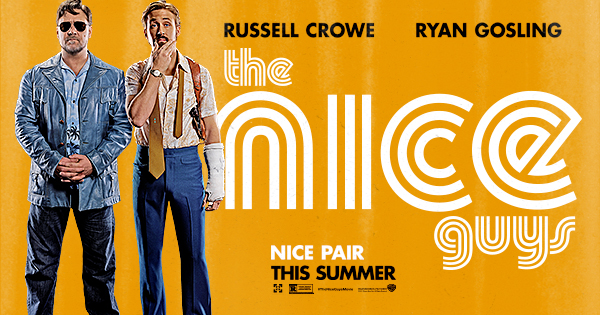
1977, Los Angeles. Holland March (Ryan Gosling) is a private detective, quite a good one actually although appearances can be deceptive, very deceptive… Whilst investigating the death of a porn star called Misty Mountains (Murielle Telio) he begins searching for a girl called Amelia Kuttner (Margaret Qualley) Holland comes into contact with an enforcer called Jackson Healy (Russell Crowe). More specifically Jackson breaks Holland’s arm to try and stop him from hunting down Amelia. But after a failed attempt on his life occurs Jackson realises that his case and Holland’s cases actually overlap, they may have to work together to solve their cases and stop more people from being killed.

There are three truly great things about this film. 1) Ryan Gosling is truly wonderful and properly hilarious. He appears to have a natural gift for physical comedy and it is a gift he utilizes for great effect here. His facial reactions are joyous to watch and his delivery of gags legendary. His bond with teen daughter Holly (Angourie Riceadds a wonderful dynamic and an extra layer of depth to things. But it is his rapport with another truly great thing about this film that is standout.

2) Russell Crowe has been rocking a certain blend of grizzled touch-guy for a few years now. In this film he goes full grizzled tough-guy in such a way that, thanks to his mis-matched partnership with Gosling, makes him likeable. The dynamic between the pair is founded on hate-fear rather than hate-love, with both characters being so fatally flawed they shouldn’t really spend any time with each other. At all. Yet the pairing proves hilarious with both characters finding a balance between each other as Crowe’s punch-punchy character, whose only friend is a pet fish, somewhat softens through his exchanges with Gosling who frequently ends up rivalling Buster Keaton in terms of physical comedy.

Finally, 3) The script. Few scripts are this crisp with brilliantly quotable one liners and dialogue such as this gem of a sequence:

Holland March: Look on the bright side. Nobody got hurt.

Jackson Healy: People got hurt.

Holland March: I’m saying, I think they died quickly. So I don’t think they got hurt.

Occasionally the plotting does get too convoluted, potentially it is too overambitious in its conspiracy plotting, but for the most part it’s typically sharp Shane Black with a blend full of action, comedy, aspects of hard-bitten noir and a side of social commentary. Few films out in the cinemas at the moment are this entertaining.

4 stars


Love & Friendship

An exquisitely elegant Austen adaptation

Love & Friendship is an adaptation of a Jane Austen novella entitled Lady Susan, written in 1794 but not published until 1871. Almost impossibly for a work by Austen it has never been adapted before. After seeing Love & Friendship the viewer will be left with two thoughts, 1) Why on Earth has such a brilliant story not made it to the screen before? and 2) Thank goodness it hadn’t as that version was absolutely perfect!  Love & Friendship is an absolute treat of a film and a gem of a must-see.

Lady Susan Vernon (Kate Beckinsale) is a widow and notorious flirt. Infamous for her ways of manipulation yet so utterly charming, magnetic and witty that most of society adores her. Seeking refuge after scandalous rumours spread about her private life, about a suspected relationship with married Lord Manwaring (Lochlann O’Mearáin), she arrives at her in-laws relying on their forced generosity. Whilst there she must continue her desperate search to find her daughter Federica (Morfydd Clark) a suitable husband and an even better match for herself. Seduction, deception, broken hearts and lots and lots of gossip ensue. 

There are so many wonderful things to say about this film. The way the story is told is extraordinarily brilliant. Originally an epistolary novella (a story told as a series of letters) writer-director-producer Whit Stillman turns monologues into dialogue with perfection. The editing is what truly makes this a success – hopping between people, places and things – nothing needless is shown and nothing is needlessly reshown. As opposed to an hours-long epic the period drama is reinvigorated with this 90 minute self-conscious comedic romp. The threads are skillfully interwoven with many outcomes that you may surprise and will definitely amuse. The dialogue is wonderfully written, snappy and lively, serving as a great reminder of just how funny Austen was. The fact the film has an age certification of ‘U’ just goes to show how well-written the script is: never have such brutal takedowns been so politely and eloquently written. 

The characterisation is superb with every character, no matter how facetious or self-indulgent, managing to be immensely likeable. Beckinsale as Lady Susan is a revelation –  a character who knows nothing nor cares little for either love or friendship yet knows just how to manipulate other’s feelings about both. Lady Susan’s manipulations are extraordinary and so skillful that you can’t help find her likeable and end up rooting for her.  She’s nasty and self-centered, others distrust of her and resentment of her status is fully understandable as is their envy of her, yet the viewer is spellbound by her. Some of her best moments are when she is scheming with the American Alicia (Chloë Sevigny) when the conversation becomes a biting satire of late 18th Century aristocracy. 

The entire cast are just as brilliant, there are no weak links here, but it is Bennett’s James Martin that almost steals the show. His performance is so earnest and well-meaning as a character who is unable to utter a sentence without creating moments of sheer awkwardness. In a film full of laugh-inducing moments, I don’t think I’ve laughed this often in ages, it is his character who has two of the biggest chuckle/chortle/tear-inducing funny moments, moments which I have been quoting constantly since.

The costumes, sets and visual style are all extraordinary. The entire cast an acting masterclass. A script and storyline that make hilarious an understatement. Easily one of the best films we will see this year (it’s not even June yet). Go see it. Now!

five star

X-Men: Apocalypse

“At Least We Can All Agree The Third One Is Always The Worst”

The above line is uttered by Jean Grey (Sophie Turner) about halfway through the movie, when she and a few other character leave a cinema screening of Return of the Jedi. It’s one of numerous strange self-aware moments within the film. If this had come out a year after Deadpool it could easily be assumed to be a rip-off of the superior film’s meta sense of humour. Instead it comes across as strangely self-satisfied and almost arrogant. Considering her character is telepathic it almost feels like she was reading this viewer’s mind…

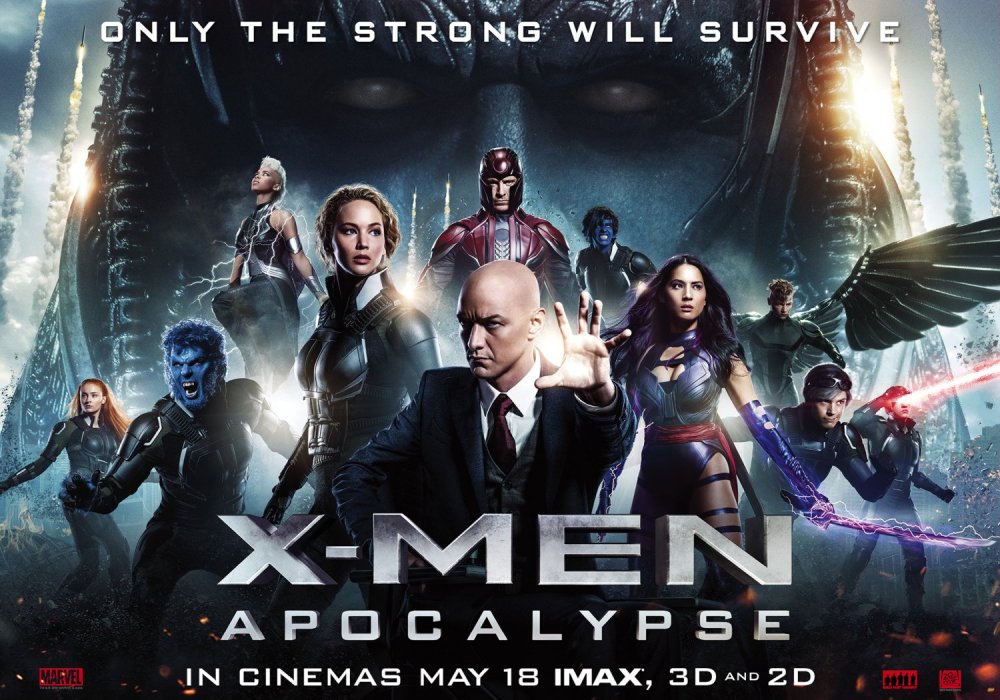
10 years after the stand-off with the Sentinel prototypes at White House the X-men have never been so far apart from each other yet have never been so strong individually. Charles Xavier’s School for Gifted Youngsters is full of mutants, with Professor Xavier himself (James McAvoy) and second is command Hank Mccoy (Nicholas Hoult)  keeping a close watch on telepathic protegee  Jean Grey (Sophie Turner) and new recruit  Scott Summers (Tye Sheridan) as both re struggling to control their powers. Raven (Jennifer Lawrence) has become a loner/nomad/mercenary helping other mutants.  Erik Lehnseer(Michael Fassbender) is now a married man with a young daughter. But when immortal physic mutant Apocalypse (Oscar Isaac) rises from a millennia -long sleep  his awakening will have consequences for the world’s population of humans and mutants alike. 

How do you like your squash? I personally like it strong and full of flavour. I don’t like it weak – diluted and lacking in flavour.  That’s my problem with this film. To use this clunky analogy for all it’s worth the cordial (the good stuff) is diluted by too much water (i.e characters, plot and action). Although the ‘too-many-characters-may-spoil-the-broth’ did cause Civil War a bit of a stumble, in the case of this film it forces the film to fall flat on its face. Repeatedly.

Fatal Flaw Time: Characterization is almost completely abandoned in favour of action and set pieces. For fans of the franchise, or any of its other incarnations, we witness one dimensional versions of the characters we know and love. Lawrence as Raven/Mystique spends the majority of the film either wearing a pinched expression of exasperated  discontentment. McAvoy’s dialogue is reduced to  platitudes and mawkish ponderings. Sheridan does little to win favour for Cyclops in the versus Wolverine debate. Turner is okay as Jean Grey but her American accent quickly steals audience focus for all the wrong reasons. And, alhough it was great to see a cool AF version of Jubilee (Lana Condor) hanging around I’d rather her not even have been there as she is bitterly unused. Talk about how to (metaphorically) prick-tease a Fan-Girl!

Then there’s the villains. Fassbender has some incredibly emotionally and engaging sequences but is then too frequently forced to fade into the background. Isaac is criminally wasted, hidden under rubbery prosthetics with a character whose character and abilities are far from defined. The three new characters who join Magneto as the Four Horsemen are completely overwhelmed – Ben Hardy as Angel is ill-served, Olivia Munn as Psylocke weirdly reminded me of this sketch by Mitchell and Webb in terms of OTT villain-face and Alexandra Shipp as Storm seems more than interesting enough but underused. The villainous plot they hatch is of such a scale that is almost becomes bland (think the final 30 minutes of Man Of Steel) and completes overwhelms its characters.

Though, in fairness it’s so overstuffed with characters  it’s almost unsurprising, although not forgivable. The motivation of the characters is devoid of reason and the plan itself lacking real purpose. The plot is also so full of holes (talking Swiss cheese territory here) that it becomes incoherent. There’s nothing new or interesting with the plot, it takes some irritatingly familiar paths, that this film feels tired and bloated in comparison to its counterparts. It’s also so unbearably serious, akin to SvS:DoJ in terms of getting ‘dark’ confused with ‘murky’. 

In fact, upon reflection, the only franchise contribution I enjoyed and I am truly thankful for is that of Kodi Smit-McPhee as Kurt Wagner/Nightcrawler. He is given some of the film’s funniest, sweetest and most moving moments. He’s a real joy to watch and probably the only reason I would risk the (inevitable) follow-up. What I can’t forgive the film for is a sequence that occurs just after the Jean Grey’s line about trilogies. After a rather wonderful and emotional sequence that has been delicately woven the tension is completely destroyed, totally sledgehammered, by a shift in tone that is so jarring it is unbearably stupid.  It’s a sequence involving Peter Maximoff/Quicksilver (Evan Peters – who totally stole the show in Days of Future Past  in the space of 10 minutes of screentime) that I would have undoubtedly loved at any other point in the film. But, straight after such a well-executed and pathos-filled sequence, it is utterly wasted and even made me resent his character. By the end of the film my faith in him was somewhat restored though my love for him has been somewhat tainted. Such an inconsistent moment reflects the very nature of the entire film.

As a teacher I’ve found the true power of saying the following phrase and it’s the only phrase I can find that fully articulates my feelings towards this film. It’s not that I’m angry X-Men:Apocalypse – I’m just disappointed.

2 stars