The Lady In The Van

British Cinema at its finest

This film is so warm, kind-hearted and endearing. Whilst on the surface it looks to be a meek and mild comedy about a nutty old lady it is so much more than that. It’s full of witty observations about society – the  lens is pointed firmly at liberals who have earned enough to become middle class yet feel a degree of guilt about their new-found  wealth – and how we do/don’t look after each other. Maggie Smith as the eponymous ‘Lady’ is magnificent,  bringing a richness and poignancy to a fiercely opinionated powerhouse of a figure. Should this be 80-year old Smith’s last leading role, it is one to be proud of. Her performance in this ‘Mostly True Story’ both perverse and profound in equal measure.

In the 1970s playwright Alan Bennett (Alex Jennings) moved into an affluent street in Camden. He swiftly became acquainted with his neighbours and the nomadic interloper Ms Shephard (Maggie Smith) known by many as the infamous ‘Ms Camden’. Ms Shepard, as Alan insists on calling her, lives in a van. The neighbours do not know why she lives in the van, or even who she is. Is she called Mary or Margret. What they do know is that she is homeless and prone to dictatorial ravings. Due to a mixture of guilt and territorial conviction they protest little (at least to her face)  as she drives around and parks up where ever she fancies. However, after council and double yellow line interference, she can no longer continuing temporarily pitching up where she choses. Loathe to offer too much help to the cantankerous old woman Alan lets her use his drive temporarily to park her Van. 15 years pass, with an often-reluctant Alan slowly-forming a bond with Ms Shepard. As time passes and takes its toll on Ms Shepard Alan begins to learn of the past that continues to consume her. 

This is the type of story that could only be true, it would be nigh-on impossible to create a character like Ms Shepard. The majority of her views were left in the dark ages and the way she treats those who try to help her is often despicable. And yet, when personified by Dame Maggie Smith, she is made almost loveable. Her hidden pain and turmoil often explaining some of her brusque character traits. Jennings is superb as her friend and foil, presenting the conflicted feelings Bennett himself had towards helping the formidable Shepard. The supporting cast are also extraordinary: Frances De La Tour, Jim Broadbent and Claire Foy to name just three, all bring various degrees of support to the grande dame of squalor that is Ms Shepard. The slow and tragic realization that Ms Shepard was more sinned against than a sinner is heart-breaking yet handled with such caution and care.

Considering the topic matter this film is ultimately uplifting, almost joyful in its exploration of what draws people to care and look out for one another.
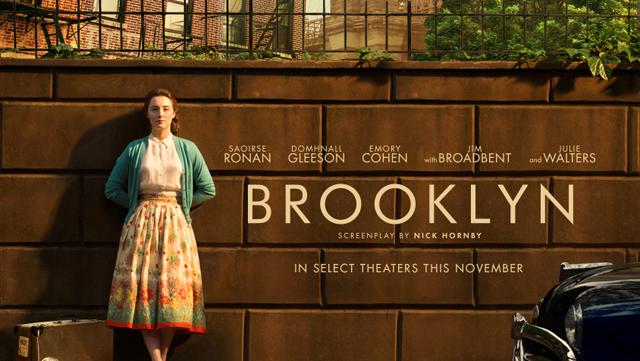
Brooklyn

A sweeping and soaring romantic epic

Whenever my Grandma watches something she really likes or is moved by she’ll simply say, with her Welsh twang ‘Oooh that’s lovely!’ As soon as the credits starting rolling on Brooklyn I found myself uttering her almost-catchphrase, as the film that had gone on before was one of pure and unadulterated loveliness. With the three charismatic central leads, the countless scene-stealing supporting roles and spectacular scenery, told with such carefully constructed and emotive style, Brooklyn is a shoe-in for the awards season.

In 1952 Ellis Lacey (Saoirse Ronan) hands in the notice for her Sunday job at the local shop. She is leaving her small village in Ireland, her home and the only place she has ever known, to move to Brooklyn. On Ellis’ behalf her older, and much- adored older sister Rose (Fiona Glascott), wrote to Father Flood (Jim Broadbent) an Irish Catholic Priest living in Brooklyn asking to give Ellis a chance. Flood agrees to sponsor Ellis – paying for her travel, the start of her accommodation and finding her a job – as there are no opportunities for a bright girl like her his offer is a life-line to a new life. The ferry journey to America is hard, the first few weeks in Brooklyn even harder. She feels so homesick she is scared that she is going to die. It does fade however with time and love – in the form of Italian-American plumber Tony Fiorello (Emory Cohen). But when tragedy strikes she must return to Ireland.  Ellis soon becomes torn between her new life in American and a new life being offered by a possible new love, eligible bachelor Jim Farrell (Domhnall Gleeson). She must choose between both countries, and they both promise.

This film is good. So good in fact that ‘good’ is an inadequate adjective. It’s marvellous. It’s wonderful. It’s exquisite. Few films are this charming: so full of pathos that stimulates both heart and mind. It even appears impossible to think of one negative trait that this film possesses – no fatal Achilles heel is present here. The performances by the entire cast are outstanding, allowing for the creation of an astonishingly well-crafted very real-seeming world.

Each character is three dimensional and rounded, yet this is Ronan’s movie. Her Ellis’ is able to articulate so much with the smallest of expressions – her internal turmoil revealed with looks rather than prosaic audible contemplations. Cohen and Gleeson both hold their own, creating characters that are shown to be equal in terms of romantic possibilities. Often films with a romantic triangle will be unfairly weighted in favour of one of the choices, pushing the audiences favour in one way. This is not true of Brooklyn as the polar opposite men, confident alpha-male Tony and charmingly unassuming Jim both offering lives which could suit Ellis, if only she could work out what it is that she wants.

Set in the 1950s, it is the perfect time capsule movie. The costumes are jaw-droppingly and envy-inducingly gorgeous. The characters are believable for the era, Julie Walters is truly hilarious as the owner of the single women’s boarding house. The music makes the heart-strings pull that much tighter.

The fear of choice, of choosing the road not yet taken, is portrayed tenderly and with nuance. Not a hint of melodrama here. A timeless must-see movie.

Suffragette

‘I’d rather be a rebel than a slave’

Upon reflecting on the important role the suffragettes have in history in their obtaining the right for women to vote, it’s incredibly hard to believe that in the eighty-seven years since all women in Britain over the age of 21 could vote this is the first movie to actually portray the events that provided the catalyst for the 1928 parliamentary decision. It was actually in 1918 that the first women of Britain could actually vote – but they had to be over the age of thirty and meet certain property conditions. Suffragette does not focus on either of those periods of time, but looks at what is perceived as a turning point in the movement – the early 1910s – when social views of the suffragette movement shifted. At the start of the era, like the start of the film, the media and therefore society is fiercely damning of these immoral women. By the end of the film, on the cusp of WW1, things had started to turn. That was through the great sacrifices by many women, and the ultimate sacrifice by one woman. That is the complete narrative arc of the film – whilst an excellent insight into this era it seems an unusual choice for a film which could have instead focused on portraying the actual granting of the vote. Consequently the impact of the film is almost limited, which, considering how much build-up and anticipation there was prior to release, may ultimately frustrate some viewers.

Bethnal Green, 1912. Maud Watts (Carey Mulligan) is a married mother in her early twenties. She works long hours in brutal conditions at a laundry, then goes home and cares for her young son and husband Sonny (Ben Whishaw). She’s aware of the women wanting the vote, but it seems so distant and irrelevant to her that she pays in little attention or mind. However a blossoming friendship with Violet (Anne-Marie Duff) leads to Maud giving a personal statement on her work and living conditions to a committee of MPs. ‘Laundry work is short if you are a woman’, she tells them. Maud’s mother died at work, scolded by a boiling vat of water. Maud has already been badly injured at work, and even faced sexual abuse. Should she have more children, her future-daughters will work there, facing the same risks and dangers. The cycle will continue, unbroken and relentless, unless Maud can do something to make it change. Violet invites Maud to attend a meeting with the East End Suffrage Movement. There she meets Edith Ellyn (Helena Bonham Carter), Emily Davison (Natalie Press) and later, albeit briefly, Emmeline Pankhurst (Meryl Streep). Maud tentatively but swiftly joins their ranks and campaigns for the right for women to vote but with the government, in the form of Inspector Arthur Steed (Brendan Gleeson), desperate to quell any uprising Maud is risking all she has to make a difference.

Perhaps because of the incredibly high expectations placed upon the film, it is not fully the fault of the film-makers that Suffragette does disappoint to some extent. The cast are truly extraordinary, and create characters so heart-breakingly believable that it would be nigh-on-impossible not to engage emotionally with this film. However, it doesn’t quite feel enough. Firstly, as previously mentioned, the creative decision to focus on less than three years is one worthy of debate. It allows a heightened focus on a short but important period of time, yet consequently drags out certain moments for too long. There is then the fact that, although Mulligan is fantastic in her role, Maud did not actually exist. Unlike the majority of other characters, Maud was a fictional creation for the purpose of the film. Though based in testimonies of real women from the era, her character arc is cherry-picked from multiple sources. The purpose of a composite character, as is true of this case, is to serve as a cipher; an ‘Every-Woman’ to act as an entry point and an emotional compass to the events we witness as an audience. For the most part this is successful, yet is at times almost frustrating. There are other characters in the story, real-women who do not get their voice heard as a result. Although the life of Maud is used to articulate the difficulties of life for the working class women, as opposed to the middle-class Mary Poppins suffragette, it feels rather rote. Maud, instead of feeling like a real character, almost feels like a narrative tool used to access the greatest hits of the suffrage. This has not been helped by the misleading advertising surrounding the film – yes Mulligan is our lead and Bonham Carter plays an important role, but Streep’s role is not nearly significant to require the top-billing the promotional material has given her. Although she does deliver a rather inspiring speech, her thirty-seconds of running time seems anti-climactic as a consequence.

Although Suffragette does offer some clear insight into the era, from the hunger strikes and force-feeding to the police brutality and social ostracisation that came with being a suffragette, it does not feel enough. Whilst it is a no-frills look into a momentous period of history, at times it feels more like a dry history lesson than the visceral and powerful movie these women deserve.

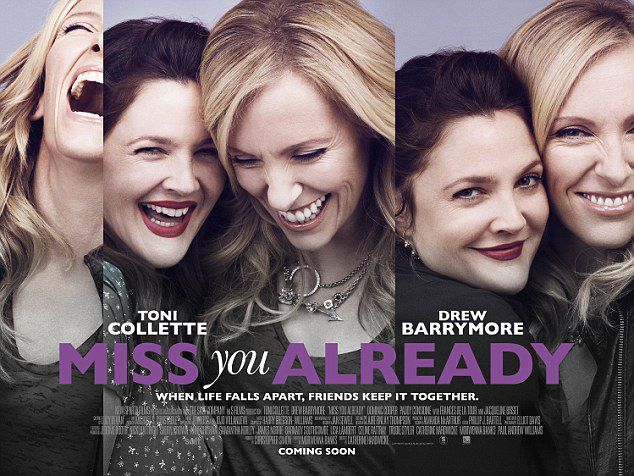
Miss You Already

An unsentimental yet sincere depiction of illness and friendship

It may not have a particularly original plot and may be presented in a way that is ultimately wildly manipulative (read as: you will cry) the film itself is admirable in what it, mostly, achieves. It presents a relatively honest depiction of breast cancer; the impact it places upon relationships both platonic and romantic along with the physical toll it takes. Whilst that alone is immensely refreshing, this is furthered by the presentation of a friendship that will resonate with audiences’.

Millie (Toni Collette) and Jess (Drew Barrymore) have been best friends since childhood. They have experienced every first together, everything from first kiss to first child, with their polar opposite personalities allowing them to bring out the best in each other. Whilst Jess is more conservative and stable, Millie is the overconfident and glamourous wild-child yet they are totally and completely inseparable. Both are happily married, yet rather than this separating them their respective husbands (Millie is married to Dominic Cooper’s Kit with Jess married to Paddy Considine’s Jago) and Millie’s two children instead make up one big family. But the family is rocked by Millie’s life-altering diagnosis of breast cancer, just as Jess finds out that she is pregnant with her much-longed for first child, which will put their friendship and their makeshift family to the ultimate test.

Collette does any amazing job (as is to be expected) playing Millie. Her acting, along with the screenplay and the film’s direction avoid what many similar films have done in the past, of making the person suffering from cancer into some sort of saint or martyr. Instead Millie stays the same as it is implied she always was – a mostly well-meaning but often not very nice person. This feature is really the film’s only comparatively unique feature. This, along with the portrayal of her treatment, make the film feel more honest and in a sense more brutal than others of this kind. Millie starts the film loud and vulgar, and although she spends the majority of the film in an oncology unit, she still stays the same person. Cancer doesn’t ‘fix’ her personalities ‘faults’, at times it only exacerbates them, consequently making her more relatable than many other presentations of the disease. It’s a reminder that cancer can, and with the current odds will, affect all of us whether we are good, bad or, like Millie, the grey area in-between.

However, it would be wrong to say this film is truly great or fully lives up to its potential. As we only see Jess and Millie’s friendship through flashback or montage, we are unable to fully latch onto their story. Aside from their respective health concerns, and a few references to a shared love of Wuthering Heights and R.E.M’s Losing My Religion, we aren’t really given enough about what makes them such good friends. The film constantly tells us this, but never shows us quite enough to engage us fully with their bond and ultimately does not earn the empathy it had the potential to do so.

Nevertheless, the ensemble cast, with Collette at the forefront, are all reliable and supply solid performances. Jacqueline Bisset is fantastic as Millie’s actress mother, Frances de la Tour momentarily steals the show in her short appearance as a wig-maker and Tyson Ritter (lead singer of All American Rejects) pops up as a swaggering barman.

From the opening of the film the inevitable outcome is presented, yet it will withhold interest and induce multiple bursts of tears throughout.

Bill

William Shakespeare: The Lost Years

Suffice to say, this is not another Bad Education Movie-style television to big screen disappointment of an adaptation. The team behind Horrible Histories have succeeded in translating their unique combination of historical-informed humour and slapstick. In fact Bill, along with Horrible Histories and their fantastical series Yonderland, has secured their place as natural successors to Monty Python and Blackadder.

Bill Shakespeare (Matthew Baynton) is a family man. He lives with his wife, Anne Hathaway (Martha Howe-Douglas), and their three children. Bill plays lute in a band called ‘Mortal Coil’, but after one concert where he tries to steal the spotlight he is told to ‘shuffle on’. It’s not us it’s you, they tell him. So Bill moves onto his next dream, being a playwright. As Stratford-Upon-Avon doesn’t actually have any theatres, he leaves his family to go and achieve his dream. In the process he befriends Christopher Marlowe and becomes embroiled in King Phillip II of Spain’s devious plot to murder Queen Elizabeth at a theatre production she is hosting.

The results are properly hilarious. The gag rate is so high, with most of it landing, that whilst laughing at one joke you may end up missing the next.  Of all the genres it is arguably comedy that is the hardest to do well. Aim too broad and you please no-one, aim too niche and you end up pleasing a minimal market. This irreverent biopic carefully, and to great effect, utilises modern references and a panto-esque tone to keep the audience tittering from start to finish. There are a few that are groan-worthy gags, a couple which are smirk-creating, many that are chuckle-inducing and a good handful of proper belly laughs. The team are not limited by their obligation to educate, as they were with the excellent Horrible Histories, and use that freedom to great effect. Considering we do not know what actually happened to Bill during the years between his abandoning his family in Stratford and emerging as royal playwright William Shakespeare, the events of this film are entirely plausible… well unlikely but possible.

One can only hope that situations such as Shakespeare educating Christopher Marlowe in ‘your mum’ jokes did in fact occur. If only because it leads to an immensely funny recurring gag within the film, that is seconded only by a henchman’s inability to understand the concept of a Trojan Horse. Other highlights include Helen McCory’s toothy and worn portrayal of Queen Elizabeth, some lovely throwaways about funding of the arts and a hilarious reference to ‘clunky exposition’. Baynton is excellent and rather endearing as an idealist and optimistic Shakespeare, as is Howe-Douglas as his under-appreciated wife.

Bill has a relatively taunt and witty script that has a joke for everyone. As expected the chemistry between the cast is electric, the gags reliably brilliant and the timing of them is spot-on. Well worth a watch.

Mistress America

A witty and endearing sister comedy

A ‘Manic Pixie Dream Girl’ was a term coined (and since abandoned) by film critic Nathan Rabin in 2007. It refers to a stock character type; a female character who is bubbly and quirky, who enters the life of a brooding, serious male to help him embrace the joys and wonderment of life. (See Kristen Dunst in Elizabethtown, Marilyn Monroe in Some Like It Hot, Belle in Beauty and the Beast and Zooey Deschanel in practically every movie.) Typically, though not in every case, the MPDG  is shown through the eyes of the male character (known as the Male Gaze) who idealises her, lusting after her and placing her on a pedestal. What’s interesting, and truly refreshing about Mistress America is that some of the MPDG and her narrative ways are on display whilst also being subverted and questioned. This film is the story of a hipster-sect but told with old-fashioned sophistication; an honest look at the complexities between worship and reality. But instead of a traditional romance the focus is on friendship.

Tracy Fishcoe (Lola Kirke) is an 18-year-old college freshman undertaking her first semester in New York. She’s not enjoying it. It’s not what she had expected, feeling like she doesn’t fit in. In fact her life feels like she’s at a party where she ‘doesn’t no anyone.’ She gets rejected by a  boy, then rejected for an elite writing society and every attempt she makes to try and fit in becomes just another knock-back. Her soon-to-be-remarried mother suggests Tracy call her Brooke (Greta Gerwig) as this marriage will make the pair step-sisters. Brooke also lives in New York, but Tracy is too intimated to make the phonecall, believing this woman 14-year her senior would not want anything to do with her. However one lonely dinner -time she takes the chance to call Brooke, who instantly agrees to meet her. They enjoy a crazy night-out together, and continue to meet-up. When Brooke’s restaurant dreams start to fall through, Tracy endeavours to help the woman she now views as a sister.

In many ways Brooke meets a lot of the criteria of a MPDG, she’s the life and soul of every party. She knows everyone, appears able to do anything, and is keen to immerse Tracy in her world. Brooke even has a ‘quirky’ habit, appearing to not listen to other people so conservations with her sound disjointed.Even after meeting Brooke just the once Tracy is inspired to writer new short story, about thinly veiled version of Brooke. If this film wanted to be conventional or typical, it could have stayed this way. Brooke could have just stayed as Tracy’s muse, whose pure function is to inspire and guide her (an aspect that is mentioned within the latter half of the film). What’s so clever and makes the film so heart-warming is it isn’t just about that. It’s about friendship and sisterhood. It’s about how life doesn’t always meet up to it’s expectations and isn’t always as easy as it appears to other people. It’s the act of putting on a smile whilst inside you’re terrified.

When you’re 18 you’re certain that by the time you’re 30 everything will be sorted. That you’ll know everything, have everything and life will be sorted. Mistress America shows that really doesn’t happen, but that’s not a bad thing.