Me Before You

A serviceable and relatively sincere weepie

Let’s start this with an admission. I am a crier. I have cried and will cry at everything and anything. An article on human kindness – I weep. An audition on a relatively television program – I sob. A particularly emotive song – I howl. Considering the nature of this film and what I had heard of the book I had the tissues at the ready. Literally I had taken a tissue out of the packet and tucked it into a jumper sleeve for easy access. Come the roll of the credits and the tissue had remained unused. I didn’t cry. This is not necessarily a criticism of the film – there were plenty of noses being blown and gentle sobbing echoed around the screen. Yet not a peep from me. Whether that is because I’m all cried out from recent weeks or whether the film didn’t have the emotional depth needed? Well, read on and see…

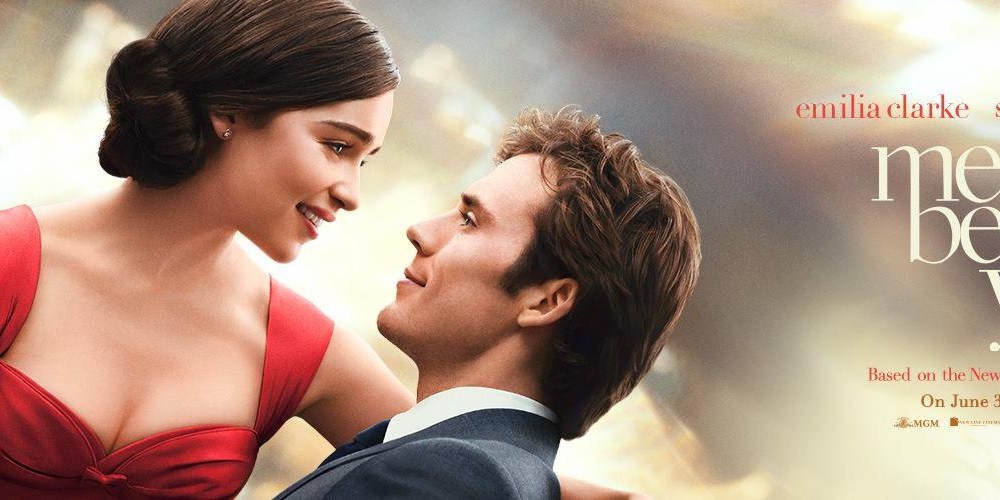
Two years ago William Traynor (Sam Claflin) was hit by a motorbike – leaving him paralysed from the neck-down. Will was once a man about town, living and hustling in London. The type of man all men envied and all women wanted. Now he is stuck back in his small-town home with his parents Camilla (Janet McTeer) and Steven (Charles Dance). Concerned by his desperately low spirits she decides to hire a carer/companion who can brighten up his lonely   existence.  Enter Louisa Clark (Emilia Clarke) who has just lost her job at the local cafe. Aged 26 she has never left her small town home, a place which she either loves too much or is too scared to leave. Her family rely on her as she brings in the only income so this job is perfect for her! Except she has zero experience as a carer. Having always been outshone by her younger sister, single mother Katrina (Jenna Coleman), or patronised by her long-term boyfriend Patrick (Matthew Lewis), Louisa is a woman not living life to its fullest. Maybe Will, a man who can no longer enjoy life, is the perfect person to help her live hers?

Having not read the book I cannot comment on the success of the transition of book to screen, although Twitter would suggest it is faithful. The story itself is relatively predictable, with little surprise, though this is not necessarily a bad thing as the story itself is told rather well. The pacing is solid with the growing bond between Louisa and Will is believable.The supporting cast are impeccably stereotypical and two-dimensional. Roll call for romantic tragedy archetypes – we have present: jealous and moody boyfriend who ‘doesn’t understand or appreciate’ how amazing his girlfriend is. Overly concerned mother and withdrawn father. Know-it-all younger sibling full of great advice. Friendly Australian nurse who steals most of the scenes he is in… (Side note: how can I get my own Nathan, Stephen Peacocke..?) 

The main cast themselves are solid. Claflin does well with his role as a man who feels he has little reason to live. He provides his character with just enough spark to hint at the man Will once was. His bond with Clarke’s character is well-established and there is plenty of charisma between them. It’s Clarke’s performance that particularly stands out, with her facial expressions providing an earnest authenticity to her character. Although her character is essentially a 2016 small-town England Manic Pixie Dream Girl (her ‘quirky’ clothes and shoes used to denote her character as opposed to providing her with any genuine character traits) she is remarkably likeable. Her eyebrow acting is, as my secondary school students would say, on point – managing to show so much with them knitted in concern.

There’s enough here to watch and enjoy with a glass of wine. It doesn’t reinvent the wheel but if you’re a fan of such films as  The Fault In Our Stars or Me, Earl and the Dying Girl then you’ll enjoy this.

stars

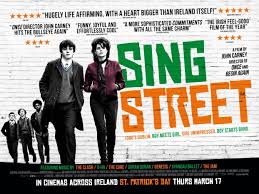
Sing Street

1980s. Dublin. New Romantics.

If the prospect of those three words being combined into a film does not fill you with glee I’m not sure how well we’re going to get on or how well you’re going to get on with this film. If you haven’t jumped ship  and are still reading – then this film may just be for you! From John Carney, the writer-director-producer of  Once and Begin Again, comes another musical tale about love and friendship. But this time our main characters are teenagers and they are forming a band The Commitments-style. The result is one of the most rewarding, enjoyable and grin-inducing films of the year so far.

It’s 1985. Like all epic stories it started with money problems and a girl. Connor (Ferdia Walsh-Peelo) is forced to leave his expensive fee-paying school and attend the local state school Synge Street CBS. The family has little money coming in as patriarch Robert (Aidan Gillen) is finding his architecture practice is not really required during a financial crisis. It’s at his new school, well on the school’s doorstep, that Connor first meets Raphina (Lucy Boynton). Raphina is an older lady, one year older, and is the most glamorous/gorgeous/extraordinary woman Cosmo has ever seen. New-found friend and wanna-be entrepreneur Darren (Ben Carolan) explains the school gossip that Raphina is a model who will soon be moving to England to make her fortune. Connor bravely introduces himself to Raphina and offers her a job that weekend to star in his band’s music video. After a bit of charming she agrees to take the job. Except Connor doesn’t actually have a band – yet. With audiophile elder brother Brendan (Jack Reynor) to guide him surely it’ll all be easy, won’t it..?

There are so many reasons to love this film – many of which I don’t want to discuss in too much detail or give away as it’s discovering them for yourself that only add to the brilliance. However I will briefly give the headlines of the reasons for my adoration. For favourite character I am torn between Brendan and bespeckled multi-instrumentalist Eamon (Mark McKenna). The soundtrack will undoubtedly be one of the best of the year – the classics are superbly chosen and the original songs (such Riddle of the Model) are wonderful tributes with some infectiously catchy riffs. The storyline is told with great empathy and sympathy. This is a film that truly cares about its characters. The music videos the band makes are both hilarious and nostalgia-inducing (even for those of us who were not alive in 1985!) I full enjoyed the references to The Cure, Duran Duran and Spandau Ballet to name just three – I can only imagine the depth of the enjoyment for those who leaved and breathed this music scene. The friendship between the newly-formed band is heart-warming and believable thanks to some fantastic chemistry between them. The film also manages to cover lots of ‘big’ topics – mental health, adultery, abuse – sensitively and appropriately. There’s a great balance here between pathos and humour. 

My main criticism would be the treatment of Raphina. Boynton does an excellent job with the material she is given but the presentation/treatment of her character is far too Maniac Pixie Dream Girl. For the most part we only learn about Raphina through what Connor (whom Raphina later renames Cosmo) sees and hears. She doesn’t transcend being his figure of worship and far too much screen time is dedicated to his male-gaze watching her. Whilst the dialogue of most of the characters is rooted in a degree of realism or believability Raphina’s craic is over-rehearsed. Arguably this could be a reflection of her personality as a character but for the most part her dialogue rarely lands as effectively like the other characters. Any film that focuses on a romantic crush, be that of a man or woman, must deal with the universality of the story arc as a duel-edged sword.  Whilst it makes for an accessible storyline, as the majority of the world’s population would have had a romantic crush at some point or another,  it means we then have to believe in the crush and that all the turmoil it brings our lead character is worth it. Is Raphina worth it?

Aside from my ponderings on potentially dubious representation, I truly loved Sing Street. So much so I think a rewatch in the new few weeks will be in order. It tickles the funny bone whilst tugging at the heart strings. It’s an old-fashioned story told with great warmth and will great skill. And, for New Romantics at heart like me, it’s chance to feel immersed in and nostalgic for a lifetime I never lived.

4.5


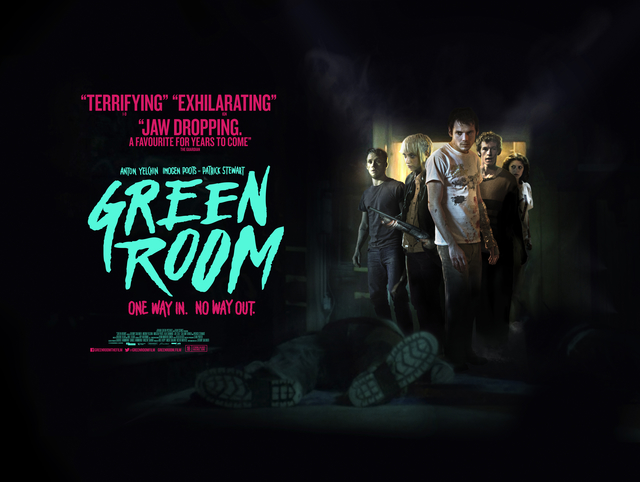
Green Room

An intelligent and electrifying horror

Usually me and horror don’t mix particularly well. Almost two months on and I am still occasionally haunted by visions of Black Phillip the goat from The Witch and I still feel a bit twitchy when I think about what I would do if I were to be trapped in a basement 10 Cloverfield Lane – style (is it normal to worry about that as a hypothetical scenario..?) But then again, Green Room isn’t your typical horror film. Yes there is gore (I’ve become very aware of my hands for the past hour since watching) but it is never overused. Whilst the narrative follows a ‘well-that-escalated-quickly’ structure it is founded in a series of cause-and-effect plot points that seem both believable and terrifying in equal measure. Then when you chuck in the superb pacing, swift editing, nerve-shredding soundtrack and  some superb character performances…well you’re in for a great time!

“The Ain’t Rights” are a punk band who are travelling through the Pacific Northwest, playing gigs and scrummaging whatever they can to get by.  The band – formed of Pat (Anton Yelchin), Sam (Alia Shawkat), Reece (Joe Cole) and Tiger (Callum Turner) – end up playing a gig in rural Seaside, Oregon to a club filled with Neo-Nazi skinheads.Upon seeing their Anti-Semitic surroundings Pat jokingly suggests they play a cover of The Dead Kennedys “Nazi Punks Fuck Off!” The band play the song during their set to  a less than receptive audience. Set over and cash in hand they make a move to leave, a move which the show organiser hastens to speed up, when Pat has to run back to grab the band’s mobile which they left charging. He stumbles across the scene of one of the skinheads leaning over the body of a young female punk with her still-alive friend Amber (Imogen Poots) rendered numb in disbelief. The band are then locked in the green room with the pair and the dead body. Reinforcements are called in the form of club owner Darcy (Patrick Stewart). The band have seen too much. Will any of them make it out alive?

There are so many reasons to like this movie. I want to say enjoy but considering the subject matter and content the verb ‘enjoy’ seems in rather poor taste. Semantics aside this is a cracking horror film. The slow-build of tension, the overwhelming sense of inevitability and the shock factor of many of moments. This is a film made with an equal blend of style and substance. The film looks damn good – the shots are well chosen with some excellent lighting choices that make for truly memorable sequences.

All of these factors would be pointless were it not for the excellent performances that drive the story. The characters are presented in a way that is a balance between wanting them to live but not really knowing them well enough to mourn any losses that occur on the way. You experience a degree of ‘oh no!’ because you care about them when certain things may or may not happen but are detached enough from them to not feel too aggrieved should/when something happens to them. Yelchin is superb as the accidental leader of punk trope. Poots is truly kick-ass as a female character who is not just cast to the sidelines, doesn’t spend the entirety of the film in shades of hysteria and who is capable of holding her own in certain situations. This is definitely/hopefully  showing a changing of the tide in Hollywood horror as her character is in line with that of Mary Elizabeth Winstead in the aforementioned 10 Cloverfield Lane. And then there’s Patrick Stewart as a properly scary baddie – whose calm and collected demeanor is unbearably (in a good way) unnerving to watch.   

Tense and taut (clocking in at 94 minutes) with some powerfully acted performances along with an admirably well-written script that is black humour laden this is definitely worth a watch.

4 stars

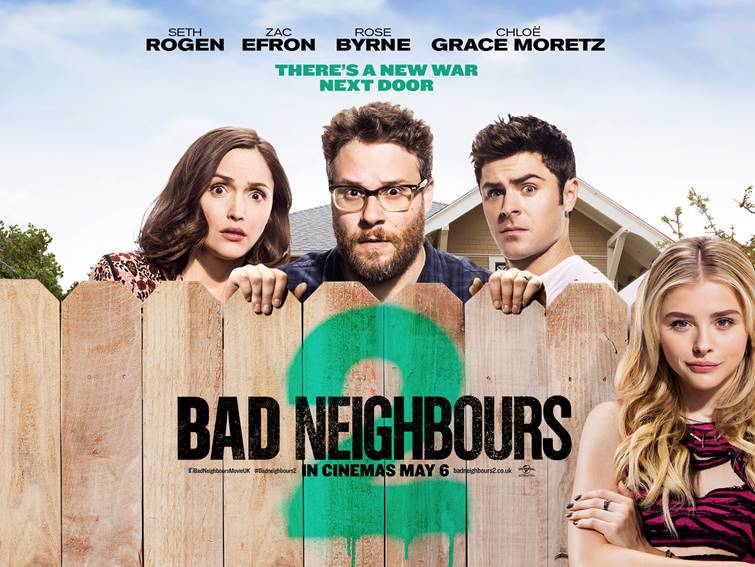
Bad Neighbours 2

A surprisingly knowledgeable and at times rather progressive comedy

It started with a tweet. On Thursday evening movie magazine Little White Lies tweeted about its review for Bad Neighbours 2. The review as written by Elena Lazic with  the tweet reading ‘I went long on the unexpectedly progressive, feminist and funny Bad Neighbours 2’. Now, as anyone who knows me, that’s the kind of click-bait that gets me hooked into reading. The review itself is wonderfully written – very reflective and articulate. Hopefully this review lives up to the one that inspired the film-watching and subsequent review! Post-watching I firmly agree with Miss Lazic’s review – for Bad Neighbours 2 is full of surprises. Most of them good and approvingly well-informed of gender politics.

Mac Radner (Seth Rogen) and his wife Kelly (Rose Byrne) are expecting their second daughter so decide to put their house on the market and move into the suburbs. A married couple with a young child place an offer putting the property into escrow – for the next 30 days the potential buyers can drop in at any time and have any inspections they wish undertaken before they confirm their buying of the property. For the next 30 days Mac and Kelly need for everything to stay the same, no big changes which will scare off the buyers. What’s more than unfortunate is that their new neighbours move in on day 1 of 30 – and their neighbours are the college’s newest sorority. Kappa Nu has been newly founded by Shelby (Chloë Grace Moretz), Beth (Kiersey Clemons) and Nora (Beanie Feldstein). The trio united and formed the new sorority as they disagree with sexist legislation that prevents the existing sororities form having parties  and were disgusted by the sexist antics of the fraternity party they attended. War is soon declared between the ‘old’ couple and the sorority girls, with ex-Frat boy Teddy Sanders (Zac Efron) leading the girls into battle. 

In the mid 2000s the term ‘Frat Pack’ was coined to describe a group of Hollywood actors – this group included Ben Stiller, Owen Wilson, Jack Black, Vince Vaughn etc.Then came the “Apatow Chapter” (named after writer/director/producer Judd Apatow) which Bad Neighbours 2 lead actor Seth Rogen was a part of. The majority of the films generated from these unholy alliances could not/should not be labelled as displaying any feminist traits. In fact one would be hard-pressed to name just one of these films that featured a single positive representation of women. That’s part of the surprise that comes from watching Bad Neighbours 2.

Many of the early parts of the film, and intermittently throughout, discuss modern issues of equality in an outstandingly sympathetic and understanding manner. The double standards of the rules about sororities not having parties is not actually fictionalised by the film – it’s not a actual law but it is a national mandate decided by those who govern the nation’s leading sororities (read this excellent Washington Post article for further insight). This film appears to be Hollywood’s attempt to address the issue and it does so rather well. The female trios decision to form their own society in which they can go against the system is reinforced when they attend a Frat party – a party in which they see sexist treatment of women being accepted as a norm with an atmosphere akin to that of a hunting ground with men stalking what they view as walking vaginas. It’s a cleverly written scene which is nowhere near as heavily-handed written as it could have been. 

The issue soon takes the backseat for the battle between the two generations/neighbours – during which very little that is new or of much interest. But what does remain on screen are portrayals of women who have a certain spark, a fight within them, that most Hollywood comedies assigns to its male characters. Ordinally the female figures on the screen are resigned to being love interests or purveyors of gratuitous nudity. As annoying as Shelby gets, and she does get pretty annoying, she remains a character who is female, who is interesting and possesses some semblance of a personality. It is scary to reflect on how rarely such a female figure makes  it onto the big screen. Bryne is also given a role that is rather atypical for Frat Pack movies – a wife who is not presented as some sort of shrieking harpy. She appears to be as fun-loving as her husband and they comes across as equals in their relationship – they are proper partners in crime.

Aside from the ensuing pontification on equality, I did release a fair few chuckles watching this film. Some of Efron’s speeches were delightful, his dancing rather exquisite and his slapstick guffaw-inducing. At only 92 minutes long the film is a more than amusing way to while away an afternoon or evening. Plus the more conversations it stirs up about portrayals of gender the better!

stars

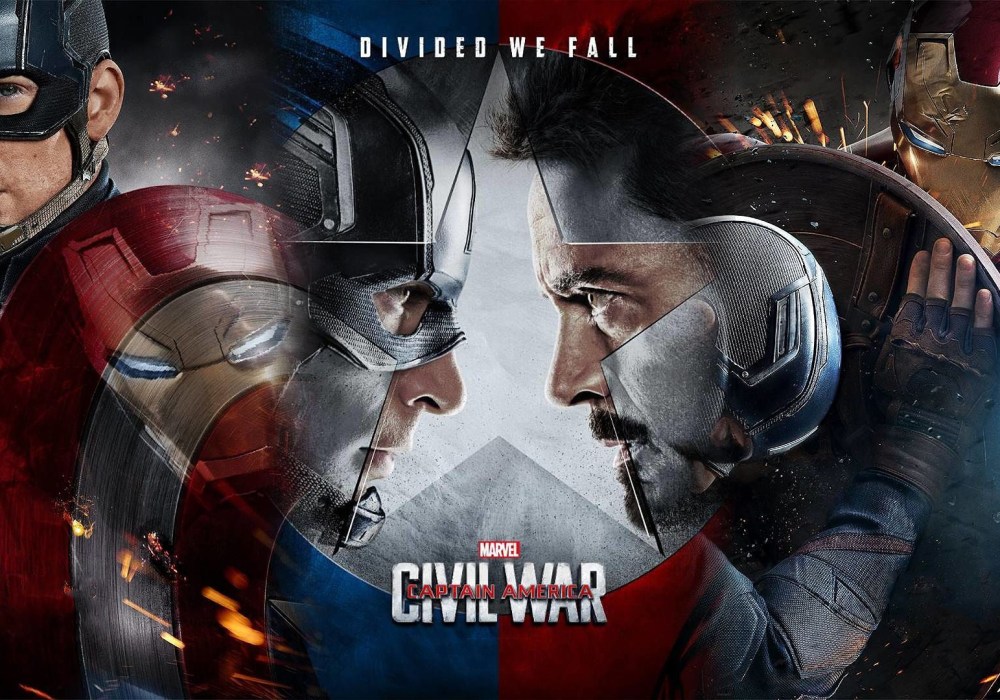
Captain America: Civil War

Is this Marvel’s greatest hour?

To start, let’s kick off with a bit of a retrospective. In 2008 Iron Man surprised the world – a superhero film packed with action, warmth and wit was a relatively new concept. The fact this one had a brilliant storyline along with making a hero most people outside of comic book fandom did not know/care about into someone they wanted to see even more of – that was the truly incredible thing. Skipping ahead several movies we then arrive at Avengers in 2012 which managed to bring the Earth’s mightest heroes together in a way that gave the entire ensemble space to shine. Captain America: Winter Soldier shook things up in 2014, showing that comic book movies could be more than just punch ups. They could come a espionage thriller editions too. Last year’s Age Of Ultron was ultimately a disappointment (though not in terms of box office) as it was too po-face and side piece-y. Now, one week ahead of the USA, we have Civil War. Civil War fixes the problems of Age Of Ultron, takes the smarts of Winter Soldier, the high-stakes suspense of Avengers and the character driven focus of Iron Man. In many ways it is one of the best Marvel movies yet, but is it really the five star perfection the majority of reviews are touting?

One year after the events in Sokovia – Steve Rodgers/Captain America (Chris Evans), Natasha Romanoff/Black Widow (Scarlett Johansson), Wanda Maximoff/Scarlet Witch (Elizabeth Olsen) and Sam WIlson/Falcon (Anthony Mackie) are in Nigeria trying to prevent the theft of a biological weapon. In the process Wanda  loses control of her powers and a building is destroyed, killing several people. It’s the final straw and the governments of nation’s from around the world demand that the Avengers be held accountable for their actions. The United Nations puts forward the Sokovia Act which would put a governing body in charge of monitoring and policing the world’s growing inhuman population. Tony Stark/Iron Man (Robert Downey Jr.) is in favour of signing that act as he has become all too aware of the consequences of their past actions. Steve, having become distrustful of government after the fall of S.H.I.E.LD, firmly disagrees. When Bucky Barnes/Winter Soldier (Sebastian Stan), Steve’s childhood friend who was tortured by H.Y.D.R.A and forced to become an assassin, becomes involved what was once a a fracture becomes a break – forcing the Avengers to take sides. United they stood tall but when divided who will be left standing?

This film is pretty superb. It balances humour with action, characterisation with big set pieces, superpowers with humanity. The end product is pure cinematic escapism, with some big questions being posed along with some laugh-out-loud gags. For instance that age old mantra from Spiderman’s Uncle Ben ‘With great power comes great responsibility’ – if you are the one in possession of great power and you do not use it (however unintentionally) responsibly, who should you be accountable to? If you are capable of destroying cities, constantly having to make life or death decisions, should you have permission? All of Marvel’s past films have led to this point, where tough unanswerable questions slot in with huge/gigantic/speculator action sequences.

However, going somewhat against the tide here, I don’t think it’s perfect. Though its ambition is admirable and mostly successful it is a watching experience akin to going to your favourite restaurant, having your favourite meals but for some reason there is a delay between courses. There are some wonderful/brilliant/extraordinary moments, but then there is a bit of waiting around before the next wonderful/brilliant/extraordinary moment. In many ways this just goes to show just how could the wonderful/brilliant/extraordinary moments are, that they are of such a high caliber that the momentum cannot be maintained. It could also be a by-product of the film’s running time, which clocks in at 147 minutes. Going back to my eating-out analogy perhaps the portion size is overly large, the chef’s eyes were bigger than my belly, and that skimming a bit off the plate may have made for a more satisfying experience.

Saying that does not ignore or take the shine away from the incredible fest that this film offers. It may just be Marvel’s most mature film yet, displaying its spectacle and smarts with great confidence. The central debate is hugely topical – so much so that Batman V Superman featured simillar just a few weeks back. But this film is the antithesis of the fatally flawed BVS:DOJ (which confused dark with murky). Civil War has an edge to it – the Airport fight-out sequence between the two newly-split allegiances easily earns a place in top five scenes in a Marvel movies. Then there’s the new depths added to RDJ’s Tony Stark, a man who seems to be enjoying the continuing evolution of his character. His authority plays a role in his relationships with his fellow Avengers, in his fraternal alliance with Steve Rodgers and most excitingly hints at what looks to be a legendary rapport with the latest incarnation of Spiderman (Tom Holland). Holland is a breath of fresh air to the franchise – he’s cheeky and full of energy, a blend of nerd and cool which neither of the previous film versions seemed to capture. The brewing mentor/mentee relationship between he and Tony Stark is one to truly get excited about. 

Without question this is the best Avengers movie yet – even if the name itself doesn’t lend itself to that. By having the pre-colon say Captain America it almost implies it is a stand-alone movie. It’s not. Although it is Cap’s conflicted conscience which drives the majority of the plot the film is made by the ensemble. Is it the best Marvel movie yet? Instinctively, after great internal battle, I have to say no. In terms of viewing experience I rank Guardians of the Galaxy  far higher and in terms of cerebrality Winter Soldier wins. However, this does not take away from what a spectacular is for the most part. It never feels overstuffed, joyfully introduces new heroes and pays great tribute to our existing heroes.

4.5


Miles Ahead

The man, a fair bit of myth and a whole lotta legend

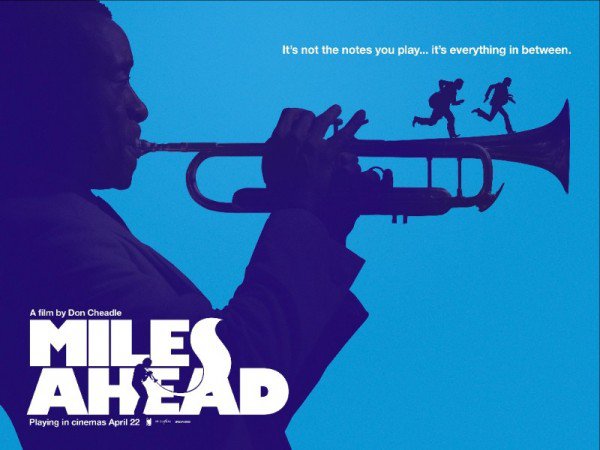
It what may be my favourite bit of description from the year so far director/co-writer/lead Don Cheadle describes ‘Miles Ahead’ as being a ‘metaphorical’ biopic of Miles Davies. Fact and fiction are rather skillfully blended to pay tribute to an incredible musician, a leader of the genre that should be called ‘social music not jazz’. For better or for worse (depending on your view) this is not a typical music biopic – it’s free from the cliches that come with it – instead favouring a magnificent mooch-like approach in exploring the lives and loves of a true musical legend.

It’s 1979 and Miles Davies (Don Cheadle) has been a recluse for five years. A rumoured comeback – not that Davies himself would call it that – is being heard on the grapevine. Having lost this muse Frances (Emayatzy Corinealdi) and his ‘lip’ thanks to self-medicating a variety of drugs, word gets around that Miles has actually recorded some new music – only he’s refusing to give it to his record label Columbia. That’s when Rolling Stone journalist Dave Brill (Ewan McGregor) literally comes a-knocking on his door. The attempted interview between the pair quickly descends into utter chaos – involving drug deals, shootouts, car chases, stolen records and a few trips into memory lane.

The greatest thing about this film is the fact that when watching it it is clear that you are watching a passion project. The adoration that Cheadle clearly feels towards Miles Davis pays off completely and shines through every mannerism or rasping of dialogue. Even when high as a kite or desperately searching for his next hit he is shown to be a true man of sharp-suited cool. And even when slightly darker sides of his personality come out – such as in the flashbacks of his relationship with Francis – he is still a character we can connect with even when we may not like him at that particular moment. His self-destruction is portrayed with such affection by Cheadle – it shines through his eyes in every scene.

The events of the film are mostly fictional, inspired by the past as opposed to retelling. It’s a unique touch, a very ambitious touch at that, and one which mostly pays off in how well it reflects its subject. This is also emphasised by the construction of the film, with neat little choices of direction allowing for the present to seamlessly blend into the past. It’s not typical ‘day in the life’ fayre, nor is it rise and fall narrative. Instead the film drifts, swaggers if you will, from one moment to the next.

Like Davis the film is smooth, if occasionally rather frustrating in terms of its storytelling. It is hugely enjoyable and incredibly well-acted. And, like the man himself, never boring.

stars 

The Jungle Book

It’s really a Bare Necessity that you see it!

For reasons somewhat unknown and potentially puzzling for many fans, Disney has decided to make a series of live-action versions of their animated classics. Apparently there are even 15 currently being planned. If they are all even half as good as this one then it’s not something to worry over. The Jungle Book (2016) is a marvelously wonderful adaptation that is both true to the original 1968 film yet with enough of its own nuances for a fresh-feel.

Mowgli was only a baby when he was found alone in the jungle by Bagheera the black panther (Ben Kingsley). Bagheera took Mowgli to the group of animals in the jungle who would best be able to care for him and protect him – the wolf pack. Raised by surrogate mother Raksha (Lupita Nyong’o) and pack leader Akela (Giancarlo Esposito) and bought up alongside their wolf cubs Mowgli learns the ways of the wolves, but as he is getting older Mowgli’s (Neel Sethi) progress is starting to lag behind his wolf siblings. One day, during the dry season, all the animals of the jungle are gathered to drink what remains of The Water Truce when Bengal tiger Shere Khan (Idris Elba) makes a reappearance after years away. Shere Khan smells Mowgli’s scent and warns the wolfpack to get rid of him or face the consequences. Bagheera offers to escort Mowgli back to the land of the man but the pair get separated on the journey. A close encounter with an enormous Indian python called Kaa (Scarlett Johansson) leads to Mowgli meeting Baloo the bear (Bill Murray). A true friendship begins to form between them but how long can it last with Shere Khan still desperate to hunt and kill Mowgli?

There are three key things that have been perfected to make this film as good as it is. Hopefully one of the things you noticed as you read the above plot summary is the cast. Firstly, how good is that cast!?! Look at the incredible group of actors that were brought together. Then look individually at each actor and the character they play. It’s not often you get to say that every casting choice is perfect within a movie and it’s something that you can say applies to this film. Kingsley provides the necessary paternal warmth hidden under layers of no-nonsense concern. Nyong’o as Raksha is a wolf fiercely protective and not afraid to speak out when it’s needed. Elba is fantastic, a properly scary villain, who growls around the land. Johansson’s Kaa is suitably seductive and hypnotic. But the award for most outstanding vocal contribution has to go to Bill Murray providing a performance that is un-bear-ably endearing and amusing in equal measure. How young newcomer Neel Sethi manages to hold his own is an incredible feat which he appears to do with ease. Let alone the fact he spends the film acting alongside CGI animals…

Leading to the second area in which this film excels – the visuals. I’m on the fence about 3D usually. After seeing too many films which claim 3d status yet do little to warrant it I tend not to be overly excited when having to choose between 2d and 3d showings.The Jungle Book is the first film in an age where I’ve been so glad I booked that 3d ticket. The depth of the frame, the landscape, the animals fur, the movement of the water and the curse of the red flower. All of these aspects are superbly enhanced by the 3d. Whilst aware of the cost it can add to a cinema visit I would firmly recommend seeing this film in 3d to access the added textures and wondrous depths it provides. The animals themselves are beautiful and almost life-like in how they look and move.I now desperately want to cuddle a baby wolf and sit upon a giant bears stomach as we float through the river.

Thirdly there’s the direction.Director Jon Favreau ensure first and foremost that this is a children’s movie whilst avoiding any pandering or talking down to the children. The film has enough darkness to give it bite – mildly frightening as opposed to truly scary. There’s even a lesson or two to be learned along the way. Unlike the original animation this film is not a musical but two of the classic songs are included – ‘The Bare Necessities’ is sung by Mowgli and Baloo during the aforementioned river floating sequences and Christopher Walken talk-sings his way through ‘Wanna Be Like You’ in such a wonderfully charming yet ultimately threatening manner – that feel like a natural fit as opposed to being shoe-horned in.

This may just be the most enchanting film of the year so far. It’s a marvellous visual spectacle told with wit and warmth. A treat for the eyes, ears and heart.

4 stars


Marguerite

A tragicomedy filled with laughs and tears

Strangely, and I hate to be one of those people, but I’m going to start of by drawing comparison with this film and Eddie the Eagle . Though this may not initially be an obvious comparison, Eddie is English and obsessed with skiing whilst Marguerite is French and obsessed with opera singing, the overriding link is the very obsession which drives them. Both characters NEED that one activity that makes them feel alive, makes them feel free and makes them feel joy unlike any other. Both are based on true stories, with Marguerite being loosely based on  the life of Florence Foster Jenkins (a Meryl Streep-staring biography is out later this year). The crucial difference, however, is that Eddie could ski and had only practised ski jumping a year prior to entering the 1988 Winter Olympics in Calgary. Marguerite has apparently been singing all of her life and cannot sing. It’s not just that she cannot sing, every single note she produces is so off-key and categorically awful, and she doesn’t even know it. All Margurite knows is the joy she feels when releasing the notes, not the fact they are atonal and truly, utterly dreadful. Her husband and friends, either out of loyalty, shame or amusement have kept the truth from her. This tension leads to the aforementioned tragedy and comedy.

Lucien Beaumont (Sylvain Dieuaide), an infamous newspaper critic, has gatecrashed a party escorted by his Dadaist artist friend Kyrill Von Priest (Aubert Fenoy). His attention is immediately taken by aspiring singer Hazel (Christa Théret) who performs as warm-up to the host. Baroness Marguerite (Catherine Frot) sweeps into the reception room in her large manor home, her room filled with guests for her charity recital. France’s finest and mightest, who all belong to the exclusive Amadeus club which she is a part of, are all there to see her. Marguerite breezes through the room, practically gliding through her audience, escorted by her loyal manservant Madelbos (Denis Mpunga) whilst desperately searching for her husband Georgeos (André Marcon) in the audience. Upon reaching the stage which is filled with her orchestra she turns to face them, her eyes sparkling with sheer and utter joy, her face is set and ready for that first note. Her mouth widens, forming that first note. What comes out of her mouth is unlike anything Lucien has heard before – it’s awful. Marguerite is not singing, she’s screeching, her voice is the embodiment of  nails on a chalkboard or a cat screaming. Unbeknownst to Marguerite children run under tables away from her noise, many of the man sneak into a private room away from the horror. Lucien must restrain himself from laughing, Kyrill believes he has found modernist art  and Hazel tries to hide her embarrassment from the poor woman. Finally Marguerite stops and her audience erupt into applause and admiration, flowers are thrust upon her and her talent is heralded. Lucien is bemused – she clearly does not know as her small aristocratic society has not told her – and feels compelled to write a review which is ladden in euphemism and  backhanded sentiment. Marguerite does not read into it and is filled with joy at having her talent recognised. Events start to spiral, with a public concert planned. How will Marguerite cope when she discovers the truth? 

I should point out that the above paragraph covers roughly the first 15 minutes of the film, leaving a solid 1 and 3/4 for you to discover on your own. I’ve not even discussed the role of the clown and the bearded lady! Marguerite is not always easy to watch, at times her singing or the events that it leads to are utterly mortifying. However it must be acknowledging that the mortification we feel on her behalf  is due to how well the story is told to allow us to connect with Marguerite and possible even empathise with her. It would be so much easier to have a film about a bad singer and laugh at her bad singing. Instead what we have here is so much more complex, layered and pleasurable to watch. We root for Marguerite, we hope for her and we fear for her – whether that be about a performance or comments that are about to be made about her.

Marguerite devoids herself to her craft, she spends everything on collecting props, music sheets, attending performances and supporting new talent. She has an all-consuming need to perform, which leads to unspoken clashes with her seemingly-cold and adulterous husband. Never has a film character been so in need of a hug. There’s something so child-like about Marguerite, something so amusing yet bitterly sad. It’s a true tribute to the talent of the filmmakers and the actress herself that we connect with her the way we do, encouraging her even though we easily recognise how talented she is in her chosen field.  Then somehow, throughout all this, we ultimately feel uplifted watching her journey. We all have something we pursue or like to believe we are really good at, even when we’re not At this point I’m really hoping you’re not thinking, ‘Ha! Yeah you are your film reviews”, but then Marguerite suggests that the opinion that others have about your talent should not be the one that is heralded, it should be your own and how it makes you that counts. And if how I feel about writing these reviews, and you out there hopefully reading them, is only a fraction of how singing makes Marguerite feel then I fully understand her.

It feels too overly simplistic to say this film is painful yet funny or that it is hilarious yet heartbreaking. It’s soul-baring exploration of passion. Exquisite.

Zootropolis/Zootopia

We may be evolved, but deep down we are still animals.”

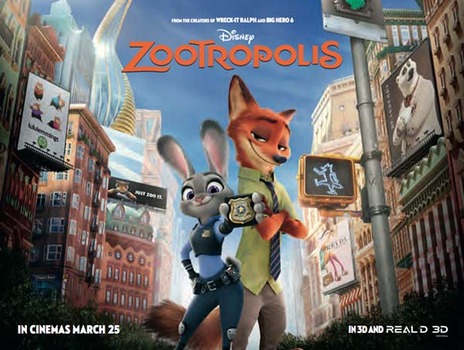
Anthropomorphism, Disney and animation have a long history. As early as Walt Disney’s first feature film Snow White (1937), in which all the woodland creatures appeared to have various personality quirks, attributing human characteristics to cartoon animals has been a way of enhancing a story. Then, with numerous Disney classics, it became the way to tell a story. In 1995, with Toy Story, Pixar began to add to the Disney magic by giving characteristics along with pathos to the inanimate objects and animals. Now, in 2016, with Zootropolis (released nearly everywhere else as Zootopia) we see this enhanced to the max with an animated film that features anthropomorphism whilst also serving multiple layers about diversity and racism, all told by Disney with just a smidge of Pixar wit. It’s funny, sweet and far deeper than it first appears.

During a school play in front of her parents, her peers and their parents, a young bunny called Judy Hopps (Ginnifer Goodwin) declares that when she grows up she wants to be a police officer. Many people laugh at her, one person even beats her up for the audacity of saying it and both her parents are a blend of supportive-but-unsure. But Judy proves them all wrong.  She’s the first bunny first to enter the police academy and the first bunny to actually join the police force. Her first posting is Zootropolis, a nearby metropolitan city. Her parents can’t believe it and neither can her new boss, an African buffalo by the name of Chief Bogo (Idris Elba), who assigns her the role of parking duty. Day one on the job seems to be going well, until she is tricked by con artist fox Nick Wilde (Jason Bateman). However the two are soon forced to work together by Mayor Lionheart (J.K. Simmons) and assistant-mayor Bellwether (Jenny Slate) to help solve a case involving a series of missing animals. Can what were once predator and prey ever work together, possibly even become friends, or is nature stronger that nurture?

It may be slightly too early to say, but Zootropolis has all the potential to be as-well regarded both critically and commercially as last year’s Inside Out. The jokes are really really funny and the drama is really really emotional. My personal favourite joke from the film has to be when fellow police officer Clawhauser (Nate Torrence) first meets Judy Hopps and calls her ‘cute’. Judy winces then carefully explains that “only a bunny can call another bunny cute”. Cue many belly laughs from the cinema screen. That gag is also an example of the kind of humour that has become prevalent in animation since Shrek (2001). The humour of these animations is almost two-layered. To explain on a very basic level, there’s the slapstick jokes for kids and the jokes for their parents that go way over their heads. It makes taking a child to the cinema a far more enjoyable experience for their parents, as opposed to having to endure some brain-dead-only-aimed-at-children romp.

The animals are very well characterised, both matching their animal types whilst also being well-rounded. Judy is fierce, dedicated and ambitious – a solid role model. Nick the fox is sly and alarmingly charming for a fox, though that may just be my personal feelings for Jason Batemen having an effect here… Idris Elba is hilarious as the imposing yet ultimately caring chief who just happens to be a buffalo. Shakira even appears as Zootropolis’ biggest star, Gazelle.

Then there’s the story itself, well-told with a solid twist. There are some fantastically inventive set pieces, be that the sloths working at the DMV or the practically word-for-word Godfather tribute. The story also has a lot you can sink your teeth into (sorry, pardon the pun!) Though the two groups of predator and prey may appear united in the metropolitan city of Zootropolis, it is a delicate union. One which is weighed down by tension and borderline-hostility. Although prey and predator may be neighbours very few are actually friends and few would choose even to be nice to each other. Some restaurants even refuse to serve certain types of customers. When it becomes clear that all the missing animals in the case are in fact predators it looks set to force the bubbling undercurrent of tension to the surface. The film is far from subtle in reflecting our own society’s tensions and forcing a degree of reassessment, yet that is no criticism. Considering the current global climate, with regards to refugees and a certain toupee-wearing president wanna-be whose delusions of grandeur reveal the current state of institutional racism, Zootropolis is perfectly-timed and well in need of watching.

This is ‘proper’ Disney with the beating heart and talking mouth of Pixar. Witty, warm and well worth seeing. A fable for 2016.

Eddie the Eagle

May Eddie the Eagle fly at the box office

One thing that really grinds my gears is when people my age say to justify a gap in their knowledge is, ‘Huh! Well that’s from before my time I guess.’ That is then proceeded with a slightly awkward shoulder shrug. For someone who often reckons that music peaked around 1985 I think it’s often used as a silly filler line. However, in a rather hypocritical move, I am going to say that the rise and soar then laughing stock of British skier Eddie “the Eagle” Edwards is ‘from before my time I guess.’ Occasionally he would pop up on various panel shows and people would poke fun, and I’d be vaguely confused and envious that a man with such an awesome nickname was being used for laughs (what can I say, I was a thoughtful child…) Anyway, I’ll save the rest of that for my therapist.

My slightly convoluted point here is that I had no idea what the man had done to achieve such levels of infamy and mockery. Then, when I heard of the film, I thought ‘Yeah…good luck with that one!’ Time passed by and the trailer was released which made me realise that the film was my kind of film. Then I got invited by Den of Geek to attend a preview screening and Q&A with the director, Dexter Fletcher, at The Courthouse Hotel (a 5* hotel with unbelievably fancy toilets) and that takes us right up to now. Three days on from seeing the film and it still makes me smile. It’s a truly wonderful movie and I beg you to go and see it. Now (and if you’re still with me after that preamble I declare) to you my utter love and gratitude for sticking with me) let me tell you why it’s so damn good.

Eddie Edwards (Taron Egerton) has wanted to be an Olympian for as long as he can remember. He was always the last to get picked for teams, spent a year in hospital due to the poor state of his knees and never quite seemed good enough for anything. He almost gave in and followed in his dad’s (Keith Allen) footsteps of becoming a plasterer until he found skiing, a hobby for which he had his mother’s (Jo Hartley) total support. He even made it to try-outs for the Olympic team before being told by the panel (lead by Mark Benton and Tim McInnerny) that he wasn’t Olympic material. That’s when Eddie decided that not only would he try on his own to make  Team GB for the 1988 Winter Olympics, he’d teach himself how to Ski Jump by decamping to a training camp in Germany. Either being ignorant or in denial about the fact that most Ski Jumpers start aged 5/6 (Eddie being 22) he proceeds to train solo with great resilience both from injury and belittlement from the experienced jumpers. That’s when alcoholic ex-ski jumper Bronson Perry (Hugh Jackman) steps in to help Eddie from death by training. A friendship/brotherhood quickly forms between the pair, under the shadow of Perry’s ex-mentor Warren Sharp (Christopher Walken). Will Eddie become skilled enough to join Team GB or will his dreams die again once more?

This film is totally and utterly brilliant; an utter joy to watch. Though it’s not a state I often occupy, I felt so patriotic after seeing this movie. Partly because it’s a British movie, and it’s the kind of movie we do so, but mainly because Eddie’s journey and how it’s told is so unique to British cinema. Yes, other countries do underdog movies, but so few do them in this way. Eddie’s journey is so lacking in glory, so real (grey-area term as some of the movie is fictionalised) that he reflects each and every one of us. It’s an important reminder not to give up on your dreams, and the power of self-belief. It’s also bloody hilarious, that blend of slapstick and deadpan and sarcasm that makes British cinema so comparatively unique. I giggled, I laughed and I even snort-laughed. It was glorious.

Taron Egerton is already on the up-and-coming, cusp-of-greatness list of actors and this film cements it. Firstly, a post-viewing google showed how similar Egerton looks to 1988-era Eddie along with how scarily accurate the expressions and mannerisms are. He’s also such a great actor to watch, his handling of the pathos and comedy of the character is extraordinary. You do well and truly root for Eddie. Hugh Jackman is great in his mentor role, forming a great rapport with Edgerton. Allen and Hartley are little seen but add much to the impact of the film. Then, with a brief cameo, Christopher Walken sasses the hell out of two lines of dialogue.

There’s also a wonderful 80s soundtrack, as uplifting and smile-inducing as the film itself, brilliant use of sets on such a small budget and some hilarious character actors in supporting roles. Eddie the Eagle is being released into the wild on March 28th, the same weekend as Batman Vs Superman. So why not give some home-grown talent some love and go see it. I promise you it’s worth the money.

We may only be a quarter of the way into the year, but this may just be THE feel-good movie of the year. Go see it.