Room

Astonishing And Devastating In Equal Measure

To begin with, an analogy. Have you ever wrung a towel, a facecloth or even just a piece of fabric in general? You put all your strength into the movement, creating enough tension to drain the cloth of the water it possesses. Are you with me? Now let’s replace a few words of that scenario – the face cloth is the viewer of ‘Room’, the water is either literal tears or just emotion in general and the source of the wringing is the film. Everything, from the cinematography, the mise-en-scene, the dialogue to the extraordinary performances , works in conjunction to drain you so brutafully (see, I made it work there too!) drain you. Never has such a thing been done so willingly, nor with such reward. ‘Room’ is otherworldly in its brilliance and ability to shatter your heart.

Jack (Jacob Tremblay) lives in Room. As far as Jack knows that is all there is to life as he has never left Room. As Ma (Brie Larson) has explained to Jack outside is ‘Space’ and filled with aliens. The only other person knows of is Old Nick who brings them food, necessities  and a ‘luxury item’ referred to as a ‘Sunday Treat’. When Old Nick comes to spend time with Ma, Jack must sleep in the wardrobe. Jack has just turned five and Ma has started to release that he may be old enough to know the truth. That there is a whole world outside of Room, but a world that has been closed off to Ma since Old Nick kidnapped and locked her away seven years ago. Ma was once Joy, a seventeen-year-old girl on her way home from school. Now no-one knows where Joy is. Joy comes up with a plan that involves tricking Old Nick into taking Jack outside of Room, allowing for Jack to escape and get help to rescue Ma. But will Jack be able to accept he could have a life outside of Room?

‘Room’ is a blend of true-crime and fairy-tale. It tells a story that is so abhorrent and seemingly hopeless in a way that is grippingly real, intimate yet somehow beautiful. Jack’s view of Room is fairy tale-like, where what are ordinary objects to us are the only one of their kind, have a personality and are therefore addressed with capitalisation (Table, Lamp, Bed etc.). The television is not a link to the outside world, there is no outside world, but instead images of things that do not exist. It is Joy’s view that is the true-crime, through her eyes the surroundings are depicted in their true horror. Joy is a prisoner, her child was born into captivity, and she has created this world to help them both survive. It is the blending of these two worlds that generates the film’s astonishing power.

But it’s the performances of its two leads that allow this power to land – to convince and cherish. Brie Larson presents an anguish that is so severe that at times becomes unbearable to watch.  Her raw and honest performance is miles, lightyears even, away from the many mawkish performances of exploitative ‘true movies’. Jacob Tremblay provides the kind of child performance you see once in a decade, his abundant glee at the rose-tinted life in Room through to his difficult transition at learning everything believed was a lie. Joy tells Jack these stories to keep him sane in confinement, and Jack’s job unbeknownst to him is to keep Joy sane.  The bond shown between mother-and-son is otherworldly in its believability and its depth.

‘Room’ is gut-wrenching, heart-wringing and brain-haunting. It’s not typical night-out to the movie fayre. At times it’s impossible to watch, and will haunt far longer than its two hours running time. Yet it’s a narrative journey well worth making, proving the power of cinema and the power of extraordinary performances.

‘When I was small, I only knew small things. But now I’m five, I know everything!’ – Jack

Krampus

The gift that keeps on creeping…

Christmas is a time of festive cheer,

for singing loud for all to hear.

But what if good ol’ Saint Nick was nowhere near?

Instead Krampus came to fill you with terror and fear…

Max used to love Christmas. He used to love wrapping presents with his sister and parents whilst watching ‘A Charlie Brown Christmas’. He used to somewhat enjoy when his extended family of aunt, uncle and four cousins made their annual visit from December 22nd to just after Christmas. But every year it’s gotten worse. His parents are growing apart, his sister spends all her time with her boyfriend and his cousins use him as a play toy to amuse themselves. Only his paternal grandmother Omi can see how his Christmas spirit is fading. When his extended family arrive once more the four adults, and surprise guest Aunt Dorothy, clash over the dinner table whilst his cousins brutally tease him for still believing in, then writing a letter to, Santa Claus. It’s the final straw for Max. He rips up the letter in anger and throws it out of the window. That’s when the storm starts, a snow storm like no other. Under the cloak of the blizzard Krampus and his villainous cronies start to arrive…No-one is safe. 

What a pleasant surpise this film was! It’s far from perfect and the pacing of both the first and third act is slightly off, but overall this film is a superb antidote to the kind of movies that some of the little-known Sky channels have been showing since mid-September.  It’s properly funny, has some jump-worthy moments and holds your attention for most of the 98 minute running time.

The story itself is deceptively clever. Though the myth of Krampus is centuries old it feels incredibly immediate and relevant.  The film opens with a sequence that has become unsettling familiar in recent years – a supermarket opening it’s doors for pre-Christmas sales. The crowds rush in, rioting, pushing, shoving and shrieking in their quest for unnesscessay discounted purchases. The fact this is soundtracked with Perry Como’s ‘It’s being to look a lot like Christmas’ successfully exemplifies the increasing commercialism of Christmas. It sets a great tone for the upcoming penance that will have to be paid.

The characters who will soon endure Krampus’ house invasion are well pot rated.  They are the right amount of unlikeable, each given just enough reason to warrant the inevitable onslaught but redeemable enough that you start to care what happens to them. The film doesn’t treat the adults any differently from the children – they have been just as naughty as their parents so need to be punished. As a secondary school teacher I can’t actaully say that Max’s two tween female cousins deserve to be punished,  but I can say that I hope they learn from their mistakes.

Krampus’ and his squad, made up of evil-looking reindeer, scary elves, oh so creepy toys and hilariously horrific gingerbread men own this film. The portryal of the homicidal gingerbread men would be my standout favourite, their evilish giggles haunting the house and they haunt it’s residents.  In fact they did somewhat remind me of Christmas horror-comedy classic ‘Gremlins’ which would make an excellent double movie feature with ‘Krampus’.

If you’re looking to briefly escape the festive season , or see and Old Testament-style backlash against it, or you just want a movie for laughs and a few scares, then this is well worth a watch.

Sunset Song

A sure-fire contender for top ten films of 2015 lists.

There are lots of sunsets. There are lots of songs. There is a huge amount of turmoil, heartbreak and devastation. There are also bitterly-short periods of joy, bookended by tragedy. This film is exquisite and truly haunting. An adaptation of of a 1932 Scottish novel of the same name, this is director Terence Davies project of passion after years passed struggling to get funding, struggling to get his film made. The passion truly shines through.

Aberdeenshire farm girl Chris Guthrie (Agyness Deyn) is the daughter of a housewife and a tyrannical father (Peter Mullan), and younger sister to a brother who is constantly beaten by their father. Her mother’s life is comprised of being raped and giving birth – she does not want the same for her daughter. Chris also does not want to be fated to live a life like her mother’s. Luckily Chris is exceptionally bright, the smartest girl at her school, and is one track to move away and train to be a teacher. When her mother falls pregnant, again, and gives birth to twins, again, the family move away to a bigger house. Once they arrive in their new home, a series of events occur which cause the family to crumble and fall away. Chris must endure so aching hardship but appears to find happiness with Ewan (Kevin Guthrie). This period of her life is shattered when war (World War One) is declared. Life for Chris and her fellow residents of Kinraddie will never be the same. 

 Considering the series of devastating events that is the life of Chris Guthrie Sunset Song never crosses the boundary into melodrama. Admirably, to great success, the film and its storytelling retain a muted stoicism. It’s bitterly sad and this effect is sharpened by its refraining to rely on exaggerated displays. Deyn in particular is extraordinary. Her Chris has a captivating innocence, an innate need to endure and stand firm when all around her are losing their heads (metaphorically speaking!) Tears roll and glide down her face, even at her most bereft she has no need for frantic or guttural moaning at the continuous losses she suffers. The film opens on a sweeping pan of the farm-land, from which Chris emerges. She is a child of the land, the love she feels for it is her only constant. Peter Mullan is excellent as her father who himself is torn between his apparent religious compass and his vices. His conflicted nature never used as an excuse for his behaviour but a reason as to why.

The cinematography is breathtakingly exquisite, treated with an almost religious adulation.  The camera tracks and pans across the land almost as if it is character not setting. In many ways it is a character, playing a part in events and meaning so much to so many. The editing is crucial is creating this tone of melodic heartbreak. Those previously aware of Davies work will notice his fades, cross-dissolves and panning to mark the passing of time. Those who were not will marvel at how they are used for sublime effect. The brief intermittent use of song furthers the sense of haunting and trauma. Never is a full song uttered, merely snippets which the film and its characters cling onto, just as they are clinging on desperately to this way of life. For the sunset being referred to is the sunset of this particular time, this particular way of life, which is fated to end. For the war did not just kill people, but communities. The brutalising effect of war has repercussions both seen and concealed. It also does not discriminate in its path of destruction

A beautifully crafted film comprise of visual grace and emotional density. Truly remarkable.

Brooklyn

A sweeping and soaring romantic epic

Whenever my Grandma watches something she really likes or is moved by she’ll simply say, with her Welsh twang ‘Oooh that’s lovely!’ As soon as the credits starting rolling on Brooklyn I found myself uttering her almost-catchphrase, as the film that had gone on before was one of pure and unadulterated loveliness. With the three charismatic central leads, the countless scene-stealing supporting roles and spectacular scenery, told with such carefully constructed and emotive style, Brooklyn is a shoe-in for the awards season.

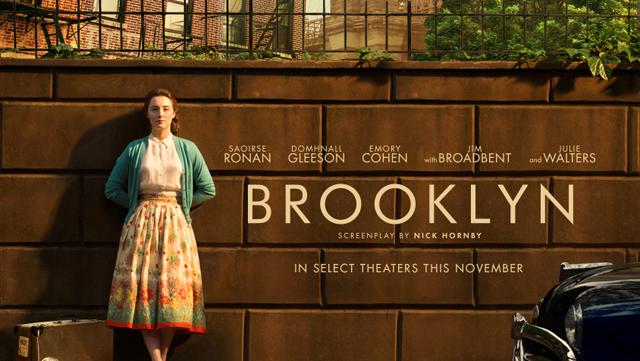
In 1952 Ellis Lacey (Saoirse Ronan) hands in the notice for her Sunday job at the local shop. She is leaving her small village in Ireland, her home and the only place she has ever known, to move to Brooklyn. On Ellis’ behalf her older, and much- adored older sister Rose (Fiona Glascott), wrote to Father Flood (Jim Broadbent) an Irish Catholic Priest living in Brooklyn asking to give Ellis a chance. Flood agrees to sponsor Ellis – paying for her travel, the start of her accommodation and finding her a job – as there are no opportunities for a bright girl like her his offer is a life-line to a new life. The ferry journey to America is hard, the first few weeks in Brooklyn even harder. She feels so homesick she is scared that she is going to die. It does fade however with time and love – in the form of Italian-American plumber Tony Fiorello (Emory Cohen). But when tragedy strikes she must return to Ireland.  Ellis soon becomes torn between her new life in American and a new life being offered by a possible new love, eligible bachelor Jim Farrell (Domhnall Gleeson). She must choose between both countries, and they both promise.

This film is good. So good in fact that ‘good’ is an inadequate adjective. It’s marvellous. It’s wonderful. It’s exquisite. Few films are this charming: so full of pathos that stimulates both heart and mind. It even appears impossible to think of one negative trait that this film possesses – no fatal Achilles heel is present here. The performances by the entire cast are outstanding, allowing for the creation of an astonishingly well-crafted very real-seeming world.

Each character is three dimensional and rounded, yet this is Ronan’s movie. Her Ellis’ is able to articulate so much with the smallest of expressions – her internal turmoil revealed with looks rather than prosaic audible contemplations. Cohen and Gleeson both hold their own, creating characters that are shown to be equal in terms of romantic possibilities. Often films with a romantic triangle will be unfairly weighted in favour of one of the choices, pushing the audiences favour in one way. This is not true of Brooklyn as the polar opposite men, confident alpha-male Tony and charmingly unassuming Jim both offering lives which could suit Ellis, if only she could work out what it is that she wants.

Set in the 1950s, it is the perfect time capsule movie. The costumes are jaw-droppingly and envy-inducingly gorgeous. The characters are believable for the era, Julie Walters is truly hilarious as the owner of the single women’s boarding house. The music makes the heart-strings pull that much tighter.

The fear of choice, of choosing the road not yet taken, is portrayed tenderly and with nuance. Not a hint of melodrama here. A timeless must-see movie.

Suffragette

‘I’d rather be a rebel than a slave’

Upon reflecting on the important role the suffragettes have in history in their obtaining the right for women to vote, it’s incredibly hard to believe that in the eighty-seven years since all women in Britain over the age of 21 could vote this is the first movie to actually portray the events that provided the catalyst for the 1928 parliamentary decision. It was actually in 1918 that the first women of Britain could actually vote – but they had to be over the age of thirty and meet certain property conditions. Suffragette does not focus on either of those periods of time, but looks at what is perceived as a turning point in the movement – the early 1910s – when social views of the suffragette movement shifted. At the start of the era, like the start of the film, the media and therefore society is fiercely damning of these immoral women. By the end of the film, on the cusp of WW1, things had started to turn. That was through the great sacrifices by many women, and the ultimate sacrifice by one woman. That is the complete narrative arc of the film – whilst an excellent insight into this era it seems an unusual choice for a film which could have instead focused on portraying the actual granting of the vote. Consequently the impact of the film is almost limited, which, considering how much build-up and anticipation there was prior to release, may ultimately frustrate some viewers.

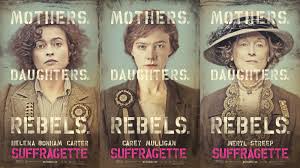
Bethnal Green, 1912. Maud Watts (Carey Mulligan) is a married mother in her early twenties. She works long hours in brutal conditions at a laundry, then goes home and cares for her young son and husband Sonny (Ben Whishaw). She’s aware of the women wanting the vote, but it seems so distant and irrelevant to her that she pays in little attention or mind. However a blossoming friendship with Violet (Anne-Marie Duff) leads to Maud giving a personal statement on her work and living conditions to a committee of MPs. ‘Laundry work is short if you are a woman’, she tells them. Maud’s mother died at work, scolded by a boiling vat of water. Maud has already been badly injured at work, and even faced sexual abuse. Should she have more children, her future-daughters will work there, facing the same risks and dangers. The cycle will continue, unbroken and relentless, unless Maud can do something to make it change. Violet invites Maud to attend a meeting with the East End Suffrage Movement. There she meets Edith Ellyn (Helena Bonham Carter), Emily Davison (Natalie Press) and later, albeit briefly, Emmeline Pankhurst (Meryl Streep). Maud tentatively but swiftly joins their ranks and campaigns for the right for women to vote but with the government, in the form of Inspector Arthur Steed (Brendan Gleeson), desperate to quell any uprising Maud is risking all she has to make a difference.

Perhaps because of the incredibly high expectations placed upon the film, it is not fully the fault of the film-makers that Suffragette does disappoint to some extent. The cast are truly extraordinary, and create characters so heart-breakingly believable that it would be nigh-on-impossible not to engage emotionally with this film. However, it doesn’t quite feel enough. Firstly, as previously mentioned, the creative decision to focus on less than three years is one worthy of debate. It allows a heightened focus on a short but important period of time, yet consequently drags out certain moments for too long. There is then the fact that, although Mulligan is fantastic in her role, Maud did not actually exist. Unlike the majority of other characters, Maud was a fictional creation for the purpose of the film. Though based in testimonies of real women from the era, her character arc is cherry-picked from multiple sources. The purpose of a composite character, as is true of this case, is to serve as a cipher; an ‘Every-Woman’ to act as an entry point and an emotional compass to the events we witness as an audience. For the most part this is successful, yet is at times almost frustrating. There are other characters in the story, real-women who do not get their voice heard as a result. Although the life of Maud is used to articulate the difficulties of life for the working class women, as opposed to the middle-class Mary Poppins suffragette, it feels rather rote. Maud, instead of feeling like a real character, almost feels like a narrative tool used to access the greatest hits of the suffrage. This has not been helped by the misleading advertising surrounding the film – yes Mulligan is our lead and Bonham Carter plays an important role, but Streep’s role is not nearly significant to require the top-billing the promotional material has given her. Although she does deliver a rather inspiring speech, her thirty-seconds of running time seems anti-climactic as a consequence.

Although Suffragette does offer some clear insight into the era, from the hunger strikes and force-feeding to the police brutality and social ostracisation that came with being a suffragette, it does not feel enough. Whilst it is a no-frills look into a momentous period of history, at times it feels more like a dry history lesson than the visceral and powerful movie these women deserve.

Crimson Peak

A film review/love letter for Guillermo Del Toro’s macabre masterpiece.

Finally. Six months in and 40 reviews written this film comes along. A Neo-Gothic epic. This is my kind of movie. The Gothic is arguably one of cinemas most underappreciated genres. This is a huge error as the tropes of the Gothic allow itself to become the truest articulation of the psychological state. Guillermo Del Toro knows this. He’s made a career of it. And this film could be his mainstream opus. The intent and scope of Crimson Peak is worthy of the highest praise: the end product astonishingly beautiful.

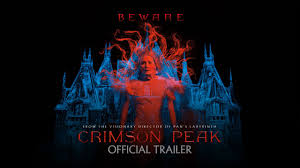
As an aspiring author Edith Cushing (Mia Wasikowska) revels in Romantic turmoil.  Her father Carter (Jim Beaver) is devoted to her and her literary exploits; having lost his wife when Edith was ten he is all too aware of the loss and pain that love can bring. His protective paternal instincts kick in when a mysterious stranger arrives into town. Thomas Sharpe (Tom Hiddleston) intent is to persuade self-industrialist Carter to invest in his machinery – it’s the last hope for he and his sister Lucille (Jessica Chastain) to restore their family estate. Carter takes an instant dislike to the Sharpe siblings; upon observing Thomas’s intent towards his daughter he becomes determined to drive them apart. However, when tragedy strikes, Edith and Thomas are pushed further together – they marry and brings her to England. Upon arrival at Allerdale Hall, observing the decrepit building and the red clay-tainted oil that desecrates the landscape, Edith realises that she must try and escape the ghosts of the past and the threats in her future.

It is impossible to over-appreciate what Del Toro has achieved here. He has utilised the motifs of the genre – the double, the spiral staircase, the brooding stranger and the desperate maiden clasping at a candle which represents her life – to create a gloriously grotesque tribute to the original 1940s Gothics whilst utilising contemporaneous cinematic creativity. The Gothic triumphed in literature during the early 1800s, and peaked in cinema during the 1940s. Though set in the same era the filmic versions of the Gothic reflected the fears of the then-present. Women were leaving the household and entering the workplace; then forced back into the home when they returned from war. Unsurprisingly there was a flux of marriages; women agreeing to marry men they had just meet believing they would not return from war. Yet so of them did, and these women realised the once-romantic gesture had in fact resulted in their being married to strangers. Films like Rebecca, The Spiral Staircase, Secret Beyond The Door and Sleep, My Love utilised this intrinsic, yet utterly understandable fear to great effect. What united them thematically was a narrative that echoed Charles Perrault’s folktale Bluebeard – what is essentially a fable warning women against marrying alluring strangers. Why this is all relevant is because few new films, one that are not reliant on being literary adaptions, even attempt to make a film in this style – let alone join the canon.

An unholy union is made between set, music, cinematography and mise-en-scene. The sets in particular are astonishing and breath-taking – with so much to see it becomes almost overwhelming, echoing the confusion of our maiden in distress.  Crimson Peak is a product of passion. Every aspect has clearly been carefully chosen and with love, which pays off ten-fold in the film’s visceral emotive impact. Combined Wasikowska, Hiddleston and Chastain make a character triangle which entraps the viewer – ensnaring them in this house of fear. This is a world where ghosts breathe and houses bleed. Melodramatic? Yes. Unashamedly and unabashedly so. Whether the film ultimately gets lost at this point, with a third act that becomes overwhelmed by pastiche, is up for personal debate. Ultimately this film is delightfully creepy – with sumptuous sets, creepy casts and unforgettable visuals – it’s an archaic yet inviting film that demands watching.

A true auteur can provide the audience a return journey to another realm. It may not be a realm we would chose to escape to – as is this case it could be a world of terror and fear – yet it was one we are fully immersed in and find the greatest beauty within. Then we are returned – shaken, frightened, bleary-eyed yet grinning. Go watch Crimson Peak and experience it for yourself.

Macbeth (2015)

‘Be bold, bloody and resolute.’

The chances are you won’t be scheduling in this film for some light Friday night entertainment (if you are, well fair play. It takes many sorts to make a world.) You want to see Macbeth for its dark brooding plot (check), an examination of fatalism and master-level acting (double check). 2015’s version of Macbeth is quite like anything that has been seen before; becoming something both of our time and times past. Gone are the claustrophobic interior dialogues. They are instead, like the characters, exposed to the elements; then dwarfed and destroyed by them. This Macbeth belongs to the Scottish landscape, here which is cruel and brutal, again, like its characters.

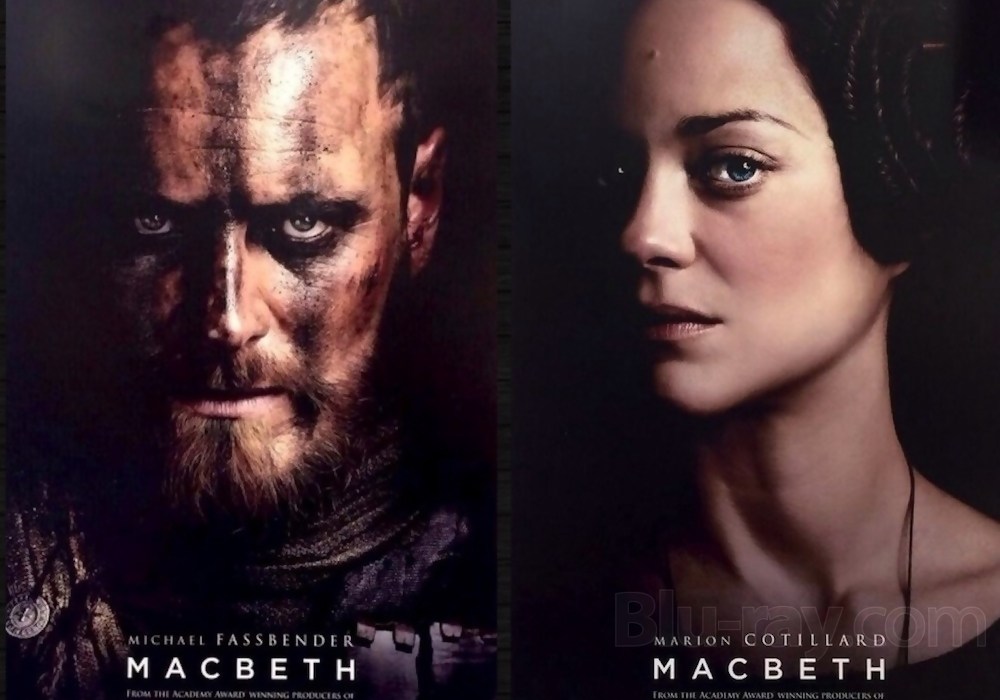
The story is still the same: a warrior-noble man is informed of a prophecy that indicates he will become King of Scotland, is then pushed into regicide by this merciless formidable wife before descending into a world of psychotic delusion and pre-emptive murders. For the most part the screenplay is unaltered, with most speeches retained word-for-word. The most fascinating aspect of this new version is the new emphasis it places onto smaller moments of the play. Small beats are given volume louder than any of its filmic predecessors, offered a refreshing take on both story and characters. Gone is what often becomes a pantomime act of the central-duo, leaving behind what often becomes shouting of dialogue and wild gesturing and replacing it with a quieter sharper intensity. Lady Macbeth (Marion Cotillard) is no femme fatale who squawks and savages her husband’s masculinity. Cotillard plays Lady Macbeth with a commanding vulnerability, a woman who utilises her insecurities for benefit instead of concealing them with rage and anger. Her famous ‘Unsex me here’ monologue, along with her rebuffing of Macbeth’s cowardice, is made all the more sinister by her demurity.  By opening the film with a funeral, that of her young son, (a death which is only referred to briefly in the play) a sympathy is generated for her character, an attempt at a reasoning for what is to come.

This is used to similar effect with Macbeth (Michael Fassbender), and adds a dimension to his friendship with Banquo (Paddy Considine). Banquo has a young son who he is absolutely besotted by and is inseparable from. Whenever Macbeth is shown to be looking at the pair, a degree of jealously is implied, a bitterness of what may have been. Considering the witches’ prophecy declared Banquo’s heirs would later become king, it’s easy to see how Macbeth’s resentment turns into murderous intent. In fact Fassbender’s portrayal of Macbeth is so effective that it makes the majority of his actions more comprehensible than others who have taken the role. His take on ‘Is This A Dagger…’ is indelible, as his ‘Tomorrow and tomorrow and tomorrow.’ How he carries the character is also intrinsic to his interpretation. The play refers to Macbeth’s status as a great warrior, but this if often under-played by adaptations. This version shows this and revels in his ferocity on the battlefield; his domination over his opponents successfully alludes to the malice underneath. His subsequent gradual submission into his own world of distraught instability has echoes of what would now diagnose as post-traumatic stress disorder. The childish ease at which he and his wife openly accept the prophecy of the witches seems almost explained by anguish twisted into an embittered for retribution.

The two central performances are cemented by the supreme skill and ability of the supporting cast; Sean Harris’ Macduff is an impassioned ball of rage, David Thewlis a benevolent Duncan and the witches combine to make an omniscient presence that haunts both screen and characters. The editing heightens the emotional tension generated by the cast; slo-mo is carefully and calculatedly integrated to great effect. The final dénouement is intensified with the mise-en-scene; the fire of the woods transplant the final battle into a world that is reminiscent of Hell, replicating the character’s diabolic emotional turmoil. The smoky reds and orange immerse Macbeth and create an unforgettable sequence that is intrinsic in its potency.

A delicate balance between subtlety and artifice results in a compellingly powerful piece of cinema. Fassbender and Cotillard where born to play these characters.