Adult Life Skills

British indie at its finest

This film sums up what we Brits do well – a somewhat melancholic story told with warmth and humour. An unsentimental tale told with compassion. Also, puns. There is so much to love about this film that I suspect I’ll be championing it a long while yet.

Anna (Jodie Whittaker) is one week away from her thirtieth birthday. She works at a nature resort in a middle-of-nowhere part of Northern England, lives in the shed at the end of her mum’s garden and enjoys making films featuring her thumbs with smiley faces on them talking about nihilism. Due to the relatively recent death of her twin brother (Edward Hogg) she can’t face talking about her birthday, yet it seems everyone from mum Marion (Lorraine Ashbourne) and Grandma Jean (Eileen Davies) to her best friend Fiona (Rachael Deering) and Fiona’s sister Alice (Alice Lowe) to the boy who used to annoy her at school Brendan (Brett Goldstein) want to talk about both her Birthday and where her life is going. 

Although the setting, the majority of the characters and their circumstances may not initially appear universal they really are. The film acts as a reflection on loss, self-isolation and the struggle to find who you are. Yes, as a 23 year old female that may appear more relevant to me than many others it’s relevant to us all. We all have experienced – be that aged 3, 23, 33,53 or 83 – a loss that derailed us, that either out of choice or not, took us on a course we never intended. Grief lasts far longer than the funeral and for some we wake up years later and look at metaphorically derelict path we ended up on. Anna’s self-loathing may be a concept I am all too aware of through personal experience, yet the battle to regain self-confidence is a ubiquitous challenge many of us have/will face. The fact we see such likeable and familiar-seeming characters facing this in ‘Adult Life Skills’ makes for a deep and visceral experience.

I apologise if the above paragraph made the film sound boring and serious. It really isn’t boring but it is somewhat serious, in terms of its themes not how it is told. It is properly funny quite often and whilst I did cry (I think it was at least three times) I did guffaw at least double that and left the screen grinning.

I loved every single one of the characters. I really felt like Anna became a friend whilst watching the film, she’s so well-rounded both in characterisation and performance. I’ve loved watching Whittaker in everything I’ve seen her in (Good Vibrations is my personal favourite) and her performance her is no exception. Fiona is brilliant as the best friend desperately trying to help her lost friend. Brett Goldstein, who was wonderful in  last year’s little known indie flick SuperBob, is just as good here. He is great at playing a logical figure to Anna’s less-than-logical thought processes, providing a truly earnest performance. Pus the man is an expert at eyebrow acting.

‘Adult Life Skills’ is now easily in my top five films of the year so far.  Whilst Mother’s Day (click here to read my review) may be filling cinema screens with a national release, profiting on cheap and disingenuous sentiment,  it is films like this we should be rooting for.  When the film ended it felt like I was saying goodbye to newfound friends. Yesterday’s preview was the first of my many watches of it.

4.5

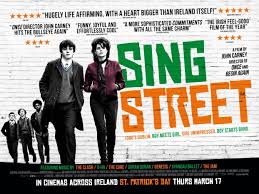
Sing Street

1980s. Dublin. New Romantics.

If the prospect of those three words being combined into a film does not fill you with glee I’m not sure how well we’re going to get on or how well you’re going to get on with this film. If you haven’t jumped ship  and are still reading – then this film may just be for you! From John Carney, the writer-director-producer of  Once and Begin Again, comes another musical tale about love and friendship. But this time our main characters are teenagers and they are forming a band The Commitments-style. The result is one of the most rewarding, enjoyable and grin-inducing films of the year so far.

It’s 1985. Like all epic stories it started with money problems and a girl. Connor (Ferdia Walsh-Peelo) is forced to leave his expensive fee-paying school and attend the local state school Synge Street CBS. The family has little money coming in as patriarch Robert (Aidan Gillen) is finding his architecture practice is not really required during a financial crisis. It’s at his new school, well on the school’s doorstep, that Connor first meets Raphina (Lucy Boynton). Raphina is an older lady, one year older, and is the most glamorous/gorgeous/extraordinary woman Cosmo has ever seen. New-found friend and wanna-be entrepreneur Darren (Ben Carolan) explains the school gossip that Raphina is a model who will soon be moving to England to make her fortune. Connor bravely introduces himself to Raphina and offers her a job that weekend to star in his band’s music video. After a bit of charming she agrees to take the job. Except Connor doesn’t actually have a band – yet. With audiophile elder brother Brendan (Jack Reynor) to guide him surely it’ll all be easy, won’t it..?

There are so many reasons to love this film – many of which I don’t want to discuss in too much detail or give away as it’s discovering them for yourself that only add to the brilliance. However I will briefly give the headlines of the reasons for my adoration. For favourite character I am torn between Brendan and bespeckled multi-instrumentalist Eamon (Mark McKenna). The soundtrack will undoubtedly be one of the best of the year – the classics are superbly chosen and the original songs (such Riddle of the Model) are wonderful tributes with some infectiously catchy riffs. The storyline is told with great empathy and sympathy. This is a film that truly cares about its characters. The music videos the band makes are both hilarious and nostalgia-inducing (even for those of us who were not alive in 1985!) I full enjoyed the references to The Cure, Duran Duran and Spandau Ballet to name just three – I can only imagine the depth of the enjoyment for those who leaved and breathed this music scene. The friendship between the newly-formed band is heart-warming and believable thanks to some fantastic chemistry between them. The film also manages to cover lots of ‘big’ topics – mental health, adultery, abuse – sensitively and appropriately. There’s a great balance here between pathos and humour. 

My main criticism would be the treatment of Raphina. Boynton does an excellent job with the material she is given but the presentation/treatment of her character is far too Maniac Pixie Dream Girl. For the most part we only learn about Raphina through what Connor (whom Raphina later renames Cosmo) sees and hears. She doesn’t transcend being his figure of worship and far too much screen time is dedicated to his male-gaze watching her. Whilst the dialogue of most of the characters is rooted in a degree of realism or believability Raphina’s craic is over-rehearsed. Arguably this could be a reflection of her personality as a character but for the most part her dialogue rarely lands as effectively like the other characters. Any film that focuses on a romantic crush, be that of a man or woman, must deal with the universality of the story arc as a duel-edged sword.  Whilst it makes for an accessible storyline, as the majority of the world’s population would have had a romantic crush at some point or another,  it means we then have to believe in the crush and that all the turmoil it brings our lead character is worth it. Is Raphina worth it?

Aside from my ponderings on potentially dubious representation, I truly loved Sing Street. So much so I think a rewatch in the new few weeks will be in order. It tickles the funny bone whilst tugging at the heart strings. It’s an old-fashioned story told with great warmth and will great skill. And, for New Romantics at heart like me, it’s chance to feel immersed in and nostalgic for a lifetime I never lived.

4.5


Victoria

A true feat of film-making. Truly extraordinary.

To put it simply, a ‘take’ refers to the period between a director saying ‘action’ and ‘cut’. It’s up to them or the cinematographer how long this period is. Typically the longer the take the more difficult the film-making process is as it requires actors to be in the right place, saying the right lines, nothing else interrupting the shot etc. Alfred Hitchcock experimented with this in 1948 making Rope which clocked in at 80 minutes and comprised of only 10 takes, the majority of which were shot in such a way to make the cuts seem seamless. It was an ambitious project which paid of in most regards, the murder and the main characters fear of being caught out in only heightened by the prolonged takes. The character cannot escape and neither can the audience. 68 years later we have Victoria which was filmed two years ago and rejected by many of Europe’s film festivals as they believed the filmmakers were lying on the submission sheet. What lie did they think the filmmakers were proclaiming? Well the film-makers claimed that Victoria, which is 2 hours and 18 minutes long, was shoot using only one take. The most unbelievable thing about this? It’s the truth.

Victoria (Laia Costa) moved from her hometown of Madrid to Berlin three months ago. She works in a coffee shop for less than minimum wage and doesn’t really know anyone in her new city. In the hours before her early morning shift she decides to go clubbing and dances alone quite happily. On her way out of the club she bumps into a group of four men – informal group leader Sonne (Frederick Lau) who Victoria feels an instant spark with, Boxer (Franz Rogowski), Blinker (Burak Yigit) and Fuß (Max Mauff) – who promise to show her ‘real Berlin’. Victoria agrees and what first follows is a fun night for Victoria, seeing parts of Berlin she had never seen before and connecting quickly with Sonne. When Boxer receives a phone call and claims that the group need Victoria’s help.  It is her connection with Sonne that prompts her to make the first in a series of bad decisions and things take a dark turn before spiralling out of control.

I repeat. The entire film is only one take long. It cannot be overemphasised how incredible this is, what a triumph of filmmaking it is and what an astounding experience of film-watching it creates as a result. It’s breath-taking, wondrous, exhilarating and utterly compelling. As it is shot though one-take it is shot in real-time. This is important to note as it adds to the authenticity, we watched events play out and escalate. We cannot question how we got from the first frame to the last as we witnessed very moment and decision which lead the characters there. And these moments don’t just take place in one room – the characters travel all over the city, up ladders, jammed into cars and lifts, dancing across the street and running across it too – and the camera is always there watching and following. Incredibly this also manages to feel gimmick-free. Instead we feel like we’ve tagged along for a night out, been immersed in the spontaneity and intensity of this world, then kicked out of the club  and ditched at the end of the film. There is a reason that the cinematographer Sturla Brandth Grøvlen receives first credit ahead of director and writer Sebastian Schipper as Victoria is an example of true technical mastery. The camerawork is dazzling ambitious, pulsating and gripping.

The performances are mostly improvised, which only adds to the feeling of authenticity and believability. This is next level realism as we get to experience this world as it happens. It’s a huge credit to the relatively inexperienced cast that they only had to shoot the film three times, this being version two. It’s only after seeing the film, when you see what they had to achieve and endure, that you can truly appreciate the level of skill being utilised here.

It’s divine. A sensational watch. It needs to be seen.


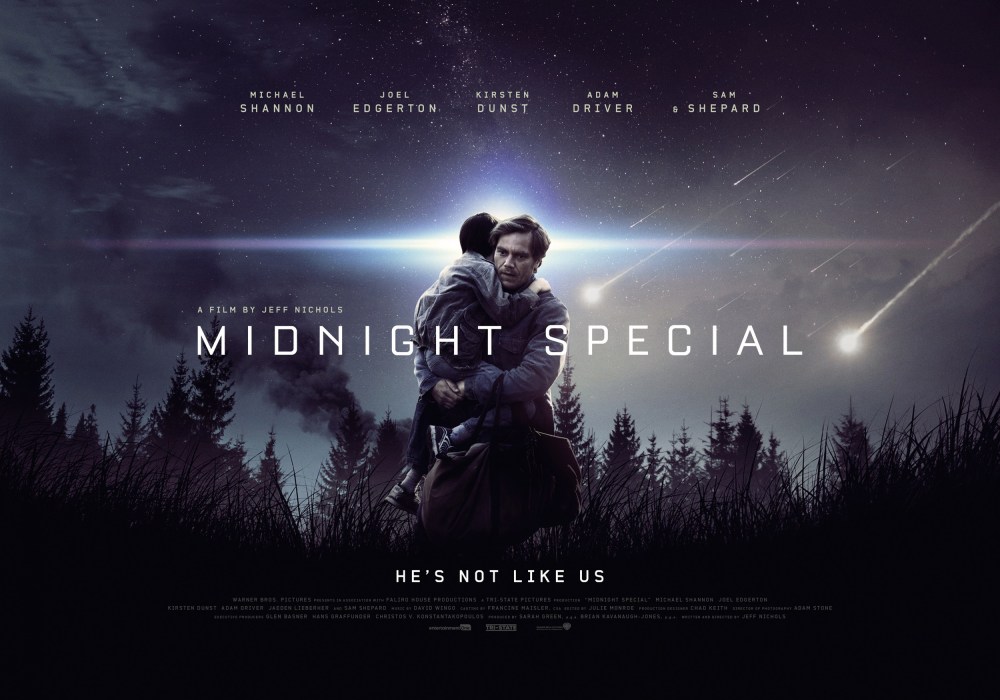
Midnight Special

Messiah or weapon? Or something else entirely?

Imagine a science fiction movie that focuses less on the fictional powers and more on the human emotions, the cost behind the power. Imagine a science fiction movie that allows you to marvel at the mystery rather than hand-feed you the plot. Imagine a science fiction movie that is a road trip/chase movie that challenges the value of belief. Now stop imagining as Midnight Special is all three of those things and much more. It is a wonderfully strange blend of genres, full of complexity and sentiment. A parable about love and extraordinary ability.

Roy (Michael Shannon) and his eight-year-old son Alton (Jaeden Lieberher) are on the run from both the government and religious extremists. Alton appears to possess special abilities, from being able to effortlessly infiltrate classified government signals  to bringing down a satellite from outer-space. A religious cult formed around Alton who, as National Safety Agent Paul Sevier (Adam Driver) discovers,  turned his encoded words into gospel. His supernatural powers so badly altered by daylight that all of the cult  became nocturnal. Upon making eye contact with people Alton’s eyes glows and show visions of unknown lands. Having fled the cult, and with the help of childhood friend Lucas (Joel Edgerton) and Alton’s mother (Kirsten Dunst),  Roy must get Alton to specific location for a specific time. Will, as everyone fears and some hope, a celestial and world-changing event take place? 

This is not your typical science fiction film. Compared to typical box office fairings Midnight Special is slow, with far more questions than answers, and a narrative that is impossible to stay ahead of. Those are not criticisms, just an acknowledgment that this film is not for everyone. In the preview screening I attended yesterday many of the audience members seemed frustrated or unfulfilled by the film. I was not in agreement with them for the film I had just witnessed was so riveting and magical. Rarely is science fiction this personal and emotive. Yes, a beginners guide to film criticism will show  you that Steven Spielberg’s films are about father-son relationships,  but what we see here is a different realm. What director and writer Jeff Nichols manages to achieve is a film which places greater emphasis of the consequences of supernatural power rather than the benefits of it, prompting the reflection that more is lost than gained in such extraordinary circumstances. Few storytellers are this damn magical.

The acting by the entire cast is wondrous, each cast member providing a wondrous blend of awe, fear and honesty. Roy’s love for his son is so deep and unconditional, a level of paternal concern rivalling that of great Epics. Lieberher’s performance here suggests that Room child star Jacob Tremblay may have a rival for Hollywood’s current greatest child actor. Egerton’s performance allows us to give loyalty to a character we know little about, believability to a man who has only known Alton for three days but is willing to give everything to the boy’s journey. Dunst is subtle yet heartbreaking as a mother who fears she will have to give up her son once more.

The cinematography is marvellous, as is the soundtrack and the storytelling. Of particular favourite is the Easter Egg of the Superman-starring comic book that Alton is reading in the back of the car. Any in depth analysis of the parallels between Superman and Alton would be spoilerific, but the very fact both are outsiders with great power is a wonderfully subtle touch. Just like the entire film it’s an allusion to other sci-fi works, but something that is so uniquely individual and riveting.

Some may say slow. I say spellbinding, sincere and utterly superb.

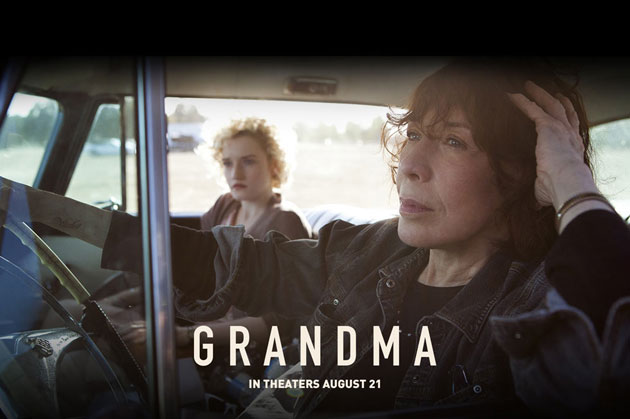
Grandma

A cinematic gem

This film is a total and utter joy to watch. So few films manage to have a plot that is so well-rounded and immersive with characters with such real depth. The fact this film is only (!) 78 minutes makes it even more magnificent – it’s not bloated nor is it lean. In fact, to an extent, the film feels far long in a good way. It feels as if you actually know these characters. They almost feel like friends.

Elle Reid (Lily Tomlin) is a sometime poet and sometime academic. 18 months ago her partner of 38 years died after a long illness. Three months into a new relationship she breaks up with girlfriend Olivia (Judy Greer).  In front of Olivia she appears to not care about her soon-to-be ex-lover, even proclaiming her to be a ‘footnote’ in comparison to her dead love. Soon after Elle’s granddaughter Sage (Julia Garner) arrives and needs her grandmothers help. Sage is pregnant and has an abortion booked for 5pm that day, but she doesn’t have the $630 to pay for it.  Elle doesn’t have that money to spare, all she has is $48 after paying of medical costs and other debts. She even cut-up all her credits cards as a symbol of a new start. Both Sage is too scared to ask her mother for help, a fear Elle shares. So the two go on a road trip to get both the money they need and to come to terms with their recent troubles.

There are not enough films like this being made at the moment. It’s witty and intelligent, heart-warming and emotional, compelling and laugh-out-loud funny. As we are in the middle of Oscar season it’s not surprising this film has had a degree of Oscar-buzz, but it’s been quiet compared to that surrounding other films that could be regarded as Oscar bait.  The prospect of a Grandma and her Granddaughter road movie may not sound massively appealing but there is so much more to it. The relationship between the pair is so well portrayed by both actresses.

Tomlin creates a character who does not have all the answers but will still insist on answering back, who is quick to get angry and can be bitter with her words. But her performance as Elle is also feisty, funny and full of vitality. She swears, she’s got tattoos, she attacks a dead-beat boyfriend but with her performance and a finely-written script she creates a truly appealing character.  We laugh with her not at her. The love she has for her granddaughter is unquestionable and fully justifies her actions.

Garner’s Sage is so carefully handled. A pregnant teen nowadays is a regular focus for reality tv, but Sage is very different from the ‘stars’ of those shows. Instead she is a girl who is looking for love, who is grieving for her dead Grandma and watching the alive one struggle with grief. Sage is immensely endearing and her narrative never strays into sappy.

Though the film’s driving force is obtaining the money for Sage’s abortion her decision is never questioned, somewhat surprising for an American film. In fact the film overall is about liberalism but never preachy. Elle clearly lived through a progressive period of time, her poetry and art-centric background were once part of the counter-culture which is slowly being forgotten and disappearing. Sage represents the new, with access to the internet and other resources she is ignorant to the world around her. She knows little of the time her Grandmother lived through, and knows nothing of women’s history. When visiting her Grandmother’s acquaintances, a transgender tattoo artist (played by Orange Is The New Black’s Laverne Cox), a rather intimidating butch cafe owner and listening to Elle’s views on society it is made clear just how little Sage really knows about the world around her. But this progressiveness is not dominant, not shoe-horned in nor heavily-handedly forced upon us. Instead these culture contrasts are treated carefully and tenderly like its characters. 

The film has an episodic narrative, with five chapter marked with title cards. Each chapter focuses on one of their visits to try and collect the $630. All of the chapters are exceptionally good but #4 titled ‘The Ogre’ is my personal standout. Elle brings Sage to visit Karl (Sam Elliott) who she has not seen in 39 years. The emotion generated by this scene is lump-in-your-throat-inducing. The pair bounce of each other as years of resentment come rising to the surface. Equally good is the emergence of the mother (Marcia Gay Harden) is manages to be worthy of the terror Elle and Sage feel towards her but still able to grab our sympathies. 

A study in character and emotion unlike many of this year’s releases. A little film worthy of much acclaim.


Bill

William Shakespeare: The Lost Years

Suffice to say, this is not another Bad Education Movie-style television to big screen disappointment of an adaptation. The team behind Horrible Histories have succeeded in translating their unique combination of historical-informed humour and slapstick. In fact Bill, along with Horrible Histories and their fantastical series Yonderland, has secured their place as natural successors to Monty Python and Blackadder.

Bill Shakespeare (Matthew Baynton) is a family man. He lives with his wife, Anne Hathaway (Martha Howe-Douglas), and their three children. Bill plays lute in a band called ‘Mortal Coil’, but after one concert where he tries to steal the spotlight he is told to ‘shuffle on’. It’s not us it’s you, they tell him. So Bill moves onto his next dream, being a playwright. As Stratford-Upon-Avon doesn’t actually have any theatres, he leaves his family to go and achieve his dream. In the process he befriends Christopher Marlowe and becomes embroiled in King Phillip II of Spain’s devious plot to murder Queen Elizabeth at a theatre production she is hosting.

The results are properly hilarious. The gag rate is so high, with most of it landing, that whilst laughing at one joke you may end up missing the next.  Of all the genres it is arguably comedy that is the hardest to do well. Aim too broad and you please no-one, aim too niche and you end up pleasing a minimal market. This irreverent biopic carefully, and to great effect, utilises modern references and a panto-esque tone to keep the audience tittering from start to finish. There are a few that are groan-worthy gags, a couple which are smirk-creating, many that are chuckle-inducing and a good handful of proper belly laughs. The team are not limited by their obligation to educate, as they were with the excellent Horrible Histories, and use that freedom to great effect. Considering we do not know what actually happened to Bill during the years between his abandoning his family in Stratford and emerging as royal playwright William Shakespeare, the events of this film are entirely plausible… well unlikely but possible.

One can only hope that situations such as Shakespeare educating Christopher Marlowe in ‘your mum’ jokes did in fact occur. If only because it leads to an immensely funny recurring gag within the film, that is seconded only by a henchman’s inability to understand the concept of a Trojan Horse. Other highlights include Helen McCory’s toothy and worn portrayal of Queen Elizabeth, some lovely throwaways about funding of the arts and a hilarious reference to ‘clunky exposition’. Baynton is excellent and rather endearing as an idealist and optimistic Shakespeare, as is Howe-Douglas as his under-appreciated wife.

Bill has a relatively taunt and witty script that has a joke for everyone. As expected the chemistry between the cast is electric, the gags reliably brilliant and the timing of them is spot-on. Well worth a watch.

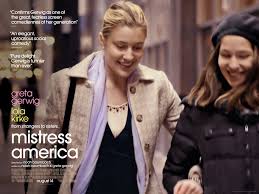
Mistress America

A witty and endearing sister comedy

A ‘Manic Pixie Dream Girl’ was a term coined (and since abandoned) by film critic Nathan Rabin in 2007. It refers to a stock character type; a female character who is bubbly and quirky, who enters the life of a brooding, serious male to help him embrace the joys and wonderment of life. (See Kristen Dunst in Elizabethtown, Marilyn Monroe in Some Like It Hot, Belle in Beauty and the Beast and Zooey Deschanel in practically every movie.) Typically, though not in every case, the MPDG  is shown through the eyes of the male character (known as the Male Gaze) who idealises her, lusting after her and placing her on a pedestal. What’s interesting, and truly refreshing about Mistress America is that some of the MPDG and her narrative ways are on display whilst also being subverted and questioned. This film is the story of a hipster-sect but told with old-fashioned sophistication; an honest look at the complexities between worship and reality. But instead of a traditional romance the focus is on friendship.

Tracy Fishcoe (Lola Kirke) is an 18-year-old college freshman undertaking her first semester in New York. She’s not enjoying it. It’s not what she had expected, feeling like she doesn’t fit in. In fact her life feels like she’s at a party where she ‘doesn’t no anyone.’ She gets rejected by a  boy, then rejected for an elite writing society and every attempt she makes to try and fit in becomes just another knock-back. Her soon-to-be-remarried mother suggests Tracy call her Brooke (Greta Gerwig) as this marriage will make the pair step-sisters. Brooke also lives in New York, but Tracy is too intimated to make the phonecall, believing this woman 14-year her senior would not want anything to do with her. However one lonely dinner -time she takes the chance to call Brooke, who instantly agrees to meet her. They enjoy a crazy night-out together, and continue to meet-up. When Brooke’s restaurant dreams start to fall through, Tracy endeavours to help the woman she now views as a sister.

In many ways Brooke meets a lot of the criteria of a MPDG, she’s the life and soul of every party. She knows everyone, appears able to do anything, and is keen to immerse Tracy in her world. Brooke even has a ‘quirky’ habit, appearing to not listen to other people so conservations with her sound disjointed.Even after meeting Brooke just the once Tracy is inspired to writer new short story, about thinly veiled version of Brooke. If this film wanted to be conventional or typical, it could have stayed this way. Brooke could have just stayed as Tracy’s muse, whose pure function is to inspire and guide her (an aspect that is mentioned within the latter half of the film). What’s so clever and makes the film so heart-warming is it isn’t just about that. It’s about friendship and sisterhood. It’s about how life doesn’t always meet up to it’s expectations and isn’t always as easy as it appears to other people. It’s the act of putting on a smile whilst inside you’re terrified.

When you’re 18 you’re certain that by the time you’re 30 everything will be sorted. That you’ll know everything, have everything and life will be sorted. Mistress America shows that really doesn’t happen, but that’s not a bad thing.