Suffragette
‘I’d rather be a rebel than a slave’
Upon reflecting on the important role the suffragettes have in history in their obtaining the right for women to vote, it’s incredibly hard to believe that in the eighty-seven years since all women in Britain over the age of 21 could vote this is the first movie to actually portray the events that provided the catalyst for the 1928 parliamentary decision. It was actually in 1918 that the first women of Britain could actually vote – but they had to be over the age of thirty and meet certain property conditions. Suffragette does not focus on either of those periods of time, but looks at what is perceived as a turning point in the movement – the early 1910s – when social views of the suffragette movement shifted. At the start of the era, like the start of the film, the media and therefore society is fiercely damning of these immoral women. By the end of the film, on the cusp of WW1, things had started to turn. That was through the great sacrifices by many women, and the ultimate sacrifice by one woman. That is the complete narrative arc of the film – whilst an excellent insight into this era it seems an unusual choice for a film which could have instead focused on portraying the actual granting of the vote. Consequently the impact of the film is almost limited, which, considering how much build-up and anticipation there was prior to release, may ultimately frustrate some viewers.
Bethnal Green, 1912. Maud Watts (Carey Mulligan) is a married mother in her early twenties. She works long hours in brutal conditions at a laundry, then goes home and cares for her young son and husband Sonny (Ben Whishaw). She’s aware of the women wanting the vote, but it seems so distant and irrelevant to her that she pays in little attention or mind. However a blossoming friendship with Violet (Anne-Marie Duff) leads to Maud giving a personal statement on her work and living conditions to a committee of MPs. ‘Laundry work is short if you are a woman’, she tells them. Maud’s mother died at work, scolded by a boiling vat of water. Maud has already been badly injured at work, and even faced sexual abuse. Should she have more children, her future-daughters will work there, facing the same risks and dangers. The cycle will continue, unbroken and relentless, unless Maud can do something to make it change. Violet invites Maud to attend a meeting with the East End Suffrage Movement. There she meets Edith Ellyn (Helena Bonham Carter), Emily Davison (Natalie Press) and later, albeit briefly, Emmeline Pankhurst (Meryl Streep). Maud tentatively but swiftly joins their ranks and campaigns for the right for women to vote but with the government, in the form of Inspector Arthur Steed (Brendan Gleeson), desperate to quell any uprising Maud is risking all she has to make a difference.
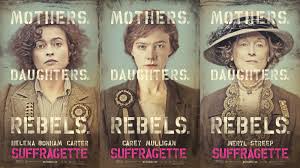
Perhaps because of the incredibly high expectations placed upon the film, it is not fully the fault of the film-makers that Suffragette does disappoint to some extent. The cast are truly extraordinary, and create characters so heart-breakingly believable that it would be nigh-on-impossible not to engage emotionally with this film. However, it doesn’t quite feel enough. Firstly, as previously mentioned, the creative decision to focus on less than three years is one worthy of debate. It allows a heightened focus on a short but important period of time, yet consequently drags out certain moments for too long. There is then the fact that, although Mulligan is fantastic in her role, Maud did not actually exist. Unlike the majority of other characters, Maud was a fictional creation for the purpose of the film. Though based in testimonies of real women from the era, her character arc is cherry-picked from multiple sources. The purpose of a composite character, as is true of this case, is to serve as a cipher; an ‘Every-Woman’ to act as an entry point and an emotional compass to the events we witness as an audience. For the most part this is successful, yet is at times almost frustrating. There are other characters in the story, real-women who do not get their voice heard as a result. Although the life of Maud is used to articulate the difficulties of life for the working class women, as opposed to the middle-class Mary Poppins suffragette, it feels rather rote. Maud, instead of feeling like a real character, almost feels like a narrative tool used to access the greatest hits of the suffrage. This has not been helped by the misleading advertising surrounding the film – yes Mulligan is our lead and Bonham Carter plays an important role, but Streep’s role is not nearly significant to require the top-billing the promotional material has given her. Although she does deliver a rather inspiring speech, her thirty-seconds of running time seems anti-climactic as a consequence.
Although Suffragette does offer some clear insight into the era, from the hunger strikes and force-feeding to the police brutality and social ostracisation that came with being a suffragette, it does not feel enough. Whilst it is a no-frills look into a momentous period of history, at times it feels more like a dry history lesson than the visceral and powerful movie these women deserve.
 Charlotte Sometimes