A Bigger Splash

A rockstar, a record producer, a documentary-maker and a recently discovered illegitimate daughter go on holiday…

The hardest thing I suspect I will find about writing this review is overusing the adjective ‘beautiful’ and its various synonyms, because that is what A Bigger Splash is. Beautiful. Beautiful cast in beautiful scenery that is beautifully shot and with a story that is beautifully told.

Marianne Lane (Tilda Swinton) is a rockstar of arena-like proportions. After surgery on her throat and vocal chords renders her mute for several weeks (as part of her post-operative recovery) she decides to go into reclusion with her partner Paul (Matthias Schoenaerts). They are staying on the remote Italian island of Pantelleria when their weeks of nudity and nookie are interrupted by the arrival of her ex-producer and ex-lover Harry (Ralph Fiennes), who has brought with him Penelope (Dakota Johnson) who recently discovered that Harry is her father. What follows will test the ties of fraternity, paternity and sexuality with catastrophic consequences.

The events of the film play out in a way that is unpredictable, sweaty and bitterly humorous. This is Swindon and Fiennes at the top of their respective games. Due to her character’s temporary muteness Swindon has little dialogue; the few lines she does say are husky and barely audible. Instead she says entire monologues on matters of the heart with her facial expressions – bitter rage, frustration, mortification, adoration and admiration shown through looks. A less-skilled actress would be constricted by her characters damaged vocal chords; instead what could be a limitation showcases the true skill Swindon possesses. The grace and manner of her movements and expressions, along her facial expressions, bring Marianne Lake: Rock Star to life. Both when painted in David Bowie-esque costume and make-up and when wearing nothing at all, it feels like you are watching the life of a real, if fatally flawed, person.

At 52, with countless film and theatre credits which demonstrate his mastery, it is incredibly impressive that Fiennes can still surprise. His Harry Hawkes is a bundle of raw energy, a magnetic charisma who dominates each scene. Along with providing the funniest moments of the film (and a dance sequence to The Rolling Stones that I challenge you to be able to watch without averting your eyes in bewildered embarrassment) he demonstrates the mythical fine line between comedy and tragedy. Harry Hawkes is a man who uses his charisma, uniqueness, nerve and talent to mask much inner-darkness. His self-destructive descent into hedonism is (dance sequence aside) utterly enthralling.

It’s a pleasure to see Schoenaerts on the big screen again, roughly 10 months since the release of Far from the Madding Crowd and his enamouring take on loyal and noble Gabriel Oak. His character here, Paul, is one who initially appears to have fewer layers than his romantic partner and love rival, but this proves that appearances can be deceptive. He is currently one of the most interesting and underappreciated supporting actors in cinema at the moment, and I greatly look forward to seeing more of his (admittedly rather beautiful) self.

And then there’s Dakota Johnson, of 50 Shades of Grey infamy. What A Bigger Splash succeeds in doing is adding another reason for why Shades is such a mediocre movie, as A Bigger Splash proves that not only can Johnson act but she is mighty fine at it. In fact, she well and truly holds her on with her fellow leads. Penelope is an intriguing character, made even more so by Johnson’s acting ability. Penelope is a character who almost defies description (in a complimentary way), suffice to say she is a product of her father in the best/worst of ways.

 There is one more crucial player in A Bigger SplashPantelleria itself. Located 100km southwest of Sicily (fact found courtesy of Google) it is a place I had not heard of prior to the film and is of such unrivalled beauty that I cannot escape mentally from the mysticism of it. Few places, when on the screen, are displayed in such heart-stopping and breath-taking beauty. The events of A Bigger Splash, when splayed out in a review such as this could seem almost borderline-soap opera. It’s the scenery, and the skill through which it is shown, that prevents this. Yes some sequences possess a degree of melodrama, but setting it in such a beautiful (alluring, dazzling, exquisite, stunning, and wonderful) landscape only elevates the emotional response of the subsequent events. However, it’s the slightly oddball, quirky tone of these events that makes the film truly memorable. Though the pacing is slightly stilled on minor occasions, with one or two plot points that drag, there is a humour tinged by darkness that makes the plot haunting and ultimately cataclysmic.

A sun-kissed soap opera told with class and comedy with an abundance of tragedy. A must-see.
 

Grandma

A cinematic gem

This film is a total and utter joy to watch. So few films manage to have a plot that is so well-rounded and immersive with characters with such real depth. The fact this film is only (!) 78 minutes makes it even more magnificent – it’s not bloated nor is it lean. In fact, to an extent, the film feels far long in a good way. It feels as if you actually know these characters. They almost feel like friends.

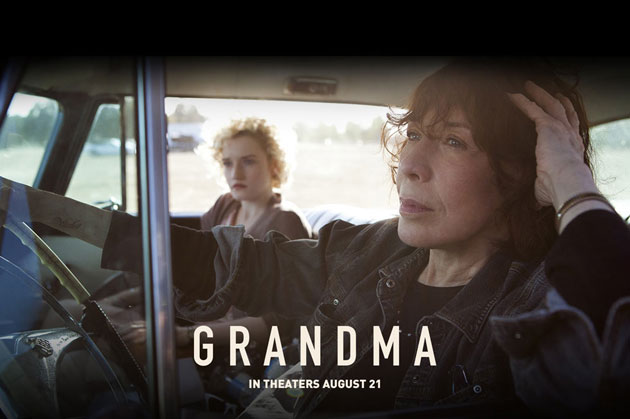
Elle Reid (Lily Tomlin) is a sometime poet and sometime academic. 18 months ago her partner of 38 years died after a long illness. Three months into a new relationship she breaks up with girlfriend Olivia (Judy Greer).  In front of Olivia she appears to not care about her soon-to-be ex-lover, even proclaiming her to be a ‘footnote’ in comparison to her dead love. Soon after Elle’s granddaughter Sage (Julia Garner) arrives and needs her grandmothers help. Sage is pregnant and has an abortion booked for 5pm that day, but she doesn’t have the $630 to pay for it.  Elle doesn’t have that money to spare, all she has is $48 after paying of medical costs and other debts. She even cut-up all her credits cards as a symbol of a new start. Both Sage is too scared to ask her mother for help, a fear Elle shares. So the two go on a road trip to get both the money they need and to come to terms with their recent troubles.

There are not enough films like this being made at the moment. It’s witty and intelligent, heart-warming and emotional, compelling and laugh-out-loud funny. As we are in the middle of Oscar season it’s not surprising this film has had a degree of Oscar-buzz, but it’s been quiet compared to that surrounding other films that could be regarded as Oscar bait.  The prospect of a Grandma and her Granddaughter road movie may not sound massively appealing but there is so much more to it. The relationship between the pair is so well portrayed by both actresses.

Tomlin creates a character who does not have all the answers but will still insist on answering back, who is quick to get angry and can be bitter with her words. But her performance as Elle is also feisty, funny and full of vitality. She swears, she’s got tattoos, she attacks a dead-beat boyfriend but with her performance and a finely-written script she creates a truly appealing character.  We laugh with her not at her. The love she has for her granddaughter is unquestionable and fully justifies her actions.

Garner’s Sage is so carefully handled. A pregnant teen nowadays is a regular focus for reality tv, but Sage is very different from the ‘stars’ of those shows. Instead she is a girl who is looking for love, who is grieving for her dead Grandma and watching the alive one struggle with grief. Sage is immensely endearing and her narrative never strays into sappy.

Though the film’s driving force is obtaining the money for Sage’s abortion her decision is never questioned, somewhat surprising for an American film. In fact the film overall is about liberalism but never preachy. Elle clearly lived through a progressive period of time, her poetry and art-centric background were once part of the counter-culture which is slowly being forgotten and disappearing. Sage represents the new, with access to the internet and other resources she is ignorant to the world around her. She knows little of the time her Grandmother lived through, and knows nothing of women’s history. When visiting her Grandmother’s acquaintances, a transgender tattoo artist (played by Orange Is The New Black’s Laverne Cox), a rather intimidating butch cafe owner and listening to Elle’s views on society it is made clear just how little Sage really knows about the world around her. But this progressiveness is not dominant, not shoe-horned in nor heavily-handedly forced upon us. Instead these culture contrasts are treated carefully and tenderly like its characters. 

The film has an episodic narrative, with five chapter marked with title cards. Each chapter focuses on one of their visits to try and collect the $630. All of the chapters are exceptionally good but #4 titled ‘The Ogre’ is my personal standout. Elle brings Sage to visit Karl (Sam Elliott) who she has not seen in 39 years. The emotion generated by this scene is lump-in-your-throat-inducing. The pair bounce of each other as years of resentment come rising to the surface. Equally good is the emergence of the mother (Marcia Gay Harden) is manages to be worthy of the terror Elle and Sage feel towards her but still able to grab our sympathies. 

A study in character and emotion unlike many of this year’s releases. A little film worthy of much acclaim.


Sunset Song

A sure-fire contender for top ten films of 2015 lists.

There are lots of sunsets. There are lots of songs. There is a huge amount of turmoil, heartbreak and devastation. There are also bitterly-short periods of joy, bookended by tragedy. This film is exquisite and truly haunting. An adaptation of of a 1932 Scottish novel of the same name, this is director Terence Davies project of passion after years passed struggling to get funding, struggling to get his film made. The passion truly shines through.

Aberdeenshire farm girl Chris Guthrie (Agyness Deyn) is the daughter of a housewife and a tyrannical father (Peter Mullan), and younger sister to a brother who is constantly beaten by their father. Her mother’s life is comprised of being raped and giving birth – she does not want the same for her daughter. Chris also does not want to be fated to live a life like her mother’s. Luckily Chris is exceptionally bright, the smartest girl at her school, and is one track to move away and train to be a teacher. When her mother falls pregnant, again, and gives birth to twins, again, the family move away to a bigger house. Once they arrive in their new home, a series of events occur which cause the family to crumble and fall away. Chris must endure so aching hardship but appears to find happiness with Ewan (Kevin Guthrie). This period of her life is shattered when war (World War One) is declared. Life for Chris and her fellow residents of Kinraddie will never be the same. 

 Considering the series of devastating events that is the life of Chris Guthrie Sunset Song never crosses the boundary into melodrama. Admirably, to great success, the film and its storytelling retain a muted stoicism. It’s bitterly sad and this effect is sharpened by its refraining to rely on exaggerated displays. Deyn in particular is extraordinary. Her Chris has a captivating innocence, an innate need to endure and stand firm when all around her are losing their heads (metaphorically speaking!) Tears roll and glide down her face, even at her most bereft she has no need for frantic or guttural moaning at the continuous losses she suffers. The film opens on a sweeping pan of the farm-land, from which Chris emerges. She is a child of the land, the love she feels for it is her only constant. Peter Mullan is excellent as her father who himself is torn between his apparent religious compass and his vices. His conflicted nature never used as an excuse for his behaviour but a reason as to why.

The cinematography is breathtakingly exquisite, treated with an almost religious adulation.  The camera tracks and pans across the land almost as if it is character not setting. In many ways it is a character, playing a part in events and meaning so much to so many. The editing is crucial is creating this tone of melodic heartbreak. Those previously aware of Davies work will notice his fades, cross-dissolves and panning to mark the passing of time. Those who were not will marvel at how they are used for sublime effect. The brief intermittent use of song furthers the sense of haunting and trauma. Never is a full song uttered, merely snippets which the film and its characters cling onto, just as they are clinging on desperately to this way of life. For the sunset being referred to is the sunset of this particular time, this particular way of life, which is fated to end. For the war did not just kill people, but communities. The brutalising effect of war has repercussions both seen and concealed. It also does not discriminate in its path of destruction

A beautifully crafted film comprise of visual grace and emotional density. Truly remarkable.

Brooklyn

A sweeping and soaring romantic epic

Whenever my Grandma watches something she really likes or is moved by she’ll simply say, with her Welsh twang ‘Oooh that’s lovely!’ As soon as the credits starting rolling on Brooklyn I found myself uttering her almost-catchphrase, as the film that had gone on before was one of pure and unadulterated loveliness. With the three charismatic central leads, the countless scene-stealing supporting roles and spectacular scenery, told with such carefully constructed and emotive style, Brooklyn is a shoe-in for the awards season.

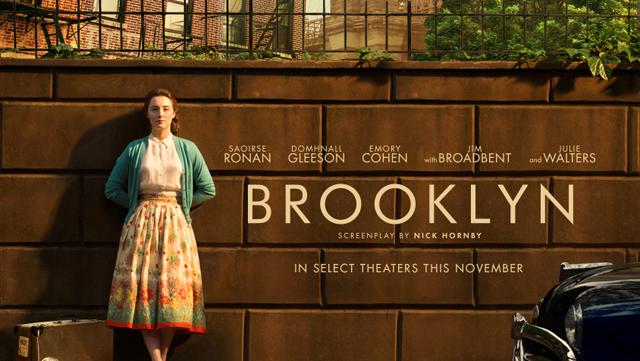
In 1952 Ellis Lacey (Saoirse Ronan) hands in the notice for her Sunday job at the local shop. She is leaving her small village in Ireland, her home and the only place she has ever known, to move to Brooklyn. On Ellis’ behalf her older, and much- adored older sister Rose (Fiona Glascott), wrote to Father Flood (Jim Broadbent) an Irish Catholic Priest living in Brooklyn asking to give Ellis a chance. Flood agrees to sponsor Ellis – paying for her travel, the start of her accommodation and finding her a job – as there are no opportunities for a bright girl like her his offer is a life-line to a new life. The ferry journey to America is hard, the first few weeks in Brooklyn even harder. She feels so homesick she is scared that she is going to die. It does fade however with time and love – in the form of Italian-American plumber Tony Fiorello (Emory Cohen). But when tragedy strikes she must return to Ireland.  Ellis soon becomes torn between her new life in American and a new life being offered by a possible new love, eligible bachelor Jim Farrell (Domhnall Gleeson). She must choose between both countries, and they both promise.

This film is good. So good in fact that ‘good’ is an inadequate adjective. It’s marvellous. It’s wonderful. It’s exquisite. Few films are this charming: so full of pathos that stimulates both heart and mind. It even appears impossible to think of one negative trait that this film possesses – no fatal Achilles heel is present here. The performances by the entire cast are outstanding, allowing for the creation of an astonishingly well-crafted very real-seeming world.

Each character is three dimensional and rounded, yet this is Ronan’s movie. Her Ellis’ is able to articulate so much with the smallest of expressions – her internal turmoil revealed with looks rather than prosaic audible contemplations. Cohen and Gleeson both hold their own, creating characters that are shown to be equal in terms of romantic possibilities. Often films with a romantic triangle will be unfairly weighted in favour of one of the choices, pushing the audiences favour in one way. This is not true of Brooklyn as the polar opposite men, confident alpha-male Tony and charmingly unassuming Jim both offering lives which could suit Ellis, if only she could work out what it is that she wants.

Set in the 1950s, it is the perfect time capsule movie. The costumes are jaw-droppingly and envy-inducingly gorgeous. The characters are believable for the era, Julie Walters is truly hilarious as the owner of the single women’s boarding house. The music makes the heart-strings pull that much tighter.

The fear of choice, of choosing the road not yet taken, is portrayed tenderly and with nuance. Not a hint of melodrama here. A timeless must-see movie.

Bill

William Shakespeare: The Lost Years

Suffice to say, this is not another Bad Education Movie-style television to big screen disappointment of an adaptation. The team behind Horrible Histories have succeeded in translating their unique combination of historical-informed humour and slapstick. In fact Bill, along with Horrible Histories and their fantastical series Yonderland, has secured their place as natural successors to Monty Python and Blackadder.

Bill Shakespeare (Matthew Baynton) is a family man. He lives with his wife, Anne Hathaway (Martha Howe-Douglas), and their three children. Bill plays lute in a band called ‘Mortal Coil’, but after one concert where he tries to steal the spotlight he is told to ‘shuffle on’. It’s not us it’s you, they tell him. So Bill moves onto his next dream, being a playwright. As Stratford-Upon-Avon doesn’t actually have any theatres, he leaves his family to go and achieve his dream. In the process he befriends Christopher Marlowe and becomes embroiled in King Phillip II of Spain’s devious plot to murder Queen Elizabeth at a theatre production she is hosting.

The results are properly hilarious. The gag rate is so high, with most of it landing, that whilst laughing at one joke you may end up missing the next.  Of all the genres it is arguably comedy that is the hardest to do well. Aim too broad and you please no-one, aim too niche and you end up pleasing a minimal market. This irreverent biopic carefully, and to great effect, utilises modern references and a panto-esque tone to keep the audience tittering from start to finish. There are a few that are groan-worthy gags, a couple which are smirk-creating, many that are chuckle-inducing and a good handful of proper belly laughs. The team are not limited by their obligation to educate, as they were with the excellent Horrible Histories, and use that freedom to great effect. Considering we do not know what actually happened to Bill during the years between his abandoning his family in Stratford and emerging as royal playwright William Shakespeare, the events of this film are entirely plausible… well unlikely but possible.

One can only hope that situations such as Shakespeare educating Christopher Marlowe in ‘your mum’ jokes did in fact occur. If only because it leads to an immensely funny recurring gag within the film, that is seconded only by a henchman’s inability to understand the concept of a Trojan Horse. Other highlights include Helen McCory’s toothy and worn portrayal of Queen Elizabeth, some lovely throwaways about funding of the arts and a hilarious reference to ‘clunky exposition’. Baynton is excellent and rather endearing as an idealist and optimistic Shakespeare, as is Howe-Douglas as his under-appreciated wife.

Bill has a relatively taunt and witty script that has a joke for everyone. As expected the chemistry between the cast is electric, the gags reliably brilliant and the timing of them is spot-on. Well worth a watch.

Mistress America

A witty and endearing sister comedy

A ‘Manic Pixie Dream Girl’ was a term coined (and since abandoned) by film critic Nathan Rabin in 2007. It refers to a stock character type; a female character who is bubbly and quirky, who enters the life of a brooding, serious male to help him embrace the joys and wonderment of life. (See Kristen Dunst in Elizabethtown, Marilyn Monroe in Some Like It Hot, Belle in Beauty and the Beast and Zooey Deschanel in practically every movie.) Typically, though not in every case, the MPDG  is shown through the eyes of the male character (known as the Male Gaze) who idealises her, lusting after her and placing her on a pedestal. What’s interesting, and truly refreshing about Mistress America is that some of the MPDG and her narrative ways are on display whilst also being subverted and questioned. This film is the story of a hipster-sect but told with old-fashioned sophistication; an honest look at the complexities between worship and reality. But instead of a traditional romance the focus is on friendship.

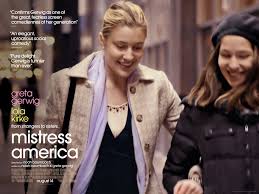
Tracy Fishcoe (Lola Kirke) is an 18-year-old college freshman undertaking her first semester in New York. She’s not enjoying it. It’s not what she had expected, feeling like she doesn’t fit in. In fact her life feels like she’s at a party where she ‘doesn’t no anyone.’ She gets rejected by a  boy, then rejected for an elite writing society and every attempt she makes to try and fit in becomes just another knock-back. Her soon-to-be-remarried mother suggests Tracy call her Brooke (Greta Gerwig) as this marriage will make the pair step-sisters. Brooke also lives in New York, but Tracy is too intimated to make the phonecall, believing this woman 14-year her senior would not want anything to do with her. However one lonely dinner -time she takes the chance to call Brooke, who instantly agrees to meet her. They enjoy a crazy night-out together, and continue to meet-up. When Brooke’s restaurant dreams start to fall through, Tracy endeavours to help the woman she now views as a sister.

In many ways Brooke meets a lot of the criteria of a MPDG, she’s the life and soul of every party. She knows everyone, appears able to do anything, and is keen to immerse Tracy in her world. Brooke even has a ‘quirky’ habit, appearing to not listen to other people so conservations with her sound disjointed.Even after meeting Brooke just the once Tracy is inspired to writer new short story, about thinly veiled version of Brooke. If this film wanted to be conventional or typical, it could have stayed this way. Brooke could have just stayed as Tracy’s muse, whose pure function is to inspire and guide her (an aspect that is mentioned within the latter half of the film). What’s so clever and makes the film so heart-warming is it isn’t just about that. It’s about friendship and sisterhood. It’s about how life doesn’t always meet up to it’s expectations and isn’t always as easy as it appears to other people. It’s the act of putting on a smile whilst inside you’re terrified.

When you’re 18 you’re certain that by the time you’re 30 everything will be sorted. That you’ll know everything, have everything and life will be sorted. Mistress America shows that really doesn’t happen, but that’s not a bad thing.