When Marnie Was There

A quietly moving and melancholic outsider tale

There are many reasons this film will leave you sobbing. First of all this may just be Studio Ghibli’s last film, at least for long while, if not ever. What an extraordinary note to go out on. When Marnie Was There is prime Ghibli, top-standard and the epitome of the brilliance the Japanese anime powerhouse is capable of. It also happens to be their most understated film yet.

Read More

Love & Friendship

An exquisitely elegant Austen adaptation

Love & Friendship is an adaptation of a Jane Austen novella entitled Lady Susan, written in 1794 but not published until 1871. Almost impossibly for a work by Austen it has never been adapted before. After seeing Love & Friendship the viewer will be left with two thoughts, 1) Why on Earth has such a brilliant story not made it to the screen before? and 2) Thank goodness it hadn’t as that version was absolutely perfect!  Love & Friendship is an absolute treat of a film and a gem of a must-see.

Lady Susan Vernon (Kate Beckinsale) is a widow and notorious flirt. Infamous for her ways of manipulation yet so utterly charming, magnetic and witty that most of society adores her. Seeking refuge after scandalous rumours spread about her private life, about a suspected relationship with married Lord Manwaring (Lochlann O’Mearáin), she arrives at her in-laws relying on their forced generosity. Whilst there she must continue her desperate search to find her daughter Federica (Morfydd Clark) a suitable husband and an even better match for herself. Seduction, deception, broken hearts and lots and lots of gossip ensue. 

There are so many wonderful things to say about this film. The way the story is told is extraordinarily brilliant. Originally an epistolary novella (a story told as a series of letters) writer-director-producer Whit Stillman turns monologues into dialogue with perfection. The editing is what truly makes this a success – hopping between people, places and things – nothing needless is shown and nothing is needlessly reshown. As opposed to an hours-long epic the period drama is reinvigorated with this 90 minute self-conscious comedic romp. The threads are skillfully interwoven with many outcomes that you may surprise and will definitely amuse. The dialogue is wonderfully written, snappy and lively, serving as a great reminder of just how funny Austen was. The fact the film has an age certification of ‘U’ just goes to show how well-written the script is: never have such brutal takedowns been so politely and eloquently written. 

The characterisation is superb with every character, no matter how facetious or self-indulgent, managing to be immensely likeable. Beckinsale as Lady Susan is a revelation –  a character who knows nothing nor cares little for either love or friendship yet knows just how to manipulate other’s feelings about both. Lady Susan’s manipulations are extraordinary and so skillful that you can’t help find her likeable and end up rooting for her.  She’s nasty and self-centered, others distrust of her and resentment of her status is fully understandable as is their envy of her, yet the viewer is spellbound by her. Some of her best moments are when she is scheming with the American Alicia (Chloë Sevigny) when the conversation becomes a biting satire of late 18th Century aristocracy. 

The entire cast are just as brilliant, there are no weak links here, but it is Bennett’s James Martin that almost steals the show. His performance is so earnest and well-meaning as a character who is unable to utter a sentence without creating moments of sheer awkwardness. In a film full of laugh-inducing moments, I don’t think I’ve laughed this often in ages, it is his character who has two of the biggest chuckle/chortle/tear-inducing funny moments, moments which I have been quoting constantly since.

The costumes, sets and visual style are all extraordinary. The entire cast an acting masterclass. A script and storyline that make hilarious an understatement. Easily one of the best films we will see this year (it’s not even June yet). Go see it. Now!

five star

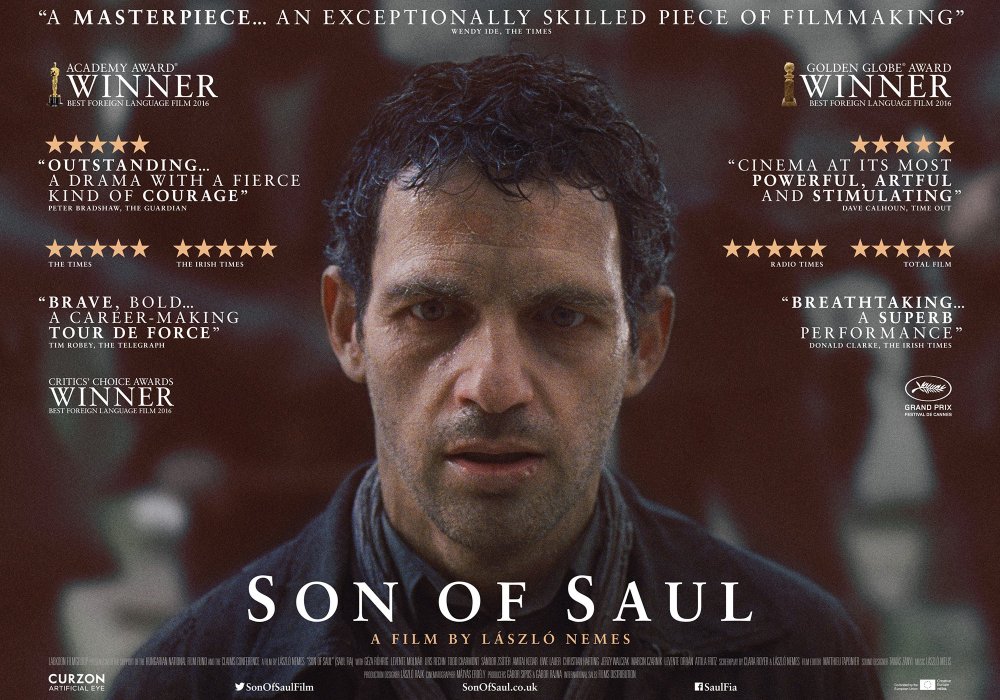
Son of Saul

A Masterpiece

When I left the mid-day screening of this film it was sunny outside. Bright rays gleamed upon the cinema and I glared at them. As I walked home there was a busker singing ‘Walking on Sunshine’. I glared at him. As I passed through a heaving farmers market I glared at the merry people chomping away. I couldn’t work out why I was reacting in this way. Ordinarily I would be thrilled by walking out of the cinema into sun. I would beam at a busker singing Katrina and the Waves 1983 seminal feel-good classic. And I’d probably only side-eye the hipsters filling the farmers market. Why was I so angry at everything? It seemed obvious that it was most likely my  response to the film and the horrors it entailed. But these were not horrors that were new to me – I hadn’t learnt anything new and the events of the film were horrifically familiar.

That’s when I fully grasped just how masterful ‘Son of Saul’ is. It’s almost a rethink of how to portray the Holocaust – by not showing it at all. Gone are any attempts at glamorization, of showy melodrama or noble heroism. Instead we are shown pieces of events – snippets of the evil that took place only feature in the side of or outside of the frame. Overt dramatization is replaced by close-up and over-the-shoulder shots with shallow focus on our central characters face. We hear the events but we don’t see them – leaving the spectator’s imagination to join the dots and fill in the gaps.  As Alfred Hitchcock said, “A glimpse into the world proves that horror is nothing other than reality.”.

It is 1944. Saul (Géza Röhrig) is a Hungarian-Jewish prisoner at Auschwitz who is part of the Sonderkommando unit. He is forced, under threat of death, to work for the Nazis in removing the “‘pieces” (the term used for bodies) from the gas chambers. Although the job delays his death it is only a temporary pardon – the job, and therefore his life, has an expiry date of five months which he is fast approaching. When clearing out the chambers post-gassing he finds a still-breathing boy that he believes to be his son. The Nazi doctors swiftly suffocate the boy and decide to have an autopost performed on him to find out how he survived. Saul desperately endeavours to stop the autopsy and find a Rabbi to lead a proper burial for the boy. 

 The events that follow are unforgettable in terms of content and portrayal – relentless and horrifying yet the carnage is skillfully implied as opposed to being explicitly shown. The two hours spent watching this film are two hours spent being a spectator in Hell. Death is not shown but instead resides off-frame – an omnipotent and omnipresent force haunting the frame. Just as one should not look directly into the sun we cannot look directly into the face of evil.

The opening sequence must be forever acknowledged in its audacity and its viscerality. We observe Saul as a sheepdog figure, one of many leading herds of bewildered people into what appears to be a changing room. An off-screen voice offers reassuring sentiments they are going for a shower and offers promises of what will follow. Our focus never leaves Saul’s face as we swiftly realise with unbearable inevitability what will happen next. We don’t see the people enter the gas chamber. We don’t see them die. But we do hear them die.

Rohrig’s performance is truly exceptional – his Saul is haunted and hollow. Grizzled by the unspeakable horror, his jaw is rigid with determination and his eyes are empty. We can only wonder how he keeps on living. The fact this is Rohrig’s first performance, as it is the director’s first feature, only adds to the remarkability of this film.

It is unbearably difficult to write this review – every word or phrase seems inadequate to fully describe the soul-altering experience of watching. It leaves you so numb you can no longer cry. Unlike any other Holocaust film there is nothing here to sweeten the devastating blow of watching this film – no beautiful musical score, no magical rescue and no story of redemption. It’s an intense and immersive experience with a the visceral immediacy it provokes that is ultimately necessary. Truly unforgettable.

five star