Sing Street

1980s. Dublin. New Romantics.

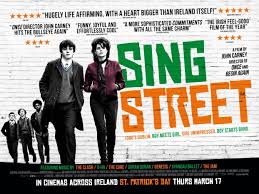
If the prospect of those three words being combined into a film does not fill you with glee I’m not sure how well we’re going to get on or how well you’re going to get on with this film. If you haven’t jumped ship  and are still reading – then this film may just be for you! From John Carney, the writer-director-producer of  Once and Begin Again, comes another musical tale about love and friendship. But this time our main characters are teenagers and they are forming a band The Commitments-style. The result is one of the most rewarding, enjoyable and grin-inducing films of the year so far.

It’s 1985. Like all epic stories it started with money problems and a girl. Connor (Ferdia Walsh-Peelo) is forced to leave his expensive fee-paying school and attend the local state school Synge Street CBS. The family has little money coming in as patriarch Robert (Aidan Gillen) is finding his architecture practice is not really required during a financial crisis. It’s at his new school, well on the school’s doorstep, that Connor first meets Raphina (Lucy Boynton). Raphina is an older lady, one year older, and is the most glamorous/gorgeous/extraordinary woman Cosmo has ever seen. New-found friend and wanna-be entrepreneur Darren (Ben Carolan) explains the school gossip that Raphina is a model who will soon be moving to England to make her fortune. Connor bravely introduces himself to Raphina and offers her a job that weekend to star in his band’s music video. After a bit of charming she agrees to take the job. Except Connor doesn’t actually have a band – yet. With audiophile elder brother Brendan (Jack Reynor) to guide him surely it’ll all be easy, won’t it..?

There are so many reasons to love this film – many of which I don’t want to discuss in too much detail or give away as it’s discovering them for yourself that only add to the brilliance. However I will briefly give the headlines of the reasons for my adoration. For favourite character I am torn between Brendan and bespeckled multi-instrumentalist Eamon (Mark McKenna). The soundtrack will undoubtedly be one of the best of the year – the classics are superbly chosen and the original songs (such Riddle of the Model) are wonderful tributes with some infectiously catchy riffs. The storyline is told with great empathy and sympathy. This is a film that truly cares about its characters. The music videos the band makes are both hilarious and nostalgia-inducing (even for those of us who were not alive in 1985!) I full enjoyed the references to The Cure, Duran Duran and Spandau Ballet to name just three – I can only imagine the depth of the enjoyment for those who leaved and breathed this music scene. The friendship between the newly-formed band is heart-warming and believable thanks to some fantastic chemistry between them. The film also manages to cover lots of ‘big’ topics – mental health, adultery, abuse – sensitively and appropriately. There’s a great balance here between pathos and humour. 

My main criticism would be the treatment of Raphina. Boynton does an excellent job with the material she is given but the presentation/treatment of her character is far too Maniac Pixie Dream Girl. For the most part we only learn about Raphina through what Connor (whom Raphina later renames Cosmo) sees and hears. She doesn’t transcend being his figure of worship and far too much screen time is dedicated to his male-gaze watching her. Whilst the dialogue of most of the characters is rooted in a degree of realism or believability Raphina’s craic is over-rehearsed. Arguably this could be a reflection of her personality as a character but for the most part her dialogue rarely lands as effectively like the other characters. Any film that focuses on a romantic crush, be that of a man or woman, must deal with the universality of the story arc as a duel-edged sword.  Whilst it makes for an accessible storyline, as the majority of the world’s population would have had a romantic crush at some point or another,  it means we then have to believe in the crush and that all the turmoil it brings our lead character is worth it. Is Raphina worth it?

Aside from my ponderings on potentially dubious representation, I truly loved Sing Street. So much so I think a rewatch in the new few weeks will be in order. It tickles the funny bone whilst tugging at the heart strings. It’s an old-fashioned story told with great warmth and will great skill. And, for New Romantics at heart like me, it’s chance to feel immersed in and nostalgic for a lifetime I never lived.

4.5


Florence Foster Jenkins

Further proof that films are like buses

Occasionally, more frequently than a blue moon but not as often as a full moon, two films about the same topic will come out at around the same time. The most famous example would be 1998’s apocalyptic clash between Michael Bay’s Armageddon and Mimi Leder’s Deep Impact (to save you from speculating, I prefer the latter). And now, in 2016, we have two films about ‘the world’s worst opera singer’ Florence Foster Jenkins. Mme Jenkins was born in 1868 and spent many of the latter years of her life as part of New York’s aristocratic music scene. Renowned for being a very generous benefactor of ‘struggling’ artists she was unsurprisingly popular, so much so her inner circle were able to put up with her recitals – recitals which recordings prove were devoid of tone, rhythm, pitch and sustainment of a single note.  Last month’s magnificent Marguerite was inspired by Florence Foster Jenkins infamous legend – transplanting the character to 1920s France. Now we have one of the grand dames of acting playing her in a biopic of her life in a production that is difficult to avoid comparison to its wonderful European spiritual counterpart

.After an incredibly well-received production in front of a gathering of her various women’s groups, most of which she chairs, Florence Foster Jenkins (Meryl Streep) decides she wants to get back into the swing of regular rehearsing again – ideally culminating in a grand performance. She sets her loving husband St Clair Bayfield (Hugh Grant) on the case. During auditions they find the perfect candidate in the form of Cosme McMoon (Simon Helberg). McMoon rehearses with Florence daily and swiftly becomes part of the furniture for Florence. Things aren’t as easy for McMoon as he must deal with the fact that he employer is the worst singer he has ever heard, something Florence’s British ex-thespian husband does not appear to acknowledge. Then again neither of them acknowledge the fact he lives in an apartment in the city with his mistress Kathleen (Rebecca Ferguson)…

As I have stated previously it is very hard to separate this from Marguerite which I enjoyed tremendously. It seems bitterly unfair to draw a comparison between two films that, subject matter aside, would never have been compared in terms of place of origin, cast or budget. However, and I have no qualms in admitting this,  I think Marguerite is the superior of the two. I really struggled when watching Florence Foster Jenkins for a multitude of reasons, reasons which have not really been addressed by the majority of reviews which shine the film’s praises.

I found the tone rather one-note (ironic considering the focus of the film!) with a plot that meandered between events and scenes. Streep’s characterisation at times bordered on pastiche. Could it be that Streep prefered to let her character reach for the high notes without providing the filler? However during the film’s quieter moments Streep really brings the character to life with some much needed depth with a revelation about 30 minutes in that does provoke a much-needed shift in tone. Admittedly this can be a common problem with ‘true story’ films as often truth can be stranger than fiction, making the truth rather difficult to believe. And yes, in case you were wondering, the singing is as bad as you’d think it would be. How the film portrays this singing is another aspect I found quite bristling when watching as I felt that the audience are called on more frequently to laugh at her rather than with her. As opposed to presenting her as a woman with a passion that truly gave her a purpose for living (*ahem* Marguerite) the film has would could almost be perceived as a mean streak as it laughs at her delusions instead.

This is not helped by the rather hollow archetype Grant portrays as her husband who spends most of his time maintaining Florence’s facade – that’s when he’s not entertaining his mistress. The reasoning for her presence is scarcely explained and results in Ferguson being vastly underused. Helberg (best known for playing Howard in The Big Bang Theorygrates profoundly as a camp closeted wannabe man about town.  The fact he spends the majority of the film with a fixed expression of embarrassed bewilderment only reinforces the sentiment that Florence is a figure of fun as opposed to one who requires understanding.

The film’s message is decidedly unclear.Many reviews refer to the affectionate and heartfelt treatment the film gives its title character. Instead the film feels light on charm, instead possessing a simplistic plot that is full of encouragement to point and laugh at a rather vulnerable figure.

2 stars

Miles Ahead

The man, a fair bit of myth and a whole lotta legend

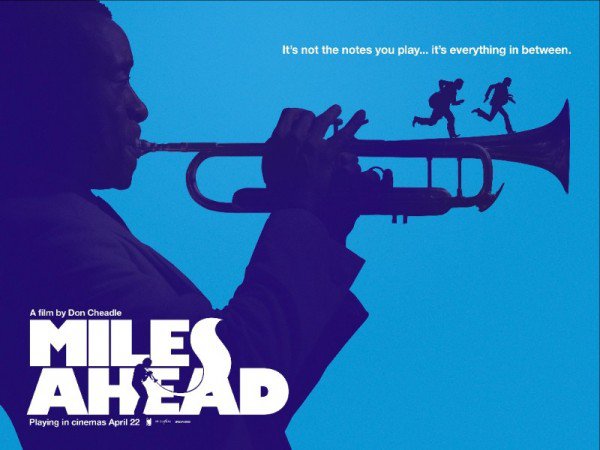
It what may be my favourite bit of description from the year so far director/co-writer/lead Don Cheadle describes ‘Miles Ahead’ as being a ‘metaphorical’ biopic of Miles Davies. Fact and fiction are rather skillfully blended to pay tribute to an incredible musician, a leader of the genre that should be called ‘social music not jazz’. For better or for worse (depending on your view) this is not a typical music biopic – it’s free from the cliches that come with it – instead favouring a magnificent mooch-like approach in exploring the lives and loves of a true musical legend.

It’s 1979 and Miles Davies (Don Cheadle) has been a recluse for five years. A rumoured comeback – not that Davies himself would call it that – is being heard on the grapevine. Having lost this muse Frances (Emayatzy Corinealdi) and his ‘lip’ thanks to self-medicating a variety of drugs, word gets around that Miles has actually recorded some new music – only he’s refusing to give it to his record label Columbia. That’s when Rolling Stone journalist Dave Brill (Ewan McGregor) literally comes a-knocking on his door. The attempted interview between the pair quickly descends into utter chaos – involving drug deals, shootouts, car chases, stolen records and a few trips into memory lane.

The greatest thing about this film is the fact that when watching it it is clear that you are watching a passion project. The adoration that Cheadle clearly feels towards Miles Davis pays off completely and shines through every mannerism or rasping of dialogue. Even when high as a kite or desperately searching for his next hit he is shown to be a true man of sharp-suited cool. And even when slightly darker sides of his personality come out – such as in the flashbacks of his relationship with Francis – he is still a character we can connect with even when we may not like him at that particular moment. His self-destruction is portrayed with such affection by Cheadle – it shines through his eyes in every scene.

The events of the film are mostly fictional, inspired by the past as opposed to retelling. It’s a unique touch, a very ambitious touch at that, and one which mostly pays off in how well it reflects its subject. This is also emphasised by the construction of the film, with neat little choices of direction allowing for the present to seamlessly blend into the past. It’s not typical ‘day in the life’ fayre, nor is it rise and fall narrative. Instead the film drifts, swaggers if you will, from one moment to the next.

Like Davis the film is smooth, if occasionally rather frustrating in terms of its storytelling. It is hugely enjoyable and incredibly well-acted. And, like the man himself, never boring.

stars