Adult Life Skills

British indie at its finest

This film sums up what we Brits do well – a somewhat melancholic story told with warmth and humour. An unsentimental tale told with compassion. Also, puns. There is so much to love about this film that I suspect I’ll be championing it a long while yet.

Anna (Jodie Whittaker) is one week away from her thirtieth birthday. She works at a nature resort in a middle-of-nowhere part of Northern England, lives in the shed at the end of her mum’s garden and enjoys making films featuring her thumbs with smiley faces on them talking about nihilism. Due to the relatively recent death of her twin brother (Edward Hogg) she can’t face talking about her birthday, yet it seems everyone from mum Marion (Lorraine Ashbourne) and Grandma Jean (Eileen Davies) to her best friend Fiona (Rachael Deering) and Fiona’s sister Alice (Alice Lowe) to the boy who used to annoy her at school Brendan (Brett Goldstein) want to talk about both her Birthday and where her life is going. 

Although the setting, the majority of the characters and their circumstances may not initially appear universal they really are. The film acts as a reflection on loss, self-isolation and the struggle to find who you are. Yes, as a 23 year old female that may appear more relevant to me than many others it’s relevant to us all. We all have experienced – be that aged 3, 23, 33,53 or 83 – a loss that derailed us, that either out of choice or not, took us on a course we never intended. Grief lasts far longer than the funeral and for some we wake up years later and look at metaphorically derelict path we ended up on. Anna’s self-loathing may be a concept I am all too aware of through personal experience, yet the battle to regain self-confidence is a ubiquitous challenge many of us have/will face. The fact we see such likeable and familiar-seeming characters facing this in ‘Adult Life Skills’ makes for a deep and visceral experience.

I apologise if the above paragraph made the film sound boring and serious. It really isn’t boring but it is somewhat serious, in terms of its themes not how it is told. It is properly funny quite often and whilst I did cry (I think it was at least three times) I did guffaw at least double that and left the screen grinning.

I loved every single one of the characters. I really felt like Anna became a friend whilst watching the film, she’s so well-rounded both in characterisation and performance. I’ve loved watching Whittaker in everything I’ve seen her in (Good Vibrations is my personal favourite) and her performance her is no exception. Fiona is brilliant as the best friend desperately trying to help her lost friend. Brett Goldstein, who was wonderful in  last year’s little known indie flick SuperBob, is just as good here. He is great at playing a logical figure to Anna’s less-than-logical thought processes, providing a truly earnest performance. Pus the man is an expert at eyebrow acting.

‘Adult Life Skills’ is now easily in my top five films of the year so far.  Whilst Mother’s Day (click here to read my review) may be filling cinema screens with a national release, profiting on cheap and disingenuous sentiment,  it is films like this we should be rooting for.  When the film ended it felt like I was saying goodbye to newfound friends. Yesterday’s preview was the first of my many watches of it.

4.5

Tale Of Tales

A twisted take on twisted tales

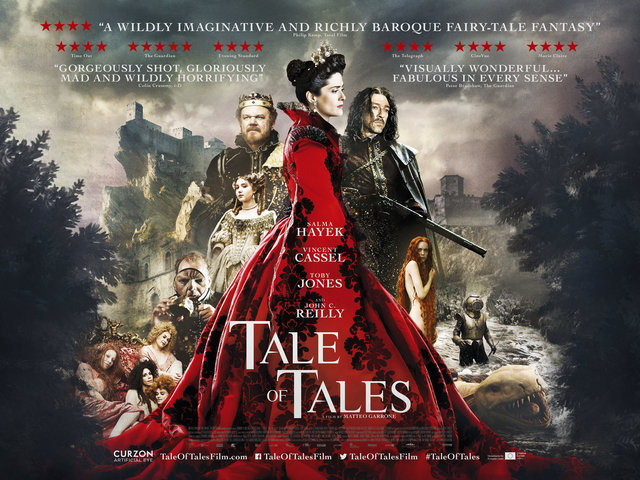
I bloody loved this film. It has everything I love in one place- fairytale s (the dark kind), kings & queens, tricks & spells, deals & plots, oaths & secrets, love & betrayal and tales of the unexpected. It’s all told so well, with so much love and care, with everything looking absolutely gorgeous. Last week I criticized Alice Through The Looking Glass for many things (see my review here)  but the main one was for being a ‘film which feels like it was made by people who read a book called ‘Pretending To Be Weird For Dummies”. Those ‘people’ need to go see this because this is how you do it. If you’re looking for strange, dark and morbidly entertaining tales then look no more!

The Queen of Longtrellis (Salma Hayek) is desperate to have a child but everything she and her husband (John C. Reilly) try fails to work. When a mysterious stranger, a necromancer (Franco Pistoni), visits the castle he offers a risky solution. They need to find a sea monster, kill it and then have its heart cooked by a virgin which the Queen must eat. She will fall instantly pregnant. The necromancer warning that this will be at the cost of a life – a warning the Queen ignores. 

The King of Highhills (Toby Jones) befriends a flea that appears to be able to follow instructions. A friendship soon blossoms and the flea grows and grows. When the now extremely and unbelievably large flea dies the King uses  the flea’s skin as part of a game – whoever can guess the what animal the skin belonged to will get to marry his only daughter. Such a shame for Princess Violet (Bebe Cave) that it’s an ogre who guesses correctly. 

The sex-obsessed King of Strongcliff (Vincent Cassel) hears the voice of an angel whilst prowling his kingdom. He pursues the voice and demands to seduce her, not knowing the voice belong to an elderly woman Dora (Hayley Carmichael) who lives with her equally elderly sister Imma (Shirley Henderson). Dora intends to lead the King along, knowing that she is putting her’s and her sister’s life in danger. A chance meeting with a witch provides her heart’s greatest desire – but is it too good to be true?

That’s only the beginning of each tale. There’s so much more for you to see – so much of which is unexpected, some of which is slightly scary, and all of which is a true pleasure to watch. It’s a feast for the eyes, the brain and the heart. The performances are all solid and utterly believable. There’s depth within each character, a reason and motivation rooted in their decisions. Hayek is stand-out, as is Toby Jones as a man who shifts from arrogance (‘ha ha they’ll never guess what animal it is and I’ll keep my daughter forever’) to devastation (‘Now my son-in-law is an ogre!’) in truly sympathetic manner. Even Cassel’s lustful pursuit manages to be bizarrely sympathetic for all parties involved.

The three tales are interwoven, tentatively linked within the story but fully linked in terms of message. The three tales are based on stories from a 17th Century anthology, they are La Cerva Fatata (The Enchanted Doe), La Pulce (The Flea), La Vecchia Scorticata (The Flayed Old Lady)- but they have been freely adapted with elements of other tales by Giambattista Basile, as well as a touch of artistic license. Although set in a medieval Italy it does feel that their are messages being targeted the audiences today – about consequences of decisions and the nature of family.

The costumes are jaw-dropping, the monsters Kafkaesque, the settings breath-taking, the soundtrack haunting yet never overwhelming and the performances totally memorable. Films like this don’t come around very often so see it whilst you can!

4.5


Miles Ahead

The man, a fair bit of myth and a whole lotta legend

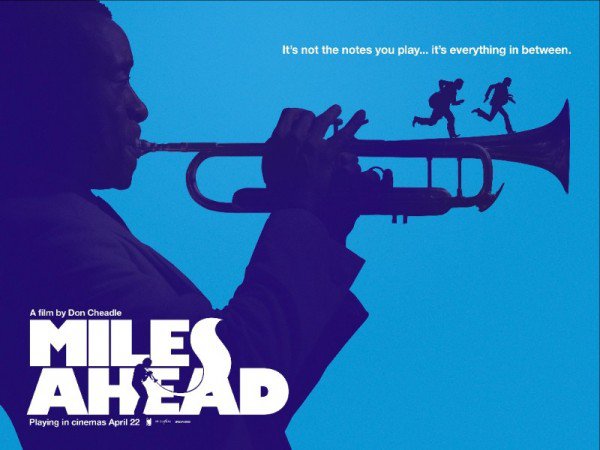
It what may be my favourite bit of description from the year so far director/co-writer/lead Don Cheadle describes ‘Miles Ahead’ as being a ‘metaphorical’ biopic of Miles Davies. Fact and fiction are rather skillfully blended to pay tribute to an incredible musician, a leader of the genre that should be called ‘social music not jazz’. For better or for worse (depending on your view) this is not a typical music biopic – it’s free from the cliches that come with it – instead favouring a magnificent mooch-like approach in exploring the lives and loves of a true musical legend.

It’s 1979 and Miles Davies (Don Cheadle) has been a recluse for five years. A rumoured comeback – not that Davies himself would call it that – is being heard on the grapevine. Having lost this muse Frances (Emayatzy Corinealdi) and his ‘lip’ thanks to self-medicating a variety of drugs, word gets around that Miles has actually recorded some new music – only he’s refusing to give it to his record label Columbia. That’s when Rolling Stone journalist Dave Brill (Ewan McGregor) literally comes a-knocking on his door. The attempted interview between the pair quickly descends into utter chaos – involving drug deals, shootouts, car chases, stolen records and a few trips into memory lane.

The greatest thing about this film is the fact that when watching it it is clear that you are watching a passion project. The adoration that Cheadle clearly feels towards Miles Davis pays off completely and shines through every mannerism or rasping of dialogue. Even when high as a kite or desperately searching for his next hit he is shown to be a true man of sharp-suited cool. And even when slightly darker sides of his personality come out – such as in the flashbacks of his relationship with Francis – he is still a character we can connect with even when we may not like him at that particular moment. His self-destruction is portrayed with such affection by Cheadle – it shines through his eyes in every scene.

The events of the film are mostly fictional, inspired by the past as opposed to retelling. It’s a unique touch, a very ambitious touch at that, and one which mostly pays off in how well it reflects its subject. This is also emphasised by the construction of the film, with neat little choices of direction allowing for the present to seamlessly blend into the past. It’s not typical ‘day in the life’ fayre, nor is it rise and fall narrative. Instead the film drifts, swaggers if you will, from one moment to the next.

Like Davis the film is smooth, if occasionally rather frustrating in terms of its storytelling. It is hugely enjoyable and incredibly well-acted. And, like the man himself, never boring.

stars 

Anomalisa


‘What is it to be human?’

Anomalisa is a masterpiece of cinema – a tale about the human condition told by puppets that is the most real movie in years.  We’ve all had awkward encounters – be that with ex-partners, conversations with strangers in a lift or the force-fed wisdom of a brusque taxi driver. We’ve all (hopefully) had a moment where you meet someone who, somehow and somewhere deep inside of yourself, you innately know that ‘this person is important to my future’. Now imagine a film that has the later as its main storyline but is layered with lots and lots of the former. That’s Anomalisa. It’s hilarious and sad at the same time, just like life, whilst reflecting on how bitterly lonely existence can be. Artistic greatness channelled through stop-motion puppetry.

It’s 2005. Michael Stone (David Thewlis), customer service consultant extraordinaire, is travelling to Cincinnati for a convention at which he is due to speak. To Michael everyone else on the planet appears to have the identical voices and faces. He is just spending one night at the hotel before travelling back home to his wife (Tom Noonan) and child (Tom Noonan. He decides that, as he’s in the area and plagued by self-hate, he’ll call up his old flame Bella (Tom Noonan) in the hope that Bella will help him find out what is wrong with him. Things do not go well, but upon retreating to his hotel room he hears a voice that is different from everyone else. He searches desperately and finds Lisa Hesselman (Jennifer Jason Leigh. Michael is instantly enraptured by her different voice and face, desperately hoping that she will cure his crippling loneliness.

This film, written and co-directed by Charlie Kaufman, does not have to try hard to be strange. Everything about it is strange, but that’s not criticism when you really reflect on how strange life often is. The most obvious ‘strange’ aspect is the fact the entire world is only voiced by three people – Thewlis as our lead, Jason Leigh supporting and Noonan as everyone else. Have one actor voicing 98% of this world has the most wondrously bleak effect, allowing for everyone else to blur in the background. They are unimportant therefore there characters are not defined, which is how our protagonist Michael Stone views the world. Few central characters are this self-hating, haunted by guilt and bad memories. Did the voices always sound the same, or has life for Michael etched away its beautiful nuances?

The interactions with both strangers and those who are supposedly the closed to him are all so affecting in there believability – many of them of the concealing-your-eyes-as-you-watch variety. But it is Michael’s interactions with Lisa that are the most beautiful and the most heart-breaking. Lisa is the exact opposite of Michael, Lisa is insecure and desperately lacking in confidence, yet is just as lonely as he is. Lisa is a great admirer or Michael’s and an obsessive reader of his book which helped her increase work ‘productivity by 90%’!  The beginning of their courtship is so tenderly handled, and perhaps the most human we’ll see on the big screen this year. Lisa’s serenading Michael with a cover of ‘Girls Just Wanna Have Fun’ will fill your eyes with tears. The film’s title stems from this point of the movie, when Lisa reveals she has always felt like an ‘anomaly’ which Michael then teams with ‘Lisa’ to form her self-appointed nickname ‘Anomalisa’. This conversation alone personifies their relationship, Michael and the film itself. Is he laughing at her by giving her this name, or showing just how much he understands?

Watching Anomalisa is almost like watching an autopsy or listening to a psychiatrist’s evaluation –   cutting apart our very psychology, our brains and being, then showing us how they work. Like The Matrix it’s up to you whether you take the blue or red pill.

Breathtakingly beautiful and bitter in equal measure; dare you see it?

Hail, Caesar!

All Hail Hollywood!  And, all Hail the Coen Brothers!

1951 was a bit of strange time for Hollywood. The studio system was starting to shift and the oligarchic owners were starting to lose power. Rather understandably its stars were getting fed up of being owned by the studios. The studios got to decide what they would be starring in, who they would be working with, what they looked like and even who they were dating. The post-world war two boom had begun to grow to a standstill and film-makers weren’t quite sure what the people wanted. Some classic films were made that year (A Street Car Named Desire, Alice In Wonderland and The African Queen, to name but three) as were a lot of terrible movies from every genre and hybrid-genre you could possibly think of. If the people don’t know what they want, adopt a ‘throw-everything-at-them-and-see-what-sticks policy’. It’s these issues that make the era a perfect setting for a movie. It’s also the reason that the Coen brothers are the perfect men for the job.

The life of the head of production at Capitol Pictures is not an easy one. In 27 hours Eddie Mannix (Josh Brolin) must handle one drama after another. First there’s the lead of his series of synchronised swimming epics (Scarlett Johansson) who’s both pregnant and unmarried. Then there’s the all-singing and little-talking cowboy(Alden Ehrenreich) who is forcibly being made to transition from Westerns into thespian drama, much to the bitter frustration of his new luvvie director (Ralph Fiennes) followed up by a check-in on the latest musical starring multi-talented (Channing Tatum), dodging the four preying eyes of gossip columnist twins (both played by Tilda Swinton) and most importantly finding his A-list star (George Clooney) who has disappeared from set. Maybe his job offer from the aviation industry isn’t that unappealing after all…

First I want to state that this is not a perfect movie. Its pacing is off, and the entire film feels like a series of rather delightful misadventures as opposed to one overarching narrative. That fact will put some people off (although that doesn’t really explain/justify the 16 people who walked out of the screening I attended). But for others, including myself, this fundamental flaw is in fact another reason to cherish the movie as surely that rhythm or tone of chaotic mayhem is how life working in the dwindling studio system would have been. What is also allows the Coen brothers to do is duel-handily poke fun at the farce-like-ness of this period of time, and also lovingly embrace it.

Each set-piece is beyond stunning. Every single costume is stunning, with every single character feeling like a tribute to a by-gone era. The synchronised swimming sequence featuring a giant, mechanical whale reinforces the notion that this is THE Dream Factory. The loving pastiche theme continues with Channing Tatum’s ludicrously inventive tap dance and singing number, where he and a dozen sailor lament their going on door as ‘We Ain’t Gonna See No Dames.” However, speaking from personal preference, it’s Alden Ehrenreich as Hobie Doyle the Cowboy-turned-actor who totally steals the show. When considering the talent (ahem, Brolin, Johansson, Finnes and Cloonney!) this is truly no mean feat. Doyle is the perfect blend of dim but charming. His attempts at ‘serious’ acting are utterly charming but it’s his date with Carlotta Valdez (cheeky nod to Hitchcock’s ‘Vertigo’ there!) , an up-and-coming Latina actress that will win the hearts of the nation. His accidental wooing of her is pinch-his-cheeks and say ‘nawww’ levels of adorability. He is definitely one to watch.

Although the ‘star of the show’ may not actually steal the spotlight (as hopefully outlined and justified above) it’s Clooney’s storyline that solidifies the fact that this film is not throughway fluff. His ‘journey’ whilst held hostage provides much reflection on the nature of Hollywood ideology, a subliminal critique of the industry by reflecting on the very nature of entertainment, the ugly work that goes into creating what we view as such beauty…but that’s a discussion for another day, (ideally in a pub, with a drink in hand!)

For now, I’ll leave you with this. For those of us who are nostalgic for a time we never lived (I’m including myself in this category) there’s escapism and incredible tributes to the past. For cinephilles there’s subtle reflection on the ugly/beautiful process of cinema-making. There’s also romance, lots of humour and Channing Tatum signing (who knew he had the voice of an angel!?!)

If you’ve got a spare hour and forty minutes this is a film well-worth your money. Enjoy!


A Bigger Splash

A rockstar, a record producer, a documentary-maker and a recently discovered illegitimate daughter go on holiday…

The hardest thing I suspect I will find about writing this review is overusing the adjective ‘beautiful’ and its various synonyms, because that is what A Bigger Splash is. Beautiful. Beautiful cast in beautiful scenery that is beautifully shot and with a story that is beautifully told.

Marianne Lane (Tilda Swinton) is a rockstar of arena-like proportions. After surgery on her throat and vocal chords renders her mute for several weeks (as part of her post-operative recovery) she decides to go into reclusion with her partner Paul (Matthias Schoenaerts). They are staying on the remote Italian island of Pantelleria when their weeks of nudity and nookie are interrupted by the arrival of her ex-producer and ex-lover Harry (Ralph Fiennes), who has brought with him Penelope (Dakota Johnson) who recently discovered that Harry is her father. What follows will test the ties of fraternity, paternity and sexuality with catastrophic consequences.

The events of the film play out in a way that is unpredictable, sweaty and bitterly humorous. This is Swindon and Fiennes at the top of their respective games. Due to her character’s temporary muteness Swindon has little dialogue; the few lines she does say are husky and barely audible. Instead she says entire monologues on matters of the heart with her facial expressions – bitter rage, frustration, mortification, adoration and admiration shown through looks. A less-skilled actress would be constricted by her characters damaged vocal chords; instead what could be a limitation showcases the true skill Swindon possesses. The grace and manner of her movements and expressions, along her facial expressions, bring Marianne Lake: Rock Star to life. Both when painted in David Bowie-esque costume and make-up and when wearing nothing at all, it feels like you are watching the life of a real, if fatally flawed, person.

At 52, with countless film and theatre credits which demonstrate his mastery, it is incredibly impressive that Fiennes can still surprise. His Harry Hawkes is a bundle of raw energy, a magnetic charisma who dominates each scene. Along with providing the funniest moments of the film (and a dance sequence to The Rolling Stones that I challenge you to be able to watch without averting your eyes in bewildered embarrassment) he demonstrates the mythical fine line between comedy and tragedy. Harry Hawkes is a man who uses his charisma, uniqueness, nerve and talent to mask much inner-darkness. His self-destructive descent into hedonism is (dance sequence aside) utterly enthralling.

It’s a pleasure to see Schoenaerts on the big screen again, roughly 10 months since the release of Far from the Madding Crowd and his enamouring take on loyal and noble Gabriel Oak. His character here, Paul, is one who initially appears to have fewer layers than his romantic partner and love rival, but this proves that appearances can be deceptive. He is currently one of the most interesting and underappreciated supporting actors in cinema at the moment, and I greatly look forward to seeing more of his (admittedly rather beautiful) self.

And then there’s Dakota Johnson, of 50 Shades of Grey infamy. What A Bigger Splash succeeds in doing is adding another reason for why Shades is such a mediocre movie, as A Bigger Splash proves that not only can Johnson act but she is mighty fine at it. In fact, she well and truly holds her on with her fellow leads. Penelope is an intriguing character, made even more so by Johnson’s acting ability. Penelope is a character who almost defies description (in a complimentary way), suffice to say she is a product of her father in the best/worst of ways.

 There is one more crucial player in A Bigger SplashPantelleria itself. Located 100km southwest of Sicily (fact found courtesy of Google) it is a place I had not heard of prior to the film and is of such unrivalled beauty that I cannot escape mentally from the mysticism of it. Few places, when on the screen, are displayed in such heart-stopping and breath-taking beauty. The events of A Bigger Splash, when splayed out in a review such as this could seem almost borderline-soap opera. It’s the scenery, and the skill through which it is shown, that prevents this. Yes some sequences possess a degree of melodrama, but setting it in such a beautiful (alluring, dazzling, exquisite, stunning, and wonderful) landscape only elevates the emotional response of the subsequent events. However, it’s the slightly oddball, quirky tone of these events that makes the film truly memorable. Though the pacing is slightly stilled on minor occasions, with one or two plot points that drag, there is a humour tinged by darkness that makes the plot haunting and ultimately cataclysmic.

A sun-kissed soap opera told with class and comedy with an abundance of tragedy. A must-see.


Pride and Prejudice and Zombies

45% Pride and 45% Prejudice and 10% Zombies

In 2004 Simon Pegg, Nick Frost and Edgar Wright created a new hybrid genre called Zombie-Romantic-Comedy (ZomRomCom) with Shaun of the Dead. In 2007 an American author took this one step further and wrote a parody novel of Jane Austen’s classic Pride and Prejudice by adding in zombies. Nearly 10 years later, after years of development hell (heh, that term has rarely been so apt) we have the film adaptation.  It may not be the most haunting (heh) Austen adaptation, nor will it give others a run for their money (heh, running from zombies) but it is more than entertaining and worth a watch. My main criticism, as you may have noticed from the subtitle is that the zombies make up a small proportion of the film, a too small proportion to really make the most of the high concept.

It is a truth universally acknowledged that a zombie in possession of brains must be in want of more brains. – Elizabeth Bennett. In a world that has been overrun by zombies for almost a hundred years, young women have more than enough to worry about than finding a husband. At least that is what Elizabeth Bennett (Lily James) thinks, and her four sisters agree to varying extents. Their mother Mrs Bennett (Sally Phillips), however, believes otherwise. Mr Bennett (Charles Dance) disagrees with his wife wholeheartedly, which is why he had his girls spend much of their childhood in China, training in the arts of killing zombies, moulding them into fearsome zombie-killing army. When Mr Bingley (Douglas Booth) reopens a residence nearby, he hosts an introductory ball to which the Bennetts are invited. It’s there that Elizabeth meets Colonel Fitzwilliam Darcy (Sam Riley) , a haughty monster-hunter renowned and feared for his zombie-killing skills. When the ball is invaded by zombies the Bennett sisters dazzle Darcy and Bingley with their skills, affection and admiration begins. But will the course of love ever run smooth whilst the undead stalk the Earth?

Overall, the film really succeeds for the first fifteen minutes. The concept feels fresh and funny, the zombie/romance balance is level (something I fear I will never get to write again…) and it’s a pleasurable novelty to see the key events of Austen’s novel enhanced by zombie tropes. There’s also a truly beautiful animated story-book style opening sequence, voiced by the legend that is Charles Dance, that informs us of how the zombies came to be. Unfortunately, the remaining 80-odd minutes of the film are not as pleasurable. The ZomRom balance (I’m going to copyright that phrase) does not really warrant the ‘and’ of the title. Maybe it should be Pride and Prejudice and a few zombies and lots of talking about zombies  (though perhaps that is not as catchy). When the zombies are actually on-screen it provides some of the best moments, producing a couple of jumps and a fair few laughs. But there is too much talking about strategies for dealing with zombies as opposed to fighting them.

However, it’s not all bad. The cast for this film is so good, and so well suited for their roles, that you actually wish this was just a straight-forward adaptation of Pride and Prejudice. Lily James, who shone in War & Peace last year’s Cinderella, is superb as a feisty and witty Elizabeth. She manages to make Elizabeth’s progression into a trained warrior seem almost plausible. She has great chemistry with Sam Riley’s Darcy, providing a degree of sexual tension previously unseen in adaptations of this work. Austen would have approved I suspect. However, as Parson Collins, Matt Smith steals every scene he is in. It’s great to see Smith in another comedic role (aside from his marmite take as The Doctor). Here his timing is brilliant and his ability to make a relatively small role stand out speaks volumes about his ability. Another wonderful surprise is Lena Headey as the one-eyed-eye-patch-wearing Lady Catherine de Bourgh, who snarls her way through her too-few-scenes. 

To conclude, this is a more than fine way to while away two hours. The cast is superb, the script has enough charm, and the novelty just great enough to entertain. Whilst easy to bemoan the minimal zombie presence, this is an excellent attempt at a twist on a classic with a fantastic cast who prevent it from being a forgettable B-movie.

Action, romance and zombies. Something for everyone with this film.

Goosebumps

“Viewer beware, you’re in for a scare!”

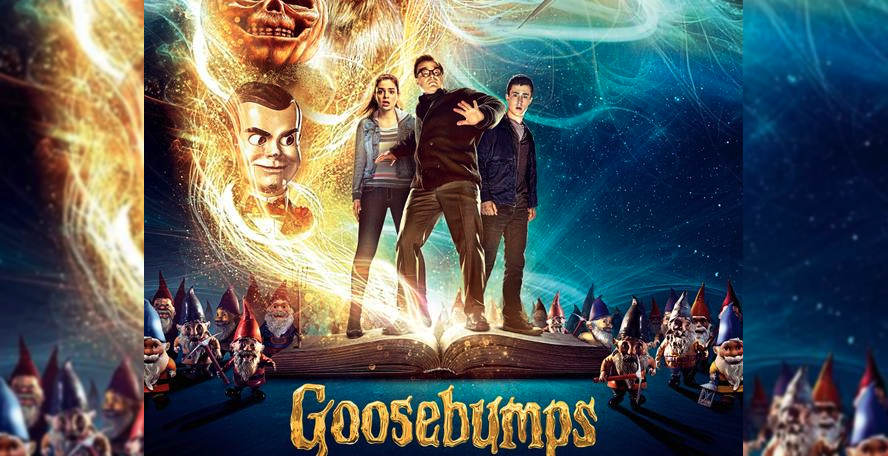
It’s easy to be a book snob. It’s easy to tell children which books are good to read and which books are bad to read. What constitutes a bad book for children? If it inspires just one child’s imagination,  gives them fears and feels in equal measure,  then surely a book can’t be bad? I’ve read Wilde, Dickens and both Poe. But I’ve also read Rowling, Wilson and Stein. Those six authors, along with countless authors, formulated my literary past and thus set the foundations for books to be read in the present and the future. J.K.Rowling may have figuratively taken me to Hogwarts and made me lament not receiving my letter when I was 11 (obviously during that period the ministry of magic was busy with other matters…), but it was R.L Stein that gave me a taste for ghouls, goblins and gore. Watching ‘Goosebumps’ felt like a risk, either prompting rage from my inner adolescent or transformative nostalgia. I’m very happy to report it’s the latter. Through a blend of live-action and animation the film manages to capture the goosebump-inducing fear of the books whilst also being rather light-hearted and funny.

A year after his dad has died, Zach Cooper (Dylan Minnette) and his vice-principal mother (Amy Ryan) move from New York to Madison, Delware. Though frustrated at his new small-town surroundings he knows that his mother’s new job will good for her, and the change in scenery may be good for both of them. When moving in, and having a box fall apart on him, he meets his new home-schooled neighbour (Odeya Rush). But their brief introduction is halted by Hannah’s grumpy and rather scary father, a man who may or may not be R.L. Stein (Jack Black). Hannah manages to sneak out and spend a day with Zach, but upon getting caught by her father she is punished. When Zach goes to rescue her, bringing along loveable loser sidekick (Ryan Lee), he stumbles across a bookshelf filled with what appear to be manuscripts for every Goosebumps story every written. However, after opening the manuscript of ‘The Abominable Snowman of Pasadena’ [side note: it is in my top ten Goosebumps] the Abominable Snowman itself comes out of the book. After a series of exciting events, manufactured by the Dummy of ‘Night of the Living Dummy [side note: definite top five contender] all of the manuscripts are opened, bringing all the monsters that Stein has ever written to live and bringing havoc among their town. Stein, Zach, Hannah and Champ must get all of them back in their books, where they belong. But things won’t be easy, and not everything is as it appears…

I really like this movie for numerous reasons, and in fact have a rather big soft spot for it. First of all, it brings all the monsters that once haunted my imagination to life. During the big crowd sequences I desperately searched the crowd for the familiar faces of the guests who overstayed their welcome in my nightmares. Going back to my opening point, I think it’s important that child can read books that scare them, and then show them how to defeat these fears. For children, and adults of a nervous disposition, this film does have rather spooky moments. There are one or two jumpy moments, and few monsters that are rather unsettling, but these are well contained moments and are more fun than fearful.

This leads me onto my second point, how surprisingly funny the film is. There are jokes for the children, and then there are jokes that will go over their heads and will crack up the adults in the audience. My three personal favourite jokes, which led to the emittance of loud laughter from many at the screening I attended, were a gag about the suffix –phile, a discussion about Stein verses Stephen King and a joke about domestic sales of books. Those three jokes (which I have intentionally poorly paraphrased) were well written, as are many others within the film.

The characterisation is good, with each character being more than likeable. In quite a nice shift, Hannah is the braver one whereas Zach and Champ are both rather jumpy in comparison. The animation is well-placed, never jarring with how it fits into the live-action, which is rather laudable. The music is never interfering, subtlety and successfully building the tension and fear. The pacing is also good, the 1hr 40mins never dragging and filled with more than enough twists and turns. This film is what family cinema should be. It shouldn’t patronise the younger members of the audience, or pander the humour towards them. It should engage them, spook them a little and excite them, just as Stein’s books did for me all those years ago.

If you’re looking for a light-hearted movie with a bit of bite, or something to entertain your children that won’t melt your brain, this is it. A very pleasant surprise.

The Big Short

Proof that reality itself provides the darkest of comedies

I was 16 on Monday the 15th of September 2008. I was watching the news while getting ready for my second week of college (yes, I was *that* kind of teen). The main headline, which kept being repeated at 15 minute intervals, was that a bank called Lehman Brothers had filed for bankruptcy.  I had no idea what this meant, but from the tone of the news reporter and from the footage of people in suits standing outside a fancy-looking building and crying, I could tell this was bad. ‘Bad’, as it turns out was an understatement. In the 8 years since the consequences have, and continue to be, devastating world-wide. But I can admit in full honesty, I had never understood how or why it happened. In fact I wasn’t quite sure what ‘it’ was. That’s where ‘The Big Short’ comes in. This film, set in the three years prior to the financial crisis, takes that serious and complicated sequence of events and turns into a scathing critique that can be understood by all. It forces you to confront the truth, whilst snorting at the true facts – the unfathomable stupidity caused by greed.

In 2005 hedge fund manager Michael Burry (Christian Bale) discovered that the American economy would be due to crash in late 2007. Why? Because the housing market was incredibly unstable, built on poor foundations of high risk subprime loans. Loans were being given out by banks to people who would never be able to pay them back, which would result in them having to default on their payments. For millions of the American public this would mean losing their homes and having to file for bankruptcy. By predicting this collapse Burry realised he could profit by betting against the banks who refused to believe it.

  Trader Jared Vennett (Ryan Gosling) hears of Burry’s actions and the prediction it is found upon and discovers it’s all true. A misplaced phone call to a wrong number leads him to hedge fund manager Mark Baum (Steve Carell). Baum invited Venett to a meeting, also attending by Baum’s three cynical partners. It is then that Venett reveals the level of greed that has occurred, and the inevitable dire consequences the level of fraudulence will have for the general public. 

Charlie Geller (John Magaro) and Jamie Shipley (Finn Wittrock) are two young friends and business partners, who have their own independent investment company. Having had some good fortune they have move to New York to play with the big leagues in New York. They are refused meetings with most of the big companies, and laughed at by those who agree to meet them. That’s when they hear of Vennett’s findings and ask for their help of old friend and retired banker Ben Rickert (Brad Pitt) to profit from the impending economic collapse. 

It’s incredible really that this domino effect (from Burry finding out the truth, Vennett hearing of it and pushing Baum to invest, with Geller and Shipley hearing of this and making their own investments) lead to his small group making an insane amount of money. What turns this incredibility into incredulity (or impassioned rage at the injustice and insanity) is that these few men saw something thousands of others in simillar jobs/positions couldn’t see or refused to see. That blind ignorance led to millions, maybe even billions, losing their jobs, homes and any possible chance of ever achieving financial stability. Four trillion dollars just disappeared – with no consequences for those whose actions led to it.

The film explores these dark crevices with a whip-smart script that provides a degree understanding that is almost a public service. It’s sardonic and full of wit, yet exposes the true woe of an ultimately depressing story. Somehow the film is wildly entertaining yet immensely informative. It’s perfect Friday night movie entertainment, yet allows for immense reflection. The editing is superb – using breaking of the fourth wall for great effect. Using stars like Margot Robbie and Selena Gomez  in cut-aways to explain key concepts is an incredible use of cultural commentary –  the banks wanted us to be distracted, ignorant of what was going on, so allowed us to focus on trivialities. Voice Over narration analyse the warped  ‘logic’ of a system that was not even understood by the bankers who used it.

The film doesn’t focuses on the suffering of the millions, but instead of the ‘outsiders’ at the centre of the storm. Each actor provides an incredible character performance – from Bale’s eccentric and tortured loner, to Carell’s pessimistic and embittered moral crusader. It’s these characters and those they interact with that make the film so entertaining. The interactions they have are farcical and beyond belief, based on incompetence and corruption – the kicker is that they are all true.

‘The Big Short’ is a contemporaneous disaster movie. We want our ‘heroes’ to succeed, knowing their success spells devastation for the entire nation. The punch-line? We watch it in hindsight, knowing what happens next. That’s the saddest’ joke’ of it all.

Joy

What is ‘Joy’?

The question above does not refer to eternal philosophical ideas, but is a question posed to director David. O. Russell. What is ‘Joy’? Is it a comedy, a tramedy, a somewhat biopic or an ironic look at the American Dream? In theory is shouldn’t be a bad thing that a film defies generic classification, that it is something new, fresh and different. However in this case this question is raised by how irregular in tone and pace the film is. The film is remarkably uneven, drifting from one genre to another. However, an incredible performance from Jennifer Lawrence anchors a film that overall doesn’t quite gel.

Joy (Jennifer Lawrence) is a divorced mother of two young children. Her ex-husband and failed musician Toni (Édgar Ramírez) lives in the basement. Her seemingly-agoraphobic divorcee mother (Virginia Madsen) doesn’t leave her bedroom and whiles away the days watching soap operas. Her lothario father Rudy (Robert De Niro) briefs comes to stay before finding love with rich but uptight Trudy (Isabella Rossellini). Her half-sister Peggy (Elisabeth Röhm) works with their father and constantly passively aggressively attacks Joy on a daily basis. All this is overseen by her loving Grandmother Mimi (Diane Ladd). Joy’s days are spent dealing with all of her family’s dramas, with life not having handed her a very even deck. Having spent the first half of childhood being incredibly creative, designing multiple inventions, her enthusiasm was crushed the day her parents split up.  17 years later Joy is not particularly happy, stuck with being her family’s errand girl. It is during one of these errands that Joy makes a new invention that she is sure will make a fortune. But persuading the world of the value of her idea, let alone even her family, will not be so easy. Yet a chance encounter with Neil Walker (Bradley Cooper) could be one step closer to the success she has always deserved. 

A great cast does not always make a great film, as some may view is true of ‘Joy.’ Though it does have some extraordinarily powerful scenes, some emotional hold-your-breath moments, that’s all they are – moments. For the film itself is rather meandering – moving in unexpected and somewhat underprepared ways. It muddles through the key events in Joy’s life in a rather lacklustre fashion – never quite achieving its potential. This could be for multiple reasons. One could be the source material, as this is not a biopic of real-life inventor Joy Mangano, but a blended narrative of multiple women O. Russell admired. Another could be the fact the film used four different screen editors, a decision that without true collaboration can result in four differently edited films being shoehorned together. Tonally the film aims for a quirkiness that seems remarkably forced, from the rather unrealistic quirks of the characters to the voiceover narration from Grandma Mimi, to the various time hops to some oddly-placed soap opera themed dreams.

Obviously once Joy has come up with her fantastic new idea it will not be easy to make it a reality, but the disequilibrium – Joy does something badass to fix it – temporary equilibrium – another bout of disequilibrium – does become rather repetitive after a while.  However is is that phrase ‘Joy does something badass to fix it’ that feels like the real point of this film. This is Lawrence’s third time at working with O. Russell and most of this ensemble cast and the benefits of that really shine through. The director knows how to help his lead achieve a star turn. And also her legacy in badass GIFS. Her performance is remarkable. Considering that she is potentially too young for this role Lawrence is incredible in how she interacts with the other characters, uses her voice to convey all manner of emotions and portray a world weariness that is beyond her years.

Overall ‘Joy’ in a enjoyable enough romp of a movie.  Though the film itself is rather direction-less Lawrence herself is a ‘Joy’ to watch.