An open letter to 20th Century Fox,
[HERE BE SPOILERS!]
Dear 20th Century Fox,
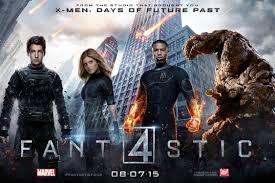
I write this letter/review to you immediately after seeing ‘Fantastic Four’. I’d like to ask to ask you one simple question. How did that happen? How did you manage to make such a mind-blowingly boring superhero movie? The film only lasts 100 minutes, but it felt like so much more. I do not write this to you as a comic book puritan, or as a ‘Fantastic Four’ puritan. I’ve only ever read one or two ‘Fantastic Four’ graphic novels, and I have a rather big soft spot for the 2005 film starring Chris Evans and Jessica Alba (yes, I know it’s pretty awful and dated but it is rather funny and, unlike this movie, rather entertaining.) I’d read the damning reviews of this, but still held out hope that there were some redeeming features within the movie. There really weren’t. The characters were tedious, unlikeable and one dimensional. The Frustratingly-dull Four, sorry ‘Fantastic’ Four (Reed Richards/ Mr Fantastic – Miles Teller, Ben Grimm/The Thing – Jamie Bell, Sue Storm/ Invisible Woman – Kate Mara and Johnny Storm/ Human Torch – Michael B. Jordan) were ill-served. They were given such rubbish material in terms of script that it’s unsurprising there was barely an ounce of charisma between them. But not only was the characterisation within the movie immensely poor – so was the pacing and story-telling. Whilst all films could be divided into acts, as an audience member you shouldn’t be able to see it. With this film there were three clear acts: the bad, the meh and the god-awful. Let’s look at them together…
‘The origin story’
Well first of all you stumbled at the first hurdle. Origin stories are problematic and require a careful balance. Whilst you want to introduce a mainstream audience who may not have any prior knowledge of the characters or their humble beginnings, you also want to placate the fans who are already well-versed in the mythology. I doubt you appeased either of those audiences. For one thing, the ‘Fantastic Four’ have a rather simple origin story – an experiment goes wrong and four scientists end up with superpowers. Done. It doesn’t require 30 minutes of screen-time to set this up, dating from childhood to the present day. It’s a bold decision, which requires a degree of audience sympathy to establish deep sympathy. Instead Reed Richards is established as a character of utter pity, presented in an unsympathetic portrayal of nerdom. He feels alone and an outcast (no points for originality here!) with his only supporter being his loyal best friend Ben Grimm. It’s at this point, 20th Century Fox, that you lost the majority of any fan-boy/girl loyalty. ‘It’s clobberin time’, The Thing’s battle-cry, his trademark for the past 54 years is established as the phrase Ben’s abusive brother uses as code that he is about to be beaten up. WHAT?!?! No. You took such a beloved catchphrase and tainted it, needlessly, utilising it as a symbol of darkness and pain. It many ways it’s the film’s Grimm-est (apologies, just trying to lighten the tone…) and one which would have alienated any of the ‘Fantastic Four’ fans who risked trailing this remake.
Conclusion: I care about Batman’s origins. I somewhat care about the Avenger’s origins (to varying degrees). I don’t care about Fantastic Four origins.
Finally the film gets to the should-be-good stuff with Reed, Ben and Johnny joined by Victor Doom (the only marginally interesting character, played by Toby Kebbell) use the machine they have created to enter another dimension, later named Zero. As made clear by the trailer (and known to anyone who knows even a small amount about comic books) it all goes wrong. The sequence itself is presented reasonably well and adequately (if not particularly subtlety) explains why each of the group got their particular power. Things seemed to be picking up…
‘Aftermath’
It’s at this point in the film that should I be forced, against my will, to retrospectively chose my ‘favourite’ five minutes, I would chose the first sequence of act two. The sequence where the three survivors, and the infected Sue Storm, are revealed to be being held at ‘Area 57’. They way their new powers are revealed to the audience, and their father figure Franklin Storm, hints at the film this could have been. The camera acts like a voyeur, examining these wounded figures and revelling in the grotesqueness of their new abilities. It’s almost like a David Cronenberg movie, with Reed’s stretched limbs, Sue intermittently fading out of existence, Johnny’s constant rage of fire and Ben’s hulking mass of boulders. They are treated and presented like the aftermath of a failed science experiment – which they are.
‘Showdown’
This sequence is cut bitterly short with Reed running away, promising to solve everything. Cut to black, ‘one year later’, then we have five minutes of exposition where we can see what the others three characters have spent the past year doing and how they can now harness their abilities. Then we have five minutes of a chase movie, where it’s proven to the viewer that Sue Storm is ‘smart’ as she can type furiously into a computer. Reed is located, returned to Area 57 and swiftly fixes the technology to revisit Zero. The human guinea pigs (some may call them idiots) who arrive at Zero are greeted by a seemingly injured Victor Doom. They bring him back to Earth and a dull-but-important man in a suit tells him that he plans to use Victor and the resources from Zero to create more human weapons. Victor does not react well to this and decides to wreak havoc on the facility and Earth itself. His proceeding actions, his Walk Of Pain if you will, are incredibly violent and rather shocking.
In fact it makes the film’s 12A rating seem pretty, erm, mind – blowing (sorry…)
We then have 15 minutes of a battle sequence. This fails for two reasons. It’s plotted in a way that induces battle fatigue, ‘wow, looks explosions and things being destroyed!’ and is scripted in a toe-curlingly clumsy manner. Highlights include,
‘It’s Victor! He’s the power source!’ and ‘He’s stronger than any of us!/Yes. But he’s not stronger than all of us!’ Victor is defeated and the four return home. They are given a new base of operations and discuss having a team name (yep, this film really favours subtlety…) Ben then reflects on his BF’s journey and says, ‘It’s just fantastic’ (spoken after he has literally been turned into a walking talking rock pile and just been used by the US military as a weapon for the past year. Reed pauses and says, ‘Wait. Say that again…’ And thus, in this ham-fisted manner, the team no-one really cares about is born and the film ends. No after-credit sequences, which this film could have really used.
All in all, 20th Century Foc, this film was bad. It was dull, boring, clunky and a poor attempt at a comic book adaption. One of the worst there has been for a long time. The fact that you made this film as a cynical way of holding onto the rights to the franchise, instead of letting them slip into the grasp of your mortal enemy (the immensely more successful Marvel Studios) make this an even more bitter cinematic experience. It’s sad to think of what might have been. You, perhaps over-eagerly, pencilled in a sequel before this film even came out. Good luck with that. It’s going to require more restructuring of both crew and cast than I think you have the balls for.
Best of luck,
Charlotte Sometimes

 Charlotte Sometimes