Mad Max: Fury Road


Not Aca-perfect, but certainly Aca-mazing…
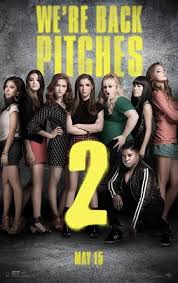
Pitch Perfect (2012) came along as a suprise hit – on the back of the Glee trend – it was funny,with an excellent soundtrack and immensly likeable characters. The sequel, set three years on (reflecting the real life time difference), also manages to hit all the right notes. All of the old favourite characters are back, with one or two new faces. Things are the same, but different. The Barden Bellas have been flying high for the past three years, undisputed and unbeaten champions at the a cappella nationals. The sequel opens mid-action, the Bellas are performing for President Obama’s birthday celebration at the Kennedy centre. This is clearly to not-so-subtly explain to the audience, ‘that’s how big they now are guys!’ Of course this success is not going to last for long (otherwise what would be the point of the next two hours!?!) and, very quickly the girls are back to being the underdogs.
As you have probably seen from the trailers or press interviews, during a fierce cover of ‘Wrecking Ball’ Fat Amy (Rebel Wilson) has a wardrobe malfunction. The wardrobe malfunction to end all wardrobe malfunctions. When hanging 40 feet in the air, wearing a skint-tight electric-blue unitard whilst performing aerobics, her unitard starts to rip. In the crotch-area. So, when tangled up in metres of fabric and therefore stuck, knowing that she it totally exposed, she is left mearly to rotate and accept the inevitable. The president, and seemingly the entire country, is then ‘forceibly’ exposed to her crotch.
The next five minutes of the film are devoted to the media reaction to the ‘horror’ that was having to see Fat Amy’s ‘gift from Down Under’. Whilst the media reaction is clearly and intentionally over-the-top it did start to feel uncomfortable to watch quite quickly. Thinking back to the media attention that used to be given to celebrities like Paris Hilton and Britney Spears – which where never as damning and seemingly disqusted as the new’s reporters are here – is that linked to Fat Amy’s (that is her self-appointed title) size that the media are so…horrified? If it had been one of the other Bellas that had been in the same situation, all of whom are slimmer and more typically Hollywood, would the incident have derailed their career in quite the same way?
Nevertheless, the girls are told they can keep their title for the remainder of the year, but are disqualified from re-entering next year or recruiting any new girls at the start of term. That appears to be it for the girls – unless they can win the world a cappella championships. Well that should be easy of these national champs, right? Well not if the reigning world champions have anything to say about it…
The Best Bits The Bellas we love are back on fine form. If you loved the first film, and loved the girls, then you’re going to love this film just as much. On a personal note – I continue to strive to be as cool as Beca (Anna Kendrick)…Her combination of music knowledge, sass with just the right amount of adorable awkardness is aspirational! In this film she has a secret that will test her dedication to the Bellas. With graduation round the corner, it’s time for her to make some big choices…Plus Jesse is back – so, you know, that’s good!
In terms of cinema’s romance of the year – this has to be a strong contender.They balance each other out perfectly – and get some fantastic scenes together in this film. Together they are sweet and funny, with just the right amount of arrogance that is entertaining as opposed to annoying. Pat Benatar’s ‘We Belong’ will never sound the same again!
On that note, what made the first film so strong was the music choices. At times somewhat suprising, but always entertaining, they made the film engaging and made you care about the characters. The same is true with the sequel – which has a soundtrack that is equably listenable and enjoyable. The stand out sequence in the sequal has to be the return of the Riff-Off. In typical sequel-style, it is bigger and more dramatic. Wanting to avoid spoilers at this point, no more detail shall be given on this!
To Conclude… All in all, this sequel is solid. Whilst it won’t draw in a new audience, it will appease those returning to a cappella Barden universe. The tone of the film is slightly uneven, at times feeling episodic many of the jokes have the same punch-line to the original and some one-note characterisation. However, this isn’t a case of ‘a difficult first album’, more like a cover or tribute to the first.
Forget Katniss Everdeen. It is Bathsheba Everdene (here played by Carey Mulligan), the heroine of this story, who is worthy of literary tribute. In a world (Victorian South East in the 1800s) Bathsheba is independent, rational and intelligent. She strives to achieve her true potential, and refuses to be be limited by matriomony. When the going gets tough (and as it’s written by Thomas Hardy, it really does!) she meets all challenges and soar. Her running a farm, and being unquestioned by the men who work for her, is a truly remarkable thing considering the known constrictions and limitations Victorian women faced.
Not only is she an uncoventional character, but she also makes unconventional decisions. She refuses two marriage proposals to men, men of good character and wealth, as she does not love them and knows that it is not she wants at that present time. Her one submission to an emotional thought leads her to accept her third proposal of marriage – a decision she very quickly regrets. In an understated scene, the post-marital celebration, she witness her new beloved drunk and uninhabited. She doesn’t need to exclaim or cry out ‘What have I done?’ for Mulligan’s expression and gestures reflect the inner turmoil we can only presume she is feeling. Her decision to marry a cocky, handsome sergeant (Tom Sturridge) instead of a solid, loving partner like Gabriel Oak (played by Matthias Schoenaerts) will continue to haunt her and she swiftly learns the error of her momentary superficiality.
The film left me with one overarching question – how is Mr Oak not amongst the pantheon of Romantic heroes? He (or at least Schoenaerts portryal of him) is warm, protective, dedicated and fircely loyal. His unwavering commitment to the woman who turned him down avoids being desperate or questionable. Instead it is admirable and rather desirable. He possesses a calm dignity in the face of her rejection, has a solid moral compass and refuses to mope over what might have been – in short lacking any of the negative qualities of his literary rivals.
It would be impossible not to love either character – just as much as it would be impossible not to fall in love with Dorset whilst watching this film. The cinematography is elegant, colourful and sumptuous. Quite simply lovely. The camera lingers over the countryside just as it lingers over the films cast – but it doesn’t feel tedious or overly superfluous. The light plays across the landscape, celebrating the true centre of the story.
For that reason, along with the enchanting romance, when the end credits started rolling for the end of the film I felt like I had been forcibly (and unwillingly!) ejected back into the real world. A solid and heartwarming period drama which I fully recommend!
The Falling, quite simply, is a film about people falling over. And when I say ‘people’ I mean young women at an all-girls school in the 1960s. And when I say ‘falling’ I refer to what is described in the film as fainting, but to those of us sitting in the audience appears to to be a mix between orgasmic shudders and interpretive dance.
The film attempts to be a dreamlike mediation on what is means to be a young woman – discovering both gender and sexuality in a repressed and limiting society. Instead the final product appears to be that of wish fufillment – young girls in short skirts and pigtails fallling and swaying with diluted desire. I desperately wanted to be moved by this film, to engage with such a difficult and profound topic as self-discovery. Instead I was moved to laughter and, rather embarrassingly on one occasion, snorts of laughter.
During a ten minute montage in which the ‘fainting’ epidemic spread across the school, we witnessed nearly every one of the schoolgirls fall to ground gracefully in slow motion. Every girl but one, the only non-caucasian schoolgirl. Perhaps the presence of only one student from a minority background was intended to represent the social era the film was set in. Instead it came across as a type of tokienstic casting. Her absence in these proceedings was only briefly touched upon within the film and not answered as to why she was unaffected by the epidemic..Considering that the girls ‘fainting’ was being aligned with their discovering of their own sexuality – it felt like an awkward statement was being attempted. In fact ‘awkward’ is the best adjective to describe the majority of this film.
The film’s main setting is an all-girls school, which from the opening credits plays up to the sterotypes society associates with such a setting. No one simply looks at each other in this film – every single look is that of longing. Every touch is a caress. Everyone appears to fancy everyone else. Characterisation is simply replaced with homoerotism. It is almost as if the filmmakers decided, ‘Why bother developing these characters into fully rounded figures, with personalities and interests? Instead let us use one dimensional character types to fufill every possible cliche that has appeared in these sorts of films since St Trinians!’
Every single one of those stereotypes is within this film, but this does not to have been done to make a point or observation of social commentary. Instead, one can only presume it was an attempt to make some kind of statement, trying to reinvent them in an Arthouse style.This attempt, however, is unsuccessful as the camera lingers for far too long and obtrusively to be poginant. It is difficult to care about the fate of any of the girls as we are given little reason to. We watch them fall and fondle, and remain ambivalent to their fate.
P.S – A note to the film makers. A sexual act is still a sexual act – no matter if it is presented in a long shot, mid shot or extreme close up. The overuse of the former does not make it artisian. Nor does overlaying it with pretentious ambient music. Or intercutting it with pretty scenes of nature.Such attempts at bypassing convention make the final product rather tedious, laboured and farcial.
Having realised that I have been paying £16 a month for a cineworld unlimited card I barely use, I have decided to set myself a mission. For the next year I will be going to the cinema at least once a week – seeing the best and worst that the modern day film industry has to offer.
Being a film studies graduate who is both a film fanatic and a film snob I thought i’d log my journey – so keep updated for various rants, ramblings and raving reviews.