Warcraft: The Beginning

123 minutes of beginnings and little take-off

I came out of Warcraft feeling confused. As a total noob when it comes to W.O.W I knew nothing about the material before seeing the film and the film has little provision for the uninitiated.  Whilst scowling the web for plot summaries and plot explanations to answer my questions I also came across the reviews. Two outcomes came out of this experience, 1) I still have unresolved questions that may just have been plot-holes 2) There are some really brutal reviews out there that make me feel very sorry indeed for Duncan Jones and his film. Read any of his PR for the film and it is clear this is a project of passion for him – an element that really shines through when watching. Warcraft is not horrendous nor particularly bad; just too convoluted to allow it to flow. Plus, considering the entire film focuses on introductions it still manages to leave too many gaps and lead to much head-scratching. 

Draenor, the homeworld of the orcs, is dying. A green-skinned orc called Gul’dan (Daniel Wu) controls a magical force called The Fel which allows him to open a doorway from their world to another, Azeroth the home of the humans. Gul’dan plans to send over the orcs in batches, the first being a group of the strongest warriors. Duratan (Toby Kebbell) the chieftain of the Frostwolf clan, his pregnant mate Draka (Anna Galvin) and his second in command Orgrim (Robert Kazinsky) are amongst the first to cross. Duratan has his doubts over the mysterious green magic, believing there to be a link between Gul’tan using it and  the destruction of their home. Fearing the same will happen again with this world me makes contact with Anduin Loather (Travis Fimmel), the military commander of the city of Stormwind who in turn contacts the king (Dominic Cooper), the Guardian (Ben Foster) and a young mage (Ben Schnetzer). United will they be able to stop the Fel from destroying yet another world?

That’s the plot as far as I understood it (apologies to any of the more informed if I have gotten anything majorly wrong there!) It’s not the plot itself that leads to confusing, but some of the main nuances. Character motivations often go unexplained, as are the links and relationships between them. Considering the film’s focus is to introduce it almost feels like a prior film that I had missed had already done so. When it comes to the storytelling process I’m still not sure if the film is really clever or really stupid, lumbering along from one set-piece to the next, frequently impenetrable to the viewers.

The world of Warcraft is a rather beautiful and detailed one, with lots of layers and depth. However although it has made the transition to the screen it has perhaps not been translated enough for it to draw in those new to franchise, and I suspect it it is too diluted for it’s loyal fanbase. I have no qualms in metaphorically using a glossary to understand a mythology for a Fandom, something I have regularly had to do whilst watching six seasons worth of Game Of Thrones or even the six Middle Earth films,  but this film has too quiet a soul and too dull to warrant such extracurricular research. There is also a prevailing sense, resulting from poor critical and commercial reviews along with poor box office takings, that this is a world that will not return to the screen again…

The characters that inhabit this world are fine, not particularly good nor particularly bad. Just. Fine. Kebbell is standout as the conflicted Orc, proving yet again at his great skill at using the technology to create such wondrous creatures. Fimmel is almost an Aragorn 2.0, a reminder of just how good Viggo Mortensen  was in the role of charmer with a heart of gold. A shoehorned-in romantic subplot with half-orc Garona (Paula Patton) is undercut in terms of believability both by underdevelopment and forced chemistry. The rest of the cast are criminally underused. 

Warcraft is a film that is fantastical, but far from fantastic. Although the story being told is adequately entertaining it is told in a manner that is rather butchered, dull and rushed. It’s enjoyable enough but there is a prevailing sense that this film is not as good as it could have/ should have been.

2 stars

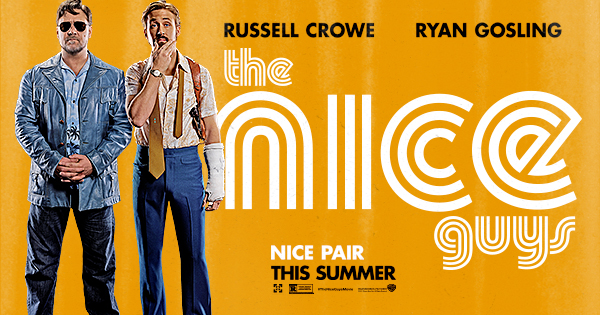
The Nice Guys

Shane Black strikes again with another brilliant buddy comedy

Kiss Kiss Bang Bang is one of my favourite films from the 21st century. Not only did it reintroduce the world to Robert Downey Jr (with Iron Man coming out three years later) and star an underrated Batman, Val Kilmer, as a character called Gay Perry, it is also a definitive example of a contemporary pulp-y neo-noir that is also truly hilarious with a side note of surreal.  I love Kiss Kiss Bang Bang so I have been impatiently waiting for The Nice Guys with desperate expectations. Thankfully those expectations were more than meet with a crime comedy that is made so much fun to watch by an awesome cast.

1977, Los Angeles. Holland March (Ryan Gosling) is a private detective, quite a good one actually although appearances can be deceptive, very deceptive… Whilst investigating the death of a porn star called Misty Mountains (Murielle Telio) he begins searching for a girl called Amelia Kuttner (Margaret Qualley) Holland comes into contact with an enforcer called Jackson Healy (Russell Crowe). More specifically Jackson breaks Holland’s arm to try and stop him from hunting down Amelia. But after a failed attempt on his life occurs Jackson realises that his case and Holland’s cases actually overlap, they may have to work together to solve their cases and stop more people from being killed.

There are three truly great things about this film. 1) Ryan Gosling is truly wonderful and properly hilarious. He appears to have a natural gift for physical comedy and it is a gift he utilizes for great effect here. His facial reactions are joyous to watch and his delivery of gags legendary. His bond with teen daughter Holly (Angourie Riceadds a wonderful dynamic and an extra layer of depth to things. But it is his rapport with another truly great thing about this film that is standout.

2) Russell Crowe has been rocking a certain blend of grizzled touch-guy for a few years now. In this film he goes full grizzled tough-guy in such a way that, thanks to his mis-matched partnership with Gosling, makes him likeable. The dynamic between the pair is founded on hate-fear rather than hate-love, with both characters being so fatally flawed they shouldn’t really spend any time with each other. At all. Yet the pairing proves hilarious with both characters finding a balance between each other as Crowe’s punch-punchy character, whose only friend is a pet fish, somewhat softens through his exchanges with Gosling who frequently ends up rivalling Buster Keaton in terms of physical comedy.

Finally, 3) The script. Few scripts are this crisp with brilliantly quotable one liners and dialogue such as this gem of a sequence:

Holland March: Look on the bright side. Nobody got hurt.

Jackson Healy: People got hurt.

Holland March: I’m saying, I think they died quickly. So I don’t think they got hurt.

Occasionally the plotting does get too convoluted, potentially it is too overambitious in its conspiracy plotting, but for the most part it’s typically sharp Shane Black with a blend full of action, comedy, aspects of hard-bitten noir and a side of social commentary. Few films out in the cinemas at the moment are this entertaining.

4 stars


Love & Friendship

An exquisitely elegant Austen adaptation

Love & Friendship is an adaptation of a Jane Austen novella entitled Lady Susan, written in 1794 but not published until 1871. Almost impossibly for a work by Austen it has never been adapted before. After seeing Love & Friendship the viewer will be left with two thoughts, 1) Why on Earth has such a brilliant story not made it to the screen before? and 2) Thank goodness it hadn’t as that version was absolutely perfect!  Love & Friendship is an absolute treat of a film and a gem of a must-see.

Lady Susan Vernon (Kate Beckinsale) is a widow and notorious flirt. Infamous for her ways of manipulation yet so utterly charming, magnetic and witty that most of society adores her. Seeking refuge after scandalous rumours spread about her private life, about a suspected relationship with married Lord Manwaring (Lochlann O’Mearáin), she arrives at her in-laws relying on their forced generosity. Whilst there she must continue her desperate search to find her daughter Federica (Morfydd Clark) a suitable husband and an even better match for herself. Seduction, deception, broken hearts and lots and lots of gossip ensue. 

There are so many wonderful things to say about this film. The way the story is told is extraordinarily brilliant. Originally an epistolary novella (a story told as a series of letters) writer-director-producer Whit Stillman turns monologues into dialogue with perfection. The editing is what truly makes this a success – hopping between people, places and things – nothing needless is shown and nothing is needlessly reshown. As opposed to an hours-long epic the period drama is reinvigorated with this 90 minute self-conscious comedic romp. The threads are skillfully interwoven with many outcomes that you may surprise and will definitely amuse. The dialogue is wonderfully written, snappy and lively, serving as a great reminder of just how funny Austen was. The fact the film has an age certification of ‘U’ just goes to show how well-written the script is: never have such brutal takedowns been so politely and eloquently written. 

The characterisation is superb with every character, no matter how facetious or self-indulgent, managing to be immensely likeable. Beckinsale as Lady Susan is a revelation –  a character who knows nothing nor cares little for either love or friendship yet knows just how to manipulate other’s feelings about both. Lady Susan’s manipulations are extraordinary and so skillful that you can’t help find her likeable and end up rooting for her.  She’s nasty and self-centered, others distrust of her and resentment of her status is fully understandable as is their envy of her, yet the viewer is spellbound by her. Some of her best moments are when she is scheming with the American Alicia (Chloë Sevigny) when the conversation becomes a biting satire of late 18th Century aristocracy. 

The entire cast are just as brilliant, there are no weak links here, but it is Bennett’s James Martin that almost steals the show. His performance is so earnest and well-meaning as a character who is unable to utter a sentence without creating moments of sheer awkwardness. In a film full of laugh-inducing moments, I don’t think I’ve laughed this often in ages, it is his character who has two of the biggest chuckle/chortle/tear-inducing funny moments, moments which I have been quoting constantly since.

The costumes, sets and visual style are all extraordinary. The entire cast an acting masterclass. A script and storyline that make hilarious an understatement. Easily one of the best films we will see this year (it’s not even June yet). Go see it. Now!

five star

Hologram for the King

A film that seems as lost as its main character

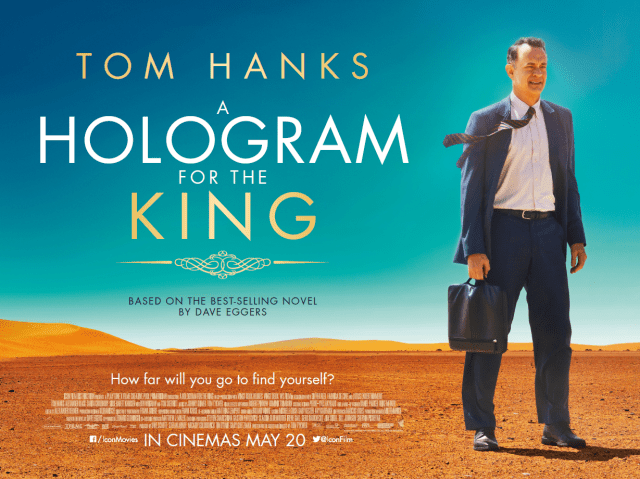
It is a fact universally acknowledged, that Tom Hanks is watchable in anything. He’s one of the great stalwarts of Hollywood – an actor who the audience can rely on for a great movie. Aside from regular debates with my younger brother on Forest Gump (he’s pro and I’m anti – a debate which should hopefully finally be settled when we watch it together during the Summer) Hanks has had an incredible career littered with successes. His last release Bridge of Spies, directed by fellow great Steven Spielberg, led to a spectator experience equivalent to sitting in a really comfy leather armchair. Safe, secure and captivating. This film? He’s the best thing in it.

American Business man Alan Clay (Tom Hanks) was once on top of the world, CEO of Schwinn bikes – the bikes that every kid in America wanted to own. Now he’s a washed-up IT salesman who has been sent to Saudi Arabia to secure a contract with the King of Saudi Arabia for his massive new complex. Alan’s boss has made it clear that this is his last chance with the company, everyone is relying on the huge contract and if he doesn’t secure it then he’s out. Running late on day one due to jet lag he’s provided with a driver called Yousef (Alexander Black). Arriving on site it is clear that things are not as clear as they appeared back in America, with the complex nowhere near being completed.. Things begin to spiral for Alan and his health appears to be suffering, which is how he comes into contact with Dr Zahra (Sarita Choudhury). In a foreign country with a culture hugely different to his own how is Alan supposed to cope, let alone sell a contract to an absentee monarch? 

“And you may find yourself living in a shotgun shack /And you may find yourself in another part of the world/ And you may find yourself behind the wheel of a large automobile/ And you may find yourself in a beautiful house, with a beautiful wife/ And you may ask yourself/ Well…How did I get here?” The film starts of with Hanks reciting these lyrics to the epic Talking Heads ‘Once in a Lifetime‘ accompanied with a short montage which alludes to Alan’s current state of well being (read: not good). It successfully sets up the tone that will fellow, of quirk and occasionally surreal.  It’s one of the best bits of the movie, a high that it struggles to replicate. For a film that is essentially about a man having a mid-life crisis the film itself also lacks an identity. It’s not a comedy nor is it a drama.

There are too many allusions to some BIG topics – Saudi Arabia’s view on women’s rights, conflicts within the country and offshoring of industry – that prevent the film from being feelgood. Yet the film seems to desperate to provide a positive message that it tries to either ignore or forget about these features. The cast are all fantastic with the material they are provided with, all three main characters are memorable and well-rounded. Alan’s burgeoning friendship with Yousef and his budding romance with Zahra are joyful to watch. Both dynamics are sweet, endearing and rather believable considering the circumstances.

However Alan’s storyline about his business contract is less successful and his relationship with his daughter is also underdeveloped. The film also attempts then appears to shy away from making comments on the previously mentioned BIG topics. Instead of allowing them to provide a degree of darkness to the story they are treated as some sort of distraction. A sequence which in the space of less than 30 seconds sees Alan observe great poverty and then great wealth deserved to have been treated with more comment or reflection as opposed to metaphorically being pushed under the carpet. The best way to describe this film it that it’s like eating salted caramel – at times it’s sweet and at times it’s savoury – yet when you’re finished it doesn’t want to leave that as an aftertaste. It wants to wash it away with saccharin and a tacked-on ending. It’s as if the film-makers decided from the outset the ending they wanted – one about new beginnings, fresh starts and eternal hope –  and chose to  ignore anything that has gone on before that contradicts it.

The film itself is a fine enough watching experience. Hanks is typically cast as the American Everyman. It’s good to see him tackle something darker and with anxiety. Yet the film itself is rather bland, pleasant enough yet nowhere near his most memorable film.

2.5

Angry Birds

The first throwaway kids film of the Summer

Most of the Western world will have played, or at least heard of, the Angry Birds franchise which flew its way into our lives in 2009. Since then the download figures of the app have entered the billions category. Endless merchandise has successfully infiltrated the shops and the production of a movie is not that surprising, with that kind of pre-sold audience it makes business sense, although a degree of universal dubiousness was held over the prospect of 90 minutes of screentime being generated from a mobile phone app. The end result? Well, it’s not offensive or massively memorable…

Red (Jason Sudeikis) is the loner of Bird island. An orphan who has always been treated with a degree of suspicion and amusement  by his fellow citizens  he’s never really fitted in. Since childhood he has been quick to anger, something that is ill-regarded by everyone else, and when a new incident occurs which leads him to lose his temper once more he is sentences to anger management classes. The classes are run by Matilda (Maya Rudolph) and are attended by regulars Chuck (Josh Gad), Bomb (Danny McBride) and Terence (Sean Penn). The four of them want to help Red and offer friendship, which he refuses.  When a pig explorer, called Leonard (Bill Hader), comes to island Red is quick to voice his suspicions. When disaster strikes there is only one person Red thinks he can turn to, the Mighty Eagle (Peter Dinklage) who has been missing for years, and he’s going to need the help from those he just tried to reject.

By all rights Angry Birds is better than any app turned film deserves to be. It’s frequently entertaining and induces enough laughs whilst watching to earn its ticket price. However it’s a cinema watching experience that is resolutely hollow. Only 15 hours on from watching and I’m hard pressed to name a favourite sequence from the film – it lacks the substance we now come to expect from animated movies. The characters are silly and fun enough, the jokes deliver frequently and occasionally crudely amusing. The audience favourite character will probably be Chuck, but that will most likely be his resemblance to characters such Quicksilver or Deadpool – just U-rated versions! Also it needs to be said that is a mighty fine cast-list! It’s a shame there talent’s are pretty underused here.

Considering Angry Birds started just after an advert for the very long awaited Finding Dory and the Angry Birds villain also voiced a character (Fear) in Inside out , well a comparison between this and Pixar is an obvious thing to make. Angry Birds is not Pixar or Zootropolis, it does not have the warmth or wit nor anything occurring that is anywhere near as memorable as the aforementioned movies. But with Half Term on the horizon there’s enough here to distract the children for 90 minutes with more than enough amuse the parents too.

2 stars

X-Men: Apocalypse

“At Least We Can All Agree The Third One Is Always The Worst”

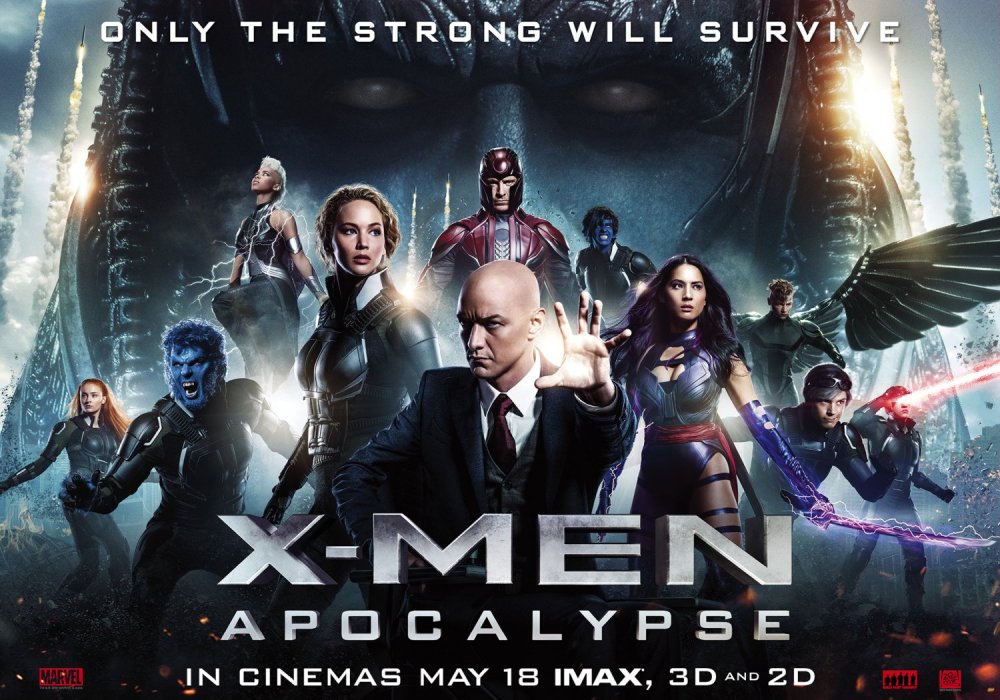
The above line is uttered by Jean Grey (Sophie Turner) about halfway through the movie, when she and a few other character leave a cinema screening of Return of the Jedi. It’s one of numerous strange self-aware moments within the film. If this had come out a year after Deadpool it could easily be assumed to be a rip-off of the superior film’s meta sense of humour. Instead it comes across as strangely self-satisfied and almost arrogant. Considering her character is telepathic it almost feels like she was reading this viewer’s mind…

10 years after the stand-off with the Sentinel prototypes at White House the X-men have never been so far apart from each other yet have never been so strong individually. Charles Xavier’s School for Gifted Youngsters is full of mutants, with Professor Xavier himself (James McAvoy) and second is command Hank Mccoy (Nicholas Hoult)  keeping a close watch on telepathic protegee  Jean Grey (Sophie Turner) and new recruit  Scott Summers (Tye Sheridan) as both re struggling to control their powers. Raven (Jennifer Lawrence) has become a loner/nomad/mercenary helping other mutants.  Erik Lehnseer(Michael Fassbender) is now a married man with a young daughter. But when immortal physic mutant Apocalypse (Oscar Isaac) rises from a millennia -long sleep  his awakening will have consequences for the world’s population of humans and mutants alike. 

How do you like your squash? I personally like it strong and full of flavour. I don’t like it weak – diluted and lacking in flavour.  That’s my problem with this film. To use this clunky analogy for all it’s worth the cordial (the good stuff) is diluted by too much water (i.e characters, plot and action). Although the ‘too-many-characters-may-spoil-the-broth’ did cause Civil War a bit of a stumble, in the case of this film it forces the film to fall flat on its face. Repeatedly.

Fatal Flaw Time: Characterization is almost completely abandoned in favour of action and set pieces. For fans of the franchise, or any of its other incarnations, we witness one dimensional versions of the characters we know and love. Lawrence as Raven/Mystique spends the majority of the film either wearing a pinched expression of exasperated  discontentment. McAvoy’s dialogue is reduced to  platitudes and mawkish ponderings. Sheridan does little to win favour for Cyclops in the versus Wolverine debate. Turner is okay as Jean Grey but her American accent quickly steals audience focus for all the wrong reasons. And, alhough it was great to see a cool AF version of Jubilee (Lana Condor) hanging around I’d rather her not even have been there as she is bitterly unused. Talk about how to (metaphorically) prick-tease a Fan-Girl!

Then there’s the villains. Fassbender has some incredibly emotionally and engaging sequences but is then too frequently forced to fade into the background. Isaac is criminally wasted, hidden under rubbery prosthetics with a character whose character and abilities are far from defined. The three new characters who join Magneto as the Four Horsemen are completely overwhelmed – Ben Hardy as Angel is ill-served, Olivia Munn as Psylocke weirdly reminded me of this sketch by Mitchell and Webb in terms of OTT villain-face and Alexandra Shipp as Storm seems more than interesting enough but underused. The villainous plot they hatch is of such a scale that is almost becomes bland (think the final 30 minutes of Man Of Steel) and completes overwhelms its characters.

Though, in fairness it’s so overstuffed with characters  it’s almost unsurprising, although not forgivable. The motivation of the characters is devoid of reason and the plan itself lacking real purpose. The plot is also so full of holes (talking Swiss cheese territory here) that it becomes incoherent. There’s nothing new or interesting with the plot, it takes some irritatingly familiar paths, that this film feels tired and bloated in comparison to its counterparts. It’s also so unbearably serious, akin to SvS:DoJ in terms of getting ‘dark’ confused with ‘murky’. 

In fact, upon reflection, the only franchise contribution I enjoyed and I am truly thankful for is that of Kodi Smit-McPhee as Kurt Wagner/Nightcrawler. He is given some of the film’s funniest, sweetest and most moving moments. He’s a real joy to watch and probably the only reason I would risk the (inevitable) follow-up. What I can’t forgive the film for is a sequence that occurs just after the Jean Grey’s line about trilogies. After a rather wonderful and emotional sequence that has been delicately woven the tension is completely destroyed, totally sledgehammered, by a shift in tone that is so jarring it is unbearably stupid.  It’s a sequence involving Peter Maximoff/Quicksilver (Evan Peters – who totally stole the show in Days of Future Past  in the space of 10 minutes of screentime) that I would have undoubtedly loved at any other point in the film. But, straight after such a well-executed and pathos-filled sequence, it is utterly wasted and even made me resent his character. By the end of the film my faith in him was somewhat restored though my love for him has been somewhat tainted. Such an inconsistent moment reflects the very nature of the entire film.

As a teacher I’ve found the true power of saying the following phrase and it’s the only phrase I can find that fully articulates my feelings towards this film. It’s not that I’m angry X-Men:Apocalypse – I’m just disappointed.

2 stars


Me Before You

A serviceable and relatively sincere weepie

Let’s start this with an admission. I am a crier. I have cried and will cry at everything and anything. An article on human kindness – I weep. An audition on a relatively television program – I sob. A particularly emotive song – I howl. Considering the nature of this film and what I had heard of the book I had the tissues at the ready. Literally I had taken a tissue out of the packet and tucked it into a jumper sleeve for easy access. Come the roll of the credits and the tissue had remained unused. I didn’t cry. This is not necessarily a criticism of the film – there were plenty of noses being blown and gentle sobbing echoed around the screen. Yet not a peep from me. Whether that is because I’m all cried out from recent weeks or whether the film didn’t have the emotional depth needed? Well, read on and see…

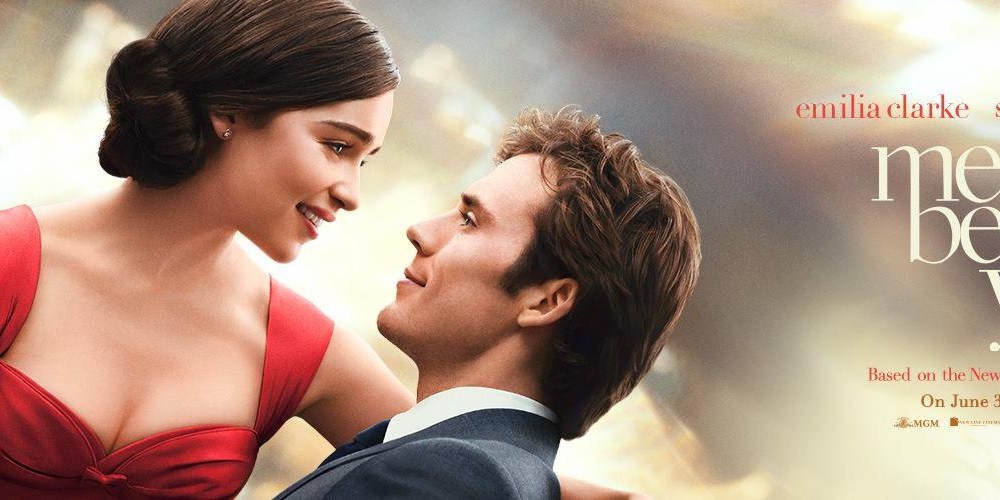
Two years ago William Traynor (Sam Claflin) was hit by a motorbike – leaving him paralysed from the neck-down. Will was once a man about town, living and hustling in London. The type of man all men envied and all women wanted. Now he is stuck back in his small-town home with his parents Camilla (Janet McTeer) and Steven (Charles Dance). Concerned by his desperately low spirits she decides to hire a carer/companion who can brighten up his lonely   existence.  Enter Louisa Clark (Emilia Clarke) who has just lost her job at the local cafe. Aged 26 she has never left her small town home, a place which she either loves too much or is too scared to leave. Her family rely on her as she brings in the only income so this job is perfect for her! Except she has zero experience as a carer. Having always been outshone by her younger sister, single mother Katrina (Jenna Coleman), or patronised by her long-term boyfriend Patrick (Matthew Lewis), Louisa is a woman not living life to its fullest. Maybe Will, a man who can no longer enjoy life, is the perfect person to help her live hers?

Having not read the book I cannot comment on the success of the transition of book to screen, although Twitter would suggest it is faithful. The story itself is relatively predictable, with little surprise, though this is not necessarily a bad thing as the story itself is told rather well. The pacing is solid with the growing bond between Louisa and Will is believable.The supporting cast are impeccably stereotypical and two-dimensional. Roll call for romantic tragedy archetypes – we have present: jealous and moody boyfriend who ‘doesn’t understand or appreciate’ how amazing his girlfriend is. Overly concerned mother and withdrawn father. Know-it-all younger sibling full of great advice. Friendly Australian nurse who steals most of the scenes he is in… (Side note: how can I get my own Nathan, Stephen Peacocke..?) 

The main cast themselves are solid. Claflin does well with his role as a man who feels he has little reason to live. He provides his character with just enough spark to hint at the man Will once was. His bond with Clarke’s character is well-established and there is plenty of charisma between them. It’s Clarke’s performance that particularly stands out, with her facial expressions providing an earnest authenticity to her character. Although her character is essentially a 2016 small-town England Manic Pixie Dream Girl (her ‘quirky’ clothes and shoes used to denote her character as opposed to providing her with any genuine character traits) she is remarkably likeable. Her eyebrow acting is, as my secondary school students would say, on point – managing to show so much with them knitted in concern.

There’s enough here to watch and enjoy with a glass of wine. It doesn’t reinvent the wheel but if you’re a fan of such films as  The Fault In Our Stars or Me, Earl and the Dying Girl then you’ll enjoy this.

stars

Sing Street

1980s. Dublin. New Romantics.

If the prospect of those three words being combined into a film does not fill you with glee I’m not sure how well we’re going to get on or how well you’re going to get on with this film. If you haven’t jumped ship  and are still reading – then this film may just be for you! From John Carney, the writer-director-producer of  Once and Begin Again, comes another musical tale about love and friendship. But this time our main characters are teenagers and they are forming a band The Commitments-style. The result is one of the most rewarding, enjoyable and grin-inducing films of the year so far.

It’s 1985. Like all epic stories it started with money problems and a girl. Connor (Ferdia Walsh-Peelo) is forced to leave his expensive fee-paying school and attend the local state school Synge Street CBS. The family has little money coming in as patriarch Robert (Aidan Gillen) is finding his architecture practice is not really required during a financial crisis. It’s at his new school, well on the school’s doorstep, that Connor first meets Raphina (Lucy Boynton). Raphina is an older lady, one year older, and is the most glamorous/gorgeous/extraordinary woman Cosmo has ever seen. New-found friend and wanna-be entrepreneur Darren (Ben Carolan) explains the school gossip that Raphina is a model who will soon be moving to England to make her fortune. Connor bravely introduces himself to Raphina and offers her a job that weekend to star in his band’s music video. After a bit of charming she agrees to take the job. Except Connor doesn’t actually have a band – yet. With audiophile elder brother Brendan (Jack Reynor) to guide him surely it’ll all be easy, won’t it..?

There are so many reasons to love this film – many of which I don’t want to discuss in too much detail or give away as it’s discovering them for yourself that only add to the brilliance. However I will briefly give the headlines of the reasons for my adoration. For favourite character I am torn between Brendan and bespeckled multi-instrumentalist Eamon (Mark McKenna). The soundtrack will undoubtedly be one of the best of the year – the classics are superbly chosen and the original songs (such Riddle of the Model) are wonderful tributes with some infectiously catchy riffs. The storyline is told with great empathy and sympathy. This is a film that truly cares about its characters. The music videos the band makes are both hilarious and nostalgia-inducing (even for those of us who were not alive in 1985!) I full enjoyed the references to The Cure, Duran Duran and Spandau Ballet to name just three – I can only imagine the depth of the enjoyment for those who leaved and breathed this music scene. The friendship between the newly-formed band is heart-warming and believable thanks to some fantastic chemistry between them. The film also manages to cover lots of ‘big’ topics – mental health, adultery, abuse – sensitively and appropriately. There’s a great balance here between pathos and humour. 

My main criticism would be the treatment of Raphina. Boynton does an excellent job with the material she is given but the presentation/treatment of her character is far too Maniac Pixie Dream Girl. For the most part we only learn about Raphina through what Connor (whom Raphina later renames Cosmo) sees and hears. She doesn’t transcend being his figure of worship and far too much screen time is dedicated to his male-gaze watching her. Whilst the dialogue of most of the characters is rooted in a degree of realism or believability Raphina’s craic is over-rehearsed. Arguably this could be a reflection of her personality as a character but for the most part her dialogue rarely lands as effectively like the other characters. Any film that focuses on a romantic crush, be that of a man or woman, must deal with the universality of the story arc as a duel-edged sword.  Whilst it makes for an accessible storyline, as the majority of the world’s population would have had a romantic crush at some point or another,  it means we then have to believe in the crush and that all the turmoil it brings our lead character is worth it. Is Raphina worth it?

Aside from my ponderings on potentially dubious representation, I truly loved Sing Street. So much so I think a rewatch in the new few weeks will be in order. It tickles the funny bone whilst tugging at the heart strings. It’s an old-fashioned story told with great warmth and will great skill. And, for New Romantics at heart like me, it’s chance to feel immersed in and nostalgic for a lifetime I never lived.

4.5


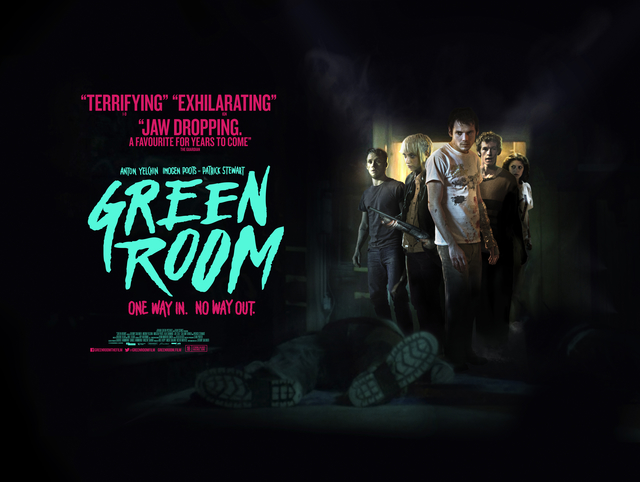
Green Room

An intelligent and electrifying horror

Usually me and horror don’t mix particularly well. Almost two months on and I am still occasionally haunted by visions of Black Phillip the goat from The Witch and I still feel a bit twitchy when I think about what I would do if I were to be trapped in a basement 10 Cloverfield Lane – style (is it normal to worry about that as a hypothetical scenario..?) But then again, Green Room isn’t your typical horror film. Yes there is gore (I’ve become very aware of my hands for the past hour since watching) but it is never overused. Whilst the narrative follows a ‘well-that-escalated-quickly’ structure it is founded in a series of cause-and-effect plot points that seem both believable and terrifying in equal measure. Then when you chuck in the superb pacing, swift editing, nerve-shredding soundtrack and  some superb character performances…well you’re in for a great time!

“The Ain’t Rights” are a punk band who are travelling through the Pacific Northwest, playing gigs and scrummaging whatever they can to get by.  The band – formed of Pat (Anton Yelchin), Sam (Alia Shawkat), Reece (Joe Cole) and Tiger (Callum Turner) – end up playing a gig in rural Seaside, Oregon to a club filled with Neo-Nazi skinheads.Upon seeing their Anti-Semitic surroundings Pat jokingly suggests they play a cover of The Dead Kennedys “Nazi Punks Fuck Off!” The band play the song during their set to  a less than receptive audience. Set over and cash in hand they make a move to leave, a move which the show organiser hastens to speed up, when Pat has to run back to grab the band’s mobile which they left charging. He stumbles across the scene of one of the skinheads leaning over the body of a young female punk with her still-alive friend Amber (Imogen Poots) rendered numb in disbelief. The band are then locked in the green room with the pair and the dead body. Reinforcements are called in the form of club owner Darcy (Patrick Stewart). The band have seen too much. Will any of them make it out alive?

There are so many reasons to like this movie. I want to say enjoy but considering the subject matter and content the verb ‘enjoy’ seems in rather poor taste. Semantics aside this is a cracking horror film. The slow-build of tension, the overwhelming sense of inevitability and the shock factor of many of moments. This is a film made with an equal blend of style and substance. The film looks damn good – the shots are well chosen with some excellent lighting choices that make for truly memorable sequences.

All of these factors would be pointless were it not for the excellent performances that drive the story. The characters are presented in a way that is a balance between wanting them to live but not really knowing them well enough to mourn any losses that occur on the way. You experience a degree of ‘oh no!’ because you care about them when certain things may or may not happen but are detached enough from them to not feel too aggrieved should/when something happens to them. Yelchin is superb as the accidental leader of punk trope. Poots is truly kick-ass as a female character who is not just cast to the sidelines, doesn’t spend the entirety of the film in shades of hysteria and who is capable of holding her own in certain situations. This is definitely/hopefully  showing a changing of the tide in Hollywood horror as her character is in line with that of Mary Elizabeth Winstead in the aforementioned 10 Cloverfield Lane. And then there’s Patrick Stewart as a properly scary baddie – whose calm and collected demeanor is unbearably (in a good way) unnerving to watch.   

Tense and taut (clocking in at 94 minutes) with some powerfully acted performances along with an admirably well-written script that is black humour laden this is definitely worth a watch.

4 stars

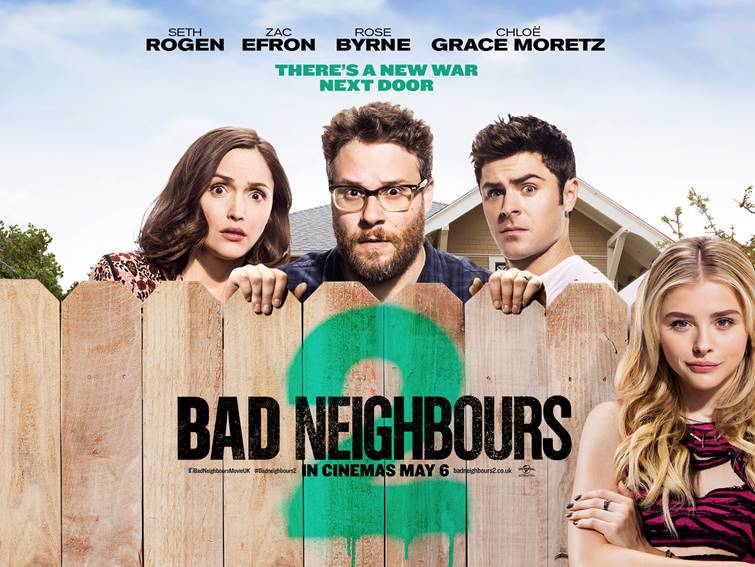
Bad Neighbours 2

A surprisingly knowledgeable and at times rather progressive comedy

It started with a tweet. On Thursday evening movie magazine Little White Lies tweeted about its review for Bad Neighbours 2. The review as written by Elena Lazic with  the tweet reading ‘I went long on the unexpectedly progressive, feminist and funny Bad Neighbours 2’. Now, as anyone who knows me, that’s the kind of click-bait that gets me hooked into reading. The review itself is wonderfully written – very reflective and articulate. Hopefully this review lives up to the one that inspired the film-watching and subsequent review! Post-watching I firmly agree with Miss Lazic’s review – for Bad Neighbours 2 is full of surprises. Most of them good and approvingly well-informed of gender politics.

Mac Radner (Seth Rogen) and his wife Kelly (Rose Byrne) are expecting their second daughter so decide to put their house on the market and move into the suburbs. A married couple with a young child place an offer putting the property into escrow – for the next 30 days the potential buyers can drop in at any time and have any inspections they wish undertaken before they confirm their buying of the property. For the next 30 days Mac and Kelly need for everything to stay the same, no big changes which will scare off the buyers. What’s more than unfortunate is that their new neighbours move in on day 1 of 30 – and their neighbours are the college’s newest sorority. Kappa Nu has been newly founded by Shelby (Chloë Grace Moretz), Beth (Kiersey Clemons) and Nora (Beanie Feldstein). The trio united and formed the new sorority as they disagree with sexist legislation that prevents the existing sororities form having parties  and were disgusted by the sexist antics of the fraternity party they attended. War is soon declared between the ‘old’ couple and the sorority girls, with ex-Frat boy Teddy Sanders (Zac Efron) leading the girls into battle. 

In the mid 2000s the term ‘Frat Pack’ was coined to describe a group of Hollywood actors – this group included Ben Stiller, Owen Wilson, Jack Black, Vince Vaughn etc.Then came the “Apatow Chapter” (named after writer/director/producer Judd Apatow) which Bad Neighbours 2 lead actor Seth Rogen was a part of. The majority of the films generated from these unholy alliances could not/should not be labelled as displaying any feminist traits. In fact one would be hard-pressed to name just one of these films that featured a single positive representation of women. That’s part of the surprise that comes from watching Bad Neighbours 2.

Many of the early parts of the film, and intermittently throughout, discuss modern issues of equality in an outstandingly sympathetic and understanding manner. The double standards of the rules about sororities not having parties is not actually fictionalised by the film – it’s not a actual law but it is a national mandate decided by those who govern the nation’s leading sororities (read this excellent Washington Post article for further insight). This film appears to be Hollywood’s attempt to address the issue and it does so rather well. The female trios decision to form their own society in which they can go against the system is reinforced when they attend a Frat party – a party in which they see sexist treatment of women being accepted as a norm with an atmosphere akin to that of a hunting ground with men stalking what they view as walking vaginas. It’s a cleverly written scene which is nowhere near as heavily-handed written as it could have been. 

The issue soon takes the backseat for the battle between the two generations/neighbours – during which very little that is new or of much interest. But what does remain on screen are portrayals of women who have a certain spark, a fight within them, that most Hollywood comedies assigns to its male characters. Ordinally the female figures on the screen are resigned to being love interests or purveyors of gratuitous nudity. As annoying as Shelby gets, and she does get pretty annoying, she remains a character who is female, who is interesting and possesses some semblance of a personality. It is scary to reflect on how rarely such a female figure makes  it onto the big screen. Bryne is also given a role that is rather atypical for Frat Pack movies – a wife who is not presented as some sort of shrieking harpy. She appears to be as fun-loving as her husband and they comes across as equals in their relationship – they are proper partners in crime.

Aside from the ensuing pontification on equality, I did release a fair few chuckles watching this film. Some of Efron’s speeches were delightful, his dancing rather exquisite and his slapstick guffaw-inducing. At only 92 minutes long the film is a more than amusing way to while away an afternoon or evening. Plus the more conversations it stirs up about portrayals of gender the better!

stars