Krampus

The gift that keeps on creeping…

Christmas is a time of festive cheer,

for singing loud for all to hear.

But what if good ol’ Saint Nick was nowhere near?

Instead Krampus came to fill you with terror and fear…

Max used to love Christmas. He used to love wrapping presents with his sister and parents whilst watching ‘A Charlie Brown Christmas’. He used to somewhat enjoy when his extended family of aunt, uncle and four cousins made their annual visit from December 22nd to just after Christmas. But every year it’s gotten worse. His parents are growing apart, his sister spends all her time with her boyfriend and his cousins use him as a play toy to amuse themselves. Only his paternal grandmother Omi can see how his Christmas spirit is fading. When his extended family arrive once more the four adults, and surprise guest Aunt Dorothy, clash over the dinner table whilst his cousins brutally tease him for still believing in, then writing a letter to, Santa Claus. It’s the final straw for Max. He rips up the letter in anger and throws it out of the window. That’s when the storm starts, a snow storm like no other. Under the cloak of the blizzard Krampus and his villainous cronies start to arrive…No-one is safe. 

What a pleasant surpise this film was! It’s far from perfect and the pacing of both the first and third act is slightly off, but overall this film is a superb antidote to the kind of movies that some of the little-known Sky channels have been showing since mid-September.  It’s properly funny, has some jump-worthy moments and holds your attention for most of the 98 minute running time.

The story itself is deceptively clever. Though the myth of Krampus is centuries old it feels incredibly immediate and relevant.  The film opens with a sequence that has become unsettling familiar in recent years – a supermarket opening it’s doors for pre-Christmas sales. The crowds rush in, rioting, pushing, shoving and shrieking in their quest for unnesscessay discounted purchases. The fact this is soundtracked with Perry Como’s ‘It’s being to look a lot like Christmas’ successfully exemplifies the increasing commercialism of Christmas. It sets a great tone for the upcoming penance that will have to be paid.

The characters who will soon endure Krampus’ house invasion are well pot rated.  They are the right amount of unlikeable, each given just enough reason to warrant the inevitable onslaught but redeemable enough that you start to care what happens to them. The film doesn’t treat the adults any differently from the children – they have been just as naughty as their parents so need to be punished. As a secondary school teacher I can’t actaully say that Max’s two tween female cousins deserve to be punished,  but I can say that I hope they learn from their mistakes.

Krampus’ and his squad, made up of evil-looking reindeer, scary elves, oh so creepy toys and hilariously horrific gingerbread men own this film. The portryal of the homicidal gingerbread men would be my standout favourite, their evilish giggles haunting the house and they haunt it’s residents.  In fact they did somewhat remind me of Christmas horror-comedy classic ‘Gremlins’ which would make an excellent double movie feature with ‘Krampus’.

If you’re looking to briefly escape the festive season , or see and Old Testament-style backlash against it, or you just want a movie for laughs and a few scares, then this is well worth a watch.


Sunset Song

A sure-fire contender for top ten films of 2015 lists.

There are lots of sunsets. There are lots of songs. There is a huge amount of turmoil, heartbreak and devastation. There are also bitterly-short periods of joy, bookended by tragedy. This film is exquisite and truly haunting. An adaptation of of a 1932 Scottish novel of the same name, this is director Terence Davies project of passion after years passed struggling to get funding, struggling to get his film made. The passion truly shines through.

Aberdeenshire farm girl Chris Guthrie (Agyness Deyn) is the daughter of a housewife and a tyrannical father (Peter Mullan), and younger sister to a brother who is constantly beaten by their father. Her mother’s life is comprised of being raped and giving birth – she does not want the same for her daughter. Chris also does not want to be fated to live a life like her mother’s. Luckily Chris is exceptionally bright, the smartest girl at her school, and is one track to move away and train to be a teacher. When her mother falls pregnant, again, and gives birth to twins, again, the family move away to a bigger house. Once they arrive in their new home, a series of events occur which cause the family to crumble and fall away. Chris must endure so aching hardship but appears to find happiness with Ewan (Kevin Guthrie). This period of her life is shattered when war (World War One) is declared. Life for Chris and her fellow residents of Kinraddie will never be the same. 

 Considering the series of devastating events that is the life of Chris Guthrie Sunset Song never crosses the boundary into melodrama. Admirably, to great success, the film and its storytelling retain a muted stoicism. It’s bitterly sad and this effect is sharpened by its refraining to rely on exaggerated displays. Deyn in particular is extraordinary. Her Chris has a captivating innocence, an innate need to endure and stand firm when all around her are losing their heads (metaphorically speaking!) Tears roll and glide down her face, even at her most bereft she has no need for frantic or guttural moaning at the continuous losses she suffers. The film opens on a sweeping pan of the farm-land, from which Chris emerges. She is a child of the land, the love she feels for it is her only constant. Peter Mullan is excellent as her father who himself is torn between his apparent religious compass and his vices. His conflicted nature never used as an excuse for his behaviour but a reason as to why.

The cinematography is breathtakingly exquisite, treated with an almost religious adulation.  The camera tracks and pans across the land almost as if it is character not setting. In many ways it is a character, playing a part in events and meaning so much to so many. The editing is crucial is creating this tone of melodic heartbreak. Those previously aware of Davies work will notice his fades, cross-dissolves and panning to mark the passing of time. Those who were not will marvel at how they are used for sublime effect. The brief intermittent use of song furthers the sense of haunting and trauma. Never is a full song uttered, merely snippets which the film and its characters cling onto, just as they are clinging on desperately to this way of life. For the sunset being referred to is the sunset of this particular time, this particular way of life, which is fated to end. For the war did not just kill people, but communities. The brutalising effect of war has repercussions both seen and concealed. It also does not discriminate in its path of destruction

A beautifully crafted film comprise of visual grace and emotional density. Truly remarkable.

The Good Dinosaur

‘Mummy, why is that lady sat over there crying so much?’

2015. The year Pixar granted us with two movies. After years and years of development hell The Good Dinosaur emerged in cinemas almost 4 months after Inside Out. The close to cinematic perfection that is Inside Out. With those two pressures alone the bar was set high – whilst The Good Dinosaur doesn’t get a place on the podium for best movies of 2015 it certainly deserves a rosette for good effort.  The main idea is so Pixar in its originality, the central characters so endearing that it’s truly unfortunate how ill-served it is by the underdeveloped storyline. Yet, even with such a shallow storyline, the pathos is still being created. Which is why I was the ‘lady’ in the question above that was uttered by a small child sat near me in the cinema on Sunday. The question is, will children really understand how truly depressing much of the film is?

65 million years ago a meteor did not hit Earth. The dinosaurs were not made extinct. Two Apatosaurus farmers are watching in awe as their three eggs hatch. Their children are about to be born. There’s Libby, Buck and finally Arlo. As the three children grow up the differences between them quickly become apparent to their parents, specifically how different Arlo is two his older siblings. Libby and Buck swiftly adjust to life on the farm and perfect their chores, so much so that they are rewarded with a muddy foot-print on the family tree. Arlo does not. Arlo is shy and timid, terrified by most things including the  chickens he has to feed everyday. Arlo’s father gives him some extra attention and finds him a purpose, to get rid off the pest that has been eating their food supply. They set a trap and Arlo waits in excited nervousness for the pest to be caught. When Arlo next checks the trap he find a feral cave-child. When Arlo finds himself unable to kill the pest his father rebukes him, and forces him to chase the pest through a ravine. On the way tragedy strikes and Arlo soon awakens to find himself far away from home and desperate to get back. 

The majority of the film is of Arlo’s journey home. After slowly befriending the pest, even naming him Spot, the pair work together to get Arlo home. Their friendship is portrayed in such a beautiful way, so heart-warming and joyus. Both Arlo and Spot are really lovely characters who you find yourself truly rooting for and willing for their survival. This is the main success of the film and the main reason to stay engaged with it through its rather facile storyline. Arlo and Spot drift from one misadventure to next, meeting some ‘interesting’ characters and frequently running into danger. It’s at this point in the film when it becomes…strange. There’s a sequence which proceeds Arlo and Spot’s ingesting hallucinogenic berries that rivals that sequence in Dumbo. Other strange, occasionally wonderful, set pieces occur. Their joining up with a family of T-rex’s is wonderful. Thunderclap and the pterodactyls are not.

Overall, however, there is enough here to make it worthy of watching. It has the best of intentions, some gorgeous landscapes and two truly lovely leads. Their friendship is one of the studio’s best.

It’s not Pixar’s worst (Cars) or its best (Inside Out or Toy Story) but comfortably in-between.

Sanjays Super Team Pixar Post

Sanjay’s Super Team

The 7 minute short which precedes The Good Dinosaur is absolutely delightful and hopefully ground-breaking in terms of representation. Without dialogue, as most of the Pixar shorts are, we watch a young boy called Sanjay be torn between wanting to watch his cartoon (representing the modern world) and his father’s want for his son to pray with him (representing tradition). The film starts with a card stating ‘This is a (mostly) true story’ and it really comes across throughout. For Sanjay realises that the superhero’s adventures that he watches on tv share a lot with the stories of the Hindu gods. His mini-journey of discovery, attempting to align the two parts of his life, is fantastically done.  The fact Pixar have made a film which diverts from their usual representation is crucial. Long may it continue!

The Lady In The Van

British Cinema at its finest

This film is so warm, kind-hearted and endearing. Whilst on the surface it looks to be a meek and mild comedy about a nutty old lady it is so much more than that. It’s full of witty observations about society – the  lens is pointed firmly at liberals who have earned enough to become middle class yet feel a degree of guilt about their new-found  wealth – and how we do/don’t look after each other. Maggie Smith as the eponymous ‘Lady’ is magnificent,  bringing a richness and poignancy to a fiercely opinionated powerhouse of a figure. Should this be 80-year old Smith’s last leading role, it is one to be proud of. Her performance in this ‘Mostly True Story’ both perverse and profound in equal measure.

In the 1970s playwright Alan Bennett (Alex Jennings) moved into an affluent street in Camden. He swiftly became acquainted with his neighbours and the nomadic interloper Ms Shephard (Maggie Smith) known by many as the infamous ‘Ms Camden’. Ms Shepard, as Alan insists on calling her, lives in a van. The neighbours do not know why she lives in the van, or even who she is. Is she called Mary or Margret. What they do know is that she is homeless and prone to dictatorial ravings. Due to a mixture of guilt and territorial conviction they protest little (at least to her face)  as she drives around and parks up where ever she fancies. However, after council and double yellow line interference, she can no longer continuing temporarily pitching up where she choses. Loathe to offer too much help to the cantankerous old woman Alan lets her use his drive temporarily to park her Van. 15 years pass, with an often-reluctant Alan slowly-forming a bond with Ms Shepard. As time passes and takes its toll on Ms Shepard Alan begins to learn of the past that continues to consume her. 

This is the type of story that could only be true, it would be nigh-on impossible to create a character like Ms Shepard. The majority of her views were left in the dark ages and the way she treats those who try to help her is often despicable. And yet, when personified by Dame Maggie Smith, she is made almost loveable. Her hidden pain and turmoil often explaining some of her brusque character traits. Jennings is superb as her friend and foil, presenting the conflicted feelings Bennett himself had towards helping the formidable Shepard. The supporting cast are also extraordinary: Frances De La Tour, Jim Broadbent and Claire Foy to name just three, all bring various degrees of support to the grande dame of squalor that is Ms Shepard. The slow and tragic realization that Ms Shepard was more sinned against than a sinner is heart-breaking yet handled with such caution and care.

Considering the topic matter this film is ultimately uplifting, almost joyful in its exploration of what draws people to care and look out for one another.

Hunger Games Mockingjay Part 2

The least ‘Hunger Games’ of the ‘Hunger Games’ Franchise 

After 7 years it is time to say goodbye to Katniss Everdeen and the dystopian post-apocalyptic nation of Panem. Suzanne Collins mega-success trilogy was given what shall hereby be known as ‘The Harry Potter Treatment’ and had its final book split into two films *cough for more money cough*. How successful that decision actually was will divide audiences. Part two picks up straight after part one, literally straight after, with Katniss awakening from her reunion/fight with love-interest Peeta.

[2/3 of this review will be spoiler-free, the final 1/3 entitled ‘Ugly’ will not be]

Katniss (Jennifer Lawrence) awakens with injuries both physical (damaged vocal chords, swelling and bruising around her neck) and mental (having witnessed her once-fiancee’s resulting psychotic break after mental torture). Aware that the gentle and warm Ying to her brusque and cold Yang has been tortured, possibly beyond repair, her endeavour to destroy the totalitarian regime of President Snow (Donald Sutherland) is stronger and more determined than ever. Whilst continuing to undertake the P.R stunts set for her by President Coin (Julianne Moore) Katniss decides to set her own agenda by sneaking into the Capital and wreak her own personal vengeance against Snow. 

The Good

The acting in this film is absolutely top-class. Lawrence is continually astounding as Katniss, playing her with a believable and engaging distance. Katniss has seen and done to many horrific things – Jennifer manages to present this in such a way that the audience still manages to connect with Katniss even when Katniss disconnects herself from everyone on-screen. Moore is fantastic as President Coin, presenting a character with understated depth. Woody Harrelson is as enjoyable as ever as Haymitch, as is Elizabeth Banks as Effie. Though have far less to do in this than the three other films their roles are still scene-stealing. Donald Sutherland is so good at being bad, presenting Snow almost as Nero watching Rome burn. The stand-out has to be Plutarch as played by Phillip Seymour Hoffmann (who sadly passed away on Feb 2nd 2014, mid-way through filming this movie). Although Hoffmann’s presence in the film is not unexpected, he was present in the previous two films, there is still a slight and devastating surprise at seeing him on-screen. The success of his character is a staunch reminder of what a great loss he was.

The Bad

For many, ‘Mockingjay’ is the weakest of the literary trilogy. Tonally it is very different from the other two books, less ‘Battle Royale’ and more political assassination. With the film adaptations ‘Mockingjay Part One’ was rather exposition-heavy, a lot of talking and borderline critique of politics. This film is almost-stoppy starty in tone, with time often needlessly given to scenes which did not require quite-so-much screen time. There are many sequences in the film which are stand-out. When the Games themselves are brought into the Capital there are some real frights.  However there are many scenes which almost drag-along, talking about what characters are going to do next then showing them as opposed to getting straight into the action. The whole ’76th Hunger Games’ aspect is cut too-short far too-soon. There is also too much screentime given to pontifications on leadership and power, speeches which become rather mawkish after a certain amount of time.

The Ugly (Herebe the Spoilers!)

The ending. When referring to the ending I don’t mean the final face-off between Katniss and Snow, or Katniss’s decision over her love interests. I mean that final 2 minute long sequence with Katniss five years into the future. It’s exactly how the book ended, though that was set further into the future and was perhaps reduced to minimize any necessity for  Harry Potter epilogue-esque aging make-up, so arguably it’s the source material which is being questioned here as opposed to the film-makers.  It is truly hard to really feel comfortable with ‘that’ ending (with Katniss, Peeta and their two young children sat in a field). For a film which prides itself on it’s strong female lead, who was not laden with any limiting feminine attributes and could truly hold her own on a battlefield, then ending with the ‘reward’ of children and a nuclear family. On the one hand it could be read as symbolic, thanks to the actions of their parents these two children will not have to undergo the horrors of the Hunger Games. Yet it could easily be read as a patriarchal return, shedding her warrior status for frumpily-dressed mother. Either way, the ending is less than a bang and more of a whimper.

If you’ve seen the previous three films it makes sense to see the finale on the big screen. But lower your expectations, set them to’ very slightly disappointing’ and embrace the film for what it is. Whilst it may have uneven pacing, the ensemble cast present a masterclass in acting. Focus on enjoying the stand-out sequences and saying goodbye to some fantastic characters.

Burnt

A rather overcooked romantic dramedy

Does anyone these days aspire to be Gordon Ramsey? Do they wish to control a kitchen as their lair, spewing and spouting swearwords and insults as they prowl? Ramsey had his peak popularity in the mid-noughties, which is probably when this film was first placed on the boil. It then got forgotten about, rushed to be finished with all of its ingredients past sell their best before date.

Adam Jones (Bradley Cooper) is in New Orleans shucking oysters, noting down the amount as he does so. He hits one million, downs his tools and walks out despots protestations of his employer. Those million oysters were his penance for his past indiscretions, now complete he can have a second chance. He goes to London to reunite his crew, although there is much bad blood between them. Adam was a rock star chef in 90s Paris – renowned for his ability and persona. However Adam was also a drugs, alcohol and sex addict who managed to burn all of his bridges who was forced to flee Paris and go into hiding. He must be forgiven by his old friends and new (Sienna Miller’s Helene) to his dream of three Michelin stars.

The film’s main ingredient (when will the cooking puns end?!?) is Bradley Cooper. Considering the fact the film’s main plot is so outdated it is perhaps the only reason people will go to see the film. However his character is so unappealing and unsympathetic that you’ll feel had. His character’s closest real-life counterpart is Gordon Ramsey, swearing continuously and having frequent blow-ups about food, with every other character either swooning over his apparent but unproven genius or admonishing him for wasting said-genius. There is genuinely no reason to like his character, which is this film’s fatal flaw. As the narrative limbers from one ‘disaster’ to a next tension is supposedly created by our concern on how he will cope/survive. If we don’t like the character enduring the trials then we don’t really care. This isn’t helped by the lack of realism within these trials – he is hounded by drug lords for the money he owes them. These drug lords are immensely polite, turning up occasionally to speak to him away from other people, and only visiting once or twice to hound him for the large amount he owes them. We are meant to care about Cooper’s character – experience concern that he may not achieve his ambition for three Mitchelin stars. Instead we experience disinterest or distain for such an ass-hat of a character.

Sienna Miller however is gutsy, transforming herself into a tattooed, pierced and partly shaven-haired single mother sous chef. Her character is far appealing than Cooper’s. Yet she is forced to endure conversations with Cooper’s character of the nature of food and eating. These conversations are nauseating to watch, not because they are hunger-inducing but for the sheer pretentiousness of their proclamations.  ‘We eat to stop eating.’ – That’s sooo deep! The rest of the friendship group are entertaining if one-note; the ex-prisoner, the novice, the daddy issues, the rival etc. The script is bland, drifting from one drama to another, and filled with stupid lines about how John Adams used to be an addict and how he hurt people when he was an addict. It’s all so ridiculous and bordering-on fluff.

If you’re seeing this for Bradley Cooper then don’t waste your time. If you’re seeing it for the food, just re-watch an episode of Hell’s Kitchen. An incredibly dated waste of a movie.

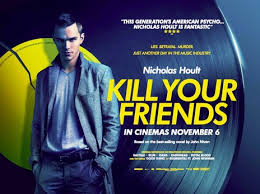
Kill Your Friends

How to succeed in business without any sense of morality

With a title like that, the content of this film really shouldn’t surprise you. We have copious usage of drugs and alcohol, some rather legendary use of swearing (‘Do these shoes look like the shoes of someone who gives a fuck about The Velvet Underground?’) and of course the aforementioned killing of friends. Why? Well it’s set in 1997 and it’s about the music industry. You don’t need to be musicophile to have a rough idea what the music industry was like in the 1990’s. The people at the top possessed little musical talent themselves and gave little care to whether the artists they were choosing to spend their thousands on were ‘good’ artists or in fact whether they were producing ‘art’. Could this unsigned act make me a fortune? Yes, well sign here on the dotted line. So you four girls can’t actually sing or dance, but you’re all rather fit..? Well The Spice Girls are big right now, so we’ll take you. We’ll just get recording artists to sing your music which you’ll mime, and we’ll give you a really crappy basic routine for everyone to copy. You’re hired! This is the sole focus of Kill Your Friends, a study in the middle management wanting to become the top dog focusing less on making good music but more on making lots and lots of money…

It’s 1997 and Britpop is ruling the airwaves. Twenty-seven year old A&R man Steven Stelfox (Nicholas Hoult) doesn’t like Britpop, or any other type of music at all actually. He’s not in the job for the music, he is far from a music puritan. He’s just in it for the money, lots and lots of money. Considering he works in an industry ‘no one knows anything’ there is little stability. Every deal you offer an act is make or break. If an act doesn’t sell, your career is broken. Fuelled by greed, ambition and Class-A drugs he craves the promotion to Head of A&R at his record label and will refuse to let his opposition, his ‘friends’, take the job from him. His calculating approach to manoeuvring the music industry will be taken to a murderous new level.

First things first – substitute music for Wall Street and 90s for 80s and this sounds rather like another film doesn’t it? There have been lots and lots of the reviews for Kill Your Friends that make a comparison between it and this other film. Let’s be straight, this is not the new American Psycho. Instead of a critique of the works of Huey Lewis and The New we have a reflection on the writing prowess of Paul Weller. Whilst is may sound like it, and makes some very noble steps to try and replicate it – Kill Your Friends is the inferior product by quite a long way. Having not read either books, I cannot comment on the book-to-film transition. However I can say from a film point of view American Psycho utilises filmic elements to greater effect, particularly in the representation of the central character which makes the audience question if the murderous acts actually happened or where in his mind. Kill Your Friends does not do this, and presents Steven’s homicidal behaviour with seemingly little consequences. It should also be said just how repellent Steven Stelfox is. He is horrific. Cold and calculating, with malice seeping from every pore, the audience is forced to spend 103 minutes with him. With no redeeming qualities whatsoever, it does become an endurance test. Whilst it should be stated that this is somewhat of a success on Hoult’s part, especially considering how likeable many of his other roles have portrayed him to be, the lack of bite or satire in the script rather ill-serves him.

That is the fatal flaw of this film. It doesn’t question the ethics, lack therefore of,  of these corporate men. It doesn’t poke fun at them, nor glorify it. As I stated in the start, if you even have a passing knowledge of the music industry, you’ll know what sort of scenes crop up in this film. There’s nothing new or particularly fresh. Whilst what is shown is good and well-acted, there are no surprises. The storyline follows Steven negotiating through one drama to the next. Considering how little we care about his character we are not really going to care if he gets caught. In fact considering the nature of his crimes, there is a degree of audience desire that is hoping he does get caught.

This film is joyless, grubby and gruelling. See at your peril.

Spectre

Is it Spectre-ular..?

This will probably read as a rather unique review of the latest James Bond release, as I have to make the admission that I have never actually seen a James Bond movie at the cinema. In fact, I have never seen the entirety of a James Bond movie. From bits I’d seen and tropes that have entered cultural infamy (cars, women, booze, guns and repeat) I had somewhat written them off. But – if you have forgiven this near-heresy and are still reading this – you may be pleased to hear that I may be willing to admit I was wrong. Well, a tiny bit. All of the factors that put me off are present by are portrayed in a way that is almost self-referential, lovingly poking fun at the Bond mythology without crossing into the boundary of satire. The tone is almost playful, with nods and winks instead of revelling in history. Yet, whilst reliant on what I can ascertain to be the well-established 007 formula, Spectre is a compelling and exhilarating movie. The fact it manages to maintain viewer interest when clocking in at 2.5 hours is no mean feat…

James Bond (Daniel Craig) is in Mexico during Día de Muertos (Day of the Dead). Bond’s order is to kill an assassin who was previously unknown to him. Upon returning to London, as a result of his actions in Mexico, Bond is placed on leave by the current M (Ralph Fiennes). But, believing there to be more to his mission than he initially realised, he must rely on the help of Moneypenny (Naomie Harris) and Q (Ben Whishaw) uncover threats both personal and that could destroy the 00 programme forever.

Bond and his helpers are incredibly well-played. Craig is a balance of head-strong and charming, playing his Bond as rather self-aware. His rapport with Q, Moneypenny, M and the Bond girls is whip-crack smart and believable. The main threat to his current way of existence is C (Andrew Scott), who believes the 00 programme to be out-dated – that the only way countries can monitor national threats is through constant surveillance and sharing of information between countries. Scott uses his experience as Moriarty in the BBC series Sherlock to great effect – creating a seemingly sinister and smarmy character. Mr. Hinx (Dave Bautista) is a fantastically malicious force, though with little dialogue he manages to have truly terrifying screen presence. Franz Oberhauser (Christoph Waltz) is a rather great Bond villain – essentially presented with less obvious malice than Bautista’s Hinx, he is swiftly revealed to be a true threat.

The opening sequence of the film, set in Mexico during Día de Muertos, is a stand-out sequence. Well-paced and action-packed it hooks the viewer in. The amount of extras is extraordinary, literally thousands all dressed in astonishingly beautiful costumes. It is then followed by a truly weird titled sequence, with a use of octopuses that seemed akin to a certain genre of Hentai. Perhaps an attempt to ensure the Japanese box office..? In this – admittedly rather bizarre context – the song works. Sam Smith’s Writings on the Wall sets up the films bittersweet tinge. The film that then proceeds has enough twists to entertain, big set pieces set all across the world and is solidly good. Perhaps on the overlong side, Spectre is a solid packed with enough punches to ensure that you’re paying attention, and filled with some excellent cast performances.

It’s good. As good as you’d exSpectre…

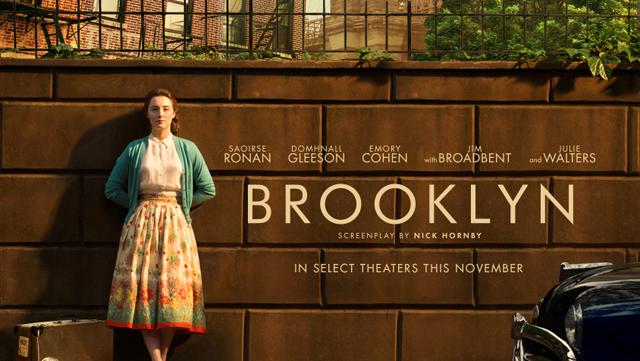
Brooklyn

A sweeping and soaring romantic epic

Whenever my Grandma watches something she really likes or is moved by she’ll simply say, with her Welsh twang ‘Oooh that’s lovely!’ As soon as the credits starting rolling on Brooklyn I found myself uttering her almost-catchphrase, as the film that had gone on before was one of pure and unadulterated loveliness. With the three charismatic central leads, the countless scene-stealing supporting roles and spectacular scenery, told with such carefully constructed and emotive style, Brooklyn is a shoe-in for the awards season.

In 1952 Ellis Lacey (Saoirse Ronan) hands in the notice for her Sunday job at the local shop. She is leaving her small village in Ireland, her home and the only place she has ever known, to move to Brooklyn. On Ellis’ behalf her older, and much- adored older sister Rose (Fiona Glascott), wrote to Father Flood (Jim Broadbent) an Irish Catholic Priest living in Brooklyn asking to give Ellis a chance. Flood agrees to sponsor Ellis – paying for her travel, the start of her accommodation and finding her a job – as there are no opportunities for a bright girl like her his offer is a life-line to a new life. The ferry journey to America is hard, the first few weeks in Brooklyn even harder. She feels so homesick she is scared that she is going to die. It does fade however with time and love – in the form of Italian-American plumber Tony Fiorello (Emory Cohen). But when tragedy strikes she must return to Ireland.  Ellis soon becomes torn between her new life in American and a new life being offered by a possible new love, eligible bachelor Jim Farrell (Domhnall Gleeson). She must choose between both countries, and they both promise.

This film is good. So good in fact that ‘good’ is an inadequate adjective. It’s marvellous. It’s wonderful. It’s exquisite. Few films are this charming: so full of pathos that stimulates both heart and mind. It even appears impossible to think of one negative trait that this film possesses – no fatal Achilles heel is present here. The performances by the entire cast are outstanding, allowing for the creation of an astonishingly well-crafted very real-seeming world.

Each character is three dimensional and rounded, yet this is Ronan’s movie. Her Ellis’ is able to articulate so much with the smallest of expressions – her internal turmoil revealed with looks rather than prosaic audible contemplations. Cohen and Gleeson both hold their own, creating characters that are shown to be equal in terms of romantic possibilities. Often films with a romantic triangle will be unfairly weighted in favour of one of the choices, pushing the audiences favour in one way. This is not true of Brooklyn as the polar opposite men, confident alpha-male Tony and charmingly unassuming Jim both offering lives which could suit Ellis, if only she could work out what it is that she wants.

Set in the 1950s, it is the perfect time capsule movie. The costumes are jaw-droppingly and envy-inducingly gorgeous. The characters are believable for the era, Julie Walters is truly hilarious as the owner of the single women’s boarding house. The music makes the heart-strings pull that much tighter.

The fear of choice, of choosing the road not yet taken, is portrayed tenderly and with nuance. Not a hint of melodrama here. A timeless must-see movie.