Adult Life Skills

British indie at its finest

This film sums up what we Brits do well – a somewhat melancholic story told with warmth and humour. An unsentimental tale told with compassion. Also, puns. There is so much to love about this film that I suspect I’ll be championing it a long while yet.

Anna (Jodie Whittaker) is one week away from her thirtieth birthday. She works at a nature resort in a middle-of-nowhere part of Northern England, lives in the shed at the end of her mum’s garden and enjoys making films featuring her thumbs with smiley faces on them talking about nihilism. Due to the relatively recent death of her twin brother (Edward Hogg) she can’t face talking about her birthday, yet it seems everyone from mum Marion (Lorraine Ashbourne) and Grandma Jean (Eileen Davies) to her best friend Fiona (Rachael Deering) and Fiona’s sister Alice (Alice Lowe) to the boy who used to annoy her at school Brendan (Brett Goldstein) want to talk about both her Birthday and where her life is going. 

Although the setting, the majority of the characters and their circumstances may not initially appear universal they really are. The film acts as a reflection on loss, self-isolation and the struggle to find who you are. Yes, as a 23 year old female that may appear more relevant to me than many others it’s relevant to us all. We all have experienced – be that aged 3, 23, 33,53 or 83 – a loss that derailed us, that either out of choice or not, took us on a course we never intended. Grief lasts far longer than the funeral and for some we wake up years later and look at metaphorically derelict path we ended up on. Anna’s self-loathing may be a concept I am all too aware of through personal experience, yet the battle to regain self-confidence is a ubiquitous challenge many of us have/will face. The fact we see such likeable and familiar-seeming characters facing this in ‘Adult Life Skills’ makes for a deep and visceral experience.

I apologise if the above paragraph made the film sound boring and serious. It really isn’t boring but it is somewhat serious, in terms of its themes not how it is told. It is properly funny quite often and whilst I did cry (I think it was at least three times) I did guffaw at least double that and left the screen grinning.

I loved every single one of the characters. I really felt like Anna became a friend whilst watching the film, she’s so well-rounded both in characterisation and performance. I’ve loved watching Whittaker in everything I’ve seen her in (Good Vibrations is my personal favourite) and her performance her is no exception. Fiona is brilliant as the best friend desperately trying to help her lost friend. Brett Goldstein, who was wonderful in  last year’s little known indie flick SuperBob, is just as good here. He is great at playing a logical figure to Anna’s less-than-logical thought processes, providing a truly earnest performance. Pus the man is an expert at eyebrow acting.

‘Adult Life Skills’ is now easily in my top five films of the year so far.  Whilst Mother’s Day (click here to read my review) may be filling cinema screens with a national release, profiting on cheap and disingenuous sentiment,  it is films like this we should be rooting for.  When the film ended it felt like I was saying goodbye to newfound friends. Yesterday’s preview was the first of my many watches of it.

4.5

Eddie the Eagle

May Eddie the Eagle fly at the box office

One thing that really grinds my gears is when people my age say to justify a gap in their knowledge is, ‘Huh! Well that’s from before my time I guess.’ That is then proceeded with a slightly awkward shoulder shrug. For someone who often reckons that music peaked around 1985 I think it’s often used as a silly filler line. However, in a rather hypocritical move, I am going to say that the rise and soar then laughing stock of British skier Eddie “the Eagle” Edwards is ‘from before my time I guess.’ Occasionally he would pop up on various panel shows and people would poke fun, and I’d be vaguely confused and envious that a man with such an awesome nickname was being used for laughs (what can I say, I was a thoughtful child…) Anyway, I’ll save the rest of that for my therapist.

My slightly convoluted point here is that I had no idea what the man had done to achieve such levels of infamy and mockery. Then, when I heard of the film, I thought ‘Yeah…good luck with that one!’ Time passed by and the trailer was released which made me realise that the film was my kind of film. Then I got invited by Den of Geek to attend a preview screening and Q&A with the director, Dexter Fletcher, at The Courthouse Hotel (a 5* hotel with unbelievably fancy toilets) and that takes us right up to now. Three days on from seeing the film and it still makes me smile. It’s a truly wonderful movie and I beg you to go and see it. Now (and if you’re still with me after that preamble I declare) to you my utter love and gratitude for sticking with me) let me tell you why it’s so damn good.

Eddie Edwards (Taron Egerton) has wanted to be an Olympian for as long as he can remember. He was always the last to get picked for teams, spent a year in hospital due to the poor state of his knees and never quite seemed good enough for anything. He almost gave in and followed in his dad’s (Keith Allen) footsteps of becoming a plasterer until he found skiing, a hobby for which he had his mother’s (Jo Hartley) total support. He even made it to try-outs for the Olympic team before being told by the panel (lead by Mark Benton and Tim McInnerny) that he wasn’t Olympic material. That’s when Eddie decided that not only would he try on his own to make  Team GB for the 1988 Winter Olympics, he’d teach himself how to Ski Jump by decamping to a training camp in Germany. Either being ignorant or in denial about the fact that most Ski Jumpers start aged 5/6 (Eddie being 22) he proceeds to train solo with great resilience both from injury and belittlement from the experienced jumpers. That’s when alcoholic ex-ski jumper Bronson Perry (Hugh Jackman) steps in to help Eddie from death by training. A friendship/brotherhood quickly forms between the pair, under the shadow of Perry’s ex-mentor Warren Sharp (Christopher Walken). Will Eddie become skilled enough to join Team GB or will his dreams die again once more?

This film is totally and utterly brilliant; an utter joy to watch. Though it’s not a state I often occupy, I felt so patriotic after seeing this movie. Partly because it’s a British movie, and it’s the kind of movie we do so, but mainly because Eddie’s journey and how it’s told is so unique to British cinema. Yes, other countries do underdog movies, but so few do them in this way. Eddie’s journey is so lacking in glory, so real (grey-area term as some of the movie is fictionalised) that he reflects each and every one of us. It’s an important reminder not to give up on your dreams, and the power of self-belief. It’s also bloody hilarious, that blend of slapstick and deadpan and sarcasm that makes British cinema so comparatively unique. I giggled, I laughed and I even snort-laughed. It was glorious.

Taron Egerton is already on the up-and-coming, cusp-of-greatness list of actors and this film cements it. Firstly, a post-viewing google showed how similar Egerton looks to 1988-era Eddie along with how scarily accurate the expressions and mannerisms are. He’s also such a great actor to watch, his handling of the pathos and comedy of the character is extraordinary. You do well and truly root for Eddie. Hugh Jackman is great in his mentor role, forming a great rapport with Edgerton. Allen and Hartley are little seen but add much to the impact of the film. Then, with a brief cameo, Christopher Walken sasses the hell out of two lines of dialogue.

There’s also a wonderful 80s soundtrack, as uplifting and smile-inducing as the film itself, brilliant use of sets on such a small budget and some hilarious character actors in supporting roles. Eddie the Eagle is being released into the wild on March 28th, the same weekend as Batman Vs Superman. So why not give some home-grown talent some love and go see it. I promise you it’s worth the money.

We may only be a quarter of the way into the year, but this may just be THE feel-good movie of the year. Go see it.

Pride and Prejudice and Zombies

45% Pride and 45% Prejudice and 10% Zombies

In 2004 Simon Pegg, Nick Frost and Edgar Wright created a new hybrid genre called Zombie-Romantic-Comedy (ZomRomCom) with Shaun of the Dead. In 2007 an American author took this one step further and wrote a parody novel of Jane Austen’s classic Pride and Prejudice by adding in zombies. Nearly 10 years later, after years of development hell (heh, that term has rarely been so apt) we have the film adaptation.  It may not be the most haunting (heh) Austen adaptation, nor will it give others a run for their money (heh, running from zombies) but it is more than entertaining and worth a watch. My main criticism, as you may have noticed from the subtitle is that the zombies make up a small proportion of the film, a too small proportion to really make the most of the high concept.

It is a truth universally acknowledged that a zombie in possession of brains must be in want of more brains. – Elizabeth Bennett. In a world that has been overrun by zombies for almost a hundred years, young women have more than enough to worry about than finding a husband. At least that is what Elizabeth Bennett (Lily James) thinks, and her four sisters agree to varying extents. Their mother Mrs Bennett (Sally Phillips), however, believes otherwise. Mr Bennett (Charles Dance) disagrees with his wife wholeheartedly, which is why he had his girls spend much of their childhood in China, training in the arts of killing zombies, moulding them into fearsome zombie-killing army. When Mr Bingley (Douglas Booth) reopens a residence nearby, he hosts an introductory ball to which the Bennetts are invited. It’s there that Elizabeth meets Colonel Fitzwilliam Darcy (Sam Riley) , a haughty monster-hunter renowned and feared for his zombie-killing skills. When the ball is invaded by zombies the Bennett sisters dazzle Darcy and Bingley with their skills, affection and admiration begins. But will the course of love ever run smooth whilst the undead stalk the Earth?

Overall, the film really succeeds for the first fifteen minutes. The concept feels fresh and funny, the zombie/romance balance is level (something I fear I will never get to write again…) and it’s a pleasurable novelty to see the key events of Austen’s novel enhanced by zombie tropes. There’s also a truly beautiful animated story-book style opening sequence, voiced by the legend that is Charles Dance, that informs us of how the zombies came to be. Unfortunately, the remaining 80-odd minutes of the film are not as pleasurable. The ZomRom balance (I’m going to copyright that phrase) does not really warrant the ‘and’ of the title. Maybe it should be Pride and Prejudice and a few zombies and lots of talking about zombies  (though perhaps that is not as catchy). When the zombies are actually on-screen it provides some of the best moments, producing a couple of jumps and a fair few laughs. But there is too much talking about strategies for dealing with zombies as opposed to fighting them.

However, it’s not all bad. The cast for this film is so good, and so well suited for their roles, that you actually wish this was just a straight-forward adaptation of Pride and Prejudice. Lily James, who shone in War & Peace last year’s Cinderella, is superb as a feisty and witty Elizabeth. She manages to make Elizabeth’s progression into a trained warrior seem almost plausible. She has great chemistry with Sam Riley’s Darcy, providing a degree of sexual tension previously unseen in adaptations of this work. Austen would have approved I suspect. However, as Parson Collins, Matt Smith steals every scene he is in. It’s great to see Smith in another comedic role (aside from his marmite take as The Doctor). Here his timing is brilliant and his ability to make a relatively small role stand out speaks volumes about his ability. Another wonderful surprise is Lena Headey as the one-eyed-eye-patch-wearing Lady Catherine de Bourgh, who snarls her way through her too-few-scenes. 

To conclude, this is a more than fine way to while away two hours. The cast is superb, the script has enough charm, and the novelty just great enough to entertain. Whilst easy to bemoan the minimal zombie presence, this is an excellent attempt at a twist on a classic with a fantastic cast who prevent it from being a forgettable B-movie.

Action, romance and zombies. Something for everyone with this film.

Sunset Song

A sure-fire contender for top ten films of 2015 lists.

There are lots of sunsets. There are lots of songs. There is a huge amount of turmoil, heartbreak and devastation. There are also bitterly-short periods of joy, bookended by tragedy. This film is exquisite and truly haunting. An adaptation of of a 1932 Scottish novel of the same name, this is director Terence Davies project of passion after years passed struggling to get funding, struggling to get his film made. The passion truly shines through.

Aberdeenshire farm girl Chris Guthrie (Agyness Deyn) is the daughter of a housewife and a tyrannical father (Peter Mullan), and younger sister to a brother who is constantly beaten by their father. Her mother’s life is comprised of being raped and giving birth – she does not want the same for her daughter. Chris also does not want to be fated to live a life like her mother’s. Luckily Chris is exceptionally bright, the smartest girl at her school, and is one track to move away and train to be a teacher. When her mother falls pregnant, again, and gives birth to twins, again, the family move away to a bigger house. Once they arrive in their new home, a series of events occur which cause the family to crumble and fall away. Chris must endure so aching hardship but appears to find happiness with Ewan (Kevin Guthrie). This period of her life is shattered when war (World War One) is declared. Life for Chris and her fellow residents of Kinraddie will never be the same. 

 Considering the series of devastating events that is the life of Chris Guthrie Sunset Song never crosses the boundary into melodrama. Admirably, to great success, the film and its storytelling retain a muted stoicism. It’s bitterly sad and this effect is sharpened by its refraining to rely on exaggerated displays. Deyn in particular is extraordinary. Her Chris has a captivating innocence, an innate need to endure and stand firm when all around her are losing their heads (metaphorically speaking!) Tears roll and glide down her face, even at her most bereft she has no need for frantic or guttural moaning at the continuous losses she suffers. The film opens on a sweeping pan of the farm-land, from which Chris emerges. She is a child of the land, the love she feels for it is her only constant. Peter Mullan is excellent as her father who himself is torn between his apparent religious compass and his vices. His conflicted nature never used as an excuse for his behaviour but a reason as to why.

The cinematography is breathtakingly exquisite, treated with an almost religious adulation.  The camera tracks and pans across the land almost as if it is character not setting. In many ways it is a character, playing a part in events and meaning so much to so many. The editing is crucial is creating this tone of melodic heartbreak. Those previously aware of Davies work will notice his fades, cross-dissolves and panning to mark the passing of time. Those who were not will marvel at how they are used for sublime effect. The brief intermittent use of song furthers the sense of haunting and trauma. Never is a full song uttered, merely snippets which the film and its characters cling onto, just as they are clinging on desperately to this way of life. For the sunset being referred to is the sunset of this particular time, this particular way of life, which is fated to end. For the war did not just kill people, but communities. The brutalising effect of war has repercussions both seen and concealed. It also does not discriminate in its path of destruction

A beautifully crafted film comprise of visual grace and emotional density. Truly remarkable.

The Lady In The Van

British Cinema at its finest

This film is so warm, kind-hearted and endearing. Whilst on the surface it looks to be a meek and mild comedy about a nutty old lady it is so much more than that. It’s full of witty observations about society – the  lens is pointed firmly at liberals who have earned enough to become middle class yet feel a degree of guilt about their new-found  wealth – and how we do/don’t look after each other. Maggie Smith as the eponymous ‘Lady’ is magnificent,  bringing a richness and poignancy to a fiercely opinionated powerhouse of a figure. Should this be 80-year old Smith’s last leading role, it is one to be proud of. Her performance in this ‘Mostly True Story’ both perverse and profound in equal measure.

In the 1970s playwright Alan Bennett (Alex Jennings) moved into an affluent street in Camden. He swiftly became acquainted with his neighbours and the nomadic interloper Ms Shephard (Maggie Smith) known by many as the infamous ‘Ms Camden’. Ms Shepard, as Alan insists on calling her, lives in a van. The neighbours do not know why she lives in the van, or even who she is. Is she called Mary or Margret. What they do know is that she is homeless and prone to dictatorial ravings. Due to a mixture of guilt and territorial conviction they protest little (at least to her face)  as she drives around and parks up where ever she fancies. However, after council and double yellow line interference, she can no longer continuing temporarily pitching up where she choses. Loathe to offer too much help to the cantankerous old woman Alan lets her use his drive temporarily to park her Van. 15 years pass, with an often-reluctant Alan slowly-forming a bond with Ms Shepard. As time passes and takes its toll on Ms Shepard Alan begins to learn of the past that continues to consume her. 

This is the type of story that could only be true, it would be nigh-on impossible to create a character like Ms Shepard. The majority of her views were left in the dark ages and the way she treats those who try to help her is often despicable. And yet, when personified by Dame Maggie Smith, she is made almost loveable. Her hidden pain and turmoil often explaining some of her brusque character traits. Jennings is superb as her friend and foil, presenting the conflicted feelings Bennett himself had towards helping the formidable Shepard. The supporting cast are also extraordinary: Frances De La Tour, Jim Broadbent and Claire Foy to name just three, all bring various degrees of support to the grande dame of squalor that is Ms Shepard. The slow and tragic realization that Ms Shepard was more sinned against than a sinner is heart-breaking yet handled with such caution and care.

Considering the topic matter this film is ultimately uplifting, almost joyful in its exploration of what draws people to care and look out for one another.

Kill Your Friends

How to succeed in business without any sense of morality

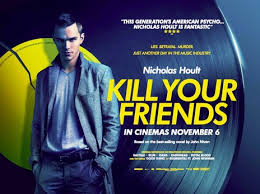
With a title like that, the content of this film really shouldn’t surprise you. We have copious usage of drugs and alcohol, some rather legendary use of swearing (‘Do these shoes look like the shoes of someone who gives a fuck about The Velvet Underground?’) and of course the aforementioned killing of friends. Why? Well it’s set in 1997 and it’s about the music industry. You don’t need to be musicophile to have a rough idea what the music industry was like in the 1990’s. The people at the top possessed little musical talent themselves and gave little care to whether the artists they were choosing to spend their thousands on were ‘good’ artists or in fact whether they were producing ‘art’. Could this unsigned act make me a fortune? Yes, well sign here on the dotted line. So you four girls can’t actually sing or dance, but you’re all rather fit..? Well The Spice Girls are big right now, so we’ll take you. We’ll just get recording artists to sing your music which you’ll mime, and we’ll give you a really crappy basic routine for everyone to copy. You’re hired! This is the sole focus of Kill Your Friends, a study in the middle management wanting to become the top dog focusing less on making good music but more on making lots and lots of money…

It’s 1997 and Britpop is ruling the airwaves. Twenty-seven year old A&R man Steven Stelfox (Nicholas Hoult) doesn’t like Britpop, or any other type of music at all actually. He’s not in the job for the music, he is far from a music puritan. He’s just in it for the money, lots and lots of money. Considering he works in an industry ‘no one knows anything’ there is little stability. Every deal you offer an act is make or break. If an act doesn’t sell, your career is broken. Fuelled by greed, ambition and Class-A drugs he craves the promotion to Head of A&R at his record label and will refuse to let his opposition, his ‘friends’, take the job from him. His calculating approach to manoeuvring the music industry will be taken to a murderous new level.

First things first – substitute music for Wall Street and 90s for 80s and this sounds rather like another film doesn’t it? There have been lots and lots of the reviews for Kill Your Friends that make a comparison between it and this other film. Let’s be straight, this is not the new American Psycho. Instead of a critique of the works of Huey Lewis and The New we have a reflection on the writing prowess of Paul Weller. Whilst is may sound like it, and makes some very noble steps to try and replicate it – Kill Your Friends is the inferior product by quite a long way. Having not read either books, I cannot comment on the book-to-film transition. However I can say from a film point of view American Psycho utilises filmic elements to greater effect, particularly in the representation of the central character which makes the audience question if the murderous acts actually happened or where in his mind. Kill Your Friends does not do this, and presents Steven’s homicidal behaviour with seemingly little consequences. It should also be said just how repellent Steven Stelfox is. He is horrific. Cold and calculating, with malice seeping from every pore, the audience is forced to spend 103 minutes with him. With no redeeming qualities whatsoever, it does become an endurance test. Whilst it should be stated that this is somewhat of a success on Hoult’s part, especially considering how likeable many of his other roles have portrayed him to be, the lack of bite or satire in the script rather ill-serves him.

That is the fatal flaw of this film. It doesn’t question the ethics, lack therefore of,  of these corporate men. It doesn’t poke fun at them, nor glorify it. As I stated in the start, if you even have a passing knowledge of the music industry, you’ll know what sort of scenes crop up in this film. There’s nothing new or particularly fresh. Whilst what is shown is good and well-acted, there are no surprises. The storyline follows Steven negotiating through one drama to the next. Considering how little we care about his character we are not really going to care if he gets caught. In fact considering the nature of his crimes, there is a degree of audience desire that is hoping he does get caught.

This film is joyless, grubby and gruelling. See at your peril.

Suffragette

‘I’d rather be a rebel than a slave’

Upon reflecting on the important role the suffragettes have in history in their obtaining the right for women to vote, it’s incredibly hard to believe that in the eighty-seven years since all women in Britain over the age of 21 could vote this is the first movie to actually portray the events that provided the catalyst for the 1928 parliamentary decision. It was actually in 1918 that the first women of Britain could actually vote – but they had to be over the age of thirty and meet certain property conditions. Suffragette does not focus on either of those periods of time, but looks at what is perceived as a turning point in the movement – the early 1910s – when social views of the suffragette movement shifted. At the start of the era, like the start of the film, the media and therefore society is fiercely damning of these immoral women. By the end of the film, on the cusp of WW1, things had started to turn. That was through the great sacrifices by many women, and the ultimate sacrifice by one woman. That is the complete narrative arc of the film – whilst an excellent insight into this era it seems an unusual choice for a film which could have instead focused on portraying the actual granting of the vote. Consequently the impact of the film is almost limited, which, considering how much build-up and anticipation there was prior to release, may ultimately frustrate some viewers.

Bethnal Green, 1912. Maud Watts (Carey Mulligan) is a married mother in her early twenties. She works long hours in brutal conditions at a laundry, then goes home and cares for her young son and husband Sonny (Ben Whishaw). She’s aware of the women wanting the vote, but it seems so distant and irrelevant to her that she pays in little attention or mind. However a blossoming friendship with Violet (Anne-Marie Duff) leads to Maud giving a personal statement on her work and living conditions to a committee of MPs. ‘Laundry work is short if you are a woman’, she tells them. Maud’s mother died at work, scolded by a boiling vat of water. Maud has already been badly injured at work, and even faced sexual abuse. Should she have more children, her future-daughters will work there, facing the same risks and dangers. The cycle will continue, unbroken and relentless, unless Maud can do something to make it change. Violet invites Maud to attend a meeting with the East End Suffrage Movement. There she meets Edith Ellyn (Helena Bonham Carter), Emily Davison (Natalie Press) and later, albeit briefly, Emmeline Pankhurst (Meryl Streep). Maud tentatively but swiftly joins their ranks and campaigns for the right for women to vote but with the government, in the form of Inspector Arthur Steed (Brendan Gleeson), desperate to quell any uprising Maud is risking all she has to make a difference.

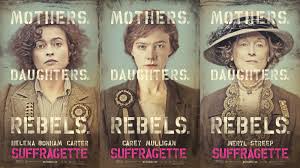
Perhaps because of the incredibly high expectations placed upon the film, it is not fully the fault of the film-makers that Suffragette does disappoint to some extent. The cast are truly extraordinary, and create characters so heart-breakingly believable that it would be nigh-on-impossible not to engage emotionally with this film. However, it doesn’t quite feel enough. Firstly, as previously mentioned, the creative decision to focus on less than three years is one worthy of debate. It allows a heightened focus on a short but important period of time, yet consequently drags out certain moments for too long. There is then the fact that, although Mulligan is fantastic in her role, Maud did not actually exist. Unlike the majority of other characters, Maud was a fictional creation for the purpose of the film. Though based in testimonies of real women from the era, her character arc is cherry-picked from multiple sources. The purpose of a composite character, as is true of this case, is to serve as a cipher; an ‘Every-Woman’ to act as an entry point and an emotional compass to the events we witness as an audience. For the most part this is successful, yet is at times almost frustrating. There are other characters in the story, real-women who do not get their voice heard as a result. Although the life of Maud is used to articulate the difficulties of life for the working class women, as opposed to the middle-class Mary Poppins suffragette, it feels rather rote. Maud, instead of feeling like a real character, almost feels like a narrative tool used to access the greatest hits of the suffrage. This has not been helped by the misleading advertising surrounding the film – yes Mulligan is our lead and Bonham Carter plays an important role, but Streep’s role is not nearly significant to require the top-billing the promotional material has given her. Although she does deliver a rather inspiring speech, her thirty-seconds of running time seems anti-climactic as a consequence.

Although Suffragette does offer some clear insight into the era, from the hunger strikes and force-feeding to the police brutality and social ostracisation that came with being a suffragette, it does not feel enough. Whilst it is a no-frills look into a momentous period of history, at times it feels more like a dry history lesson than the visceral and powerful movie these women deserve.