The Gift (2015)

Dare you look inside?

This film is good. Really good. It’s wicked, smart and tense. So tense, you’ll be on the edge of your sheet for most of the film’s 1hr 50min running time. Few contemporary Hollywood films are able to hook in an audience so quickly, so subtly, and keep them gripped to the end credits. Belonging to the ‘thriller’ genre this film (written directed and starring Joel Edgerton) it manages to avoid all the perils of a bad thriller movie. Typically films of this genre are set up with a chunk of exposition, a boring and obvious way of introducing character and story. With ‘The Gift’ Egerton totally avoids this hurdle, instead he sprinkles exposition into dialogue. Twists and turns are set up in a way that it is only once they happen that you realise they were even set up in the first place. Not once does the film dip in tension or give any hints on what will happen next. If you’ve seen the trailer and thought you’d seen it all, you really haven’t!

Robin (Rebecca Hall) and Simon (Jason Batman) move from Chicago to California, to an area not far from Simon’s hometown. When shopping for new home supplies the pair are approached by ‘Gordo’ (Joel Edgerton) who identifies himself as being an old school friend of Simon’s. Gordo quickly establishes himself in their lives, dropping off gifts and making surprise visits at their home. Although Robin seems happy enough to maintain contact with the ‘socially awkward’ Gordo, Simon grows uneasy with Gordo’s behaviour and decides to ‘break-up’ with him and ends their friendship. Gordo does not let this go easily and continues to have a hold over the pair. Secrets from the past swiftly and menacingly threaten to ruin their seemingly idealistic life.

This film is both modern yet welcomingly old-fashioned. Its plot and pacing align it with Hitchcockian storytelling. The fact that much of the film focuses on Robin’s perspective is a throwback to the Gothics of the 1940s. Her doubts over Gordo, and as a result doubts about her husband, are never overblown or ‘too’ melodramatic but rooted in a degree of realism and with complete sympathy. What could be a one dimensional role is instead fully rounded with Hall’s nuances, her subtle discomfort apparent yet carefully and gradually revealed. Bateman is equally as good, barely recognizable in a role that goes far beyond type. All too often taking the role of fraught and downtrodden father figure, he places the role of Simon with ease as he carefully navigates the fine lien between charming and douchebaggery. Whilst we are swift to become uncertain of Gordo’s intent, we soon realise that we know just as little about Simon. His interactions with both Robin and Gordo remain intriguing and frequently unsettling from start to finish.

 But it is Edgerton who remains the star here, portraying the oddest and most secretive of the three leads. Often films like this will signpost, practically with flashing neon lights, what will happen next and who we can trust. Within his script, cinematography and characterisation Edgerton doesn’t do this. All of these dimensions are far too complex for that, refusing to let the viewer rest on their laurels or take a breather. Nothing is certain in this cinematic universe; no-one can be trusted.

A surprise of a movie, engrossing and unpredictable in equal measure. This is a fantastic directorial debut, a tense psycho-thriller and well worth seeing.

Inside Out

Pixar proving that it really does know us Inside Out…

This film is Pixar’s best outing yet. It’s so clever, moving and beautifully told – in the way only Pixar an master. An outstanding treat of a film for both kids and adults. Both silly yet serious, it manages to articulate the traumas of growing up in a way that both reflects them for the kids but prompts self-reflection from the adults. It cannot be emphasised enough how universal the film is, with a multitude of jokes that will appeal to all markets. It’s witty, yet warm and oh-so wise. Joy. Sadness. Fear. Disgust. Anger. These are all emotions that we feel, often simultaneously, yet this film makes us consider the true power of these emotions and how they are all equally important – in a manner that will make you giggle and possibly shed a tear or two.

11-year-old Riley lives in Minnesota with her mum and dad. For Riley, everyday is a great day. She loves her family, friends, hockey and goofing around. With Joy (Amy Poehler) at the helm in the Headquarters -Riley’s conscious mind- to influence Riley’s actions and memories. Joy, along with Fear (Bill Hader), Anger (Lewis Black) and Disgust (Mindy Kaling), use a control console to interact with Riley. Even after 11 years, they still cannot understand the purpose of Sadness (Phyllis Smith). Yet Riley’s life quickly changes, with her family moving to San Francisco for her dad’s work. Whilst Joy and the other three emotions are trying to negotiate Riley’s well-being upon moving, they most also deal with Sadness who has started to touch some of Riley’s happy memories, transforming them to be sad. When trying to fix one of these memories Joy and Sadness end up being transported away from Headquarters into the labyrinthian maze that is Riley’s mind.

It’s immensely hard to find the words to explain just how extraordinary this film is. In typical Pixar-style it has created a film with a premise that seems so obvious, the idea of our emotions having personalities, yet manages to create something so beautifully poignant, entertaining and moving. Riley’s turmoil is so well reflected, it will bring back evocative memories for all. For the parents of the audience it could only be doubly heartfelt – an opportunity to see inside your child’s mind!

How these aspects are converted onto the screen are what makes Pixar so innovative. We have the Train of Thought, Personality Islands and the dreaded Memory Dump. A stand-out sequence has to when Sadness, Joy and Bing-Bong (Riley’s long forgotten imaginary friend) stop by the production studio for Dreams. It’s just so meta, with the revelation that dreams are actually created in a movie studio style-operation, reflecting on the manufacturing and perception of moving image. All of this is incredibly astute, but told in a way that is accessible to all ages. But what really makes us care about the events of this film is the characterisation. All the characters are fully developed and three dimensional – Riley is portrayed as such a lovely kid going through a real crisis, her loving parents doing all they can to help and their bond is so endearing. The emotions do steal the show here – they each have nuances and quirks yet are all untied with their tender treatment of Riley.

If you decide to go to the cinema only once this Summer, this is the film to see. It’s conceptually daring in both emotion and intellect, so comforting and simple but also affecting and thoughtful. A masterpiece.

Mini-Review: Lava

lava

Like all Pixar movies this film starts with a short, a beautiful love story called ‘Lava’. Told through song, a lonely volcano expresses his need for a companion he can love. It’s a beautiful sequence, the colourings and textures of the island landscape with the camera panning over so elegantly create an almost mythical tone. It’s hard to believe how far, animation-wise Pixar and its technology has developed since ‘Knick-Knack’ (1989) one of its earliest and similarly themed shorts. A timeless and universal theme presented in a extraordinary setting and style – setting you up perfectly for the main picture.

London Road

The citizens of London Road will talk-sing their way to a brighter tomorrow!

london rd

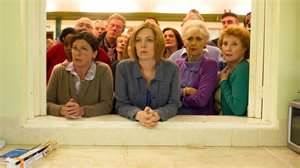
In 2006, in different locations across Ipswich and over a period of roughly three months, the bodies of five prostitutes were found. The murderer, Steven Wright, was identified and arrested. A resident of (you guessed it!) London Road, the discovery of his crimes led to the street being given a reputation and haunted his unknowing neighbours. The film follows the residents through; the period of uncertainty of a serial killer being on the loose: the identification of the murderer: his arrest, trial and convictions for all five crimes; and the community trying to rebuild itself by hosting events culminating in a flower show in their front gardens. The fact that these are all real events that occurred is echoed by the construction of the film – the residents of London Road were interviewed by Alecky Blythe over a period of three years. Her questions focused on the wellbeing of the community were well-received by the interviews and resulted in the unburdening of some very honest and heartfelt opinions. These recording were then transferred to a theatre production which was produced in a verbatim style – with the spoken text being reproduced by the performers exactly as it was recorded. Everything from tone, meter, pitch, inflection and fillers were retained to create a ‘real’ reflection of what happened. The twist is that the dialogue is set to music to expedite the emotion – intensifying what is being spoken/sung.

This film is, as far as I can gather, a true stage-to-screen adaptation. The killer and his victims remain unseen, the focus staying with the neighbourhood as it tried to regenerate in the aftermath. In fact the only change appears to have been with regards casting. Instead of retaining a main ensemble cast of unknown, the film has made the use of stunt casting. We have Anita Dobson (of Golden-era Eastenders fame), Olivia Colman (she of everywhere-on-the-telly fame) and Tom Hardy. Yes, you did read that right, the Tom Hardy (of the-awesomeness-that-is-Mad-Max fame and loads more.) This is one of two aspects of the film I found rather difficult. I will be very honest at this point and admit I was rather looking forward to Tom Hardy’s appearance (A- cracking actor B- also rather attractive.) When he finally appeared (I guesstimate 15 minutes in) he was good, for the three minutes of running time he featured. He was clearly chosen (and given top billing!) to draw in a crowd (I shamefully admit to this…) and does a fantastic job of creating well-rounded creepy character. In fact considering the short screen-time this is very impressive indeed. But one cannot help but ask, was he really needed? Why not use an equally talented but lesser known actor? When the USP for this film is the authentic-ness, the realism of what is being shown and heard, why then hire a big star like Hardy? Why pull the viewer out of such an immersive play but using such a familiar face? Why spend so much effort creating a suspension of disbelief, only to return them to relate with his (very skilled but very recognisable) presence?

This leads on somewhat to my second difficulty with regards this film. 24 hours on, I am still not sure if I liked this film. Also, I am not sure how necessary it really is. Whilst is it does celebrate the restoration of a community – in a time of utter emotional devastation light is brought in to conquer the darkness – is there not a degree of profiteering of the deaths of five young women?  This is surely a matter of personal opinion, although I am yet to decide mine (slightly flawed review then perhaps!?!) Those in the former camp will revel in the engaging sincerity, dazzle in the niche display and chuckle along with the dark humour. Others, however, will feel unsettled by the plot, bored by the pacing and find the emotion cloying.

For the most part, I’m afraid, I am in most agreement with the second of the two opinions. Though I desperately tried to will myself to like it, to an almost feverish extent, I just didn’t ‘get it’. Whilst the intent is admirable, the execution is jarring. Considering the film is so claustrophobic, the overly optimistic ending undercuts the power of what has gone on before. An interesting but flawed experiment.