Grandma

A cinematic gem

This film is a total and utter joy to watch. So few films manage to have a plot that is so well-rounded and immersive with characters with such real depth. The fact this film is only (!) 78 minutes makes it even more magnificent – it’s not bloated nor is it lean. In fact, to an extent, the film feels far long in a good way. It feels as if you actually know these characters. They almost feel like friends.

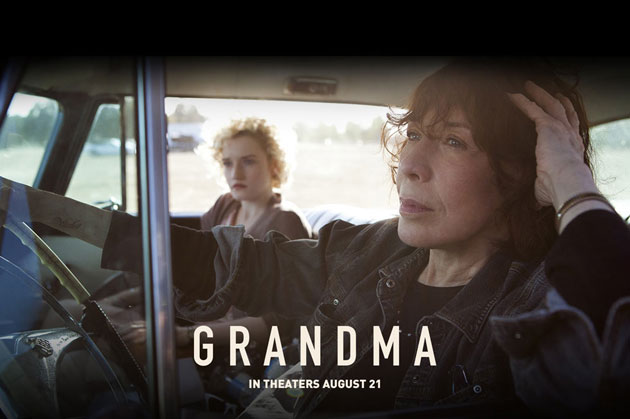
Elle Reid (Lily Tomlin) is a sometime poet and sometime academic. 18 months ago her partner of 38 years died after a long illness. Three months into a new relationship she breaks up with girlfriend Olivia (Judy Greer).  In front of Olivia she appears to not care about her soon-to-be ex-lover, even proclaiming her to be a ‘footnote’ in comparison to her dead love. Soon after Elle’s granddaughter Sage (Julia Garner) arrives and needs her grandmothers help. Sage is pregnant and has an abortion booked for 5pm that day, but she doesn’t have the $630 to pay for it.  Elle doesn’t have that money to spare, all she has is $48 after paying of medical costs and other debts. She even cut-up all her credits cards as a symbol of a new start. Both Sage is too scared to ask her mother for help, a fear Elle shares. So the two go on a road trip to get both the money they need and to come to terms with their recent troubles.

There are not enough films like this being made at the moment. It’s witty and intelligent, heart-warming and emotional, compelling and laugh-out-loud funny. As we are in the middle of Oscar season it’s not surprising this film has had a degree of Oscar-buzz, but it’s been quiet compared to that surrounding other films that could be regarded as Oscar bait.  The prospect of a Grandma and her Granddaughter road movie may not sound massively appealing but there is so much more to it. The relationship between the pair is so well portrayed by both actresses.

Tomlin creates a character who does not have all the answers but will still insist on answering back, who is quick to get angry and can be bitter with her words. But her performance as Elle is also feisty, funny and full of vitality. She swears, she’s got tattoos, she attacks a dead-beat boyfriend but with her performance and a finely-written script she creates a truly appealing character.  We laugh with her not at her. The love she has for her granddaughter is unquestionable and fully justifies her actions.

Garner’s Sage is so carefully handled. A pregnant teen nowadays is a regular focus for reality tv, but Sage is very different from the ‘stars’ of those shows. Instead she is a girl who is looking for love, who is grieving for her dead Grandma and watching the alive one struggle with grief. Sage is immensely endearing and her narrative never strays into sappy.

Though the film’s driving force is obtaining the money for Sage’s abortion her decision is never questioned, somewhat surprising for an American film. In fact the film overall is about liberalism but never preachy. Elle clearly lived through a progressive period of time, her poetry and art-centric background were once part of the counter-culture which is slowly being forgotten and disappearing. Sage represents the new, with access to the internet and other resources she is ignorant to the world around her. She knows little of the time her Grandmother lived through, and knows nothing of women’s history. When visiting her Grandmother’s acquaintances, a transgender tattoo artist (played by Orange Is The New Black’s Laverne Cox), a rather intimidating butch cafe owner and listening to Elle’s views on society it is made clear just how little Sage really knows about the world around her. But this progressiveness is not dominant, not shoe-horned in nor heavily-handedly forced upon us. Instead these culture contrasts are treated carefully and tenderly like its characters. 

The film has an episodic narrative, with five chapter marked with title cards. Each chapter focuses on one of their visits to try and collect the $630. All of the chapters are exceptionally good but #4 titled ‘The Ogre’ is my personal standout. Elle brings Sage to visit Karl (Sam Elliott) who she has not seen in 39 years. The emotion generated by this scene is lump-in-your-throat-inducing. The pair bounce of each other as years of resentment come rising to the surface. Equally good is the emergence of the mother (Marcia Gay Harden) is manages to be worthy of the terror Elle and Sage feel towards her but still able to grab our sympathies. 

A study in character and emotion unlike many of this year’s releases. A little film worthy of much acclaim.


The Lady In The Van

British Cinema at its finest

This film is so warm, kind-hearted and endearing. Whilst on the surface it looks to be a meek and mild comedy about a nutty old lady it is so much more than that. It’s full of witty observations about society – the  lens is pointed firmly at liberals who have earned enough to become middle class yet feel a degree of guilt about their new-found  wealth – and how we do/don’t look after each other. Maggie Smith as the eponymous ‘Lady’ is magnificent,  bringing a richness and poignancy to a fiercely opinionated powerhouse of a figure. Should this be 80-year old Smith’s last leading role, it is one to be proud of. Her performance in this ‘Mostly True Story’ both perverse and profound in equal measure.

In the 1970s playwright Alan Bennett (Alex Jennings) moved into an affluent street in Camden. He swiftly became acquainted with his neighbours and the nomadic interloper Ms Shephard (Maggie Smith) known by many as the infamous ‘Ms Camden’. Ms Shepard, as Alan insists on calling her, lives in a van. The neighbours do not know why she lives in the van, or even who she is. Is she called Mary or Margret. What they do know is that she is homeless and prone to dictatorial ravings. Due to a mixture of guilt and territorial conviction they protest little (at least to her face)  as she drives around and parks up where ever she fancies. However, after council and double yellow line interference, she can no longer continuing temporarily pitching up where she choses. Loathe to offer too much help to the cantankerous old woman Alan lets her use his drive temporarily to park her Van. 15 years pass, with an often-reluctant Alan slowly-forming a bond with Ms Shepard. As time passes and takes its toll on Ms Shepard Alan begins to learn of the past that continues to consume her. 

This is the type of story that could only be true, it would be nigh-on impossible to create a character like Ms Shepard. The majority of her views were left in the dark ages and the way she treats those who try to help her is often despicable. And yet, when personified by Dame Maggie Smith, she is made almost loveable. Her hidden pain and turmoil often explaining some of her brusque character traits. Jennings is superb as her friend and foil, presenting the conflicted feelings Bennett himself had towards helping the formidable Shepard. The supporting cast are also extraordinary: Frances De La Tour, Jim Broadbent and Claire Foy to name just three, all bring various degrees of support to the grande dame of squalor that is Ms Shepard. The slow and tragic realization that Ms Shepard was more sinned against than a sinner is heart-breaking yet handled with such caution and care.

Considering the topic matter this film is ultimately uplifting, almost joyful in its exploration of what draws people to care and look out for one another.

Bill

William Shakespeare: The Lost Years

Suffice to say, this is not another Bad Education Movie-style television to big screen disappointment of an adaptation. The team behind Horrible Histories have succeeded in translating their unique combination of historical-informed humour and slapstick. In fact Bill, along with Horrible Histories and their fantastical series Yonderland, has secured their place as natural successors to Monty Python and Blackadder.

Bill Shakespeare (Matthew Baynton) is a family man. He lives with his wife, Anne Hathaway (Martha Howe-Douglas), and their three children. Bill plays lute in a band called ‘Mortal Coil’, but after one concert where he tries to steal the spotlight he is told to ‘shuffle on’. It’s not us it’s you, they tell him. So Bill moves onto his next dream, being a playwright. As Stratford-Upon-Avon doesn’t actually have any theatres, he leaves his family to go and achieve his dream. In the process he befriends Christopher Marlowe and becomes embroiled in King Phillip II of Spain’s devious plot to murder Queen Elizabeth at a theatre production she is hosting.

The results are properly hilarious. The gag rate is so high, with most of it landing, that whilst laughing at one joke you may end up missing the next.  Of all the genres it is arguably comedy that is the hardest to do well. Aim too broad and you please no-one, aim too niche and you end up pleasing a minimal market. This irreverent biopic carefully, and to great effect, utilises modern references and a panto-esque tone to keep the audience tittering from start to finish. There are a few that are groan-worthy gags, a couple which are smirk-creating, many that are chuckle-inducing and a good handful of proper belly laughs. The team are not limited by their obligation to educate, as they were with the excellent Horrible Histories, and use that freedom to great effect. Considering we do not know what actually happened to Bill during the years between his abandoning his family in Stratford and emerging as royal playwright William Shakespeare, the events of this film are entirely plausible… well unlikely but possible.

One can only hope that situations such as Shakespeare educating Christopher Marlowe in ‘your mum’ jokes did in fact occur. If only because it leads to an immensely funny recurring gag within the film, that is seconded only by a henchman’s inability to understand the concept of a Trojan Horse. Other highlights include Helen McCory’s toothy and worn portrayal of Queen Elizabeth, some lovely throwaways about funding of the arts and a hilarious reference to ‘clunky exposition’. Baynton is excellent and rather endearing as an idealist and optimistic Shakespeare, as is Howe-Douglas as his under-appreciated wife.

Bill has a relatively taunt and witty script that has a joke for everyone. As expected the chemistry between the cast is electric, the gags reliably brilliant and the timing of them is spot-on. Well worth a watch.

Ant-Man

An elegANTly told origin story

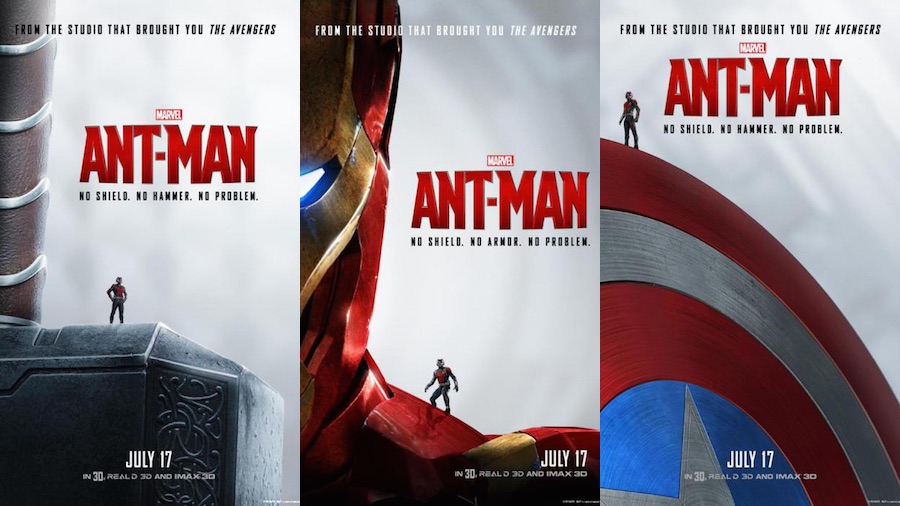
In 1962 Ant-Man made his comic book introduction – a brilliant scientist who invented a substance which allowed him to shrink size. Specifically to size of Ant (get it?!?) Along with his girlfriend, known as Wasp, they became a crime fighting duo who utilised their ability to shrink to the sizes of insects. In 1963 they were established as founding members of that little known superhero team, the Avengers. The chances are that this is all new information to you, for Ant-Man as a comic book series was not particularly popular. In fact he was not successful enough to even warrant his own series until relatively recently, mainly making appearances in ensembles as opposed to solo adventures.  The first you probably knew of Ant-Man was when the promo campaign started for this movie. You probably snorted, scoffed on your popcorn and sniggered at the ridiculousness thinking, ‘First Ironman, then Star-Lord now…Ant-Man!?!’  You may have laughed at one or two of the gags in the trailer and remained uncertain about the film. Don’t be fooled by his name, for in his cinematic debut Ant-Man confounds all expectations and proves that size is not everything. He may be small but this movie is gigantic in scope, laughs and pathos. In what could be viewed as its most outlandish adaptation yet, Marvel studios have created its most human movie yet.

Scott Lang (Paul Rudd) is a thief who has just been realised from a three year prison sentence. Struggling to find employment due to his checkered past and consequently unable to pay child support for his daughter he is a man desperate for a second chance at life. This is when Hank Pym (Michael Douglas) enters his life, a biophysicist who left the laboratory he founded under less than friendly-circumstances. Hank discovered a set of subatomic particles that made it possible to transform to the size of an ant, which his board members wanted to use for less than altruistic purposes. This, along with the mysterious disappearance of his wife, led to his estrangement from his daughter Hope (Evangeline Lily) Years after his quitting Pym technologies Hank needs Scott’s ‘unique set of skills’ to prevent his former-protégée turned possible evil genius Darren Cross (Corey Stoll) from using Hank’s research to create America’s next military weapon.  Scott must learn to use the ants, his own inner strength and skill-set, to plot the ultimate heist to save the earth.

This narrative is typical origin-movie stuff – a hero is given a call to arms, has an assistant who provides him with the help he needs and must defeat a villain who poses a mass threat – and in this manner may be Marvel’s most conventional narrative yet but it is also its most sublime. The sequences where Scott is ant-sized are superb, harking back to 50s sci-fi b-movies but with far better SFX. This is one of the few films that is released in 3d and is really worth watching in 3d. The humour along the journey is well-pitched and at times provides proper belly-laughs. If you found Avengers: Age of Ultron to be too dour then Ant-Man is your antidote. Paul Rudd’s Scott is pitched in the same manner as Chris Pratt’s Star Lord in Guardians of The Galaxy – the most unlikely of heroes can still be noble of heart and funny of tongue. A few of the quips made get lost in the action, but this is just a reason to re-watch the film. Although Edgar Wright left the film prior to filming, there are a few Wright touches here. Scott’s best friend Luis (Micheal Pena) is a scene-stealer and his flash-back narratives are told in Hot Fuzz stylee-editing to great effect.

Whilst the film is not perfect, with slightly too much of its running time spent on exposition and a few obvious twists, it is still an entertaining thrill-ride which suggests fantastic things to come. It’s an immensely likeable film with an equally likeable hero, proving that good things can come in small packages.