drama
Denial
“This case is happening to you, but it’s not about you.”

Maggie’s Plan
A film well worth planning to see
You have a choice this weekend. You could see cold and divisive Neon Demon (click here for my review) or you could see this proper gem of a movie. It’s so warm and smart, meandering about with utterly superb dialogue. It’s immensely well observed and occasionally practically profound – just how much can we plan and how much do we leave to the hands of destiny?
Maggie (Greta Gerwig) wants a baby. Needs one even. Except she hasn’t got a partner so she’s going to go it alone and use a sperm donor. A friend from college, Guy (Travis Fimmel), is more than happy to help. Best friend Tony (Bill Hader) and his wife Felicia (Maya Rudolph) think she should wait a bit longer, just in case she meets someone. She does, and her plan is interupted by a meet-cute with married John (Ethan Hawke). An affair follows and he leaves his wife, Georgette (Julianne Moore), for Maggie. Three years later and Maggie has the child she was desperate for, but she’s starting to have serious doubts about her relationship with John. Maybe she can give him back to his first wife..?
Several reviews are referring to this film as a screwball comedy. Personally I think the pace is slightly too slow to categorise it as screwball – not a criticism as I love the pace but screwball comedies are noted for their break-neck speed of story and delivery. However, this has many other elements of screwball. Think Woody Allen meets Jane Austen in terms of the characters and their dialogue.Greta Gerwig provides another knitwear-atired delight (I really wish I was friends with her!) who is utterly sympathetic in a role that could easily not be. Maggie is simillar to Emma (title character of Austen’s 1815 novel) as she is a matchmaker who loves to be in control, who is unable to let other forces control hers or others lives.
Hawke is fantastic as John, both glorifying and sending up the figure of intellectual. He also delivers what will most likely be my favourite line of 2016 cinema – “Like is a language condom.” It’s obvious that he is having the time of his life playing this character, which hugely pays off as it’s delightful to watch. The interactions he has with Maggie both convert then subvert the expectations of the romantic comedy, resulting in the film being both old-fashioned yet astutely modern.
The scenes when Gerwig and Moore share screen time are truly electric. All too rarely do we get such well-rounded female figures on the screen at the same time, they bounce off each other and the result is electric. What’s fantastic is how layered Moore’s character is. It would have been all too easy to have her as a woman scorned, who pushed her incredible man away with the glacial and disinterested temperament. We quickly learn there is more to her character than her ex-husband revealed, and that John is far from a perfect husband.
A quick note has to be made of just how fantastic the supporting cast are. Bill Hader, yet again, is superb (I want to be his friend too!), Maya Rudolph has little screen time but contributes massively, Travis Fimmel is really likeable as Guy (far more interesting here than he was in Warcraft) and Wallace Shawn has a lovely little cameo.
It’s funny and quirky, may not be for everyone, but for many it will be a winning comedy-drama. An utter delight to watch!

Hologram for the King
A film that seems as lost as its main character
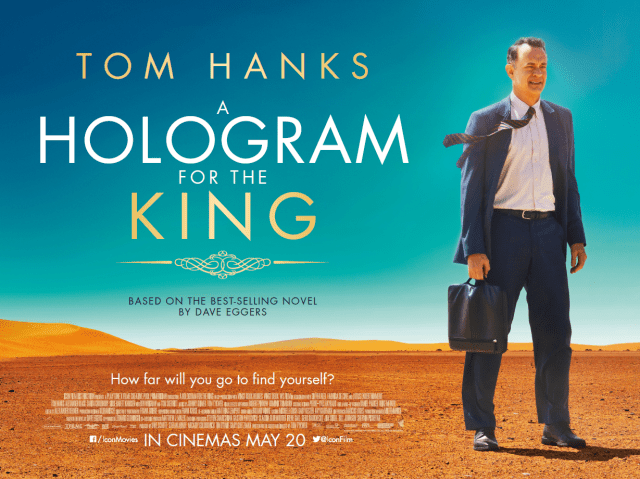
It is a fact universally acknowledged, that Tom Hanks is watchable in anything. He’s one of the great stalwarts of Hollywood – an actor who the audience can rely on for a great movie. Aside from regular debates with my younger brother on Forest Gump (he’s pro and I’m anti – a debate which should hopefully finally be settled when we watch it together during the Summer) Hanks has had an incredible career littered with successes. His last release Bridge of Spies, directed by fellow great Steven Spielberg, led to a spectator experience equivalent to sitting in a really comfy leather armchair. Safe, secure and captivating. This film? He’s the best thing in it.
American Business man Alan Clay (Tom Hanks) was once on top of the world, CEO of Schwinn bikes – the bikes that every kid in America wanted to own. Now he’s a washed-up IT salesman who has been sent to Saudi Arabia to secure a contract with the King of Saudi Arabia for his massive new complex. Alan’s boss has made it clear that this is his last chance with the company, everyone is relying on the huge contract and if he doesn’t secure it then he’s out. Running late on day one due to jet lag he’s provided with a driver called Yousef (Alexander Black). Arriving on site it is clear that things are not as clear as they appeared back in America, with the complex nowhere near being completed.. Things begin to spiral for Alan and his health appears to be suffering, which is how he comes into contact with Dr Zahra (Sarita Choudhury). In a foreign country with a culture hugely different to his own how is Alan supposed to cope, let alone sell a contract to an absentee monarch?
“And you may find yourself living in a shotgun shack /And you may find yourself in another part of the world/ And you may find yourself behind the wheel of a large automobile/ And you may find yourself in a beautiful house, with a beautiful wife/ And you may ask yourself/ Well…How did I get here?” The film starts of with Hanks reciting these lyrics to the epic Talking Heads ‘Once in a Lifetime‘ accompanied with a short montage which alludes to Alan’s current state of well being (read: not good). It successfully sets up the tone that will fellow, of quirk and occasionally surreal. It’s one of the best bits of the movie, a high that it struggles to replicate. For a film that is essentially about a man having a mid-life crisis the film itself also lacks an identity. It’s not a comedy nor is it a drama.
There are too many allusions to some BIG topics – Saudi Arabia’s view on women’s rights, conflicts within the country and offshoring of industry – that prevent the film from being feelgood. Yet the film seems to desperate to provide a positive message that it tries to either ignore or forget about these features. The cast are all fantastic with the material they are provided with, all three main characters are memorable and well-rounded. Alan’s burgeoning friendship with Yousef and his budding romance with Zahra are joyful to watch. Both dynamics are sweet, endearing and rather believable considering the circumstances.
However Alan’s storyline about his business contract is less successful and his relationship with his daughter is also underdeveloped. The film also attempts then appears to shy away from making comments on the previously mentioned BIG topics. Instead of allowing them to provide a degree of darkness to the story they are treated as some sort of distraction. A sequence which in the space of less than 30 seconds sees Alan observe great poverty and then great wealth deserved to have been treated with more comment or reflection as opposed to metaphorically being pushed under the carpet. The best way to describe this film it that it’s like eating salted caramel – at times it’s sweet and at times it’s savoury – yet when you’re finished it doesn’t want to leave that as an aftertaste. It wants to wash it away with saccharin and a tacked-on ending. It’s as if the film-makers decided from the outset the ending they wanted – one about new beginnings, fresh starts and eternal hope – and chose to ignore anything that has gone on before that contradicts it.
The film itself is a fine enough watching experience. Hanks is typically cast as the American Everyman. It’s good to see him tackle something darker and with anxiety. Yet the film itself is rather bland, pleasant enough yet nowhere near his most memorable film.


Our Little Sister
A quietly touching family drama
Our Little Sister is a wonderful example of a sentimental yet ultimately subtle delight of a film. Watching it is a bit like being in a 128 minute-long embrace, warm and imitate with undercurrents of deep emotion. There’s no real melodrama – no dramatic shouting matches, intensive confrontations or shocking revelations – it’s far more real than that. We start the film with the character being total strangers to us then end the film feeling as if we are part of the family.
15 years ago a father left his wife and three young daughters behind. Soon after his heartbroken wife left the daughters in the care of her mother and left the town. 15 years later and the three, now fully grown, receive a phone call that their father has died, leaving behind his 14-year-old daughter who nursed him until the end. The trio – 29 year old Sachi (Haruka Ayase), 22 year old Yoshino (Masami Nagasawa) and 19 year old Chika (Kaho) – travel to his funeral and to meet their little sister Suzu (Suzu Hirose). The girls make an offer to the now orphaned Suzu, that she could come and live with the three of them in their big house in Kamakura.
What is so effective about this film as it doesn’t require a big overarching plot – there’s no big problem or issue to solve. Instead we watch the three women over a period of about a year as they bond and face different issues within their own personal lives. Days blend into weeks with only a few references to dictate how much time has passed – at one point the three tell their little sister that in six months they’ll be able to undertake the family tradition of making plum wine, later in the film they do so etc. This alone with the absence of a melodramatic narrative instead presents a more realistic portrayal of family life by choosing to instead use what is essentially a series of interconnected vignettes. Each of the girls faces different issues in their lives, typically resulting around love or work, some are returned to and resolved and others are not as they do not need to be.
The film plays a magical spell as you watch it, drawing you into the lives of four young women who are each dealing with the grief of a departed parent in different ways. All four girls are fully sketched out and wonderfully characterised by both positive and negative traits, each as charming at the movie itself. How the story is shown is as extraordinary as it is told, finding beauty in even the smallest of moments – such as the way a plum floats in a jar of plum wine – and within the landscape itself – with the ‘tunnel’ of cherry blossoms being a personal favourite.
Few family-based dramas whisper instead of shout. This is one of them. A film that is quietly powerful and immensely appealing.

Grandma
A cinematic gem
This film is a total and utter joy to watch. So few films manage to have a plot that is so well-rounded and immersive with characters with such real depth. The fact this film is only (!) 78 minutes makes it even more magnificent – it’s not bloated nor is it lean. In fact, to an extent, the film feels far long in a good way. It feels as if you actually know these characters. They almost feel like friends.
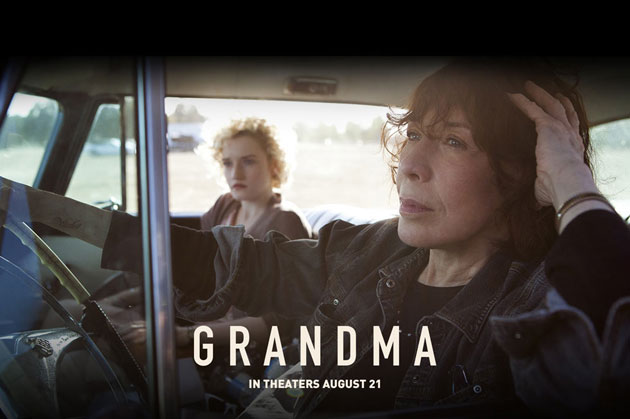
Elle Reid (Lily Tomlin) is a sometime poet and sometime academic. 18 months ago her partner of 38 years died after a long illness. Three months into a new relationship she breaks up with girlfriend Olivia (Judy Greer). In front of Olivia she appears to not care about her soon-to-be ex-lover, even proclaiming her to be a ‘footnote’ in comparison to her dead love. Soon after Elle’s granddaughter Sage (Julia Garner) arrives and needs her grandmothers help. Sage is pregnant and has an abortion booked for 5pm that day, but she doesn’t have the $630 to pay for it. Elle doesn’t have that money to spare, all she has is $48 after paying of medical costs and other debts. She even cut-up all her credits cards as a symbol of a new start. Both Sage is too scared to ask her mother for help, a fear Elle shares. So the two go on a road trip to get both the money they need and to come to terms with their recent troubles.
There are not enough films like this being made at the moment. It’s witty and intelligent, heart-warming and emotional, compelling and laugh-out-loud funny. As we are in the middle of Oscar season it’s not surprising this film has had a degree of Oscar-buzz, but it’s been quiet compared to that surrounding other films that could be regarded as Oscar bait. The prospect of a Grandma and her Granddaughter road movie may not sound massively appealing but there is so much more to it. The relationship between the pair is so well portrayed by both actresses.
Tomlin creates a character who does not have all the answers but will still insist on answering back, who is quick to get angry and can be bitter with her words. But her performance as Elle is also feisty, funny and full of vitality. She swears, she’s got tattoos, she attacks a dead-beat boyfriend but with her performance and a finely-written script she creates a truly appealing character. We laugh with her not at her. The love she has for her granddaughter is unquestionable and fully justifies her actions.
Garner’s Sage is so carefully handled. A pregnant teen nowadays is a regular focus for reality tv, but Sage is very different from the ‘stars’ of those shows. Instead she is a girl who is looking for love, who is grieving for her dead Grandma and watching the alive one struggle with grief. Sage is immensely endearing and her narrative never strays into sappy.
Though the film’s driving force is obtaining the money for Sage’s abortion her decision is never questioned, somewhat surprising for an American film. In fact the film overall is about liberalism but never preachy. Elle clearly lived through a progressive period of time, her poetry and art-centric background were once part of the counter-culture which is slowly being forgotten and disappearing. Sage represents the new, with access to the internet and other resources she is ignorant to the world around her. She knows little of the time her Grandmother lived through, and knows nothing of women’s history. When visiting her Grandmother’s acquaintances, a transgender tattoo artist (played by Orange Is The New Black’s Laverne Cox), a rather intimidating butch cafe owner and listening to Elle’s views on society it is made clear just how little Sage really knows about the world around her. But this progressiveness is not dominant, not shoe-horned in nor heavily-handedly forced upon us. Instead these culture contrasts are treated carefully and tenderly like its characters.
The film has an episodic narrative, with five chapter marked with title cards. Each chapter focuses on one of their visits to try and collect the $630. All of the chapters are exceptionally good but #4 titled ‘The Ogre’ is my personal standout. Elle brings Sage to visit Karl (Sam Elliott) who she has not seen in 39 years. The emotion generated by this scene is lump-in-your-throat-inducing. The pair bounce of each other as years of resentment come rising to the surface. Equally good is the emergence of the mother (Marcia Gay Harden) is manages to be worthy of the terror Elle and Sage feel towards her but still able to grab our sympathies.
A study in character and emotion unlike many of this year’s releases. A little film worthy of much acclaim.
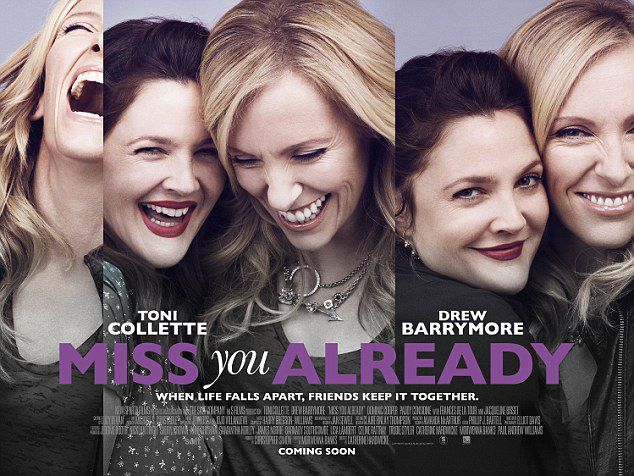
Miss You Already
An unsentimental yet sincere depiction of illness and friendship
It may not have a particularly original plot and may be presented in a way that is ultimately wildly manipulative (read as: you will cry) the film itself is admirable in what it, mostly, achieves. It presents a relatively honest depiction of breast cancer; the impact it places upon relationships both platonic and romantic along with the physical toll it takes. Whilst that alone is immensely refreshing, this is furthered by the presentation of a friendship that will resonate with audiences’.
Millie (Toni Collette) and Jess (Drew Barrymore) have been best friends since childhood. They have experienced every first together, everything from first kiss to first child, with their polar opposite personalities allowing them to bring out the best in each other. Whilst Jess is more conservative and stable, Millie is the overconfident and glamourous wild-child yet they are totally and completely inseparable. Both are happily married, yet rather than this separating them their respective husbands (Millie is married to Dominic Cooper’s Kit with Jess married to Paddy Considine’s Jago) and Millie’s two children instead make up one big family. But the family is rocked by Millie’s life-altering diagnosis of breast cancer, just as Jess finds out that she is pregnant with her much-longed for first child, which will put their friendship and their makeshift family to the ultimate test.
Collette does any amazing job (as is to be expected) playing Millie. Her acting, along with the screenplay and the film’s direction avoid what many similar films have done in the past, of making the person suffering from cancer into some sort of saint or martyr. Instead Millie stays the same as it is implied she always was – a mostly well-meaning but often not very nice person. This feature is really the film’s only comparatively unique feature. This, along with the portrayal of her treatment, make the film feel more honest and in a sense more brutal than others of this kind. Millie starts the film loud and vulgar, and although she spends the majority of the film in an oncology unit, she still stays the same person. Cancer doesn’t ‘fix’ her personalities ‘faults’, at times it only exacerbates them, consequently making her more relatable than many other presentations of the disease. It’s a reminder that cancer can, and with the current odds will, affect all of us whether we are good, bad or, like Millie, the grey area in-between.
However, it would be wrong to say this film is truly great or fully lives up to its potential. As we only see Jess and Millie’s friendship through flashback or montage, we are unable to fully latch onto their story. Aside from their respective health concerns, and a few references to a shared love of Wuthering Heights and R.E.M’s Losing My Religion, we aren’t really given enough about what makes them such good friends. The film constantly tells us this, but never shows us quite enough to engage us fully with their bond and ultimately does not earn the empathy it had the potential to do so.
Nevertheless, the ensemble cast, with Collette at the forefront, are all reliable and supply solid performances. Jacqueline Bisset is fantastic as Millie’s actress mother, Frances de la Tour momentarily steals the show in her short appearance as a wig-maker and Tyson Ritter (lead singer of All American Rejects) pops up as a swaggering barman.
From the opening of the film the inevitable outcome is presented, yet it will withhold interest and induce multiple bursts of tears throughout.
 Charlotte Sometimes