Room

Astonishing And Devastating In Equal Measure

To begin with, an analogy. Have you ever wrung a towel, a facecloth or even just a piece of fabric in general? You put all your strength into the movement, creating enough tension to drain the cloth of the water it possesses. Are you with me? Now let’s replace a few words of that scenario – the face cloth is the viewer of ‘Room’, the water is either literal tears or just emotion in general and the source of the wringing is the film. Everything, from the cinematography, the mise-en-scene, the dialogue to the extraordinary performances , works in conjunction to drain you so brutafully (see, I made it work there too!) drain you. Never has such a thing been done so willingly, nor with such reward. ‘Room’ is otherworldly in its brilliance and ability to shatter your heart.

Jack (Jacob Tremblay) lives in Room. As far as Jack knows that is all there is to life as he has never left Room. As Ma (Brie Larson) has explained to Jack outside is ‘Space’ and filled with aliens. The only other person knows of is Old Nick who brings them food, necessities  and a ‘luxury item’ referred to as a ‘Sunday Treat’. When Old Nick comes to spend time with Ma, Jack must sleep in the wardrobe. Jack has just turned five and Ma has started to release that he may be old enough to know the truth. That there is a whole world outside of Room, but a world that has been closed off to Ma since Old Nick kidnapped and locked her away seven years ago. Ma was once Joy, a seventeen-year-old girl on her way home from school. Now no-one knows where Joy is. Joy comes up with a plan that involves tricking Old Nick into taking Jack outside of Room, allowing for Jack to escape and get help to rescue Ma. But will Jack be able to accept he could have a life outside of Room?

‘Room’ is a blend of true-crime and fairy-tale. It tells a story that is so abhorrent and seemingly hopeless in a way that is grippingly real, intimate yet somehow beautiful. Jack’s view of Room is fairy tale-like, where what are ordinary objects to us are the only one of their kind, have a personality and are therefore addressed with capitalisation (Table, Lamp, Bed etc.). The television is not a link to the outside world, there is no outside world, but instead images of things that do not exist. It is Joy’s view that is the true-crime, through her eyes the surroundings are depicted in their true horror. Joy is a prisoner, her child was born into captivity, and she has created this world to help them both survive. It is the blending of these two worlds that generates the film’s astonishing power.

But it’s the performances of its two leads that allow this power to land – to convince and cherish. Brie Larson presents an anguish that is so severe that at times becomes unbearable to watch.  Her raw and honest performance is miles, lightyears even, away from the many mawkish performances of exploitative ‘true movies’. Jacob Tremblay provides the kind of child performance you see once in a decade, his abundant glee at the rose-tinted life in Room through to his difficult transition at learning everything believed was a lie. Joy tells Jack these stories to keep him sane in confinement, and Jack’s job unbeknownst to him is to keep Joy sane.  The bond shown between mother-and-son is otherworldly in its believability and its depth.

‘Room’ is gut-wrenching, heart-wringing and brain-haunting. It’s not typical night-out to the movie fayre. At times it’s impossible to watch, and will haunt far longer than its two hours running time. Yet it’s a narrative journey well worth making, proving the power of cinema and the power of extraordinary performances.

‘When I was small, I only knew small things. But now I’m five, I know everything!’ – Jack

Joy

What is ‘Joy’?

The question above does not refer to eternal philosophical ideas, but is a question posed to director David. O. Russell. What is ‘Joy’? Is it a comedy, a tramedy, a somewhat biopic or an ironic look at the American Dream? In theory is shouldn’t be a bad thing that a film defies generic classification, that it is something new, fresh and different. However in this case this question is raised by how irregular in tone and pace the film is. The film is remarkably uneven, drifting from one genre to another. However, an incredible performance from Jennifer Lawrence anchors a film that overall doesn’t quite gel.

Joy (Jennifer Lawrence) is a divorced mother of two young children. Her ex-husband and failed musician Toni (Édgar Ramírez) lives in the basement. Her seemingly-agoraphobic divorcee mother (Virginia Madsen) doesn’t leave her bedroom and whiles away the days watching soap operas. Her lothario father Rudy (Robert De Niro) briefs comes to stay before finding love with rich but uptight Trudy (Isabella Rossellini). Her half-sister Peggy (Elisabeth Röhm) works with their father and constantly passively aggressively attacks Joy on a daily basis. All this is overseen by her loving Grandmother Mimi (Diane Ladd). Joy’s days are spent dealing with all of her family’s dramas, with life not having handed her a very even deck. Having spent the first half of childhood being incredibly creative, designing multiple inventions, her enthusiasm was crushed the day her parents split up.  17 years later Joy is not particularly happy, stuck with being her family’s errand girl. It is during one of these errands that Joy makes a new invention that she is sure will make a fortune. But persuading the world of the value of her idea, let alone even her family, will not be so easy. Yet a chance encounter with Neil Walker (Bradley Cooper) could be one step closer to the success she has always deserved. 

A great cast does not always make a great film, as some may view is true of ‘Joy.’ Though it does have some extraordinarily powerful scenes, some emotional hold-your-breath moments, that’s all they are – moments. For the film itself is rather meandering – moving in unexpected and somewhat underprepared ways. It muddles through the key events in Joy’s life in a rather lacklustre fashion – never quite achieving its potential. This could be for multiple reasons. One could be the source material, as this is not a biopic of real-life inventor Joy Mangano, but a blended narrative of multiple women O. Russell admired. Another could be the fact the film used four different screen editors, a decision that without true collaboration can result in four differently edited films being shoehorned together. Tonally the film aims for a quirkiness that seems remarkably forced, from the rather unrealistic quirks of the characters to the voiceover narration from Grandma Mimi, to the various time hops to some oddly-placed soap opera themed dreams.

Obviously once Joy has come up with her fantastic new idea it will not be easy to make it a reality, but the disequilibrium – Joy does something badass to fix it – temporary equilibrium – another bout of disequilibrium – does become rather repetitive after a while.  However is is that phrase ‘Joy does something badass to fix it’ that feels like the real point of this film. This is Lawrence’s third time at working with O. Russell and most of this ensemble cast and the benefits of that really shine through. The director knows how to help his lead achieve a star turn. And also her legacy in badass GIFS. Her performance is remarkable. Considering that she is potentially too young for this role Lawrence is incredible in how she interacts with the other characters, uses her voice to convey all manner of emotions and portray a world weariness that is beyond her years.

Overall ‘Joy’ in a enjoyable enough romp of a movie.  Though the film itself is rather direction-less Lawrence herself is a ‘Joy’ to watch.

No Escape

Escape from [insert name of fictional Asian city here]

Considering the plot, characterisation and cinematography this film contains, it is not difficult to imagine it being made in the 1980’s (with Harrison Ford replacing Owen Wilson as the lead hero) or even the 1950’s (starring Jimmy Stewart). This is not a way of complimenting the film and suggesting it is timeless, anything but. This film is dreary, predictable and exceptionally dated. It’s portrayal of foreign conflict and politics is extremely problematic, a one-sided view of global issues that is almost xenophobic in presentation. The only thing that separates No Escape from a B-movie shown on the dark and misty unknown entities of Sky Movies channels after channel 315 is it’s talented cast, who are severely let down by the dross of a screenplay. Having not stayed for the end credits (in my desperation to leave the cinema)  I can only presume my hunch that the ‘research’ for this film was the greatest hits of The Daily Mail is in fact true…
Jack (Owen Wilson), an American engineer, leaves behind a failed business to drag his family to 
Southeast Asia to head his water manufacturing company’s new plant there. When they get there; they seem to be having problems, the electronics don’t work and rarely any cars are seen in the streets. When he goes to the market the next morning, he finds himself caught in the middle of a violent rebellion headed by armed rebels executing foreigners. Unbeknownst to Jack, just days before these armed rebels assassinated their prime minster. Jack must get back to the hotel and with the help of a mysterious British “tourist” (Pierce Brosnan), must get his family to the American Embassy in the midst of the chaos. But is there any escape? 
Firstly, the family. Jack is the archaic kind of hero of cinema long ago. He’s the Everyman. A husband. A father. By agreeing to this new job he has uprooted his family and doesn’t appreciate how they might feel, so he must learn his lesson through enduring this hero’s journey. He has a jarringly good range of survival skills; he knows instantaneously how to survive the most incredible and most ridiculous situations without having to think about it. Most depressingly of all, he is intentionally presented as all charmness and niceties whereas his wife Annie (Lake Bell) spends most of the film crying or with her face contorted into fear/outrage.  And, as bad as it will sound, their children are unbearably annoying. The majority of hurdles the family face are either caused by the children or severely complicated by the children. Pierce Brosnan enters, exits and reenters the film to little effect. His presence here echos something Micheal Caine declared when once asked about his role in Jaws: The Revenge,’ I have never seen it, but by all accounts it is terrible. However, I have seen the house that it built, and it is terrific.’ That must be the only reason that Brosnan is here giving a throwaway performance as a mysterious lothario Cockney.
The film’s biggest error is its portrayal of the ‘enemy’, The way the armed rebels are presented could have been an intelligent examination of ISIS or other militant groups. Instead they reflect the sentiments of those who use the term ‘swarm’ to label those currently seeking European asylum. They are characiatures: nameless, faceless and brainless. They are zombies, an epidemic the hero must save his family from.
No Escape mistakes creating tension by instead creating frustration. It’s one-part popcorn movie to two-parts shameless exploitation.

Man From U.N.C.L.E

A light-hearted and immensely entertaining spy caper

Finally, we get a proper Hollywood summer movie (admittedly slightly belatedly as the week of British summer time appears to have drawn to a close…) Nevertheless, this is the kind of film you’d expect to see, a fizzling and refreshing take of a much-loved genre. The story might not be the most original, or particularly remarkable, but the immensely charismatic performances of its stars make it a hilarious romp that is well-worth seeing.

It’s 1963. In the midst of a global stand-off, with the world on the on the cusp of nuclear war, ex-con turned leading C.I.A agent Napoleon Solo (Henry Cavill) is tasked with tracking down and rescuing Gabby Teller (Alicia Vikander). Her father, who is currently missing, was a Nazi scientist who worked for the U.S government due to his specialism of nuclear weaponry. Solo finds Gabby easily enough, but was being pursued by leading KGB agent Illyra Kuryakin (Armie Hammer) who is also on a mission to locate Gabby. A chase sequence follows, with Solo managing to get Gabby over the Berlin wall into West Berlin and leaving Illyra on the other side of it. That’s not the last the trio will see of each other, as the next day Solo’a American handler and Illyra’s Russian counterpart bring them to a meeting and announce that they will be working together to stop a pair of former Nazi’s who are forcing Gabby’s father to create their own personal nuclear weapon.  They must go undercover and work together to find Gabby’s father, however, Solo and Illyra are given private orders from their seniors to steal the data from the project for their respective governments.

What follows is a breezy, stylisation and oh-so elegant production. It’s an affectionate tribute to the Bond series and other espionage classics; a fun and frivolous, and even rather fresh, take on a much-worn genre. With a sparky soundtrack, gorgeous costumes and speedy editing to set the tone you’ll be kept engage from frame-to-frame. These features, along with the magnetic leads, make for a charming ride of a movie. Vikander is scintillating as a German mechanic who becomes embroiled in matters of international performance. Hammer is incredibly endearing as a Russian spy who may have a sweet heart within his looming psychique. Then we have Cavill whose charm, wit and suave emulates the pre- Daniel-Craig-era Bond.

It’s nothing particularly new, but with a few inventive twists and turns this makes for a laugh out loud cinematic gem.

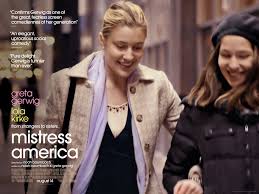
Mistress America

A witty and endearing sister comedy

A ‘Manic Pixie Dream Girl’ was a term coined (and since abandoned) by film critic Nathan Rabin in 2007. It refers to a stock character type; a female character who is bubbly and quirky, who enters the life of a brooding, serious male to help him embrace the joys and wonderment of life. (See Kristen Dunst in Elizabethtown, Marilyn Monroe in Some Like It Hot, Belle in Beauty and the Beast and Zooey Deschanel in practically every movie.) Typically, though not in every case, the MPDG  is shown through the eyes of the male character (known as the Male Gaze) who idealises her, lusting after her and placing her on a pedestal. What’s interesting, and truly refreshing about Mistress America is that some of the MPDG and her narrative ways are on display whilst also being subverted and questioned. This film is the story of a hipster-sect but told with old-fashioned sophistication; an honest look at the complexities between worship and reality. But instead of a traditional romance the focus is on friendship.

Tracy Fishcoe (Lola Kirke) is an 18-year-old college freshman undertaking her first semester in New York. She’s not enjoying it. It’s not what she had expected, feeling like she doesn’t fit in. In fact her life feels like she’s at a party where she ‘doesn’t no anyone.’ She gets rejected by a  boy, then rejected for an elite writing society and every attempt she makes to try and fit in becomes just another knock-back. Her soon-to-be-remarried mother suggests Tracy call her Brooke (Greta Gerwig) as this marriage will make the pair step-sisters. Brooke also lives in New York, but Tracy is too intimated to make the phonecall, believing this woman 14-year her senior would not want anything to do with her. However one lonely dinner -time she takes the chance to call Brooke, who instantly agrees to meet her. They enjoy a crazy night-out together, and continue to meet-up. When Brooke’s restaurant dreams start to fall through, Tracy endeavours to help the woman she now views as a sister.

In many ways Brooke meets a lot of the criteria of a MPDG, she’s the life and soul of every party. She knows everyone, appears able to do anything, and is keen to immerse Tracy in her world. Brooke even has a ‘quirky’ habit, appearing to not listen to other people so conservations with her sound disjointed.Even after meeting Brooke just the once Tracy is inspired to writer new short story, about thinly veiled version of Brooke. If this film wanted to be conventional or typical, it could have stayed this way. Brooke could have just stayed as Tracy’s muse, whose pure function is to inspire and guide her (an aspect that is mentioned within the latter half of the film). What’s so clever and makes the film so heart-warming is it isn’t just about that. It’s about friendship and sisterhood. It’s about how life doesn’t always meet up to it’s expectations and isn’t always as easy as it appears to other people. It’s the act of putting on a smile whilst inside you’re terrified.

When you’re 18 you’re certain that by the time you’re 30 everything will be sorted. That you’ll know everything, have everything and life will be sorted. Mistress America shows that really doesn’t happen, but that’s not a bad thing.

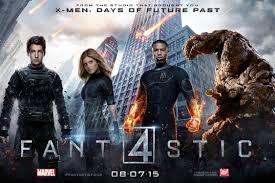
Fantastic Four

An open letter to 20th Century Fox,

[HERE BE SPOILERS!]

Dear 20th Century Fox,

I write this letter/review to you immediately after seeing ‘Fantastic Four’. I’d like to ask to ask you one simple question. How did that happen? How did you manage to make such a mind-blowingly boring superhero movie? The film only lasts 100 minutes, but it felt like so much more. I do not write this to you as a comic book puritan, or as a ‘Fantastic Four’ puritan. I’ve only ever read one or two ‘Fantastic Four’ graphic novels, and I have a rather big soft spot for the 2005 film starring Chris Evans and Jessica Alba (yes, I know it’s pretty awful and dated but it is rather funny and, unlike this movie, rather entertaining.) I’d read the damning reviews of this, but still held out hope that there were some redeeming features within the movie. There really weren’t. The characters were tedious, unlikeable and one dimensional. The Frustratingly-dull Four, sorry ‘Fantastic’ Four (Reed Richards/ Mr Fantastic – Miles Teller, Ben Grimm/The Thing – Jamie Bell, Sue Storm/ Invisible Woman – Kate Mara and Johnny Storm/ Human Torch – Michael B. Jordan) were ill-served. They were given such rubbish material in terms of script that it’s unsurprising there was barely an ounce of charisma between them. But not only was the characterisation within the movie immensely poor – so was the pacing and story-telling. Whilst all films could be divided into acts, as an audience member you shouldn’t be able to see it. With this film there were three clear acts: the bad, the meh and the god-awful. Let’s look at them together…

The origin story’
Well first of all you stumbled at the first hurdle. Origin stories are problematic and require a careful balance. Whilst you want to introduce a mainstream audience who may not have any prior knowledge of the characters or their humble beginnings, you also want to placate the fans who are already well-versed in the mythology. I doubt you appeased either of those audiences. For one thing, the ‘Fantastic Four’ have a rather simple origin story – an experiment goes wrong and four scientists end up with superpowers. Done. It doesn’t require 30 minutes of screen-time to set this up, dating from childhood to the present day. It’s a bold decision, which requires a degree of audience sympathy to establish deep sympathy. Instead Reed Richards is established as a character of utter pity, presented in an unsympathetic portrayal of nerdom. He feels alone and an outcast (no points for originality here!) with his only supporter being his loyal best friend Ben Grimm. It’s at this point, 20th Century Fox, that you lost the majority of any fan-boy/girl loyalty. ‘It’s clobberin time’, The Thing’s battle-cry, his trademark for the past 54 years is established as the phrase Ben’s abusive brother uses as code that he is about to be beaten up. WHAT?!?! No. You took such a beloved catchphrase and tainted it, needlessly, utilising it as a symbol of darkness and pain. It many ways it’s the film’s Grimm-est (apologies, just trying to lighten the tone…) and one which would have alienated any of the ‘Fantastic Four’ fans who risked trailing this remake.
Conclusion: I care about Batman’s origins. I somewhat care about the Avenger’s origins (to varying degrees). I don’t care about Fantastic Four origins.
Finally the film gets to the should-be-good stuff with Reed, Ben and Johnny joined by Victor Doom (the only marginally interesting character, played by Toby Kebbell) use the machine they have created to enter another dimension, later named Zero. As made clear by the trailer (and known to anyone who knows even a small amount about comic books) it all goes wrong. The sequence itself is presented reasonably well and adequately (if not particularly subtlety) explains why each of the group got their particular power. Things seemed to be picking up…
 ‘Aftermath’
It’s at this point in the film that should I be forced, against my will, to retrospectively chose my ‘favourite’ five minutes, I would chose the first sequence of act two. The sequence where the three survivors, and the infected Sue Storm, are revealed to be being held at ‘Area 57’. They way their new powers are revealed to the audience, and their father figure Franklin Storm, hints at the film this could have been. The camera acts like a voyeur, examining these wounded figures and revelling in the grotesqueness of their new abilities. It’s almost like a David Cronenberg movie, with Reed’s stretched limbs, Sue intermittently fading out of existence, Johnny’s constant rage of fire and Ben’s hulking mass of boulders. They are treated and presented like the aftermath of a failed science experiment – which they are.
 ‘Showdown’
This sequence is cut bitterly short with Reed running away, promising to solve everything. Cut to black, ‘one year later’, then we have five minutes of exposition where we can see what the others three characters have spent the past year doing and how they can now harness their abilities. Then we have five minutes of a chase movie, where it’s proven to the viewer that Sue Storm is ‘smart’ as she can type furiously into a computer. Reed is located, returned to Area 57 and swiftly fixes the technology to revisit Zero. The human guinea pigs (some may call them idiots) who arrive at Zero are greeted by a seemingly injured Victor Doom. They bring him back to Earth and a dull-but-important man in a suit tells him that he plans to use Victor and the resources from Zero to create more human weapons. Victor does not react well to this and decides to wreak havoc on the facility and Earth itself. His proceeding actions, his Walk Of Pain if you will, are incredibly violent and rather shocking.
 In fact it makes the film’s 12A rating seem pretty, erm, mind – blowing (sorry…)
We then have 15 minutes of a battle sequence. This fails for two reasons. It’s plotted in a way that induces battle fatigue, ‘wow, looks explosions and things being destroyed!’ and is scripted in a toe-curlingly clumsy manner. Highlights include,
‘It’s Victor! He’s the power source!’ and  ‘He’s stronger than any of us!/Yes. But he’s not stronger than all of us!’ Victor is defeated and the four return home. They are given a new base of operations and discuss having a team name (yep, this film really favours subtlety…) Ben then reflects on his BF’s journey and says, ‘It’s just fantastic’ (spoken after he has literally been turned into a walking talking rock pile and just been used by the US military as a weapon for the past year. Reed pauses and says, ‘Wait. Say that again…’ And thus, in this ham-fisted manner, the team no-one really cares about is born and the film ends. No after-credit sequences, which this film could have really used.
All in all, 20th Century Foc, this film was bad. It was dull, boring, clunky and a poor attempt at a comic book adaption. One of the worst there has been for a long time. The fact that you made this film as a cynical way of holding onto the rights to the franchise, instead of letting them slip into the grasp of your mortal enemy (the immensely more successful Marvel Studios) make this an even more bitter cinematic experience. It’s sad to think of what might have been. You, perhaps over-eagerly, pencilled in a sequel before this film even came out. Good luck with that. It’s going to require more restructuring of both crew and cast than I think you have the balls for.
Best of luck,
Charlotte Sometimes

London Road

The citizens of London Road will talk-sing their way to a brighter tomorrow!

london rd

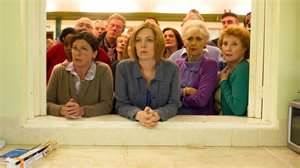
In 2006, in different locations across Ipswich and over a period of roughly three months, the bodies of five prostitutes were found. The murderer, Steven Wright, was identified and arrested. A resident of (you guessed it!) London Road, the discovery of his crimes led to the street being given a reputation and haunted his unknowing neighbours. The film follows the residents through; the period of uncertainty of a serial killer being on the loose: the identification of the murderer: his arrest, trial and convictions for all five crimes; and the community trying to rebuild itself by hosting events culminating in a flower show in their front gardens. The fact that these are all real events that occurred is echoed by the construction of the film – the residents of London Road were interviewed by Alecky Blythe over a period of three years. Her questions focused on the wellbeing of the community were well-received by the interviews and resulted in the unburdening of some very honest and heartfelt opinions. These recording were then transferred to a theatre production which was produced in a verbatim style – with the spoken text being reproduced by the performers exactly as it was recorded. Everything from tone, meter, pitch, inflection and fillers were retained to create a ‘real’ reflection of what happened. The twist is that the dialogue is set to music to expedite the emotion – intensifying what is being spoken/sung.

This film is, as far as I can gather, a true stage-to-screen adaptation. The killer and his victims remain unseen, the focus staying with the neighbourhood as it tried to regenerate in the aftermath. In fact the only change appears to have been with regards casting. Instead of retaining a main ensemble cast of unknown, the film has made the use of stunt casting. We have Anita Dobson (of Golden-era Eastenders fame), Olivia Colman (she of everywhere-on-the-telly fame) and Tom Hardy. Yes, you did read that right, the Tom Hardy (of the-awesomeness-that-is-Mad-Max fame and loads more.) This is one of two aspects of the film I found rather difficult. I will be very honest at this point and admit I was rather looking forward to Tom Hardy’s appearance (A- cracking actor B- also rather attractive.) When he finally appeared (I guesstimate 15 minutes in) he was good, for the three minutes of running time he featured. He was clearly chosen (and given top billing!) to draw in a crowd (I shamefully admit to this…) and does a fantastic job of creating well-rounded creepy character. In fact considering the short screen-time this is very impressive indeed. But one cannot help but ask, was he really needed? Why not use an equally talented but lesser known actor? When the USP for this film is the authentic-ness, the realism of what is being shown and heard, why then hire a big star like Hardy? Why pull the viewer out of such an immersive play but using such a familiar face? Why spend so much effort creating a suspension of disbelief, only to return them to relate with his (very skilled but very recognisable) presence?

This leads on somewhat to my second difficulty with regards this film. 24 hours on, I am still not sure if I liked this film. Also, I am not sure how necessary it really is. Whilst is it does celebrate the restoration of a community – in a time of utter emotional devastation light is brought in to conquer the darkness – is there not a degree of profiteering of the deaths of five young women?  This is surely a matter of personal opinion, although I am yet to decide mine (slightly flawed review then perhaps!?!) Those in the former camp will revel in the engaging sincerity, dazzle in the niche display and chuckle along with the dark humour. Others, however, will feel unsettled by the plot, bored by the pacing and find the emotion cloying.

For the most part, I’m afraid, I am in most agreement with the second of the two opinions. Though I desperately tried to will myself to like it, to an almost feverish extent, I just didn’t ‘get it’. Whilst the intent is admirable, the execution is jarring. Considering the film is so claustrophobic, the overly optimistic ending undercuts the power of what has gone on before. An interesting but flawed experiment.

Moomins on the Riviera

Is it Moomin’ marvellous? Well, yes and no…

Going into this film with no context of The Moomins is inadvisable. In fact, I would probably recommend this film only to big fans of the Moomins (shout out to Carrie ‘Cookie’ Turner-Gould and Matthew at this point!) Unfortunately, I am not a big fan of the Moomins. Although I have vague memories of the cartoon series, of strange hippo-looking creatures going on adventures, I do not really remember enough of the series to confirm that this film is merely a continuation onto the big screen. And I really did not remember The Moomins being so… strange…

The film opens with Snuffkin (yes I have got tabs open of Google and IMDB to help with this review!) strolling across Moomin Valley.In fact the entire opening sequence (3-5 mins) is of Snuffkin on his journey, of what and who he sees along the way. It is in this aspect the film really excels – the artwork and colouring is truly extraordinary. Every single frame could be printed off and used as artwork. The hand-drawn animation is truly glorious to watch on the big screen, and sets up a would could be described as a whimsical and quaint tone for the rest of the film. Or you could describe it as tedious. But I digress…

Finally, Snuffkin arrives at his journey. At the point the party (literally) gets started. Moominpappa makes a speech about how at this present moment he would not want to be anywhere else. He then plays a bit with fire then the party is over. Then we cut to the next day and a pirate ship is the distance (there is no transition or explanation, which may divide audiences) It starts to sink and the pirates escape – leaving behind their prisoners, Little My and her sister, who are tied up. They have also abandoned two treasures chests – one filled with gold and the other, seeds. The Moomins go to scavenge, accidentially rescuing the hostages in the process. The pirates come to collect their treasure chest from the Moomin family – who chose to collect books, fireworks and seeds instead. The pirates leave. The next day, whilst relaxing in the garden, they decide to go to the Riveria. They go to the Riveria. Various adventures happen. They go home.

And that is it in terms of the plot. It is incredibly simplistic and that both works, yet also doesn’t. Yes, it is a kids film but that doesn’t mean it has to be so simple or almost lackadaisical. Also, if this really is a kids film, I’m not so sure they would understand that many of the jokes or nuances. In fact the entire sequence in the Riveria is essentially a satire of a Monte Carlo- esque resort: about how ‘appearances can be deceptive’, to ‘be careful what you wish for’ and how ‘the grass isn’t greener on the other side’. Snorkmaiden is wooed by a charming celebrity man/dog/thing, who rivals Moomin in her afffections. It takes a fencing duel for her to realise the error of her ways. One character, the Marquis Mongaga, in fact personifies woes of consumerism completely. He spends most of the film charmed by the misadventures of Moominpappa (adventures I can only presume are recounted events from the comic strips?) until he feels bold enough to confess- he would give it all up to be a poor, struggling artist. Needless to say, he isn’t really suited to the lifestyle he has glamourised.  In this sense the film is quite clever, gently poking fun at bohemia and culture with some rather sharp gags. But this is done in a manner far too episodic for it to actually flow as a film.

This film, perhaps like marmite, will divide audiences totally. One side will leave the cinema describing it with adjectives including, ‘wistful’, ‘gentle’, ‘charming’, ‘mischievous’, ‘heartwarming’ and ‘eccentric’.

The other side will leave asking, ‘What did I just see..?’