Midnight Special

Messiah or weapon? Or something else entirely?

Imagine a science fiction movie that focuses less on the fictional powers and more on the human emotions, the cost behind the power. Imagine a science fiction movie that allows you to marvel at the mystery rather than hand-feed you the plot. Imagine a science fiction movie that is a road trip/chase movie that challenges the value of belief. Now stop imagining as Midnight Special is all three of those things and much more. It is a wonderfully strange blend of genres, full of complexity and sentiment. A parable about love and extraordinary ability.

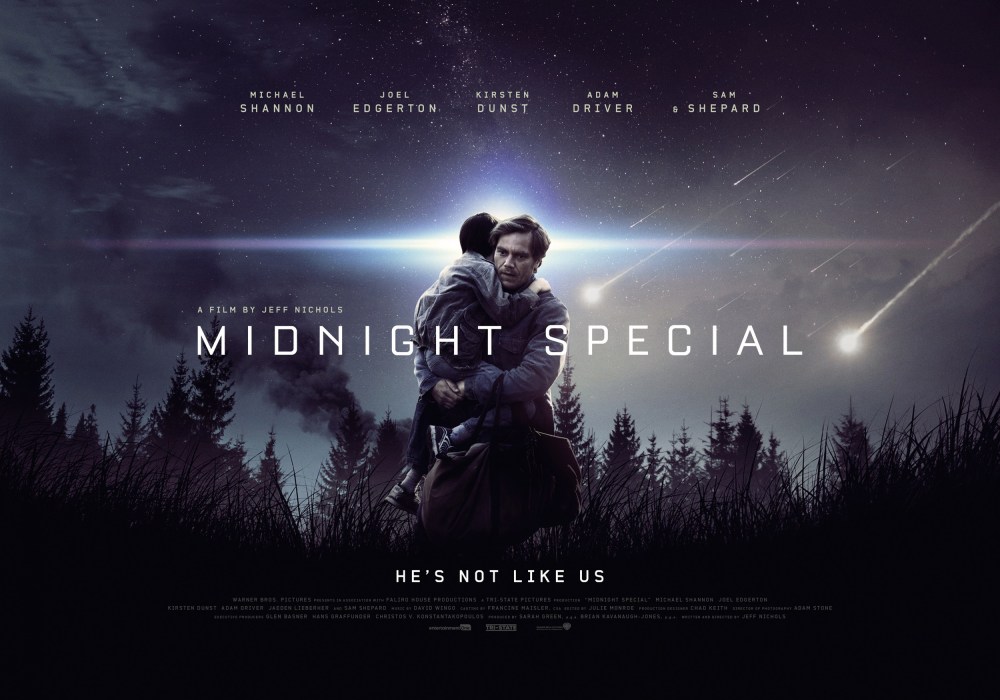
Roy (Michael Shannon) and his eight-year-old son Alton (Jaeden Lieberher) are on the run from both the government and religious extremists. Alton appears to possess special abilities, from being able to effortlessly infiltrate classified government signals  to bringing down a satellite from outer-space. A religious cult formed around Alton who, as National Safety Agent Paul Sevier (Adam Driver) discovers,  turned his encoded words into gospel. His supernatural powers so badly altered by daylight that all of the cult  became nocturnal. Upon making eye contact with people Alton’s eyes glows and show visions of unknown lands. Having fled the cult, and with the help of childhood friend Lucas (Joel Edgerton) and Alton’s mother (Kirsten Dunst),  Roy must get Alton to specific location for a specific time. Will, as everyone fears and some hope, a celestial and world-changing event take place? 

This is not your typical science fiction film. Compared to typical box office fairings Midnight Special is slow, with far more questions than answers, and a narrative that is impossible to stay ahead of. Those are not criticisms, just an acknowledgment that this film is not for everyone. In the preview screening I attended yesterday many of the audience members seemed frustrated or unfulfilled by the film. I was not in agreement with them for the film I had just witnessed was so riveting and magical. Rarely is science fiction this personal and emotive. Yes, a beginners guide to film criticism will show  you that Steven Spielberg’s films are about father-son relationships,  but what we see here is a different realm. What director and writer Jeff Nichols manages to achieve is a film which places greater emphasis of the consequences of supernatural power rather than the benefits of it, prompting the reflection that more is lost than gained in such extraordinary circumstances. Few storytellers are this damn magical.

The acting by the entire cast is wondrous, each cast member providing a wondrous blend of awe, fear and honesty. Roy’s love for his son is so deep and unconditional, a level of paternal concern rivalling that of great Epics. Lieberher’s performance here suggests that Room child star Jacob Tremblay may have a rival for Hollywood’s current greatest child actor. Egerton’s performance allows us to give loyalty to a character we know little about, believability to a man who has only known Alton for three days but is willing to give everything to the boy’s journey. Dunst is subtle yet heartbreaking as a mother who fears she will have to give up her son once more.

The cinematography is marvellous, as is the soundtrack and the storytelling. Of particular favourite is the Easter Egg of the Superman-starring comic book that Alton is reading in the back of the car. Any in depth analysis of the parallels between Superman and Alton would be spoilerific, but the very fact both are outsiders with great power is a wonderfully subtle touch. Just like the entire film it’s an allusion to other sci-fi works, but something that is so uniquely individual and riveting.

Some may say slow. I say spellbinding, sincere and utterly superb.

Anomalisa


‘What is it to be human?’

Anomalisa is a masterpiece of cinema – a tale about the human condition told by puppets that is the most real movie in years.  We’ve all had awkward encounters – be that with ex-partners, conversations with strangers in a lift or the force-fed wisdom of a brusque taxi driver. We’ve all (hopefully) had a moment where you meet someone who, somehow and somewhere deep inside of yourself, you innately know that ‘this person is important to my future’. Now imagine a film that has the later as its main storyline but is layered with lots and lots of the former. That’s Anomalisa. It’s hilarious and sad at the same time, just like life, whilst reflecting on how bitterly lonely existence can be. Artistic greatness channelled through stop-motion puppetry.

It’s 2005. Michael Stone (David Thewlis), customer service consultant extraordinaire, is travelling to Cincinnati for a convention at which he is due to speak. To Michael everyone else on the planet appears to have the identical voices and faces. He is just spending one night at the hotel before travelling back home to his wife (Tom Noonan) and child (Tom Noonan. He decides that, as he’s in the area and plagued by self-hate, he’ll call up his old flame Bella (Tom Noonan) in the hope that Bella will help him find out what is wrong with him. Things do not go well, but upon retreating to his hotel room he hears a voice that is different from everyone else. He searches desperately and finds Lisa Hesselman (Jennifer Jason Leigh. Michael is instantly enraptured by her different voice and face, desperately hoping that she will cure his crippling loneliness.

This film, written and co-directed by Charlie Kaufman, does not have to try hard to be strange. Everything about it is strange, but that’s not criticism when you really reflect on how strange life often is. The most obvious ‘strange’ aspect is the fact the entire world is only voiced by three people – Thewlis as our lead, Jason Leigh supporting and Noonan as everyone else. Have one actor voicing 98% of this world has the most wondrously bleak effect, allowing for everyone else to blur in the background. They are unimportant therefore there characters are not defined, which is how our protagonist Michael Stone views the world. Few central characters are this self-hating, haunted by guilt and bad memories. Did the voices always sound the same, or has life for Michael etched away its beautiful nuances?

The interactions with both strangers and those who are supposedly the closed to him are all so affecting in there believability – many of them of the concealing-your-eyes-as-you-watch variety. But it is Michael’s interactions with Lisa that are the most beautiful and the most heart-breaking. Lisa is the exact opposite of Michael, Lisa is insecure and desperately lacking in confidence, yet is just as lonely as he is. Lisa is a great admirer or Michael’s and an obsessive reader of his book which helped her increase work ‘productivity by 90%’!  The beginning of their courtship is so tenderly handled, and perhaps the most human we’ll see on the big screen this year. Lisa’s serenading Michael with a cover of ‘Girls Just Wanna Have Fun’ will fill your eyes with tears. The film’s title stems from this point of the movie, when Lisa reveals she has always felt like an ‘anomaly’ which Michael then teams with ‘Lisa’ to form her self-appointed nickname ‘Anomalisa’. This conversation alone personifies their relationship, Michael and the film itself. Is he laughing at her by giving her this name, or showing just how much he understands?

Watching Anomalisa is almost like watching an autopsy or listening to a psychiatrist’s evaluation –   cutting apart our very psychology, our brains and being, then showing us how they work. Like The Matrix it’s up to you whether you take the blue or red pill.

Breathtakingly beautiful and bitter in equal measure; dare you see it?

Grandma

A cinematic gem

This film is a total and utter joy to watch. So few films manage to have a plot that is so well-rounded and immersive with characters with such real depth. The fact this film is only (!) 78 minutes makes it even more magnificent – it’s not bloated nor is it lean. In fact, to an extent, the film feels far long in a good way. It feels as if you actually know these characters. They almost feel like friends.

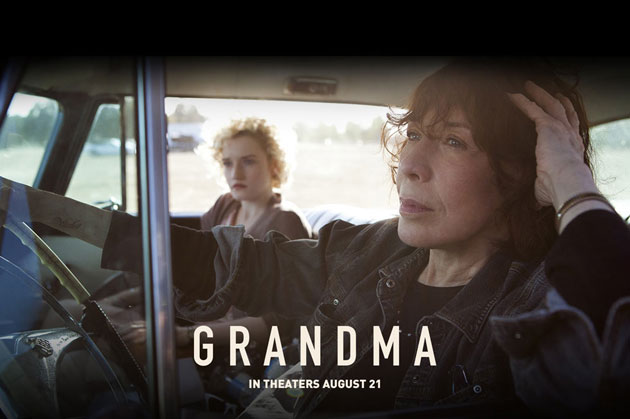
Elle Reid (Lily Tomlin) is a sometime poet and sometime academic. 18 months ago her partner of 38 years died after a long illness. Three months into a new relationship she breaks up with girlfriend Olivia (Judy Greer).  In front of Olivia she appears to not care about her soon-to-be ex-lover, even proclaiming her to be a ‘footnote’ in comparison to her dead love. Soon after Elle’s granddaughter Sage (Julia Garner) arrives and needs her grandmothers help. Sage is pregnant and has an abortion booked for 5pm that day, but she doesn’t have the $630 to pay for it.  Elle doesn’t have that money to spare, all she has is $48 after paying of medical costs and other debts. She even cut-up all her credits cards as a symbol of a new start. Both Sage is too scared to ask her mother for help, a fear Elle shares. So the two go on a road trip to get both the money they need and to come to terms with their recent troubles.

There are not enough films like this being made at the moment. It’s witty and intelligent, heart-warming and emotional, compelling and laugh-out-loud funny. As we are in the middle of Oscar season it’s not surprising this film has had a degree of Oscar-buzz, but it’s been quiet compared to that surrounding other films that could be regarded as Oscar bait.  The prospect of a Grandma and her Granddaughter road movie may not sound massively appealing but there is so much more to it. The relationship between the pair is so well portrayed by both actresses.

Tomlin creates a character who does not have all the answers but will still insist on answering back, who is quick to get angry and can be bitter with her words. But her performance as Elle is also feisty, funny and full of vitality. She swears, she’s got tattoos, she attacks a dead-beat boyfriend but with her performance and a finely-written script she creates a truly appealing character.  We laugh with her not at her. The love she has for her granddaughter is unquestionable and fully justifies her actions.

Garner’s Sage is so carefully handled. A pregnant teen nowadays is a regular focus for reality tv, but Sage is very different from the ‘stars’ of those shows. Instead she is a girl who is looking for love, who is grieving for her dead Grandma and watching the alive one struggle with grief. Sage is immensely endearing and her narrative never strays into sappy.

Though the film’s driving force is obtaining the money for Sage’s abortion her decision is never questioned, somewhat surprising for an American film. In fact the film overall is about liberalism but never preachy. Elle clearly lived through a progressive period of time, her poetry and art-centric background were once part of the counter-culture which is slowly being forgotten and disappearing. Sage represents the new, with access to the internet and other resources she is ignorant to the world around her. She knows little of the time her Grandmother lived through, and knows nothing of women’s history. When visiting her Grandmother’s acquaintances, a transgender tattoo artist (played by Orange Is The New Black’s Laverne Cox), a rather intimidating butch cafe owner and listening to Elle’s views on society it is made clear just how little Sage really knows about the world around her. But this progressiveness is not dominant, not shoe-horned in nor heavily-handedly forced upon us. Instead these culture contrasts are treated carefully and tenderly like its characters. 

The film has an episodic narrative, with five chapter marked with title cards. Each chapter focuses on one of their visits to try and collect the $630. All of the chapters are exceptionally good but #4 titled ‘The Ogre’ is my personal standout. Elle brings Sage to visit Karl (Sam Elliott) who she has not seen in 39 years. The emotion generated by this scene is lump-in-your-throat-inducing. The pair bounce of each other as years of resentment come rising to the surface. Equally good is the emergence of the mother (Marcia Gay Harden) is manages to be worthy of the terror Elle and Sage feel towards her but still able to grab our sympathies. 

A study in character and emotion unlike many of this year’s releases. A little film worthy of much acclaim.


Kill Your Friends

How to succeed in business without any sense of morality

With a title like that, the content of this film really shouldn’t surprise you. We have copious usage of drugs and alcohol, some rather legendary use of swearing (‘Do these shoes look like the shoes of someone who gives a fuck about The Velvet Underground?’) and of course the aforementioned killing of friends. Why? Well it’s set in 1997 and it’s about the music industry. You don’t need to be musicophile to have a rough idea what the music industry was like in the 1990’s. The people at the top possessed little musical talent themselves and gave little care to whether the artists they were choosing to spend their thousands on were ‘good’ artists or in fact whether they were producing ‘art’. Could this unsigned act make me a fortune? Yes, well sign here on the dotted line. So you four girls can’t actually sing or dance, but you’re all rather fit..? Well The Spice Girls are big right now, so we’ll take you. We’ll just get recording artists to sing your music which you’ll mime, and we’ll give you a really crappy basic routine for everyone to copy. You’re hired! This is the sole focus of Kill Your Friends, a study in the middle management wanting to become the top dog focusing less on making good music but more on making lots and lots of money…

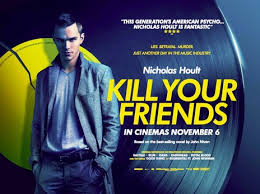
It’s 1997 and Britpop is ruling the airwaves. Twenty-seven year old A&R man Steven Stelfox (Nicholas Hoult) doesn’t like Britpop, or any other type of music at all actually. He’s not in the job for the music, he is far from a music puritan. He’s just in it for the money, lots and lots of money. Considering he works in an industry ‘no one knows anything’ there is little stability. Every deal you offer an act is make or break. If an act doesn’t sell, your career is broken. Fuelled by greed, ambition and Class-A drugs he craves the promotion to Head of A&R at his record label and will refuse to let his opposition, his ‘friends’, take the job from him. His calculating approach to manoeuvring the music industry will be taken to a murderous new level.

First things first – substitute music for Wall Street and 90s for 80s and this sounds rather like another film doesn’t it? There have been lots and lots of the reviews for Kill Your Friends that make a comparison between it and this other film. Let’s be straight, this is not the new American Psycho. Instead of a critique of the works of Huey Lewis and The New we have a reflection on the writing prowess of Paul Weller. Whilst is may sound like it, and makes some very noble steps to try and replicate it – Kill Your Friends is the inferior product by quite a long way. Having not read either books, I cannot comment on the book-to-film transition. However I can say from a film point of view American Psycho utilises filmic elements to greater effect, particularly in the representation of the central character which makes the audience question if the murderous acts actually happened or where in his mind. Kill Your Friends does not do this, and presents Steven’s homicidal behaviour with seemingly little consequences. It should also be said just how repellent Steven Stelfox is. He is horrific. Cold and calculating, with malice seeping from every pore, the audience is forced to spend 103 minutes with him. With no redeeming qualities whatsoever, it does become an endurance test. Whilst it should be stated that this is somewhat of a success on Hoult’s part, especially considering how likeable many of his other roles have portrayed him to be, the lack of bite or satire in the script rather ill-serves him.

That is the fatal flaw of this film. It doesn’t question the ethics, lack therefore of,  of these corporate men. It doesn’t poke fun at them, nor glorify it. As I stated in the start, if you even have a passing knowledge of the music industry, you’ll know what sort of scenes crop up in this film. There’s nothing new or particularly fresh. Whilst what is shown is good and well-acted, there are no surprises. The storyline follows Steven negotiating through one drama to the next. Considering how little we care about his character we are not really going to care if he gets caught. In fact considering the nature of his crimes, there is a degree of audience desire that is hoping he does get caught.

This film is joyless, grubby and gruelling. See at your peril.

The Diary of a Teenage Girl

‘I had sex last night. Holy shit!’

From those opening lines, uttered by 15-year-old Minnie Goetze, the tone and content of the film is clear. It might not be to everyone’s taste but this film is a crucial and poignant portrayal of adolescence. It’s also one of the very few films which not only presents an honest deception of female sexulaity and desire, but makes it the primary focus of the film. It does not shy away from showing Minnie’s inner turmoil, and the lust which is consuming and controlling her. It’s isn’t scared to show how tumultuous sex, lust and love can for anyone, especially a fifteen-year old. Most importantly, this is done so in a truthful way told by a distinctive and unconventional voice.

As you may have gathered from the opening line, Minnie has just lost her virginity. Upon arriving home, after a rather self-satisfied strut around the park, she digs out her old voice recorder. Recent events have become so overwhelming for her she requires an outlet, one which will not judge her as friends and family might. For Minnie knows that her first sexual encounter, however good it felt, would not be considered ‘right’. This is because she slept with Monroe (Alexander Skarsgard), a man who is twenty years older than her. He is also dating her mother, Charlotte (Kristen Wiig). The film follows Minnie, in a non-linear fashion, as she rides out an affair with Monroe, lying to her mother and experimenting with her sexuliaty. This is all presented in a manner which is so frank and honest it’s almost wince-inducing at times, with a degree of candor that is refreshing but depressingly rare.

What is perhaps even more depressing is that this film has been given a ’18’ rating, 3 years older than its main protagonist, therefore cutting it off from the audience it deserves and the audience who most deserve it. It’s a frustrating decision, especially with the sex or sexual references that form the foundations of this film are more honest than glorified. The language Minnie uses, and the way her sex-life presented is no worse than what a few choice searches into google could unearth. In fact, the sex in this film is unfiltered in the way that the pornogrpahy that drowns the web isn’t. Our society complains openly, yet in hush-hush tones about the ‘epidemic’ that is sexualising our youth. But why not address the problem with a film like this, which presents these issues but also teaches the viewers how to learn from them. Hollywood is dominated with so many films with negative portrayals of women, who are presented simply as boobs/bums/faces (delete as appropriate) that it seems bitterly unfair that a film which ultimately has a valuable positive message, of self-worth, is restricted to those who may learn from and appreciate it the most.

Though at times the pacing of the film maybe uneven, with some of the plot threads either unexplored or abandoned, it is hugely worth seeing. Not only is it’s content insightful and important, but it’s cinematography is beautiful, mixing the real with the comic book art that dominates Minnie’s life. A totally convincing and refreshing take on a coming-of-age tale.