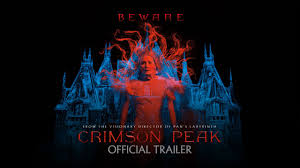
Crimson Peak
A film review/love letter for Guillermo Del Toro’s macabre masterpiece.
Finally. Six months in and 40 reviews written this film comes along. A Neo-Gothic epic. This is my kind of movie. The Gothic is arguably one of cinemas most underappreciated genres. This is a huge error as the tropes of the Gothic allow itself to become the truest articulation of the psychological state. Guillermo Del Toro knows this. He’s made a career of it. And this film could be his mainstream opus. The intent and scope of Crimson Peak is worthy of the highest praise: the end product astonishingly beautiful.
As an aspiring author Edith Cushing (Mia Wasikowska) revels in Romantic turmoil. Her father Carter (Jim Beaver) is devoted to her and her literary exploits; having lost his wife when Edith was ten he is all too aware of the loss and pain that love can bring. His protective paternal instincts kick in when a mysterious stranger arrives into town. Thomas Sharpe (Tom Hiddleston) intent is to persuade self-industrialist Carter to invest in his machinery – it’s the last hope for he and his sister Lucille (Jessica Chastain) to restore their family estate. Carter takes an instant dislike to the Sharpe siblings; upon observing Thomas’s intent towards his daughter he becomes determined to drive them apart. However, when tragedy strikes, Edith and Thomas are pushed further together – they marry and brings her to England. Upon arrival at Allerdale Hall, observing the decrepit building and the red clay-tainted oil that desecrates the landscape, Edith realises that she must try and escape the ghosts of the past and the threats in her future.
It is impossible to over-appreciate what Del Toro has achieved here. He has utilised the motifs of the genre – the double, the spiral staircase, the brooding stranger and the desperate maiden clasping at a candle which represents her life – to create a gloriously grotesque tribute to the original 1940s Gothics whilst utilising contemporaneous cinematic creativity. The Gothic triumphed in literature during the early 1800s, and peaked in cinema during the 1940s. Though set in the same era the filmic versions of the Gothic reflected the fears of the then-present. Women were leaving the household and entering the workplace; then forced back into the home when they returned from war. Unsurprisingly there was a flux of marriages; women agreeing to marry men they had just meet believing they would not return from war. Yet so of them did, and these women realised the once-romantic gesture had in fact resulted in their being married to strangers. Films like Rebecca, The Spiral Staircase, Secret Beyond The Door and Sleep, My Love utilised this intrinsic, yet utterly understandable fear to great effect. What united them thematically was a narrative that echoed Charles Perrault’s folktale Bluebeard – what is essentially a fable warning women against marrying alluring strangers. Why this is all relevant is because few new films, one that are not reliant on being literary adaptions, even attempt to make a film in this style – let alone join the canon.
An unholy union is made between set, music, cinematography and mise-en-scene. The sets in particular are astonishing and breath-taking – with so much to see it becomes almost overwhelming, echoing the confusion of our maiden in distress. Crimson Peak is a product of passion. Every aspect has clearly been carefully chosen and with love, which pays off ten-fold in the film’s visceral emotive impact. Combined Wasikowska, Hiddleston and Chastain make a character triangle which entraps the viewer – ensnaring them in this house of fear. This is a world where ghosts breathe and houses bleed. Melodramatic? Yes. Unashamedly and unabashedly so. Whether the film ultimately gets lost at this point, with a third act that becomes overwhelmed by pastiche, is up for personal debate. Ultimately this film is delightfully creepy – with sumptuous sets, creepy casts and unforgettable visuals – it’s an archaic yet inviting film that demands watching.
A true auteur can provide the audience a return journey to another realm. It may not be a realm we would chose to escape to – as is this case it could be a world of terror and fear – yet it was one we are fully immersed in and find the greatest beauty within. Then we are returned – shaken, frightened, bleary-eyed yet grinning. Go watch Crimson Peak and experience it for yourself.
 Charlotte Sometimes