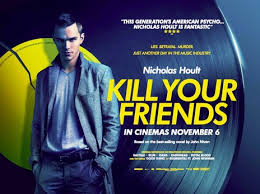
Kill Your Friends
How to succeed in business without any sense of morality
With a title like that, the content of this film really shouldn’t surprise you. We have copious usage of drugs and alcohol, some rather legendary use of swearing (‘Do these shoes look like the shoes of someone who gives a fuck about The Velvet Underground?’) and of course the aforementioned killing of friends. Why? Well it’s set in 1997 and it’s about the music industry. You don’t need to be musicophile to have a rough idea what the music industry was like in the 1990’s. The people at the top possessed little musical talent themselves and gave little care to whether the artists they were choosing to spend their thousands on were ‘good’ artists or in fact whether they were producing ‘art’. Could this unsigned act make me a fortune? Yes, well sign here on the dotted line. So you four girls can’t actually sing or dance, but you’re all rather fit..? Well The Spice Girls are big right now, so we’ll take you. We’ll just get recording artists to sing your music which you’ll mime, and we’ll give you a really crappy basic routine for everyone to copy. You’re hired! This is the sole focus of Kill Your Friends, a study in the middle management wanting to become the top dog focusing less on making good music but more on making lots and lots of money…
It’s 1997 and Britpop is ruling the airwaves. Twenty-seven year old A&R man Steven Stelfox (Nicholas Hoult) doesn’t like Britpop, or any other type of music at all actually. He’s not in the job for the music, he is far from a music puritan. He’s just in it for the money, lots and lots of money. Considering he works in an industry ‘no one knows anything’ there is little stability. Every deal you offer an act is make or break. If an act doesn’t sell, your career is broken. Fuelled by greed, ambition and Class-A drugs he craves the promotion to Head of A&R at his record label and will refuse to let his opposition, his ‘friends’, take the job from him. His calculating approach to manoeuvring the music industry will be taken to a murderous new level.
First things first – substitute music for Wall Street and 90s for 80s and this sounds rather like another film doesn’t it? There have been lots and lots of the reviews for Kill Your Friends that make a comparison between it and this other film. Let’s be straight, this is not the new American Psycho. Instead of a critique of the works of Huey Lewis and The New we have a reflection on the writing prowess of Paul Weller. Whilst is may sound like it, and makes some very noble steps to try and replicate it – Kill Your Friends is the inferior product by quite a long way. Having not read either books, I cannot comment on the book-to-film transition. However I can say from a film point of view American Psycho utilises filmic elements to greater effect, particularly in the representation of the central character which makes the audience question if the murderous acts actually happened or where in his mind. Kill Your Friends does not do this, and presents Steven’s homicidal behaviour with seemingly little consequences. It should also be said just how repellent Steven Stelfox is. He is horrific. Cold and calculating, with malice seeping from every pore, the audience is forced to spend 103 minutes with him. With no redeeming qualities whatsoever, it does become an endurance test. Whilst it should be stated that this is somewhat of a success on Hoult’s part, especially considering how likeable many of his other roles have portrayed him to be, the lack of bite or satire in the script rather ill-serves him.
That is the fatal flaw of this film. It doesn’t question the ethics, lack therefore of, of these corporate men. It doesn’t poke fun at them, nor glorify it. As I stated in the start, if you even have a passing knowledge of the music industry, you’ll know what sort of scenes crop up in this film. There’s nothing new or particularly fresh. Whilst what is shown is good and well-acted, there are no surprises. The storyline follows Steven negotiating through one drama to the next. Considering how little we care about his character we are not really going to care if he gets caught. In fact considering the nature of his crimes, there is a degree of audience desire that is hoping he does get caught.
This film is joyless, grubby and gruelling. See at your peril.

 Charlotte Sometimes