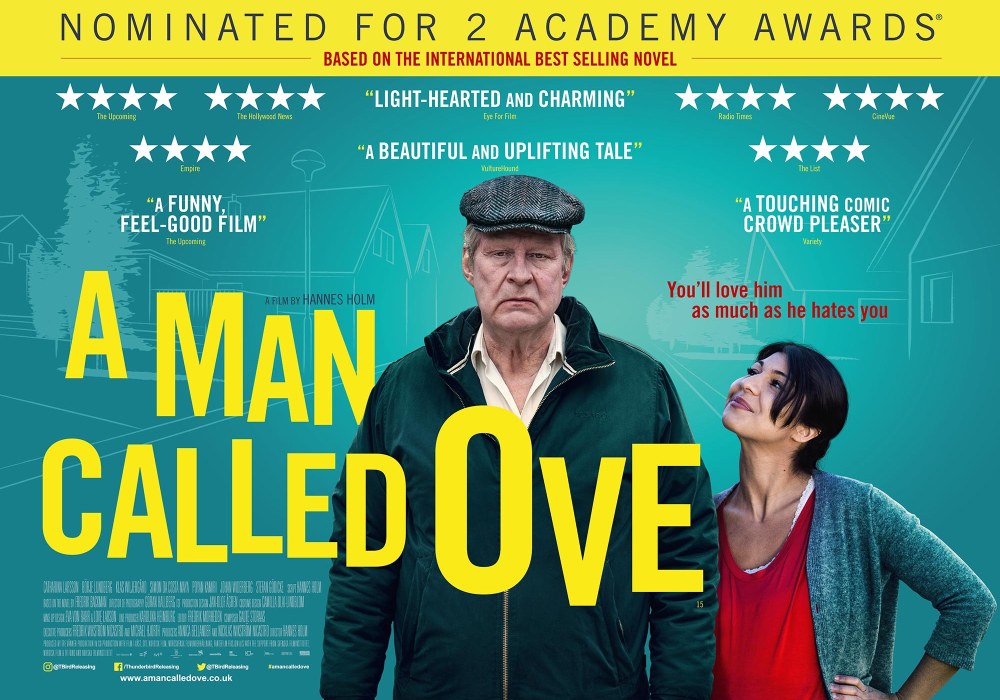
A Man Called Ove

(Review published in June 2017)

Carl Fredricksen from Up (2009) and the eponymous Ove (played by Rolf Lassgård) have a few things in common. They are old, pretty much on their own (through choice along with the way life has played out) and they are grumpy. Very grumpy. There’s a special word to describe characters of such ilk – curmudgeons. 59-year-old Ove may be cinema’s greatest curmudgeon yet. He’s miserable – he doesn’t care who knows it and it almost seems like he wants to spread the misery onto the masses, i.e the people who live in the same fancy housing estate he lives in. The older residents know Ove and know they are better off leaving the ex-chairman of the board of the neighbourhood associations to his own devices. If they follow his many rules, routines and regulations, there shouldn’t be any problems.

The new neighbours – an Iranian immigrant Parvenah (Pars), her Swedish husband and their two young daughters – don’t know this, however. They manage, totally inadvertently and completely unmaliciously, to break several rules as soon as they arrive. Ove does not react well. They even ask him for favours and rope him in to help them! Unlike the other residents, yet just like us, they do not know Ove’s past and what led him to being such a curmudgeon. They also do not realise, but unlike us, that they’ve just interrupted Ove’s suicide attempt…

It feels intrinsically and morally wrong to associate the adjective ‘funny’ with suicide and yet Ove’s multiple suicide attempts are somehow incredibly funny. They’ve been filmed that way. Ove may be a man desperate for a way out, and a way to be reunited with his late wife, but life has other plans in store for him, in the form of the new arrivals who have not-so-rudely interrupted him. Throughout the film, Ove tries to end his life but either Parvenah, her family, or flashbacks prevent Ove from ending his life. The world clearly isn’t ready to let him go and it’s through the flashbacks we fully begin to understand why. We bare witness to numerous key moments from Ove’s life – love, loss and everything in between. In these moments he is both the same man yet one who is vastly different. The reason for that? Sonja.

We find out in the film’s early moments that Ove’s wife died from cancer six months prior. Like yin and yang they completed each other, her tenderness smoothing out Ove’s harshness and forcing him out into a world he really wasn’t all that fond of. The utter devastation he feels at her loss is only compounded when he is fired from the company he has worked at for 43 years. He sees no reason to carry on living and it’s clear the universe is desperate to intervene. Repeatedly.

The aforementioned funny is the result of a careful blend of gallows humour, black comedy, dash of slapstick and excellent characterisation to make Ove truly endearing, even during his more pernickety moments. Over the film’s running time, courtesy of having his flashbacks juxtaposed with the present day, we get to bare witness to Ove’s greatness. We see just how extraordinary this seemingly ordinary man actually is. We realise just how kind and caring he has been and can be – it soon becomes clear there is a heart of gold behind exterior layers of steel. In fact, it would take the possessor of a heart of stone not to release more than a few tears during the moving journey through Ove’s past. The burgeoning friendship between Ove and Parvenah becomes a much needed reminder of the nature of first impressions – it’s all too easy to form a judgement from what we see on the outside looking in and that in doing so we might just miss the inner pain that person is hiding away.

The film is just like Ove himself. Quietly moving, darkly funny, sweetly tender, incredibly sincere and oh-so heartbreaking. The result is a film that is life affirming in a way that is all too rare and all too needed.
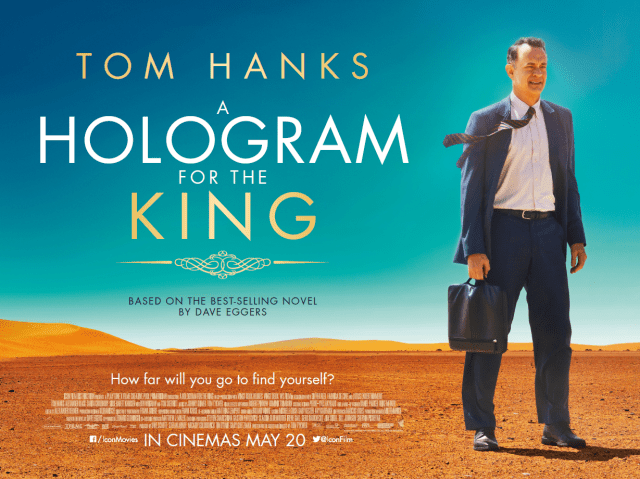

Hologram for the King

A film that seems as lost as its main character

It is a fact universally acknowledged, that Tom Hanks is watchable in anything. He’s one of the great stalwarts of Hollywood – an actor who the audience can rely on for a great movie. Aside from regular debates with my younger brother on Forest Gump (he’s pro and I’m anti – a debate which should hopefully finally be settled when we watch it together during the Summer) Hanks has had an incredible career littered with successes. His last release Bridge of Spies, directed by fellow great Steven Spielberg, led to a spectator experience equivalent to sitting in a really comfy leather armchair. Safe, secure and captivating. This film? He’s the best thing in it.

American Business man Alan Clay (Tom Hanks) was once on top of the world, CEO of Schwinn bikes – the bikes that every kid in America wanted to own. Now he’s a washed-up IT salesman who has been sent to Saudi Arabia to secure a contract with the King of Saudi Arabia for his massive new complex. Alan’s boss has made it clear that this is his last chance with the company, everyone is relying on the huge contract and if he doesn’t secure it then he’s out. Running late on day one due to jet lag he’s provided with a driver called Yousef (Alexander Black). Arriving on site it is clear that things are not as clear as they appeared back in America, with the complex nowhere near being completed.. Things begin to spiral for Alan and his health appears to be suffering, which is how he comes into contact with Dr Zahra (Sarita Choudhury). In a foreign country with a culture hugely different to his own how is Alan supposed to cope, let alone sell a contract to an absentee monarch? 

“And you may find yourself living in a shotgun shack /And you may find yourself in another part of the world/ And you may find yourself behind the wheel of a large automobile/ And you may find yourself in a beautiful house, with a beautiful wife/ And you may ask yourself/ Well…How did I get here?” The film starts of with Hanks reciting these lyrics to the epic Talking Heads ‘Once in a Lifetime‘ accompanied with a short montage which alludes to Alan’s current state of well being (read: not good). It successfully sets up the tone that will fellow, of quirk and occasionally surreal.  It’s one of the best bits of the movie, a high that it struggles to replicate. For a film that is essentially about a man having a mid-life crisis the film itself also lacks an identity. It’s not a comedy nor is it a drama.

There are too many allusions to some BIG topics – Saudi Arabia’s view on women’s rights, conflicts within the country and offshoring of industry – that prevent the film from being feelgood. Yet the film seems to desperate to provide a positive message that it tries to either ignore or forget about these features. The cast are all fantastic with the material they are provided with, all three main characters are memorable and well-rounded. Alan’s burgeoning friendship with Yousef and his budding romance with Zahra are joyful to watch. Both dynamics are sweet, endearing and rather believable considering the circumstances.

However Alan’s storyline about his business contract is less successful and his relationship with his daughter is also underdeveloped. The film also attempts then appears to shy away from making comments on the previously mentioned BIG topics. Instead of allowing them to provide a degree of darkness to the story they are treated as some sort of distraction. A sequence which in the space of less than 30 seconds sees Alan observe great poverty and then great wealth deserved to have been treated with more comment or reflection as opposed to metaphorically being pushed under the carpet. The best way to describe this film it that it’s like eating salted caramel – at times it’s sweet and at times it’s savoury – yet when you’re finished it doesn’t want to leave that as an aftertaste. It wants to wash it away with saccharin and a tacked-on ending. It’s as if the film-makers decided from the outset the ending they wanted – one about new beginnings, fresh starts and eternal hope –  and chose to  ignore anything that has gone on before that contradicts it.

The film itself is a fine enough watching experience. Hanks is typically cast as the American Everyman. It’s good to see him tackle something darker and with anxiety. Yet the film itself is rather bland, pleasant enough yet nowhere near his most memorable film.

2.5