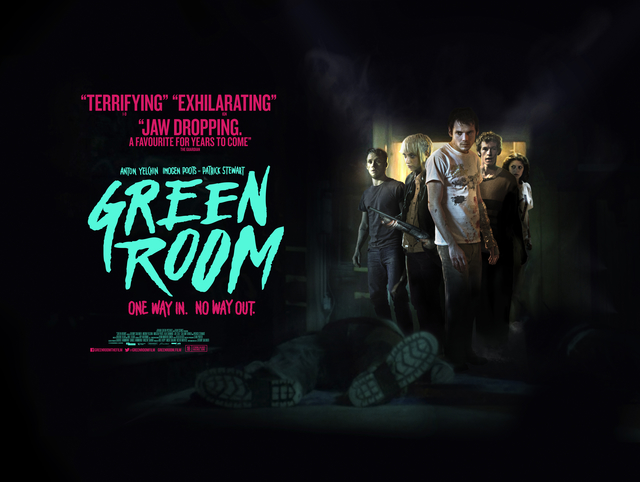
Green Room

An intelligent and electrifying horror

Usually me and horror don’t mix particularly well. Almost two months on and I am still occasionally haunted by visions of Black Phillip the goat from The Witch and I still feel a bit twitchy when I think about what I would do if I were to be trapped in a basement 10 Cloverfield Lane – style (is it normal to worry about that as a hypothetical scenario..?) But then again, Green Room isn’t your typical horror film. Yes there is gore (I’ve become very aware of my hands for the past hour since watching) but it is never overused. Whilst the narrative follows a ‘well-that-escalated-quickly’ structure it is founded in a series of cause-and-effect plot points that seem both believable and terrifying in equal measure. Then when you chuck in the superb pacing, swift editing, nerve-shredding soundtrack and  some superb character performances…well you’re in for a great time!

“The Ain’t Rights” are a punk band who are travelling through the Pacific Northwest, playing gigs and scrummaging whatever they can to get by.  The band – formed of Pat (Anton Yelchin), Sam (Alia Shawkat), Reece (Joe Cole) and Tiger (Callum Turner) – end up playing a gig in rural Seaside, Oregon to a club filled with Neo-Nazi skinheads.Upon seeing their Anti-Semitic surroundings Pat jokingly suggests they play a cover of The Dead Kennedys “Nazi Punks Fuck Off!” The band play the song during their set to  a less than receptive audience. Set over and cash in hand they make a move to leave, a move which the show organiser hastens to speed up, when Pat has to run back to grab the band’s mobile which they left charging. He stumbles across the scene of one of the skinheads leaning over the body of a young female punk with her still-alive friend Amber (Imogen Poots) rendered numb in disbelief. The band are then locked in the green room with the pair and the dead body. Reinforcements are called in the form of club owner Darcy (Patrick Stewart). The band have seen too much. Will any of them make it out alive?

There are so many reasons to like this movie. I want to say enjoy but considering the subject matter and content the verb ‘enjoy’ seems in rather poor taste. Semantics aside this is a cracking horror film. The slow-build of tension, the overwhelming sense of inevitability and the shock factor of many of moments. This is a film made with an equal blend of style and substance. The film looks damn good – the shots are well chosen with some excellent lighting choices that make for truly memorable sequences.

All of these factors would be pointless were it not for the excellent performances that drive the story. The characters are presented in a way that is a balance between wanting them to live but not really knowing them well enough to mourn any losses that occur on the way. You experience a degree of ‘oh no!’ because you care about them when certain things may or may not happen but are detached enough from them to not feel too aggrieved should/when something happens to them. Yelchin is superb as the accidental leader of punk trope. Poots is truly kick-ass as a female character who is not just cast to the sidelines, doesn’t spend the entirety of the film in shades of hysteria and who is capable of holding her own in certain situations. This is definitely/hopefully  showing a changing of the tide in Hollywood horror as her character is in line with that of Mary Elizabeth Winstead in the aforementioned 10 Cloverfield Lane. And then there’s Patrick Stewart as a properly scary baddie – whose calm and collected demeanor is unbearably (in a good way) unnerving to watch.   

Tense and taut (clocking in at 94 minutes) with some powerfully acted performances along with an admirably well-written script that is black humour laden this is definitely worth a watch.

4 stars

Florence Foster Jenkins

Further proof that films are like buses

Occasionally, more frequently than a blue moon but not as often as a full moon, two films about the same topic will come out at around the same time. The most famous example would be 1998’s apocalyptic clash between Michael Bay’s Armageddon and Mimi Leder’s Deep Impact (to save you from speculating, I prefer the latter). And now, in 2016, we have two films about ‘the world’s worst opera singer’ Florence Foster Jenkins. Mme Jenkins was born in 1868 and spent many of the latter years of her life as part of New York’s aristocratic music scene. Renowned for being a very generous benefactor of ‘struggling’ artists she was unsurprisingly popular, so much so her inner circle were able to put up with her recitals – recitals which recordings prove were devoid of tone, rhythm, pitch and sustainment of a single note.  Last month’s magnificent Marguerite was inspired by Florence Foster Jenkins infamous legend – transplanting the character to 1920s France. Now we have one of the grand dames of acting playing her in a biopic of her life in a production that is difficult to avoid comparison to its wonderful European spiritual counterpart

.After an incredibly well-received production in front of a gathering of her various women’s groups, most of which she chairs, Florence Foster Jenkins (Meryl Streep) decides she wants to get back into the swing of regular rehearsing again – ideally culminating in a grand performance. She sets her loving husband St Clair Bayfield (Hugh Grant) on the case. During auditions they find the perfect candidate in the form of Cosme McMoon (Simon Helberg). McMoon rehearses with Florence daily and swiftly becomes part of the furniture for Florence. Things aren’t as easy for McMoon as he must deal with the fact that he employer is the worst singer he has ever heard, something Florence’s British ex-thespian husband does not appear to acknowledge. Then again neither of them acknowledge the fact he lives in an apartment in the city with his mistress Kathleen (Rebecca Ferguson)…

As I have stated previously it is very hard to separate this from Marguerite which I enjoyed tremendously. It seems bitterly unfair to draw a comparison between two films that, subject matter aside, would never have been compared in terms of place of origin, cast or budget. However, and I have no qualms in admitting this,  I think Marguerite is the superior of the two. I really struggled when watching Florence Foster Jenkins for a multitude of reasons, reasons which have not really been addressed by the majority of reviews which shine the film’s praises.

I found the tone rather one-note (ironic considering the focus of the film!) with a plot that meandered between events and scenes. Streep’s characterisation at times bordered on pastiche. Could it be that Streep prefered to let her character reach for the high notes without providing the filler? However during the film’s quieter moments Streep really brings the character to life with some much needed depth with a revelation about 30 minutes in that does provoke a much-needed shift in tone. Admittedly this can be a common problem with ‘true story’ films as often truth can be stranger than fiction, making the truth rather difficult to believe. And yes, in case you were wondering, the singing is as bad as you’d think it would be. How the film portrays this singing is another aspect I found quite bristling when watching as I felt that the audience are called on more frequently to laugh at her rather than with her. As opposed to presenting her as a woman with a passion that truly gave her a purpose for living (*ahem* Marguerite) the film has would could almost be perceived as a mean streak as it laughs at her delusions instead.

This is not helped by the rather hollow archetype Grant portrays as her husband who spends most of his time maintaining Florence’s facade – that’s when he’s not entertaining his mistress. The reasoning for her presence is scarcely explained and results in Ferguson being vastly underused. Helberg (best known for playing Howard in The Big Bang Theorygrates profoundly as a camp closeted wannabe man about town.  The fact he spends the majority of the film with a fixed expression of embarrassed bewilderment only reinforces the sentiment that Florence is a figure of fun as opposed to one who requires understanding.

The film’s message is decidedly unclear.Many reviews refer to the affectionate and heartfelt treatment the film gives its title character. Instead the film feels light on charm, instead possessing a simplistic plot that is full of encouragement to point and laugh at a rather vulnerable figure.

2 stars

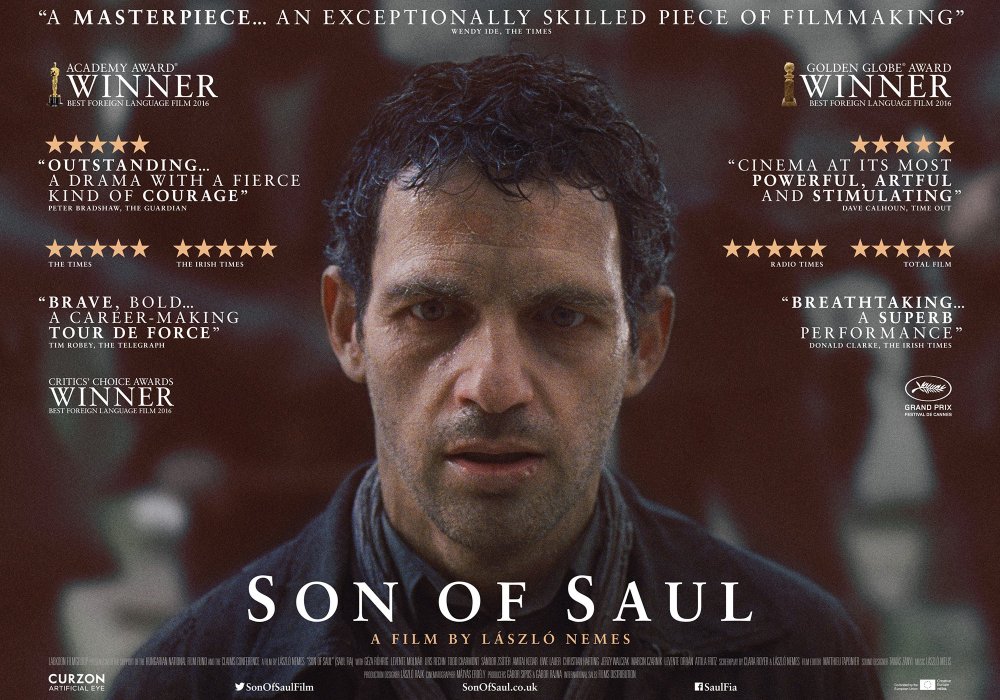
Son of Saul

A Masterpiece

When I left the mid-day screening of this film it was sunny outside. Bright rays gleamed upon the cinema and I glared at them. As I walked home there was a busker singing ‘Walking on Sunshine’. I glared at him. As I passed through a heaving farmers market I glared at the merry people chomping away. I couldn’t work out why I was reacting in this way. Ordinarily I would be thrilled by walking out of the cinema into sun. I would beam at a busker singing Katrina and the Waves 1983 seminal feel-good classic. And I’d probably only side-eye the hipsters filling the farmers market. Why was I so angry at everything? It seemed obvious that it was most likely my  response to the film and the horrors it entailed. But these were not horrors that were new to me – I hadn’t learnt anything new and the events of the film were horrifically familiar.

That’s when I fully grasped just how masterful ‘Son of Saul’ is. It’s almost a rethink of how to portray the Holocaust – by not showing it at all. Gone are any attempts at glamorization, of showy melodrama or noble heroism. Instead we are shown pieces of events – snippets of the evil that took place only feature in the side of or outside of the frame. Overt dramatization is replaced by close-up and over-the-shoulder shots with shallow focus on our central characters face. We hear the events but we don’t see them – leaving the spectator’s imagination to join the dots and fill in the gaps.  As Alfred Hitchcock said, “A glimpse into the world proves that horror is nothing other than reality.”.

It is 1944. Saul (Géza Röhrig) is a Hungarian-Jewish prisoner at Auschwitz who is part of the Sonderkommando unit. He is forced, under threat of death, to work for the Nazis in removing the “‘pieces” (the term used for bodies) from the gas chambers. Although the job delays his death it is only a temporary pardon – the job, and therefore his life, has an expiry date of five months which he is fast approaching. When clearing out the chambers post-gassing he finds a still-breathing boy that he believes to be his son. The Nazi doctors swiftly suffocate the boy and decide to have an autopost performed on him to find out how he survived. Saul desperately endeavours to stop the autopsy and find a Rabbi to lead a proper burial for the boy. 

 The events that follow are unforgettable in terms of content and portrayal – relentless and horrifying yet the carnage is skillfully implied as opposed to being explicitly shown. The two hours spent watching this film are two hours spent being a spectator in Hell. Death is not shown but instead resides off-frame – an omnipotent and omnipresent force haunting the frame. Just as one should not look directly into the sun we cannot look directly into the face of evil.

The opening sequence must be forever acknowledged in its audacity and its viscerality. We observe Saul as a sheepdog figure, one of many leading herds of bewildered people into what appears to be a changing room. An off-screen voice offers reassuring sentiments they are going for a shower and offers promises of what will follow. Our focus never leaves Saul’s face as we swiftly realise with unbearable inevitability what will happen next. We don’t see the people enter the gas chamber. We don’t see them die. But we do hear them die.

Rohrig’s performance is truly exceptional – his Saul is haunted and hollow. Grizzled by the unspeakable horror, his jaw is rigid with determination and his eyes are empty. We can only wonder how he keeps on living. The fact this is Rohrig’s first performance, as it is the director’s first feature, only adds to the remarkability of this film.

It is unbearably difficult to write this review – every word or phrase seems inadequate to fully describe the soul-altering experience of watching. It leaves you so numb you can no longer cry. Unlike any other Holocaust film there is nothing here to sweeten the devastating blow of watching this film – no beautiful musical score, no magical rescue and no story of redemption. It’s an intense and immersive experience with a the visceral immediacy it provokes that is ultimately necessary. Truly unforgettable.

five star


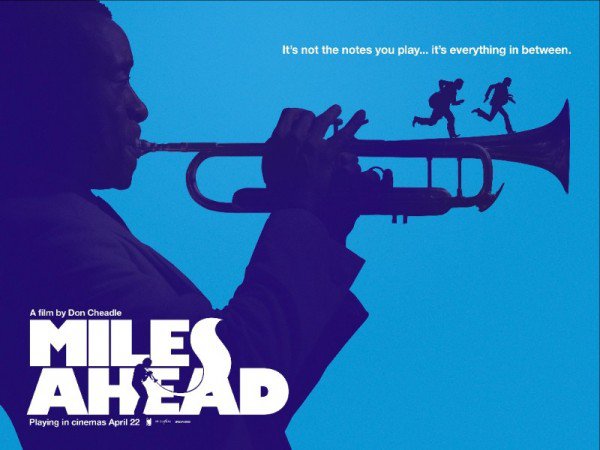
Miles Ahead

The man, a fair bit of myth and a whole lotta legend

It what may be my favourite bit of description from the year so far director/co-writer/lead Don Cheadle describes ‘Miles Ahead’ as being a ‘metaphorical’ biopic of Miles Davies. Fact and fiction are rather skillfully blended to pay tribute to an incredible musician, a leader of the genre that should be called ‘social music not jazz’. For better or for worse (depending on your view) this is not a typical music biopic – it’s free from the cliches that come with it – instead favouring a magnificent mooch-like approach in exploring the lives and loves of a true musical legend.

It’s 1979 and Miles Davies (Don Cheadle) has been a recluse for five years. A rumoured comeback – not that Davies himself would call it that – is being heard on the grapevine. Having lost this muse Frances (Emayatzy Corinealdi) and his ‘lip’ thanks to self-medicating a variety of drugs, word gets around that Miles has actually recorded some new music – only he’s refusing to give it to his record label Columbia. That’s when Rolling Stone journalist Dave Brill (Ewan McGregor) literally comes a-knocking on his door. The attempted interview between the pair quickly descends into utter chaos – involving drug deals, shootouts, car chases, stolen records and a few trips into memory lane.

The greatest thing about this film is the fact that when watching it it is clear that you are watching a passion project. The adoration that Cheadle clearly feels towards Miles Davis pays off completely and shines through every mannerism or rasping of dialogue. Even when high as a kite or desperately searching for his next hit he is shown to be a true man of sharp-suited cool. And even when slightly darker sides of his personality come out – such as in the flashbacks of his relationship with Francis – he is still a character we can connect with even when we may not like him at that particular moment. His self-destruction is portrayed with such affection by Cheadle – it shines through his eyes in every scene.

The events of the film are mostly fictional, inspired by the past as opposed to retelling. It’s a unique touch, a very ambitious touch at that, and one which mostly pays off in how well it reflects its subject. This is also emphasised by the construction of the film, with neat little choices of direction allowing for the present to seamlessly blend into the past. It’s not typical ‘day in the life’ fayre, nor is it rise and fall narrative. Instead the film drifts, swaggers if you will, from one moment to the next.

Like Davis the film is smooth, if occasionally rather frustrating in terms of its storytelling. It is hugely enjoyable and incredibly well-acted. And, like the man himself, never boring.

stars 

Our Little Sister

A quietly touching family drama

Our Little Sister is a wonderful example of a sentimental yet ultimately subtle delight of a film. Watching it is a bit like being in a 128 minute-long embrace, warm and imitate with undercurrents of deep emotion. There’s no real melodrama – no dramatic shouting matches, intensive confrontations or shocking revelations – it’s far more real than that. We start the film with the character being total strangers to us then end the film feeling as if we are part of the family.

15 years ago a father left his wife and three young daughters behind. Soon after his heartbroken wife left the daughters in the care of her mother and left the town. 15 years later and the three, now fully grown, receive a phone call that their father has died, leaving behind his 14-year-old daughter who nursed him until the end. The trio – 29 year old Sachi (Haruka Ayase), 22 year old Yoshino (Masami Nagasawa) and 19 year old Chika (Kaho) – travel to his funeral and to meet their little sister Suzu (Suzu Hirose). The girls make an offer to the now orphaned Suzu, that she could come and live with the three of them in their big house in Kamakura. 

What is so effective about this film as it doesn’t require a big overarching plot – there’s no big problem or issue to solve. Instead we watch the three women over a period of about a year as they bond and face different issues within their own personal lives. Days blend into weeks with only a few references to dictate how much time has passed – at one point the three tell their little sister that in six months they’ll be able to undertake the family tradition of making plum wine, later in the film they do so etc. This alone with the absence of a melodramatic narrative instead presents a more realistic portrayal of family life by choosing to instead use what is essentially a series of interconnected vignettes. Each of the girls faces different issues in their lives, typically resulting around love or work, some are returned to and resolved and others are not as they do not need to be.

The film plays a magical spell as you watch it, drawing you into the lives of four young women who are each dealing with the grief of a departed parent in different ways. All four girls are fully sketched out and wonderfully characterised by both positive and negative traits, each as charming at the movie itself. How the story is shown is as extraordinary as it is told, finding beauty in even the smallest of moments – such as the way a plum floats in a jar of plum wine – and within the landscape itself – with the ‘tunnel’ of cherry blossoms being a personal favourite.

Few family-based dramas whisper instead of shout. This is one of them. A film that is quietly powerful and immensely appealing.

4 stars

The Jungle Book

It’s really a Bare Necessity that you see it!

For reasons somewhat unknown and potentially puzzling for many fans, Disney has decided to make a series of live-action versions of their animated classics. Apparently there are even 15 currently being planned. If they are all even half as good as this one then it’s not something to worry over. The Jungle Book (2016) is a marvelously wonderful adaptation that is both true to the original 1968 film yet with enough of its own nuances for a fresh-feel.

Mowgli was only a baby when he was found alone in the jungle by Bagheera the black panther (Ben Kingsley). Bagheera took Mowgli to the group of animals in the jungle who would best be able to care for him and protect him – the wolf pack. Raised by surrogate mother Raksha (Lupita Nyong’o) and pack leader Akela (Giancarlo Esposito) and bought up alongside their wolf cubs Mowgli learns the ways of the wolves, but as he is getting older Mowgli’s (Neel Sethi) progress is starting to lag behind his wolf siblings. One day, during the dry season, all the animals of the jungle are gathered to drink what remains of The Water Truce when Bengal tiger Shere Khan (Idris Elba) makes a reappearance after years away. Shere Khan smells Mowgli’s scent and warns the wolfpack to get rid of him or face the consequences. Bagheera offers to escort Mowgli back to the land of the man but the pair get separated on the journey. A close encounter with an enormous Indian python called Kaa (Scarlett Johansson) leads to Mowgli meeting Baloo the bear (Bill Murray). A true friendship begins to form between them but how long can it last with Shere Khan still desperate to hunt and kill Mowgli?

There are three key things that have been perfected to make this film as good as it is. Hopefully one of the things you noticed as you read the above plot summary is the cast. Firstly, how good is that cast!?! Look at the incredible group of actors that were brought together. Then look individually at each actor and the character they play. It’s not often you get to say that every casting choice is perfect within a movie and it’s something that you can say applies to this film. Kingsley provides the necessary paternal warmth hidden under layers of no-nonsense concern. Nyong’o as Raksha is a wolf fiercely protective and not afraid to speak out when it’s needed. Elba is fantastic, a properly scary villain, who growls around the land. Johansson’s Kaa is suitably seductive and hypnotic. But the award for most outstanding vocal contribution has to go to Bill Murray providing a performance that is un-bear-ably endearing and amusing in equal measure. How young newcomer Neel Sethi manages to hold his own is an incredible feat which he appears to do with ease. Let alone the fact he spends the film acting alongside CGI animals…

Leading to the second area in which this film excels – the visuals. I’m on the fence about 3D usually. After seeing too many films which claim 3d status yet do little to warrant it I tend not to be overly excited when having to choose between 2d and 3d showings.The Jungle Book is the first film in an age where I’ve been so glad I booked that 3d ticket. The depth of the frame, the landscape, the animals fur, the movement of the water and the curse of the red flower. All of these aspects are superbly enhanced by the 3d. Whilst aware of the cost it can add to a cinema visit I would firmly recommend seeing this film in 3d to access the added textures and wondrous depths it provides. The animals themselves are beautiful and almost life-like in how they look and move.I now desperately want to cuddle a baby wolf and sit upon a giant bears stomach as we float through the river.

Thirdly there’s the direction.Director Jon Favreau ensure first and foremost that this is a children’s movie whilst avoiding any pandering or talking down to the children. The film has enough darkness to give it bite – mildly frightening as opposed to truly scary. There’s even a lesson or two to be learned along the way. Unlike the original animation this film is not a musical but two of the classic songs are included – ‘The Bare Necessities’ is sung by Mowgli and Baloo during the aforementioned river floating sequences and Christopher Walken talk-sings his way through ‘Wanna Be Like You’ in such a wonderfully charming yet ultimately threatening manner – that feel like a natural fit as opposed to being shoe-horned in.

This may just be the most enchanting film of the year so far. It’s a marvellous visual spectacle told with wit and warmth. A treat for the eyes, ears and heart.

4 stars


Eye in the Sky

A powerful and reflective examination of the cost of warfare. 

Very few films are this good. It’s well-acted by a truly terrific cast, impeccably shot with a thrillingly taut script. It also poses such incredibly cerebral and difficult questions without copping out and providing easy answers. Then again, war itself doesn’t provide any easy answers.

Colonel Katherine Powell (Helen Mirren) arrives at a military base in Sussex to oversee a high-level mission, to capture Al-Shabaab extremists who are meeting at a safe-house in Nairobi. Jama Farah (Barkhad Abdi) is one of numerous undercover Kenyan field agents on the scene using covert surveillance. In Nevada USAF pilot Steve Watts (Aaron Paul) takes his seat alongside rookie Carrie Gershon (Phoebe Fox) to provide aerial surveillance (the Eye in the Sky). Lt. General Frank Benson (Alan Rickman) arrives at his work, an office in London, taking the seat at the head of a table with members of the government to oversee the operation. What starts of as a seemingly routine capture mission soon becomes deeply complicated when it’s discovered the extremists are preparing to send two suicide bombers into the busy city streets. The only option appears to be to drop a hellfire missile on the safe house, but a little girl is out on the street nearby who would be fatally injured in the process. Those involved are deeply conflicted about what to do, and time is quickly running out.

I do not say this words lightly, but I firmly believe that everyone should see this film. Far beyond the fact that it is superbly acted and written, things I will discuss shortly, few films about war are this suspenseful and affecting.. The very term ‘collateral damage’ is a term complicated enough when you reflect on the fact it is a label used for human beings  caught in the crossfire but having the film truly immersing the audience debate generates a new level of soul searching. This is a genuine nail-biting thriller, with moments of true edge-of-your-seat-ness and wringing your hands in despair.

The cast for this film is awe-worthy and all of their performances justify completely justify that awe. This is one of two posthumous roles for Alan Rickman and serves as a reminder of what a genuine talent we lost this year. His iconic tone and manner are both fully in display here, truly serving his character and the film itself very well indeed. Helen Mirren is wonderful and fully believable as the stoic Colonel who watches her mission escalate from out of her control yet never losing her calm or nerve in the process. Aaron Paul is extraordinary as a man with two years experience in the job who is finally being told to pull the trigger, torn between duty and morality. Barkhad Abdi is one of the characters we know least about yet the strength and depth of his performance allows the audience to truly understand his role in events.

The script, cinematography, sound and performances of Eye in the Sky align to make this easily one of the best movies of the year so far. A riveting, fully entertaining yet equally chilling study of the morality of warfare. The questions it raises are not and cannot be truly answered yet will continue to haunt long after the credits roll.

This needs to be seen by all.

five star

The Huntsman: Winter’s War

A fantasy with just enough farce to make it fun

I doubt there are many people who have spent the past four years desperately counting down until the sequel of the rather mediocre Snow White and the Huntsman. The film was lacking entertainment and personifies Hollywood’s serious issue with getting ‘dark’ confused with ‘murky’ and deeply frowning viewed as the only way to articulate inner torment. Now we have the prequel/sequel sans Snow White aka. Kristen Stewart (after a certain scandal involving the film’s director Rupert Sanders) who realistically is not much of a loss as she spent most of the film biting her lip. A new threat befalls the kingdom and the Huntsman is called in to help, after we learn more about his mysterious backstory.

Many years ago evil queen Ravenna (Charlize Theron) murdered her way through the land to rule the kingdoms, with her powerless sister Freya (Emily Blunt) by her side. Freya falls in love, something her sister is against as love is a foolish distraction, and has a daughter. When tragedy strikes Freya’s powers are activated (think Elsa-from-Frozen-type powers) and she moves away to take control of her own land. She decides that she must have her own unique army and orphans the children of a village. The children are brought to her castle and taught the one commandment of her rule, that love is a sin. Years pass as the children are trained and moulded into true Huntsman but two children, her two best, break her one rule and fall in love. Eric (Chris Hemsworth) and Sara (Jessica Chastain) marry and try to flee but are caught in the process. Freya the Frost, as she is now known, places a great wall of ice between the pair to separate them. Sara appears to be murdered and Eric is thrown into a nearby river to be swept away. Seven years later, after the events of the previous film when Snow White killed Ravenna, Eric is called on by Snow White’s close friend William (Sam Claflin) to stop the Mirror being intercepted by Freya. 

You do not go into films like this with a closed mind. They require a deep suspension of disbelief, with any concepts of logic or reason needing to be locked away for 114 minutes. If you do this you will find this film to be a serviceable and entertaining lark. It would be easy to list all of the flaws within this film but doing so would ignore how relatively entertaining it is.The script is truly mediocre, full of boulder-sized clunky exposition and mawkish sentiments. In fact a bingo or drinking game could be formed based on all the lines/phrases that are uttered about love (‘love is a sin’ ‘love doesn’t conquer all’ ‘love is not a fairytale’ ‘you reek of love’ etc.) There’s a line about wet-never regions which shows how uncertain the filmmakers are about who their audience actually is.  Liam Neeson is on needless and grating omniscient narrator duties.

If you can ignore that, which I know is asking for rather a lot, what is left is a host of charming performances going above and beyond to make the lifeless script fun. Chastain is a fantastic new addition, being far more kick-ass than her running in heels stint in Jurassic World. Hemsworth is as charming as we now expect from him, mugging about and having fun. I doubt there is little I wouldn’t watch if he was in it. Blunt and Theron are solid and borderline-stirring in their villainous portrayals, making some truly dreadful lines sound half-way believable.  Complex issues aside about people playing dwarves the four dwarves who aide the Huntsman on his journey (Nick FrostRob BrydonAlexandra Roach and Sheridan Smith) are great fun and a joy to watch.

It’s not going to win any awards and will most likely be forgotten by the end of the month. It also does not deserve nor need a sequel (instead I would propose a new series called ‘Let’s watch Chris Hemsworth do things’ where we watch Hemsworth do a variety of activities and charm us all). BUT, it is an entertaining enough farce with just enough camp and laughs to fill a dull afternoon/evening.

 2 stars

Victoria

A true feat of film-making. Truly extraordinary.

To put it simply, a ‘take’ refers to the period between a director saying ‘action’ and ‘cut’. It’s up to them or the cinematographer how long this period is. Typically the longer the take the more difficult the film-making process is as it requires actors to be in the right place, saying the right lines, nothing else interrupting the shot etc. Alfred Hitchcock experimented with this in 1948 making Rope which clocked in at 80 minutes and comprised of only 10 takes, the majority of which were shot in such a way to make the cuts seem seamless. It was an ambitious project which paid of in most regards, the murder and the main characters fear of being caught out in only heightened by the prolonged takes. The character cannot escape and neither can the audience. 68 years later we have Victoria which was filmed two years ago and rejected by many of Europe’s film festivals as they believed the filmmakers were lying on the submission sheet. What lie did they think the filmmakers were proclaiming? Well the film-makers claimed that Victoria, which is 2 hours and 18 minutes long, was shoot using only one take. The most unbelievable thing about this? It’s the truth.

Victoria (Laia Costa) moved from her hometown of Madrid to Berlin three months ago. She works in a coffee shop for less than minimum wage and doesn’t really know anyone in her new city. In the hours before her early morning shift she decides to go clubbing and dances alone quite happily. On her way out of the club she bumps into a group of four men – informal group leader Sonne (Frederick Lau) who Victoria feels an instant spark with, Boxer (Franz Rogowski), Blinker (Burak Yigit) and Fuß (Max Mauff) – who promise to show her ‘real Berlin’. Victoria agrees and what first follows is a fun night for Victoria, seeing parts of Berlin she had never seen before and connecting quickly with Sonne. When Boxer receives a phone call and claims that the group need Victoria’s help.  It is her connection with Sonne that prompts her to make the first in a series of bad decisions and things take a dark turn before spiralling out of control.

I repeat. The entire film is only one take long. It cannot be overemphasised how incredible this is, what a triumph of filmmaking it is and what an astounding experience of film-watching it creates as a result. It’s breath-taking, wondrous, exhilarating and utterly compelling. As it is shot though one-take it is shot in real-time. This is important to note as it adds to the authenticity, we watched events play out and escalate. We cannot question how we got from the first frame to the last as we witnessed very moment and decision which lead the characters there. And these moments don’t just take place in one room – the characters travel all over the city, up ladders, jammed into cars and lifts, dancing across the street and running across it too – and the camera is always there watching and following. Incredibly this also manages to feel gimmick-free. Instead we feel like we’ve tagged along for a night out, been immersed in the spontaneity and intensity of this world, then kicked out of the club  and ditched at the end of the film. There is a reason that the cinematographer Sturla Brandth Grøvlen receives first credit ahead of director and writer Sebastian Schipper as Victoria is an example of true technical mastery. The camerawork is dazzling ambitious, pulsating and gripping.

The performances are mostly improvised, which only adds to the feeling of authenticity and believability. This is next level realism as we get to experience this world as it happens. It’s a huge credit to the relatively inexperienced cast that they only had to shoot the film three times, this being version two. It’s only after seeing the film, when you see what they had to achieve and endure, that you can truly appreciate the level of skill being utilised here.

It’s divine. A sensational watch. It needs to be seen.


10 Cloverfield Lane

The low budget “spiritual successor” to Cloverfield

Cloverfield was a serviceable found footage horror film that did well at the box office predominately due to its marketing strategy which featured things that took the burgeoning viral marketing to a whole new level. MySpace accounts were created for each of the characters, websites for the fictional companies that featured in the film could be trawled through for clues and the film itself was announced only as a series of numbers which formed clues that were eventually revealed to the release date. Cloverfield appeared in a few films of the year lists and that was about it. Producer J.J. Abrams would regularly be hounded for details of a possible sequel but appeared not to be able to give a definitive answer. When the upcoming release of 10 Cloverfield Lane was announced early this year there was real surprise as no-one had known that it was even filming let alone finished. This was due to the fact 10 Cloverfield Lane had not been filmed – originally based on a script called ‘The Cellar‘ it was adapted and linked to Cloverfield it was filmed under the codename ‘Valencia’. Here we are in March 2016 and 10 Cloverfield Lane has been released and it bares little resemblance either in tone or story to its predecessor. And it’s good. Very good indeed. So good that it’s definitely in the running for my end of the year top ten list.

Fleeing New Orleans and her fiance, intentionally leaving her engagement ring behind in the process, Michelle (Mary Elizabeth Winstead) drives far away from the city. In the process she ends up in a nasty car accident. Next thing she knows she wakes up in a basement, her injured leg is handcuffed to the wall. She desperately does all she can to escape but all attempts are futile. The locked door opens and she is greeted by Howard (John Goodman) who explains that he saved her life and yes he is keeping her trapped down in the basement but it’s for her own good. His rather menacing nature and pointing out of how much Michelle owes him hugely unsettle Michelle who is desperate to leave. She also meets the other resident of the bunker, Emmett (John Gallagher Jr.), who has known Howard for most of his life and is certain that Howard is a conspiracy nut but fundamentally a good guy. Time passes before the pair admit to Michelle why she cannot leave the bunker, a chemical attack has taken place in the outside world contaminating  the air and killing the world’s population in the process. The unknown assailants have made the outside world unlivable and the trio’s only hope to stay alive is to remain in the bunker. All of life’s comforts are there, as Howard has spent most of life preparing for such a situation, but Howard’s increasingly controlling and menacing behaviour makes Michelle desperate to leave. Taking matters into her own hands Michelle soon realises the truth of what has happened.

What is truly impressive about this film is how cleverly it terrifies the audience. Considering it is a 12a (something I have an issue with concerning the themes and some of the moments of the film) it manages to do so much with so few of the big violent scares of other horror films. Two of the film’s tensest moments are when Michelle crawls through the ventilation shaft, twice. Through a brilliant combination of editing, camera work, sound and acting they were both sequences I had to watch through my fingers whilst desperately hoping for the best possible outcome. There are a few moments of big and jumpy scares, many of them coming from loud noises that have never sounded so scary, but most of the moments are slow-building subtle fears that build to genuine terror. This is through the fantastic storytelling and narrative. Information is so carefully withheld then slowly realised to the audience. Every new revelation requires a reassessment of what we know and what we expect will happen next.

We know little about what has actually happened outside and we have little reason to trust our primary source for that information. John Goodman is truly terrifying as mysterious Howard whose character gains murkier and murkier added depths with each conversation. He’s a dangerous blend of menace and deluded altruism with every sequence in which he appears forcing us to eye him dubiously, wondering how much he says is actually the truth and how big a threat he plays towards Michelle. The slow revelations that follow only complicate our distrust and unease of his character. Gallagher Jr.’s Emmett is a much-needed comic foil into the tense mix, when tension hits sky-high level it is masterfully lowered with  a dose black humour. Winstead’s performance as Michelle is the best of her career, making a character who is truly sympathetic and one which we are desperate to succeed. I’d even argue that, in a year which saw Brie Larson win an Oscar from Room in which she played a woman held in captivity, that Winstead’s performance rivals Larson’s. Winstead’s blend of determination to leave and her struggling to accept the awareness of its possible futility may have resulted in one of the finest acting performances of the year.

If you’re looking for a film that clocks in at one hour and a half, that will drain you of every emotion possible, make you jump out of your seat and shield your eyes in concern, then you’ve come to the right place. Well worth seeing, if you dare…