Marguerite

A tragicomedy filled with laughs and tears

Strangely, and I hate to be one of those people, but I’m going to start of by drawing comparison with this film and Eddie the Eagle . Though this may not initially be an obvious comparison, Eddie is English and obsessed with skiing whilst Marguerite is French and obsessed with opera singing, the overriding link is the very obsession which drives them. Both characters NEED that one activity that makes them feel alive, makes them feel free and makes them feel joy unlike any other. Both are based on true stories, with Marguerite being loosely based on  the life of Florence Foster Jenkins (a Meryl Streep-staring biography is out later this year). The crucial difference, however, is that Eddie could ski and had only practised ski jumping a year prior to entering the 1988 Winter Olympics in Calgary. Marguerite has apparently been singing all of her life and cannot sing. It’s not just that she cannot sing, every single note she produces is so off-key and categorically awful, and she doesn’t even know it. All Margurite knows is the joy she feels when releasing the notes, not the fact they are atonal and truly, utterly dreadful. Her husband and friends, either out of loyalty, shame or amusement have kept the truth from her. This tension leads to the aforementioned tragedy and comedy.

Lucien Beaumont (Sylvain Dieuaide), an infamous newspaper critic, has gatecrashed a party escorted by his Dadaist artist friend Kyrill Von Priest (Aubert Fenoy). His attention is immediately taken by aspiring singer Hazel (Christa Théret) who performs as warm-up to the host. Baroness Marguerite (Catherine Frot) sweeps into the reception room in her large manor home, her room filled with guests for her charity recital. France’s finest and mightest, who all belong to the exclusive Amadeus club which she is a part of, are all there to see her. Marguerite breezes through the room, practically gliding through her audience, escorted by her loyal manservant Madelbos (Denis Mpunga) whilst desperately searching for her husband Georgeos (André Marcon) in the audience. Upon reaching the stage which is filled with her orchestra she turns to face them, her eyes sparkling with sheer and utter joy, her face is set and ready for that first note. Her mouth widens, forming that first note. What comes out of her mouth is unlike anything Lucien has heard before – it’s awful. Marguerite is not singing, she’s screeching, her voice is the embodiment of  nails on a chalkboard or a cat screaming. Unbeknownst to Marguerite children run under tables away from her noise, many of the man sneak into a private room away from the horror. Lucien must restrain himself from laughing, Kyrill believes he has found modernist art  and Hazel tries to hide her embarrassment from the poor woman. Finally Marguerite stops and her audience erupt into applause and admiration, flowers are thrust upon her and her talent is heralded. Lucien is bemused – she clearly does not know as her small aristocratic society has not told her – and feels compelled to write a review which is ladden in euphemism and  backhanded sentiment. Marguerite does not read into it and is filled with joy at having her talent recognised. Events start to spiral, with a public concert planned. How will Marguerite cope when she discovers the truth? 

I should point out that the above paragraph covers roughly the first 15 minutes of the film, leaving a solid 1 and 3/4 for you to discover on your own. I’ve not even discussed the role of the clown and the bearded lady! Marguerite is not always easy to watch, at times her singing or the events that it leads to are utterly mortifying. However it must be acknowledging that the mortification we feel on her behalf  is due to how well the story is told to allow us to connect with Marguerite and possible even empathise with her. It would be so much easier to have a film about a bad singer and laugh at her bad singing. Instead what we have here is so much more complex, layered and pleasurable to watch. We root for Marguerite, we hope for her and we fear for her – whether that be about a performance or comments that are about to be made about her.

Marguerite devoids herself to her craft, she spends everything on collecting props, music sheets, attending performances and supporting new talent. She has an all-consuming need to perform, which leads to unspoken clashes with her seemingly-cold and adulterous husband. Never has a film character been so in need of a hug. There’s something so child-like about Marguerite, something so amusing yet bitterly sad. It’s a true tribute to the talent of the filmmakers and the actress herself that we connect with her the way we do, encouraging her even though we easily recognise how talented she is in her chosen field.  Then somehow, throughout all this, we ultimately feel uplifted watching her journey. We all have something we pursue or like to believe we are really good at, even when we’re not At this point I’m really hoping you’re not thinking, ‘Ha! Yeah you are your film reviews”, but then Marguerite suggests that the opinion that others have about your talent should not be the one that is heralded, it should be your own and how it makes you that counts. And if how I feel about writing these reviews, and you out there hopefully reading them, is only a fraction of how singing makes Marguerite feel then I fully understand her.

It feels too overly simplistic to say this film is painful yet funny or that it is hilarious yet heartbreaking. It’s soul-baring exploration of passion. Exquisite.
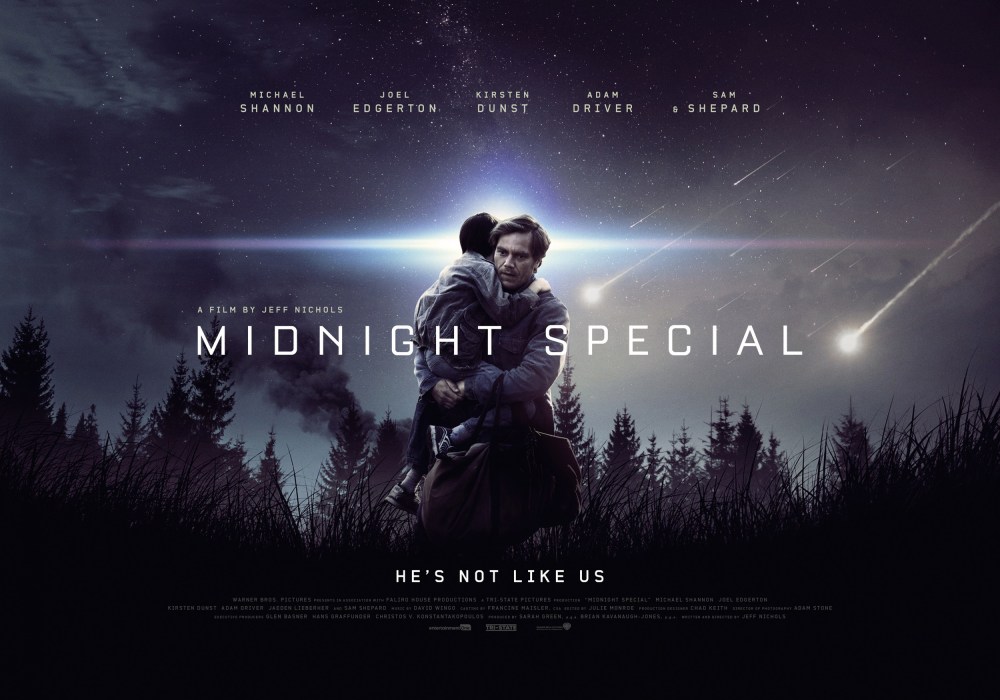
Midnight Special

Messiah or weapon? Or something else entirely?

Imagine a science fiction movie that focuses less on the fictional powers and more on the human emotions, the cost behind the power. Imagine a science fiction movie that allows you to marvel at the mystery rather than hand-feed you the plot. Imagine a science fiction movie that is a road trip/chase movie that challenges the value of belief. Now stop imagining as Midnight Special is all three of those things and much more. It is a wonderfully strange blend of genres, full of complexity and sentiment. A parable about love and extraordinary ability.

Roy (Michael Shannon) and his eight-year-old son Alton (Jaeden Lieberher) are on the run from both the government and religious extremists. Alton appears to possess special abilities, from being able to effortlessly infiltrate classified government signals  to bringing down a satellite from outer-space. A religious cult formed around Alton who, as National Safety Agent Paul Sevier (Adam Driver) discovers,  turned his encoded words into gospel. His supernatural powers so badly altered by daylight that all of the cult  became nocturnal. Upon making eye contact with people Alton’s eyes glows and show visions of unknown lands. Having fled the cult, and with the help of childhood friend Lucas (Joel Edgerton) and Alton’s mother (Kirsten Dunst),  Roy must get Alton to specific location for a specific time. Will, as everyone fears and some hope, a celestial and world-changing event take place? 

This is not your typical science fiction film. Compared to typical box office fairings Midnight Special is slow, with far more questions than answers, and a narrative that is impossible to stay ahead of. Those are not criticisms, just an acknowledgment that this film is not for everyone. In the preview screening I attended yesterday many of the audience members seemed frustrated or unfulfilled by the film. I was not in agreement with them for the film I had just witnessed was so riveting and magical. Rarely is science fiction this personal and emotive. Yes, a beginners guide to film criticism will show  you that Steven Spielberg’s films are about father-son relationships,  but what we see here is a different realm. What director and writer Jeff Nichols manages to achieve is a film which places greater emphasis of the consequences of supernatural power rather than the benefits of it, prompting the reflection that more is lost than gained in such extraordinary circumstances. Few storytellers are this damn magical.

The acting by the entire cast is wondrous, each cast member providing a wondrous blend of awe, fear and honesty. Roy’s love for his son is so deep and unconditional, a level of paternal concern rivalling that of great Epics. Lieberher’s performance here suggests that Room child star Jacob Tremblay may have a rival for Hollywood’s current greatest child actor. Egerton’s performance allows us to give loyalty to a character we know little about, believability to a man who has only known Alton for three days but is willing to give everything to the boy’s journey. Dunst is subtle yet heartbreaking as a mother who fears she will have to give up her son once more.

The cinematography is marvellous, as is the soundtrack and the storytelling. Of particular favourite is the Easter Egg of the Superman-starring comic book that Alton is reading in the back of the car. Any in depth analysis of the parallels between Superman and Alton would be spoilerific, but the very fact both are outsiders with great power is a wonderfully subtle touch. Just like the entire film it’s an allusion to other sci-fi works, but something that is so uniquely individual and riveting.

Some may say slow. I say spellbinding, sincere and utterly superb.

Anomalisa


‘What is it to be human?’

Anomalisa is a masterpiece of cinema – a tale about the human condition told by puppets that is the most real movie in years.  We’ve all had awkward encounters – be that with ex-partners, conversations with strangers in a lift or the force-fed wisdom of a brusque taxi driver. We’ve all (hopefully) had a moment where you meet someone who, somehow and somewhere deep inside of yourself, you innately know that ‘this person is important to my future’. Now imagine a film that has the later as its main storyline but is layered with lots and lots of the former. That’s Anomalisa. It’s hilarious and sad at the same time, just like life, whilst reflecting on how bitterly lonely existence can be. Artistic greatness channelled through stop-motion puppetry.

It’s 2005. Michael Stone (David Thewlis), customer service consultant extraordinaire, is travelling to Cincinnati for a convention at which he is due to speak. To Michael everyone else on the planet appears to have the identical voices and faces. He is just spending one night at the hotel before travelling back home to his wife (Tom Noonan) and child (Tom Noonan. He decides that, as he’s in the area and plagued by self-hate, he’ll call up his old flame Bella (Tom Noonan) in the hope that Bella will help him find out what is wrong with him. Things do not go well, but upon retreating to his hotel room he hears a voice that is different from everyone else. He searches desperately and finds Lisa Hesselman (Jennifer Jason Leigh. Michael is instantly enraptured by her different voice and face, desperately hoping that she will cure his crippling loneliness.

This film, written and co-directed by Charlie Kaufman, does not have to try hard to be strange. Everything about it is strange, but that’s not criticism when you really reflect on how strange life often is. The most obvious ‘strange’ aspect is the fact the entire world is only voiced by three people – Thewlis as our lead, Jason Leigh supporting and Noonan as everyone else. Have one actor voicing 98% of this world has the most wondrously bleak effect, allowing for everyone else to blur in the background. They are unimportant therefore there characters are not defined, which is how our protagonist Michael Stone views the world. Few central characters are this self-hating, haunted by guilt and bad memories. Did the voices always sound the same, or has life for Michael etched away its beautiful nuances?

The interactions with both strangers and those who are supposedly the closed to him are all so affecting in there believability – many of them of the concealing-your-eyes-as-you-watch variety. But it is Michael’s interactions with Lisa that are the most beautiful and the most heart-breaking. Lisa is the exact opposite of Michael, Lisa is insecure and desperately lacking in confidence, yet is just as lonely as he is. Lisa is a great admirer or Michael’s and an obsessive reader of his book which helped her increase work ‘productivity by 90%’!  The beginning of their courtship is so tenderly handled, and perhaps the most human we’ll see on the big screen this year. Lisa’s serenading Michael with a cover of ‘Girls Just Wanna Have Fun’ will fill your eyes with tears. The film’s title stems from this point of the movie, when Lisa reveals she has always felt like an ‘anomaly’ which Michael then teams with ‘Lisa’ to form her self-appointed nickname ‘Anomalisa’. This conversation alone personifies their relationship, Michael and the film itself. Is he laughing at her by giving her this name, or showing just how much he understands?

Watching Anomalisa is almost like watching an autopsy or listening to a psychiatrist’s evaluation –   cutting apart our very psychology, our brains and being, then showing us how they work. Like The Matrix it’s up to you whether you take the blue or red pill.

Breathtakingly beautiful and bitter in equal measure; dare you see it?

High-Rise

‘Where are those happy days, they seem so hard to find.”

41 years after its publication, J. G. Ballad’s High-Rise proves itself to be scarily accurate in its predictions of the then-future and our now-present. The film adaptation is equally brutal and dark, tinted with the blackest of humours. Deciding to set it in the time period in which it was written, director Ben Wheatley succeeds in using Ballad’s bleak hypothesises of societal hierarchy to transform the big screen into a mirror reflecting our darkest innermost fears. This review comes from the preview screening and Q&A session I attended at the British Library (Hello to Galia, Alison and Alex…)

London. 1975. Dr Robert Laing (Tom Hiddleston), a psychologist, movies into a high-rise building having been seduced by the lifestyle it would bring with it. The building itself is isolated from the rest of London and is so self-contained with a supermarket, gym and swimming pool that, aside from work, there is little reason for the residents to leave. They are cut off from the rest of society in their luxury tower block. The higher your floor the higher your status – Laing takes up residence on floor 25, his new friend Charlotte Melville (Sienna Miller) is on floor 26 and the architect of the building, Anthony Royal (Jeremy Irons) and his wife Ann (Keeley Hawes), take up the entire top floor. Laing also comes into contact with a family relegated to the second floor, BBC documentary-maker Richard Wilder (Luke Evans), his heavily pregnant wife Helen (Elisabeth Moss) and their two children. When Wilder becomes so embittered by the social hierarchy he decides it will be the focus of his next project. A dangerous situation develops causing a domino effect which leads to the fragmentation of the residents and formulation of violent tribes.

Where to start when reviewing this film? It’s excellent, terrific and truly haunting in equal measures. Like many of Ben Wheatley’s films High-Rise is of the ‘well-that-escalated-quickly’ genre. However, this film does not require a suspension of belief for the dissention into madness. Whilst accelerated the resulting horrors stems from social resentment that has been apparent since time immemorial. History showcases time and time again society’s that form then self-destruct that little exposition is required in High-Rise to explain why things get so bad so quickly (not that I can really imagine Wheatley wanting to spoon-feed us in this way). The script is bitterly funny, laden with comments that are iceberg-en in terms of depth. Social commentary is rarely this sharp-tongued, appalling yet absurdly funny.

Wheatley doesn’t waste a shot in the telling of this story; countless viewings would be required to access even half of the detail and imagery it possesses. And practically every shot could be printed out as a still and put on a wall, for the cinematography and mise-en-scene is otherworldly in its beauty. There’s the generic, unbranded supermarket made of quadrilaterals in primary colours, the kaleidoscopic parties of the various factions, the riding of a white house across the luminescent greenery of the rooftop garden and the seemingly innocent shades of grey of a certain floor 25.The blend of lighting and framing makes for sequences that are fraught, depraved and agitating. This is only exasperated by the incredible soundtrack, with two appearances of ABBA’s ‘S.O.S’ (hence the subheading of this review) that bring chills in way that one would never have though possible. At one point the BAFTA award makes a cameo, which Wheatley later explained he chose to include as it ‘would be the closest he’d ever get to an actual BAFTA’. It would be an utter travesty if for visuals and soundtrack alone High-Rise is not recognised and justifiably awarded.

Speaking of awards, there’s then the performances of the cast. Hiddelston as Dr.Laing, a self-contained possessor of wide-eyed optimism and underlying volcanic rage, is a match made in heaven. Wheatley spoke of his having Hiddelston’s ‘photo on the fridge’ during pre-production and casting as they (they being Wheatley and wife Amy Jump who wrote the script) viewed him as the perfect candidate. But, whilst Moss, Miller, Hawes and Irons are all good in equal measure it is Luke Evans performance that is stand-out to that of Hiddelston’s. If Laing is untapped rage cloaked in a suit, then Evans as Wilder is the untamed man. Evans must have come close to the edge in making this film, for his character is a powerhouse of bitterness and injustice whose raging against the machine is awash with inevitable destruction.

With so many reasons to see High-Rise; the performances, the script, the visuals are just three broad reasons which should justify you’re purchasing a ticket upon the film’s release next week.

Go see it and be haunted for days afterwards.

Hail, Caesar!

All Hail Hollywood!  And, all Hail the Coen Brothers!

1951 was a bit of strange time for Hollywood. The studio system was starting to shift and the oligarchic owners were starting to lose power. Rather understandably its stars were getting fed up of being owned by the studios. The studios got to decide what they would be starring in, who they would be working with, what they looked like and even who they were dating. The post-world war two boom had begun to grow to a standstill and film-makers weren’t quite sure what the people wanted. Some classic films were made that year (A Street Car Named Desire, Alice In Wonderland and The African Queen, to name but three) as were a lot of terrible movies from every genre and hybrid-genre you could possibly think of. If the people don’t know what they want, adopt a ‘throw-everything-at-them-and-see-what-sticks policy’. It’s these issues that make the era a perfect setting for a movie. It’s also the reason that the Coen brothers are the perfect men for the job.

The life of the head of production at Capitol Pictures is not an easy one. In 27 hours Eddie Mannix (Josh Brolin) must handle one drama after another. First there’s the lead of his series of synchronised swimming epics (Scarlett Johansson) who’s both pregnant and unmarried. Then there’s the all-singing and little-talking cowboy(Alden Ehrenreich) who is forcibly being made to transition from Westerns into thespian drama, much to the bitter frustration of his new luvvie director (Ralph Fiennes) followed up by a check-in on the latest musical starring multi-talented (Channing Tatum), dodging the four preying eyes of gossip columnist twins (both played by Tilda Swinton) and most importantly finding his A-list star (George Clooney) who has disappeared from set. Maybe his job offer from the aviation industry isn’t that unappealing after all…

First I want to state that this is not a perfect movie. Its pacing is off, and the entire film feels like a series of rather delightful misadventures as opposed to one overarching narrative. That fact will put some people off (although that doesn’t really explain/justify the 16 people who walked out of the screening I attended). But for others, including myself, this fundamental flaw is in fact another reason to cherish the movie as surely that rhythm or tone of chaotic mayhem is how life working in the dwindling studio system would have been. What is also allows the Coen brothers to do is duel-handily poke fun at the farce-like-ness of this period of time, and also lovingly embrace it.

Each set-piece is beyond stunning. Every single costume is stunning, with every single character feeling like a tribute to a by-gone era. The synchronised swimming sequence featuring a giant, mechanical whale reinforces the notion that this is THE Dream Factory. The loving pastiche theme continues with Channing Tatum’s ludicrously inventive tap dance and singing number, where he and a dozen sailor lament their going on door as ‘We Ain’t Gonna See No Dames.” However, speaking from personal preference, it’s Alden Ehrenreich as Hobie Doyle the Cowboy-turned-actor who totally steals the show. When considering the talent (ahem, Brolin, Johansson, Finnes and Cloonney!) this is truly no mean feat. Doyle is the perfect blend of dim but charming. His attempts at ‘serious’ acting are utterly charming but it’s his date with Carlotta Valdez (cheeky nod to Hitchcock’s ‘Vertigo’ there!) , an up-and-coming Latina actress that will win the hearts of the nation. His accidental wooing of her is pinch-his-cheeks and say ‘nawww’ levels of adorability. He is definitely one to watch.

Although the ‘star of the show’ may not actually steal the spotlight (as hopefully outlined and justified above) it’s Clooney’s storyline that solidifies the fact that this film is not throughway fluff. His ‘journey’ whilst held hostage provides much reflection on the nature of Hollywood ideology, a subliminal critique of the industry by reflecting on the very nature of entertainment, the ugly work that goes into creating what we view as such beauty…but that’s a discussion for another day, (ideally in a pub, with a drink in hand!)

For now, I’ll leave you with this. For those of us who are nostalgic for a time we never lived (I’m including myself in this category) there’s escapism and incredible tributes to the past. For cinephilles there’s subtle reflection on the ugly/beautiful process of cinema-making. There’s also romance, lots of humour and Channing Tatum signing (who knew he had the voice of an angel!?!)

If you’ve got a spare hour and forty minutes this is a film well-worth your money. Enjoy!


Pride and Prejudice and Zombies

45% Pride and 45% Prejudice and 10% Zombies

In 2004 Simon Pegg, Nick Frost and Edgar Wright created a new hybrid genre called Zombie-Romantic-Comedy (ZomRomCom) with Shaun of the Dead. In 2007 an American author took this one step further and wrote a parody novel of Jane Austen’s classic Pride and Prejudice by adding in zombies. Nearly 10 years later, after years of development hell (heh, that term has rarely been so apt) we have the film adaptation.  It may not be the most haunting (heh) Austen adaptation, nor will it give others a run for their money (heh, running from zombies) but it is more than entertaining and worth a watch. My main criticism, as you may have noticed from the subtitle is that the zombies make up a small proportion of the film, a too small proportion to really make the most of the high concept.

It is a truth universally acknowledged that a zombie in possession of brains must be in want of more brains. – Elizabeth Bennett. In a world that has been overrun by zombies for almost a hundred years, young women have more than enough to worry about than finding a husband. At least that is what Elizabeth Bennett (Lily James) thinks, and her four sisters agree to varying extents. Their mother Mrs Bennett (Sally Phillips), however, believes otherwise. Mr Bennett (Charles Dance) disagrees with his wife wholeheartedly, which is why he had his girls spend much of their childhood in China, training in the arts of killing zombies, moulding them into fearsome zombie-killing army. When Mr Bingley (Douglas Booth) reopens a residence nearby, he hosts an introductory ball to which the Bennetts are invited. It’s there that Elizabeth meets Colonel Fitzwilliam Darcy (Sam Riley) , a haughty monster-hunter renowned and feared for his zombie-killing skills. When the ball is invaded by zombies the Bennett sisters dazzle Darcy and Bingley with their skills, affection and admiration begins. But will the course of love ever run smooth whilst the undead stalk the Earth?

Overall, the film really succeeds for the first fifteen minutes. The concept feels fresh and funny, the zombie/romance balance is level (something I fear I will never get to write again…) and it’s a pleasurable novelty to see the key events of Austen’s novel enhanced by zombie tropes. There’s also a truly beautiful animated story-book style opening sequence, voiced by the legend that is Charles Dance, that informs us of how the zombies came to be. Unfortunately, the remaining 80-odd minutes of the film are not as pleasurable. The ZomRom balance (I’m going to copyright that phrase) does not really warrant the ‘and’ of the title. Maybe it should be Pride and Prejudice and a few zombies and lots of talking about zombies  (though perhaps that is not as catchy). When the zombies are actually on-screen it provides some of the best moments, producing a couple of jumps and a fair few laughs. But there is too much talking about strategies for dealing with zombies as opposed to fighting them.

However, it’s not all bad. The cast for this film is so good, and so well suited for their roles, that you actually wish this was just a straight-forward adaptation of Pride and Prejudice. Lily James, who shone in War & Peace last year’s Cinderella, is superb as a feisty and witty Elizabeth. She manages to make Elizabeth’s progression into a trained warrior seem almost plausible. She has great chemistry with Sam Riley’s Darcy, providing a degree of sexual tension previously unseen in adaptations of this work. Austen would have approved I suspect. However, as Parson Collins, Matt Smith steals every scene he is in. It’s great to see Smith in another comedic role (aside from his marmite take as The Doctor). Here his timing is brilliant and his ability to make a relatively small role stand out speaks volumes about his ability. Another wonderful surprise is Lena Headey as the one-eyed-eye-patch-wearing Lady Catherine de Bourgh, who snarls her way through her too-few-scenes. 

To conclude, this is a more than fine way to while away two hours. The cast is superb, the script has enough charm, and the novelty just great enough to entertain. Whilst easy to bemoan the minimal zombie presence, this is an excellent attempt at a twist on a classic with a fantastic cast who prevent it from being a forgettable B-movie.

Action, romance and zombies. Something for everyone with this film.

Zoolander No.2

Another example of a sequel that is a poor imitation of the original.

In 2001 (15 years ago!) the world was posed a question, a question for the ages, “Have you ever wondered if there was more to life, other than being really, really, ridiculously good looking?” Derek Zoolander found the answer by the end of the film (spoiler alert!) with family, friends and a charity project running “The Derek Zoolander Center For Kids Who Can’t Read Good And Wanna Learn To Do Other Stuff Good Too.” Within the first three minutes of the sequel all of that resolution is turned on it head, then burned to the ground and thrown away. If the intent was to then set up the sequel as being completely different, and ‘fresh’ compared to the original, then the fatal flaw in that plan is writing a film that’s funniest (and only) laugh-inducing moments are references to the original…

Justin Bieber is dead. After running away from assassins on motorbikes (having displayed some serious parkour moves) he is shot countless times. In his dying moments he manipulates his face into Blue Steel and takes a selfie, then gives into his fatal injuries. He is the latest in a long line of celebrities to be assassinated, taking a Derek Zoolander-themed selfie before dying. The fashion division of Interpol need his help but no-one knows where he is. Seven years ago, after the death of his wife and losing custody of his child, he decided to become a ‘Hermit Crab’ and go into hiding. Only one man can bring him out of his slump…

From the opening sequence alone you can tell how the rest of the ‘humour’ of the film will play out. An opening sequence is so key to a film, so crucial for setting the tone and level of the rest of the film. In this case? Well, it’s such a pandering sequence – ‘Hey! You average Joe, you hate Justin Bieber right? So we’re going to kill him off to make you laugh. We can make your dreams a reality. Love us!’ It’s a problematic choice for multiple reasons.

1) Hating Justin Bieber seems so last year/s. He’s had a bit of a renaissance in the past 18 months so the hate has become, for most, either ambivalence or embarrassed adoration. Therefore the slightly dated nature of the script becomes apparent. He’s also an easy target, one of many that are used to minimal effect, within a script seemingly tailored from social media circa 2013/4.

2) It’s an overlong sequence. Stretching out the humour becomes a motif of the film. Pacing of jokes never really seemed an issue with the first film (queue my rewatching it ASAP) but it is a real issue here. The ratio between gag build-up and punchline is definitely off.

3) Having Bieber appearing to do parkour, then being shot at least 30 times before taking a selfie before dying demonstrates how overblown and tacky the film will be. Zoolander No.2 presumably has a bigger budget, gladly and gawdly shows this fact off.

4) He is one of the countless celebrities to be shoehorned into an overwrought and clunky script. Though his role in the events of the story is clear (if rather ineffective) many others are not. A few stand out in terms of strange but also strangely funny (I’m looking at you here Benedict Cumberbatch and Kiefer Sutherland) but others are borderline pitiful (Anna Wintour and your crew, you didn’t, to quote Tim Guun, ‘make it work!’) 

Zoolander No.2 is a difficult watching experience for fans of the original. The plot is thin, the jokes humiliate rather than delight and the frivolity leaves the film rather throwaway. Like its eponymous character, Zoolander No.2 is empty and full of air. It may be filled of those who are ‘really really ridiculously good-looking’ but it’s forgotten that there’s more to life than that.

I hope they had more fun making the film that I had watching it. Disappointing.

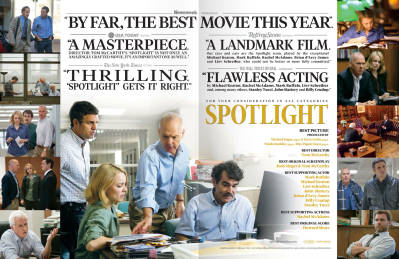
Spotlight

A subtle masterpiece of an exposé cinema

This film is proof, were it truly needed, that to invoke emotion from a viewer you do not needed to forcibly bulldoze them emotionally. You do not need people screaming at each other about how they really care about something and think it’s important; you do not need violence to prove someone’s inner rage; you don’t need monologues that reflect on social injustice. This film will grab you and drain you entirely. You will experience burning anger for those who used their positions for powers for unimaginable crimes; hopelessness at how dire at how things have and continue to still be; and cheeks so sodden with tears even when you hadn’t realised you were crying. All of these responses were generated without needless melodrama. Instead the absence of overwrought sentimentality  puts the events of the movie and the subsequent emotional response in bold, underlined and italics. A truly crucial and powerful movie. The fact that these are true events is the ultimate sucker punch.

In 2001 Marty Baron (Liev Schreiber) joined the Boston Globe as its new editor. The fact he is Jewish was viewed as something of a notable scandal, considering the influence of the Catholic church. In his early introductory meetings with his new staff he meets Walter ‘Roddy’ Robinson (Michael Keaton) who is head of  the Spotlight team, a small group of journalists who undertake investigative projects that take months to research and publish.  The rest of the team is made up of Mike Rezendes (Mark Ruffalo), Matt Carroll (Brian d’Arcy James) and Sacha Pfeiffer (Rachel McAdams).  In his new editorial role Baron urges the Spotlight team to follow a lead, a lead which suggests that the Archbishop of Boston knew of a priest who was sexually abusing children and doing nothing about it. A small-time lawyer called Micheal Garabedian (Stanley Tucciis seemingly the only person doing something about it. However Garabedian is on his own against the entire Catholic church, so after his initial reluctance and a lot of persuading he agrees to work along with Spotlight. A terrifying prospect soon becomes clear, this is not just about one priest but is instead about a huge cover-up of far more and dating back longer than can be imagined. But these secrets have been hidden for so long,  and with so many desperate to keep them,  it will be far from an easy journey.

Within all of that, and the remaining 3/4 of the movie, there is only one scene of loud, embittered shouting. Only one scene where one character, haunted by the true horror of what has gone on, lets rip at the hoops he will have to continue to jump and dive through. That one scene is made all the more climatic and devastating as a consequence, packing more potency than the entirety of Joy. The storytelling here is superb, the way each revelation unfolds is shown not told. The information is not forcible spoon-fed, instead delivered with little fanfare or fabrication, and is all the more absorbing for it. The suspense created is unlike much of recent cinema, with an awful sense of inevitability and foreboding that doesn’t take away any viscerality from watching the character’s gradual comprehension of their story’s terrible breadth.

However, the emotional impact of the script would be nowhere near as traumatising were it not for the performances of the cast. ‘Ensemble cast’ is a phrase too easily banded-about, but the cast of Spotlight is a true ensemble. Every actor gives the role their all. ‘All’ does not mean flapping your arms about and saying how angry you are. ‘All’ is, and perhaps should be, a simple look at another person that reveals unobjectionable horror. A gaze into the distance with eyes that expose a haunting that will never be forgotten. The ‘heroes’ of this story are not embellished, nor martyred or hero-worshipped. They are real human beings, forced to comprehend and expose systematic abuse from an institution that had such an intrinsic role in all of their lives.

Though it may have only been released in the first month of the year, this will be one of the greatest films of 2016. A fact-based thriller with a beating heart.

The Big Short

Proof that reality itself provides the darkest of comedies

I was 16 on Monday the 15th of September 2008. I was watching the news while getting ready for my second week of college (yes, I was *that* kind of teen). The main headline, which kept being repeated at 15 minute intervals, was that a bank called Lehman Brothers had filed for bankruptcy.  I had no idea what this meant, but from the tone of the news reporter and from the footage of people in suits standing outside a fancy-looking building and crying, I could tell this was bad. ‘Bad’, as it turns out was an understatement. In the 8 years since the consequences have, and continue to be, devastating world-wide. But I can admit in full honesty, I had never understood how or why it happened. In fact I wasn’t quite sure what ‘it’ was. That’s where ‘The Big Short’ comes in. This film, set in the three years prior to the financial crisis, takes that serious and complicated sequence of events and turns into a scathing critique that can be understood by all. It forces you to confront the truth, whilst snorting at the true facts – the unfathomable stupidity caused by greed.

In 2005 hedge fund manager Michael Burry (Christian Bale) discovered that the American economy would be due to crash in late 2007. Why? Because the housing market was incredibly unstable, built on poor foundations of high risk subprime loans. Loans were being given out by banks to people who would never be able to pay them back, which would result in them having to default on their payments. For millions of the American public this would mean losing their homes and having to file for bankruptcy. By predicting this collapse Burry realised he could profit by betting against the banks who refused to believe it.

  Trader Jared Vennett (Ryan Gosling) hears of Burry’s actions and the prediction it is found upon and discovers it’s all true. A misplaced phone call to a wrong number leads him to hedge fund manager Mark Baum (Steve Carell). Baum invited Venett to a meeting, also attending by Baum’s three cynical partners. It is then that Venett reveals the level of greed that has occurred, and the inevitable dire consequences the level of fraudulence will have for the general public. 

Charlie Geller (John Magaro) and Jamie Shipley (Finn Wittrock) are two young friends and business partners, who have their own independent investment company. Having had some good fortune they have move to New York to play with the big leagues in New York. They are refused meetings with most of the big companies, and laughed at by those who agree to meet them. That’s when they hear of Vennett’s findings and ask for their help of old friend and retired banker Ben Rickert (Brad Pitt) to profit from the impending economic collapse. 

It’s incredible really that this domino effect (from Burry finding out the truth, Vennett hearing of it and pushing Baum to invest, with Geller and Shipley hearing of this and making their own investments) lead to his small group making an insane amount of money. What turns this incredibility into incredulity (or impassioned rage at the injustice and insanity) is that these few men saw something thousands of others in simillar jobs/positions couldn’t see or refused to see. That blind ignorance led to millions, maybe even billions, losing their jobs, homes and any possible chance of ever achieving financial stability. Four trillion dollars just disappeared – with no consequences for those whose actions led to it.

The film explores these dark crevices with a whip-smart script that provides a degree understanding that is almost a public service. It’s sardonic and full of wit, yet exposes the true woe of an ultimately depressing story. Somehow the film is wildly entertaining yet immensely informative. It’s perfect Friday night movie entertainment, yet allows for immense reflection. The editing is superb – using breaking of the fourth wall for great effect. Using stars like Margot Robbie and Selena Gomez  in cut-aways to explain key concepts is an incredible use of cultural commentary –  the banks wanted us to be distracted, ignorant of what was going on, so allowed us to focus on trivialities. Voice Over narration analyse the warped  ‘logic’ of a system that was not even understood by the bankers who used it.

The film doesn’t focuses on the suffering of the millions, but instead of the ‘outsiders’ at the centre of the storm. Each actor provides an incredible character performance – from Bale’s eccentric and tortured loner, to Carell’s pessimistic and embittered moral crusader. It’s these characters and those they interact with that make the film so entertaining. The interactions they have are farcical and beyond belief, based on incompetence and corruption – the kicker is that they are all true.

‘The Big Short’ is a contemporaneous disaster movie. We want our ‘heroes’ to succeed, knowing their success spells devastation for the entire nation. The punch-line? We watch it in hindsight, knowing what happens next. That’s the saddest’ joke’ of it all.

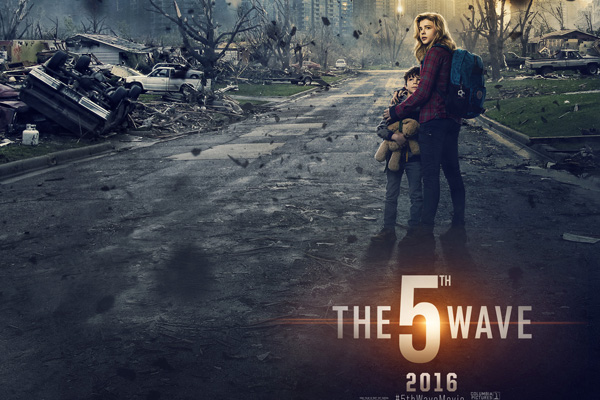
The 5th Wave

The worst film of 2016 (well, 23 days in at least…)

Did you know that discount retailer Poundland (for those outside the UK it’s a shop where everything costs £1, which is roughly 1.32 euro or 1.43 dollars) stocks its own brand of Lego Star Wars? It’s called Battle of the Galactic. It’s an incredibly cheap and tacky-looking rip off of the original. That is what ‘The 5th Wave’ is to franchises like ‘The Hunger Games’ or even ‘Maze Runner’ and ‘Divergent’. It’s cheapily made, poorly constructed and steals the best bits from other films/books then regurgitates them into a mediocre mess. What makes this film even more ‘impressive’ is that it is not even ‘so bad it’s good’. It’s just really really bad and remarkably boring.

Cassie Sullivan (Chloë Grace Moretz) was a ‘super normal teenage girl’. She had friends, went to parties, had a 2.2 family and had a crush called Ben Parish (Nick Robinson) who she spent most of her time day-dreaming about. But then… ‘it’ appeared. Some sort of alien space ship came from nowhere and started hovering above America. For ten days nothing happened. On the tenth day the first attack happened (the 1st wave) and destroyed all electric currents, followed shortly after by waves 2, 3 and 4. Most of the Earth’s population has been killed, with Cassie going with her family to a refugee camp. It’s at the camp that she is separated from her young brother Sammy (Zackary Arthur).  Nobody knows when the Fifth Wave will strike, or in what from it will strike, but it will happen. Against a backdrop of mistrust and fear Cassie makes a desperate journey to find her little brother, on the way meeting mysterious stranger Evan (Alex Roe) who may just be her only hope.

I would like to apologise in advance if, when you read that plot summary above you thought ‘Hey! This doesn’t sound quite so bad!’ Upon rereading it I have made the film sound far more interesting than it actually is. Between each of those events there is so much talking, needless and endless mundane talking, and dire reflecting. Whenever the action picks up it’s then forced to slow again by some pitifully-lacking, poorly-scripted, cliche-ridden sentiments.  For a film that is supposedly the end of the world, the world it features is so dreary and mind-numbingly boring that you do end up wishing for armageddon to happen so the film will end and you can go home.

Considering this film is a 15 (Hunger Games interestingly is a 12A) there is little to warrant it. The action here is so minimal, so bland and lacking in emotion compared to the superior franchise. The set pieces the film possess are so ineffective, clunky and predictable that there is little chance for escapism. The film becomes more and more absurd with each mind-numbingly boring sequence, yet remains utterly lacking in enjoyment. There is an occasional some-what amusing joke that gets shoe-horned into the narrative, but these moments are few and far between.

However, there was one factor about this film that was really reassuring – that will allow me to sleep a little lighter at night. The one thing I did learn from this film was that no matter how bad the alien apocalypse gets, I can still get my beauty products. There’s Moretz’s survivalist with the perfect hair, the sergeant (Maria Bello) with the perfect lipstick/foundation combo, and the smoky kohl-rimmed eyes (a pretty bad-ass Maika Monroe). It’s immensely reassuring to know that no-matter how desperate my battle for survival may get, my look will still be on-point. 

This film is not entertaining enough to hate-watch, or to watch ironically. There’s not even enough to make a drinking game out of it. I can’t even be bothered to turn this into a film rant. It’s just bad. It’s cheapily made, lazily shot with adequate-enough acting. The obvious intention is for this to be the start of a new franchise, one which nobody will want. In a week where I got to see ‘The Revenant’, a film which proved the potential power that film can have, I endured this film which shows that not everyone can handle the responsibility that the great power of cinema can have.

Watch it. Or don’t. Either way – it’s bad.