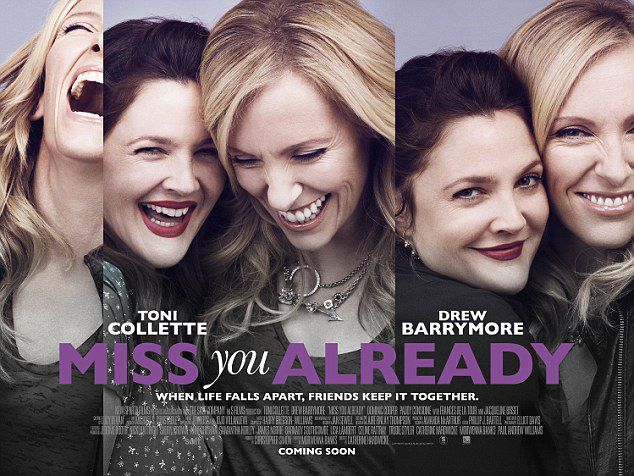
Miss You Already

An unsentimental yet sincere depiction of illness and friendship

It may not have a particularly original plot and may be presented in a way that is ultimately wildly manipulative (read as: you will cry) the film itself is admirable in what it, mostly, achieves. It presents a relatively honest depiction of breast cancer; the impact it places upon relationships both platonic and romantic along with the physical toll it takes. Whilst that alone is immensely refreshing, this is furthered by the presentation of a friendship that will resonate with audiences’.

Millie (Toni Collette) and Jess (Drew Barrymore) have been best friends since childhood. They have experienced every first together, everything from first kiss to first child, with their polar opposite personalities allowing them to bring out the best in each other. Whilst Jess is more conservative and stable, Millie is the overconfident and glamourous wild-child yet they are totally and completely inseparable. Both are happily married, yet rather than this separating them their respective husbands (Millie is married to Dominic Cooper’s Kit with Jess married to Paddy Considine’s Jago) and Millie’s two children instead make up one big family. But the family is rocked by Millie’s life-altering diagnosis of breast cancer, just as Jess finds out that she is pregnant with her much-longed for first child, which will put their friendship and their makeshift family to the ultimate test.

Collette does any amazing job (as is to be expected) playing Millie. Her acting, along with the screenplay and the film’s direction avoid what many similar films have done in the past, of making the person suffering from cancer into some sort of saint or martyr. Instead Millie stays the same as it is implied she always was – a mostly well-meaning but often not very nice person. This feature is really the film’s only comparatively unique feature. This, along with the portrayal of her treatment, make the film feel more honest and in a sense more brutal than others of this kind. Millie starts the film loud and vulgar, and although she spends the majority of the film in an oncology unit, she still stays the same person. Cancer doesn’t ‘fix’ her personalities ‘faults’, at times it only exacerbates them, consequently making her more relatable than many other presentations of the disease. It’s a reminder that cancer can, and with the current odds will, affect all of us whether we are good, bad or, like Millie, the grey area in-between.

However, it would be wrong to say this film is truly great or fully lives up to its potential. As we only see Jess and Millie’s friendship through flashback or montage, we are unable to fully latch onto their story. Aside from their respective health concerns, and a few references to a shared love of Wuthering Heights and R.E.M’s Losing My Religion, we aren’t really given enough about what makes them such good friends. The film constantly tells us this, but never shows us quite enough to engage us fully with their bond and ultimately does not earn the empathy it had the potential to do so.

Nevertheless, the ensemble cast, with Collette at the forefront, are all reliable and supply solid performances. Jacqueline Bisset is fantastic as Millie’s actress mother, Frances de la Tour momentarily steals the show in her short appearance as a wig-maker and Tyson Ritter (lead singer of All American Rejects) pops up as a swaggering barman.

From the opening of the film the inevitable outcome is presented, yet it will withhold interest and induce multiple bursts of tears throughout.

Bill

William Shakespeare: The Lost Years

Suffice to say, this is not another Bad Education Movie-style television to big screen disappointment of an adaptation. The team behind Horrible Histories have succeeded in translating their unique combination of historical-informed humour and slapstick. In fact Bill, along with Horrible Histories and their fantastical series Yonderland, has secured their place as natural successors to Monty Python and Blackadder.

Bill Shakespeare (Matthew Baynton) is a family man. He lives with his wife, Anne Hathaway (Martha Howe-Douglas), and their three children. Bill plays lute in a band called ‘Mortal Coil’, but after one concert where he tries to steal the spotlight he is told to ‘shuffle on’. It’s not us it’s you, they tell him. So Bill moves onto his next dream, being a playwright. As Stratford-Upon-Avon doesn’t actually have any theatres, he leaves his family to go and achieve his dream. In the process he befriends Christopher Marlowe and becomes embroiled in King Phillip II of Spain’s devious plot to murder Queen Elizabeth at a theatre production she is hosting.

The results are properly hilarious. The gag rate is so high, with most of it landing, that whilst laughing at one joke you may end up missing the next.  Of all the genres it is arguably comedy that is the hardest to do well. Aim too broad and you please no-one, aim too niche and you end up pleasing a minimal market. This irreverent biopic carefully, and to great effect, utilises modern references and a panto-esque tone to keep the audience tittering from start to finish. There are a few that are groan-worthy gags, a couple which are smirk-creating, many that are chuckle-inducing and a good handful of proper belly laughs. The team are not limited by their obligation to educate, as they were with the excellent Horrible Histories, and use that freedom to great effect. Considering we do not know what actually happened to Bill during the years between his abandoning his family in Stratford and emerging as royal playwright William Shakespeare, the events of this film are entirely plausible… well unlikely but possible.

One can only hope that situations such as Shakespeare educating Christopher Marlowe in ‘your mum’ jokes did in fact occur. If only because it leads to an immensely funny recurring gag within the film, that is seconded only by a henchman’s inability to understand the concept of a Trojan Horse. Other highlights include Helen McCory’s toothy and worn portrayal of Queen Elizabeth, some lovely throwaways about funding of the arts and a hilarious reference to ‘clunky exposition’. Baynton is excellent and rather endearing as an idealist and optimistic Shakespeare, as is Howe-Douglas as his under-appreciated wife.

Bill has a relatively taunt and witty script that has a joke for everyone. As expected the chemistry between the cast is electric, the gags reliably brilliant and the timing of them is spot-on. Well worth a watch.

Legend

Two Tom Hardy’s don’t make for a Legend-ary film

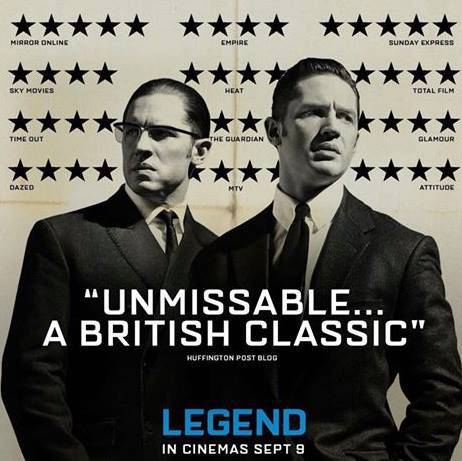
On paper, this film seems like a great idea. The Kray twins were London’s most notorious gangsters – two men who both enjoyed being gangsters and what it entailed. Having Tom Hardy, one of cinema’s men of the moment, felt like a logical next step. After Armie Hammer successfully played the Winklevoss twins in The Social Network, having Hardy playing the central dual role didn’t seem outlandish. In practice, his performances do work. It’s the rest of the film that really doesn’t. With a wealth of material out there on the Krays, with so much of the truth being better than fiction, it’s frustrating how much Legend misses the mark.  Although the film is marked as charting ‘the true story of the rise and fall’ it does no such thing. The ‘true’ bit is questionable after some post-screening research, and ‘the rise and fall’ is false-advertising. The film opens when the Krays are comfortably on the rise (so much so they are under constant police surveillance) and ends just before the start of the fall. The decision to pick these two periods as plot-points seems questionable, as a narrative they are not the most engaging, nor do they provide the audience with enough information to get them engaged. Audience members will be left with countless unanswered questions, no information about how the pair actually achieved this ‘rise’ nor the events or the aftermath of the ‘fall’. It seems ridiculous for a film with a 130 minute running time  to have such serious gaps, even more so when it is filled with such needless fluff that make the film feel boring and far longer than the actual running time.

Our entry character into the world of the Krays is Frances Shea (Emily Browning). Frances meets Reggie Kray (Tom Hardy) as her brother (Colin Morgan) works for Reggie as a driver. It’s heavy-handedly alluded that Frances has a history of mental illness, she’s ‘fragile’ and just returned home after ‘being away’. Little more information or film time is given to this, which is unfortunate as it could have increased the impact of France’s characterisation. It’s also doubly unfortunate as it could have created a nice parallel with the character plotting of Ronnie Kray (also, Tom Hardy). In the film’s single funniest sequence we witness Reggie visiting his twin, whose prison sentence resulted in being institutionalised and being declared certifiably insane. During this sequence we are informed that whenever Ronnie was uncertain or confused by what people said he would respond ‘interesting’. It’s a quirky touch that could have been utilised for greater effect. Their reunion is intercut with a conversation with a Kray heavy negotiating with a physiatrist for an all-clear for Ronnie. Ronnie is released from the mental hospital, leaving Reggie to start balancing loyalties to the two most important people in his life – Frances and his brother. These relationships are the main focus of the film, not the brother underworld careers. If you were looking for a ‘proper gangster’ (a phrase of Ronnie’s) movie, you’ve come to the wrong movie.

Frances and Reggie date for an unspecified amount of time, then become engaged for an unspecified amount of time and then marry for an unspecified amount of time. Not having a timeline for this period is frustrating, and furthers the sense of the film drifting from one sequence to another. This is a fatal flaw for two reasons. Firstly, the film appears to have strived to place character development over story arc yet there is no stand-out antagonist, rarely a clear motivation for character’s actions, and often no clear link between sequential scenes.. The film tries to restrict itself to how these events impacted the relationship between Frances and Reggie. This leads to the film’s second major fault, which makes Legend such a muddled and convoluted mess. If Frances was our entry point, and the focus is on her viewpoint on events, why are we shown events that she was not at and would never have known about? Reggie and Ronnie attend events and confrontations that would have been concealed from France’s knowledge as, in their eyes, she would not have needed to know what was going on. This flawed decision is empathised with the use of voiceover narration, with Frances narrating the majority of events. The use of voiceover narration in Legend is not used to great effect, it’s cloying and sentimental. The fact she narrates over events that would have been unknown to her confuses whether her viewpoint is truly restricted, as it would have been during the time of the actual events, or has been promoted to omniscient which then undercuts the themes and tone of the film.

Watching Legend makes for an exasperating cinematic experience. The cast do a truly fantastic job with the material they have been provided with – Hardy is suitably magnetic as Reggie though a bit of a caricature as Ronnie, Browning gives her best performance to date and Taron Egerton steals every scene as Teddy Smith – but that material is banal and structurally incoherent. Disappointing.

The Visit

Spoilers. Spoilers. Spoilers.

Aged nineteen a small town girl, living in a lonely world, ran away with a substitute English teacher. Her parents had tried to persuade her that it was an awful idea. They had begged her to stay. On that afternoon, before she fled, something ‘awful’ happened during that confrontation, which led to the relationship between her and her parents being severed. The girl and her now-husband had a baby girl shortly after, followed two years later by a baby boy. Ten years later the substitute English teacher ran away with another woman, leaving behind his wife and two young children. A difficult five years followed, with the three still struggling to come to terms with the abandonment. That’s when a message arrives from her parents, who found them online. They acknowledge that it may be difficult to re-establish their relationship with their daughter, but would love to start one with their grandchildren. The grandchildren agree and beg to visit their grandparents. The mother reluctantly agrees, sending them off to her old hometown, whilst she herself goes on holiday with her new partner.

The grandchildren make their own way there by train, and are met at the station by their anxiously waiting grandparents who are holding a banner decorated with welcomes. They drive back to the family home, and a mutual fondness is formed. The grandparents dot on the grandchildren and their quirks, and the grandchildren are bemused by these old folks whose bedtime is 9:30pm. At 10.15pm the granddaughter leaves her bedroom to be greeted by her grandmother pacing the downstairs in a trance and projectile vomiting. The next day this is explained away by a tummy bug.

For the rest of their week-long stay the grandchildren realise that there is more than just character quirks going on here, something is seriously wrong. What makes them think this? The grandfather stores hundreds of used adult diapers in the shed. The grandmother runs around the house naked at night scraping the walls and crawling around the floor. She sits in a rocking chair cackling to herself whilst staring at the wall. She chases them underneath the house. She has a breakdown whilst discussing ‘that afternoon’ and also spends one night waiting outside the grandchildren’s room holding a knife.

When having a conversation via Skype with their mother they hold the camera towards the grandparents and the plot twist is revealed – those are not actually their grandparents. The mother tells them to try to escape and that she is on their way. The grandchildren are trapped into playing a game of trivial pursuit, during the course of which all is revealed. For when the granddaughter escapes into the basement she find the bodies of an elderly couple – a framed photograph beside them reveals that they were her grandparents. The imposters are escaped mental patients, who wanted to pretend to have a family just for a week. They were jealous of the actual grandparents, who were volunteer therapists. In fact, the fake-grandmother had actually drowned both of her own children.

Two confrontations happen, with fake-grandfather rubbing a used diaper in the face of the grandson and the fake-grandmother chasing the granddaughter around a locked bedroom. The granddaughter kills the fake-grandmother with shards of a broken mirror. The grandson, with the aid of his sister, kills the fake-grandfather by slamming his head in the fridge doors multiple times. The mother then arrives and takes them to safety; the final scene has the mother revealing the ‘awful’ events of that afternoon fifteen years ago. She had slapped her mother and her father had slapped her in return. Fade to black.

There are so many issues with this film it is hard to start. So instead of a normal review, which would instead become an incomprehensible and lengthy rant, I will instead use bullet points to divide these issues into sections.

  • Child Safety: The fact the mother does not actually check the children have been collected by the right people. Yes, she has not seen or spoken her parents for fifteen years who explain her reluctance to do so, but surely any parent would want to perform some sort of check? This aspect then undermines and already ridiculous plot twist. During the week the mother tries to explain away the oddness of the grandparents by stating that they elderly. But, realistically, the problems that the grandchildren are describing cannot be explained by that when considering how old the grandparents should be. If the mother was nineteen when she had the children, the oldest of which is now fifteen, her parents really couldn’t be much older than seventy. When her children describe these incidents to her, wouldn’t she be shocked that her parents were acting in such a way?
  • Plot twist: After a week of increasingly terrifying antics from the grandparents – which they attempt to explain away with a night-induced form of sleep disorder as well as a– to explain be explained away by the fact ‘well, they were crazy’ is so flawed and archaic that it’s offensive. Considering this is 2015, to have a portrayal of escaped mental patients is already asking for trouble, but to then assign them traits such as staring into the distance at nothing, an obsession with bodily functions, homicidal tendencies (involving knives, hammers and ovens), crawling along floors, scrapping at walls and screaming is disturbing in its facileness. The fact that both grandparents try to explain away their behaviours with varying excuses such as dementia and Alzheimer’s may anger some, let alone the fact the children do not question whether these things could actually be related to the frightening behaviour of their grandparents, is also problematic.
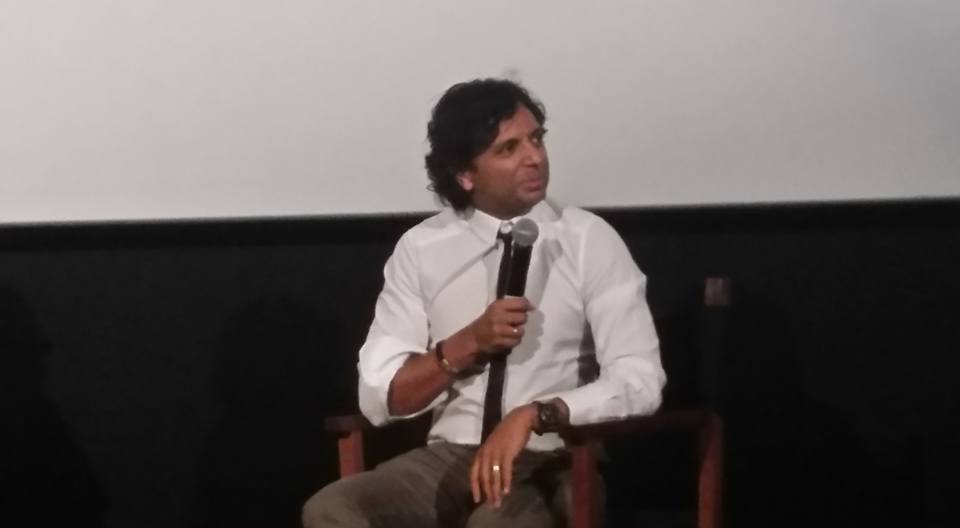
  • Storytelling: This is yet another M Night Shyamalan film that depends on a twist. The Sixth Sense is viewed as his best attempt at this, though that film only holds up for two viewings maximum before the novelty is shed. Interestingly, at the preview screening I attended Shyamalan was asked whether he wrote the plot twist first then filled in the rest. Shyamalan vehemently denied this, claiming he wrote stories about people and the twist followed. There is no evidence of this claim upon watching The Visit. Unlike The Sixth Sense, few will inflict a repeat viewing upon themselves. The film hinges on the twist, and your opinion on the twist will depend on whether you actually care about the main characters.
  • Characterisation: The grandchildren will divide audiences. 15-year-old Beca is a profoundly pretentious wanna-be documentary maker, who views life as a series of moments that she could record if they have the correct lighting and naturalistic elements. 13-year-old Tyler is a wanna-be rapper who tries to make up for his pre-pubescent features with attempts at charm and swagger. He likes to freestyle rap. They are each given a character trait which the film deems in need of ‘fixing’. Beca has low self-esteem and cannot look at herself in the mirror. Tyler is a germaphobe. Again, if you end up caring about the characters who may consider this important. Or, you may think it’s a waste of time.
  • Shaky Cam: Used to tell the entire film. Overused and nausea-inducing.
  • Genre mash-up: A blending of genres can work. This one doesn’t. Shyamalan explained that he wanted to blend family drama with the horror elements, along with comedy. The result is a film which is confused about what it actually wants it to be. It creates tension, sheds it to try to make you laugh, then tries for a quick scare.
  • Ending: Five people die during the film. By having a final sequence with the mother recounting the events of that afternoon fifteen years ago, reconnecting with herself and her past, then suggests that this was the entire purpose of the movie. That everything her children endured, and that those five people died for, was to allow her to come to terms with the events and herself. The fact the actual events of that afternoon remain secret creates tension that is bound for anti-climax. For what could be as awful as what her children endured, or the fact both her parents are now dead? Yes, the fact she hit her mother and her father retaliated was awful, but if one were to rank awful events during this film it would not own the number one place. The fact we are not given many opportunities prior to develop sympathy for her, reduces the emotional response that is supposed to be generated.

The Visit is only roughly ninety minutes long, but it feels like so much more. It’s bloated with ridiculousness, flawed ideas and frustrating characters.

M Night Shyamalan explaining his 'craft'

M Night Shyamalan explaining his ‘craft’

No Escape

Escape from [insert name of fictional Asian city here]

Considering the plot, characterisation and cinematography this film contains, it is not difficult to imagine it being made in the 1980’s (with Harrison Ford replacing Owen Wilson as the lead hero) or even the 1950’s (starring Jimmy Stewart). This is not a way of complimenting the film and suggesting it is timeless, anything but. This film is dreary, predictable and exceptionally dated. It’s portrayal of foreign conflict and politics is extremely problematic, a one-sided view of global issues that is almost xenophobic in presentation. The only thing that separates No Escape from a B-movie shown on the dark and misty unknown entities of Sky Movies channels after channel 315 is it’s talented cast, who are severely let down by the dross of a screenplay. Having not stayed for the end credits (in my desperation to leave the cinema)  I can only presume my hunch that the ‘research’ for this film was the greatest hits of The Daily Mail is in fact true…
Jack (Owen Wilson), an American engineer, leaves behind a failed business to drag his family to 
Southeast Asia to head his water manufacturing company’s new plant there. When they get there; they seem to be having problems, the electronics don’t work and rarely any cars are seen in the streets. When he goes to the market the next morning, he finds himself caught in the middle of a violent rebellion headed by armed rebels executing foreigners. Unbeknownst to Jack, just days before these armed rebels assassinated their prime minster. Jack must get back to the hotel and with the help of a mysterious British “tourist” (Pierce Brosnan), must get his family to the American Embassy in the midst of the chaos. But is there any escape? 
Firstly, the family. Jack is the archaic kind of hero of cinema long ago. He’s the Everyman. A husband. A father. By agreeing to this new job he has uprooted his family and doesn’t appreciate how they might feel, so he must learn his lesson through enduring this hero’s journey. He has a jarringly good range of survival skills; he knows instantaneously how to survive the most incredible and most ridiculous situations without having to think about it. Most depressingly of all, he is intentionally presented as all charmness and niceties whereas his wife Annie (Lake Bell) spends most of the film crying or with her face contorted into fear/outrage.  And, as bad as it will sound, their children are unbearably annoying. The majority of hurdles the family face are either caused by the children or severely complicated by the children. Pierce Brosnan enters, exits and reenters the film to little effect. His presence here echos something Micheal Caine declared when once asked about his role in Jaws: The Revenge,’ I have never seen it, but by all accounts it is terrible. However, I have seen the house that it built, and it is terrific.’ That must be the only reason that Brosnan is here giving a throwaway performance as a mysterious lothario Cockney.
The film’s biggest error is its portrayal of the ‘enemy’, The way the armed rebels are presented could have been an intelligent examination of ISIS or other militant groups. Instead they reflect the sentiments of those who use the term ‘swarm’ to label those currently seeking European asylum. They are characiatures: nameless, faceless and brainless. They are zombies, an epidemic the hero must save his family from.
No Escape mistakes creating tension by instead creating frustration. It’s one-part popcorn movie to two-parts shameless exploitation.

Gemma Bovery

As charming and bittersweet as it’s kindred text

This is not a modern-retelling of Gustave Flaubert’s Madame Bovery,or at least not a conventional update. With similar events and characters the film is instead a winsome, endearing if slightly flawed echo of the 19th Century novel.

Martin Joubert (Fabrice Luchini) moved from Paris to a small village in Normandy seven years previously to takeover his father’s bakery. Martin mostly enjoys village-life; the simple routines of making and selling bread, being a husband and a father. However his ‘years of sexual tranquility’ end upon the arrival of Gemma Bovery (Gemma Arterton) and her husband Charlie Jason Flemyng. Martin cannot believe the coincidence of this British couple with THAT surname taking up residence in his village which has links to Flaubert and his novel. Not only do their names link to the book, but their lives appear to be following the text also. Martin quickly engrains himself into their lives, taking it upon himself to mentor Gemma and guide her away from the tragic end of the eponymous Madame Bovery.

It would make sense to briefly talk about the main, and only, real flaw of this film before really getting into the good stuff. The film doesn’t really have a main focus, instead drifting from scenario to scenario through irregular pacing or, occasionally, irregular links. In fact between a promising first act and a surprising (and rather entertaining) third act, the middle does meander therefore reducing the tautness of the narrative.

But this is compensated by the film itself being utterly endearing. The village and it’s surrounding areas is beautifully shot, with the camera finding beauty in every shot. The main beauty is Gemma herself, who is adored by many men and the clearly the cinematographer. Happily the script and Arterton’s performance combined make this adoration understandable to be audience, creating a bewitching character who is both beguiling yet frustrating in behaviour.

With this film you are forced into a fantasy world, which you are immersed in quickly and readily. The film is fun and engaging but with a melancholic heart at the centre.  Gemma Bovery is pleasant and ambling depiction of how love can be fraught and frantic, full of yearning and seduction, adultery and scandal.

Pixels

This is not a film; it’s an endurance test.

The best simile to describe this film? It’s as if the writers of the film were like children on Halloween, though instead of pick’n mixing sweets they pick’n mixed pieces of a generation’s childhood nostalgia. Then, just like a child having a sugar rush before the inevitable crash and throwing up. The resulting technicolour vomit in this case is ‘Pixels’, which will leave you with the same feelings of regret and shame of a sweet-tooth binge. Throughout watching you’ll be left wondering who thought this mash-up of beloved video-games and crappy cinema was a good idea and why they spent $88 million making it. Before you carry on reading I will warn at this point that here be SPOILERS as this will not be a film review but will mostly become an essay on why this film is so bad and has had such negative reviews. Whenever one goes to see a film that has been as poorly received as this film, there is always a degree of hope that ‘Maybe it’s not as bad as the reviews say?’ or ‘Surely it has a couple of good moments!’ Prepare to be disappointed…

In case you’ve not seen the trailers, here is a plot summary. The film opens in the Summer of 1982, with 13-year olds Sam Brenner (later played by Adam Sandler) and Will Cooper (later played by Kevin James) excited by the opening of a video game arcade opening in their town. Both are naturals at the games, with Sam able to win most (but not all, hint hint!) games due to his innate ability to identify and memorise the formulas.  Will is good at crane machines (a skill momentarily useful later in the film, unsurprisingly). Will persuades Sam to enter the ‘Arcade Game Championships’ which their hometown is conventionally hosting, with Dan Aykroyd (WHY?!?) playing MC. He announces that a time capsule featuring aspects of the game championships is being launched into space (an example of the neon flashing exposition light I mentioned in my review yesterday!) They meet Ludlow Lamonsoff (later played by Josh Gad) who is opposed with a game character called Lady Lisa (more on this later) and befriend him as he is a kindred spirit. Sam breezes through the competition, but stumbles at the final hurdle when he loses playing Donkey Kong to Eddie Plant (later played by Peter Dinklage, another WHY?!?!).

The film then comes to the present day. Will is now president of the United States (no reason is given as to why this happened, how or what skills the man actually has to befit him of this title. He is a buffoon for the majority of the film, so maybe this is an attempt at satire?) It’s alluded that Sam never recovered from the loss, his second place status at a game championship scuppered his dreams of MIT and probable resulting success (because that is totally believable and not at all odd or regressive). Sam instead works for ‘Nerd’ a company who install electronics and software (because clearly a company supplying these skills had to be given that name). Whenever he arrives at a house for a job he must state, ‘Hello. I am a Nerd from Nerd Squad.’ (Yes, presumably someone got paid for this literary masterpiece.) At his latest job he meets a divorcee called Violet (Michelle Monaghan)  who lives with her son Matty. Sam bonds with Matty over video games (they are of seemingly similar maturity) and has a ‘moment’ with Violet where they almost kiss. Or, more accurately, he goes to kiss her and she refuses (of course, how dare she!) He berates her for being a snob as to why she din’;t kiss him (ignoring the fact he is a self-entitled man-child who is not the catch he seems to believe he is). He then throws back the killer line, ‘I’m a good kisser. All us nerd are. It’s because we’re so grateful.'( I, on the other hand, am grateful not to have meet such an arrogant arsehat.)

Sam gets a call from Will, telling him to get to the White House asap. He gets there and finds out that Violet wasn’t in fact following him in her care (because obviously he is such a catch that she will be so filled with regret for letting him go that she must follow and ensnare him) but is instead a Lieutenant Corporal. It turns out Earth has started been invaded by aliens using old video games to attack Earth (wonder who saw that coming from the opening? Maybe everyone?!?) They are told that first to three wins is the ultimate winner. If Sam and his arcade buddies loss, then it’s Game Over for Earth. After winning a level they are awarded a trophy, a ‘warrior’ from the opposition. After completing ‘Centipede’ in Hyde Park (overseen by Sean Bean. WHY?!?) then ‘Pac-Man’ in New York City they are awarded Q*bert (last seen in the far superior ‘Wreck It Ralph!) They then have a ball to celebrate (even though they still must complete one more challenge…) Sam and Violet bond (over her attractiveness and his infantility) when the aliens announce that Eddie, who had been released from prison (imprisoned for fraud. Surprising, as I thought a Lannister always paid their debts…sorry…not sorry.) to help the cause, had in fact cheated when playing ‘Pac-Man’. In fact Eddie even cheated during the championships, so Sam was the worthy winner that he always believed he was and spent the past 30 years brooding over (because that’s normal…) The aliens do not react will to that cheating, taking Matty as a trophy and sending their entire fleet to destroy Earth. However, they are given a reprieve within the invitation to enter the battleship and ‘meet the boss’ . The team split up. Violet, Sam and Will enter leaving behind Ludlow to ‘defend Earth’ (I wouldn’t hold out much for that.) He’s soon joined by Eddie, then Lady Lisa (the collection of pixels Ludlow had spent his life lusting over).

Meanwhile Sam, Eddie and Violet find out that the ‘boss’ is Donkey Kong. We are then given the unnecessary reminder that this is the only game Sam ‘sucks at.’ Yet, with the realisation that his 13-year-old self rightfully worn the world championships he is filled with enough confidence (as if he wasn’t inflated with enough of it) to beat Donkey Kong, rescue Matty and save Earth from annihilation. The aliens on Earth are destroyed, including Lady Lisa which devastates Ludlow. Yet somehow, during the awards ceremony for their ‘heroic’ efforts Q’bert transforms into Lady Lisa (no reason or explanation is given as to how or why). Fast forward to a year later, Ludlow and Lady Lisa are married and have five Q’bert children. THE END.

There are two main issues (of many) about this film that I really need to discuss. One, Lady Lisa. From the age of ten Ludlow worships her. Then she appears as a warrior for the opposition, but does not retain the pixel format of every other single alien and instead becomes human. She is incredibly attractive and Ludlow is overcome with emotion. Lady Lisa proceeds to fight Ludlow until he declares love for her. Obviously, as this is the kind of wish-fulfillment world this film is set in, his unrequited love and obsession with her is enough to persuade her to stop fighting him. Then when Ludlow announces to Eddie she is actually his fiancee she just smiles. When Q*bert then regenerates into her she is thrilled to see Ludlow. All of this is done without a single line from Lady Lisa herself, she does not utter a single word or do anything beyond looking gorgeous or briefly flailing a sword around. It’s the one of the more distressing negative stereotypes of ‘nerdom’, of obsessive and controlling lust and views of women as objects, brought to life.

Two, the film’s message is condescending garbage. The entire story-arch is to redeem Adam Sandler’s character, to give him the adulation and recognition he felt he always deserved. It’s as if they want him to represent every ‘nerd’ in the audience and try to clumsily reassure them that they aren’t actually wasting their lives playing videogames, you are actually heroes. It is this kind of ‘the geeks shall inherit the Earth’ bullshit narrative that is the waste of time, space and energy. It implies that anyone who thinks of themselves or is labelled as being anything considered ‘nerdy’ has this consuming desire to be appreciated for their niche skills asset or affirmation of self worth, which is total bollocks. f I want to spend hours playing zelda, Sims or song pop! Then that is my choice. I don’t need you patronising cockends telling me that’ll it’s fine and may even all for a greater cause. I know my ability of being able to guess an 80s song from 6 seconds of intro will never be called upon to help save the Earth, and I’ve no idea who these writers believe actually think in that way. Maybe themselves?

‘Pixels’ is a cynical and empty attempt to jump on the ‘nerdom’ bandwagon. A total misfire. A synthetic attempt which instead undermines and humiliates anyone who considers themselves ‘nerdy’.
The Gift (2015)

Dare you look inside?

This film is good. Really good. It’s wicked, smart and tense. So tense, you’ll be on the edge of your sheet for most of the film’s 1hr 50min running time. Few contemporary Hollywood films are able to hook in an audience so quickly, so subtly, and keep them gripped to the end credits. Belonging to the ‘thriller’ genre this film (written directed and starring Joel Edgerton) it manages to avoid all the perils of a bad thriller movie. Typically films of this genre are set up with a chunk of exposition, a boring and obvious way of introducing character and story. With ‘The Gift’ Egerton totally avoids this hurdle, instead he sprinkles exposition into dialogue. Twists and turns are set up in a way that it is only once they happen that you realise they were even set up in the first place. Not once does the film dip in tension or give any hints on what will happen next. If you’ve seen the trailer and thought you’d seen it all, you really haven’t!

Robin (Rebecca Hall) and Simon (Jason Batman) move from Chicago to California, to an area not far from Simon’s hometown. When shopping for new home supplies the pair are approached by ‘Gordo’ (Joel Edgerton) who identifies himself as being an old school friend of Simon’s. Gordo quickly establishes himself in their lives, dropping off gifts and making surprise visits at their home. Although Robin seems happy enough to maintain contact with the ‘socially awkward’ Gordo, Simon grows uneasy with Gordo’s behaviour and decides to ‘break-up’ with him and ends their friendship. Gordo does not let this go easily and continues to have a hold over the pair. Secrets from the past swiftly and menacingly threaten to ruin their seemingly idealistic life.

This film is both modern yet welcomingly old-fashioned. Its plot and pacing align it with Hitchcockian storytelling. The fact that much of the film focuses on Robin’s perspective is a throwback to the Gothics of the 1940s. Her doubts over Gordo, and as a result doubts about her husband, are never overblown or ‘too’ melodramatic but rooted in a degree of realism and with complete sympathy. What could be a one dimensional role is instead fully rounded with Hall’s nuances, her subtle discomfort apparent yet carefully and gradually revealed. Bateman is equally as good, barely recognizable in a role that goes far beyond type. All too often taking the role of fraught and downtrodden father figure, he places the role of Simon with ease as he carefully navigates the fine lien between charming and douchebaggery. Whilst we are swift to become uncertain of Gordo’s intent, we soon realise that we know just as little about Simon. His interactions with both Robin and Gordo remain intriguing and frequently unsettling from start to finish.

 But it is Edgerton who remains the star here, portraying the oddest and most secretive of the three leads. Often films like this will signpost, practically with flashing neon lights, what will happen next and who we can trust. Within his script, cinematography and characterisation Edgerton doesn’t do this. All of these dimensions are far too complex for that, refusing to let the viewer rest on their laurels or take a breather. Nothing is certain in this cinematic universe; no-one can be trusted.

A surprise of a movie, engrossing and unpredictable in equal measure. This is a fantastic directorial debut, a tense psycho-thriller and well worth seeing.

The Diary of a Teenage Girl

‘I had sex last night. Holy shit!’

From those opening lines, uttered by 15-year-old Minnie Goetze, the tone and content of the film is clear. It might not be to everyone’s taste but this film is a crucial and poignant portrayal of adolescence. It’s also one of the very few films which not only presents an honest deception of female sexulaity and desire, but makes it the primary focus of the film. It does not shy away from showing Minnie’s inner turmoil, and the lust which is consuming and controlling her. It’s isn’t scared to show how tumultuous sex, lust and love can for anyone, especially a fifteen-year old. Most importantly, this is done so in a truthful way told by a distinctive and unconventional voice.

As you may have gathered from the opening line, Minnie has just lost her virginity. Upon arriving home, after a rather self-satisfied strut around the park, she digs out her old voice recorder. Recent events have become so overwhelming for her she requires an outlet, one which will not judge her as friends and family might. For Minnie knows that her first sexual encounter, however good it felt, would not be considered ‘right’. This is because she slept with Monroe (Alexander Skarsgard), a man who is twenty years older than her. He is also dating her mother, Charlotte (Kristen Wiig). The film follows Minnie, in a non-linear fashion, as she rides out an affair with Monroe, lying to her mother and experimenting with her sexuliaty. This is all presented in a manner which is so frank and honest it’s almost wince-inducing at times, with a degree of candor that is refreshing but depressingly rare.

What is perhaps even more depressing is that this film has been given a ’18’ rating, 3 years older than its main protagonist, therefore cutting it off from the audience it deserves and the audience who most deserve it. It’s a frustrating decision, especially with the sex or sexual references that form the foundations of this film are more honest than glorified. The language Minnie uses, and the way her sex-life presented is no worse than what a few choice searches into google could unearth. In fact, the sex in this film is unfiltered in the way that the pornogrpahy that drowns the web isn’t. Our society complains openly, yet in hush-hush tones about the ‘epidemic’ that is sexualising our youth. But why not address the problem with a film like this, which presents these issues but also teaches the viewers how to learn from them. Hollywood is dominated with so many films with negative portrayals of women, who are presented simply as boobs/bums/faces (delete as appropriate) that it seems bitterly unfair that a film which ultimately has a valuable positive message, of self-worth, is restricted to those who may learn from and appreciate it the most.

Though at times the pacing of the film maybe uneven, with some of the plot threads either unexplored or abandoned, it is hugely worth seeing. Not only is it’s content insightful and important, but it’s cinematography is beautiful, mixing the real with the comic book art that dominates Minnie’s life. A totally convincing and refreshing take on a coming-of-age tale.

Inside Out

Pixar proving that it really does know us Inside Out…

This film is Pixar’s best outing yet. It’s so clever, moving and beautifully told – in the way only Pixar an master. An outstanding treat of a film for both kids and adults. Both silly yet serious, it manages to articulate the traumas of growing up in a way that both reflects them for the kids but prompts self-reflection from the adults. It cannot be emphasised enough how universal the film is, with a multitude of jokes that will appeal to all markets. It’s witty, yet warm and oh-so wise. Joy. Sadness. Fear. Disgust. Anger. These are all emotions that we feel, often simultaneously, yet this film makes us consider the true power of these emotions and how they are all equally important – in a manner that will make you giggle and possibly shed a tear or two.

11-year-old Riley lives in Minnesota with her mum and dad. For Riley, everyday is a great day. She loves her family, friends, hockey and goofing around. With Joy (Amy Poehler) at the helm in the Headquarters -Riley’s conscious mind- to influence Riley’s actions and memories. Joy, along with Fear (Bill Hader), Anger (Lewis Black) and Disgust (Mindy Kaling), use a control console to interact with Riley. Even after 11 years, they still cannot understand the purpose of Sadness (Phyllis Smith). Yet Riley’s life quickly changes, with her family moving to San Francisco for her dad’s work. Whilst Joy and the other three emotions are trying to negotiate Riley’s well-being upon moving, they most also deal with Sadness who has started to touch some of Riley’s happy memories, transforming them to be sad. When trying to fix one of these memories Joy and Sadness end up being transported away from Headquarters into the labyrinthian maze that is Riley’s mind.

It’s immensely hard to find the words to explain just how extraordinary this film is. In typical Pixar-style it has created a film with a premise that seems so obvious, the idea of our emotions having personalities, yet manages to create something so beautifully poignant, entertaining and moving. Riley’s turmoil is so well reflected, it will bring back evocative memories for all. For the parents of the audience it could only be doubly heartfelt – an opportunity to see inside your child’s mind!

How these aspects are converted onto the screen are what makes Pixar so innovative. We have the Train of Thought, Personality Islands and the dreaded Memory Dump. A stand-out sequence has to when Sadness, Joy and Bing-Bong (Riley’s long forgotten imaginary friend) stop by the production studio for Dreams. It’s just so meta, with the revelation that dreams are actually created in a movie studio style-operation, reflecting on the manufacturing and perception of moving image. All of this is incredibly astute, but told in a way that is accessible to all ages. But what really makes us care about the events of this film is the characterisation. All the characters are fully developed and three dimensional – Riley is portrayed as such a lovely kid going through a real crisis, her loving parents doing all they can to help and their bond is so endearing. The emotions do steal the show here – they each have nuances and quirks yet are all untied with their tender treatment of Riley.

If you decide to go to the cinema only once this Summer, this is the film to see. It’s conceptually daring in both emotion and intellect, so comforting and simple but also affecting and thoughtful. A masterpiece.

Mini-Review: Lava

lava

Like all Pixar movies this film starts with a short, a beautiful love story called ‘Lava’. Told through song, a lonely volcano expresses his need for a companion he can love. It’s a beautiful sequence, the colourings and textures of the island landscape with the camera panning over so elegantly create an almost mythical tone. It’s hard to believe how far, animation-wise Pixar and its technology has developed since ‘Knick-Knack’ (1989) one of its earliest and similarly themed shorts. A timeless and universal theme presented in a extraordinary setting and style – setting you up perfectly for the main picture.