Deadpool

The Merc with a Mouth has a big heart, and an excellent first film.

Few films produce the level of antici…pation that Deadpool had prior to release. Even fewer films meet, let alone exceed, the eager expectation of its future audience. Deadpool is, thankfully, on of those films. It even led to a reshuffle of my top five Marvel-related films (as of 14/02/16: 1) Guardians of the Galaxy, 2) Deadpool, 3) Winter Soldier, 4) Ant Man and 5) Thor). The film is filthy, frantic and feverish. I can see (if I squint and put on my reflective hat) that those three reasons for why I love it so much are the same three reasons why a small minority may hate it (if you are in the later category I will *try* not to judge). However, the film is exactly my kind of humour and, heck, it’s my name in the blog title (chica chica!) Even my overuse of brackets in this paragraph (sorry, no sorry!) would indicate the fourth wall breaks/sidebars of the film. Anyway, I’ve rambled on enough here… let’s get cracking!

The film opens with a truly hilarious montage of Deadpool (Ryan Reynolds) in an overturned car with some villains (soundtracked to ‘Angel Of The Morning’ by Juice Newton). Through an array of flashbacks and flashforwards we learn about the past and present of the man behind the mask. Wade Wilson was a bad guy who was paid to hurt even badder guys. He was definitely *not* a hero. One night, after a successful job, he meets Vanessa (Morena Baccarin). They have simillar senses of humour and the connection between them is electric. One date leds to one year of happiness – a year than ends with Wade being diagnosed with terminal cancer. He’s offered a solution: to join a secret program that will get rid of his cancer and grant him superpowers. Ajax/Francis (Ed Skrein) is the man running the program and injects Wade with a secret serum, teaming up with Angel Dust (Gina Carano) to torture Wade for weeks on end in an effort to trigger a mutation. One torture in successful in triggering the mutation, providing with the power of healing that is so great he is essentially immortal,  but in the process leads to Wade being totally disfigured. Once escaped Wade seeks out the man who destroyed his life, desperate for revenge and a cure. 

Where to begin with reasons for why I love this film so greatly, without turning this review into a stream of consciousness? Ryan Reynolds is utterly fantastic in this role, creating a character who is nuanced and full of depth whilst also making cock jokes. Reynolds has not been given the opportunity to  show of his funny bone for so long, and having spent ten years getting this show on the road, the fact it is a clear passion product for him really illuminates just how good he is.

Often with superhero films the mask is a barrier between the ‘hero’ and the audience. In this case the barrier is shattered literally by having Deadpool talk directly to the audience (just like in the comic books)  and through his use of facial expressions. Even with the red mask on we can see the facial expressions, the eyebrow raises, glaring, moments of surprise and amusement. With regards the jokes, not every joke lands but there are so many that when one does fall flat there will be two more in the next 30 seconds to get you laughing again.

His take on Deadpool is also the required level of sexy. I don’t just mean fanciable (though, yes.) But his interactions with Vanessa are sparky, sweet yet erotic. When you really think about it, how many superheros in film adaptations are given that side to their character? Batman is rather caste and crippled by his past, Superman looks great but is too noble for that, Captain America too innocent and Ironman is implied – all talk and no action (though admittedly Stark’s conquests occur in films rated 12/12A). Wade Wilson has a fully-functioning relationship with Vanessa , raunchy  yet founded-in love. Which sums up the whole films ethos really – it may parody the entire genre but is done so with love and thus still honouring it. One way of doing this is with the treatment of its big baddie.

Skrein makes a fantastic villain, reaching towards (though no equal to) the heights of Tom Hiddleston’s Loki. Ajax/Francis is a nasty man, who ‘enjoys’ causing others man and misery yet he’s so charming in the process. We want Wade to get the vengeance he is so desperately wants, which means we get to see more Ajax/Francis in the process (a total win-win). His cool, calm borderline-psychopath-at-the-core sit he perfect contrast to the maniac ‘talker’ that is Wade Wilson. Their onscreen rapport brings the best out of both characters.

Baccarin is good, if slightly underused, as Wilson’s girlfriend. Brianna Hildebrand is awesome as Negasonic Teenage Warhead, the X-Men trainee who is shadowing Stefan Kapicic‘s Colossous. Using such little-known and under-valued X-men was a great idea, bringing out the best from Wade Wilson. Including some of the films stand-out gags… 

This may be the perfect Valentine’s Day film. There’s romance, sex, dirty jokes, lots and lots of killing (think Kick-Ass or Kingsmen level violence) and more dirty jokes.

I’m seeing it for the third time this week. Go see it!

Zoolander No.2

Another example of a sequel that is a poor imitation of the original.

In 2001 (15 years ago!) the world was posed a question, a question for the ages, “Have you ever wondered if there was more to life, other than being really, really, ridiculously good looking?” Derek Zoolander found the answer by the end of the film (spoiler alert!) with family, friends and a charity project running “The Derek Zoolander Center For Kids Who Can’t Read Good And Wanna Learn To Do Other Stuff Good Too.” Within the first three minutes of the sequel all of that resolution is turned on it head, then burned to the ground and thrown away. If the intent was to then set up the sequel as being completely different, and ‘fresh’ compared to the original, then the fatal flaw in that plan is writing a film that’s funniest (and only) laugh-inducing moments are references to the original…

Justin Bieber is dead. After running away from assassins on motorbikes (having displayed some serious parkour moves) he is shot countless times. In his dying moments he manipulates his face into Blue Steel and takes a selfie, then gives into his fatal injuries. He is the latest in a long line of celebrities to be assassinated, taking a Derek Zoolander-themed selfie before dying. The fashion division of Interpol need his help but no-one knows where he is. Seven years ago, after the death of his wife and losing custody of his child, he decided to become a ‘Hermit Crab’ and go into hiding. Only one man can bring him out of his slump…

From the opening sequence alone you can tell how the rest of the ‘humour’ of the film will play out. An opening sequence is so key to a film, so crucial for setting the tone and level of the rest of the film. In this case? Well, it’s such a pandering sequence – ‘Hey! You average Joe, you hate Justin Bieber right? So we’re going to kill him off to make you laugh. We can make your dreams a reality. Love us!’ It’s a problematic choice for multiple reasons.

1) Hating Justin Bieber seems so last year/s. He’s had a bit of a renaissance in the past 18 months so the hate has become, for most, either ambivalence or embarrassed adoration. Therefore the slightly dated nature of the script becomes apparent. He’s also an easy target, one of many that are used to minimal effect, within a script seemingly tailored from social media circa 2013/4.

2) It’s an overlong sequence. Stretching out the humour becomes a motif of the film. Pacing of jokes never really seemed an issue with the first film (queue my rewatching it ASAP) but it is a real issue here. The ratio between gag build-up and punchline is definitely off.

3) Having Bieber appearing to do parkour, then being shot at least 30 times before taking a selfie before dying demonstrates how overblown and tacky the film will be. Zoolander No.2 presumably has a bigger budget, gladly and gawdly shows this fact off.

4) He is one of the countless celebrities to be shoehorned into an overwrought and clunky script. Though his role in the events of the story is clear (if rather ineffective) many others are not. A few stand out in terms of strange but also strangely funny (I’m looking at you here Benedict Cumberbatch and Kiefer Sutherland) but others are borderline pitiful (Anna Wintour and your crew, you didn’t, to quote Tim Guun, ‘make it work!’) 

Zoolander No.2 is a difficult watching experience for fans of the original. The plot is thin, the jokes humiliate rather than delight and the frivolity leaves the film rather throwaway. Like its eponymous character, Zoolander No.2 is empty and full of air. It may be filled of those who are ‘really really ridiculously good-looking’ but it’s forgotten that there’s more to life than that.

I hope they had more fun making the film that I had watching it. Disappointing.

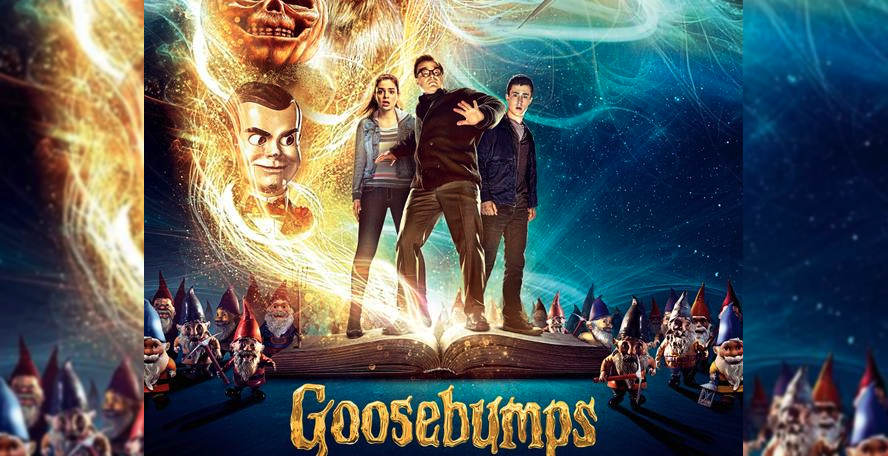
Goosebumps

“Viewer beware, you’re in for a scare!”

It’s easy to be a book snob. It’s easy to tell children which books are good to read and which books are bad to read. What constitutes a bad book for children? If it inspires just one child’s imagination,  gives them fears and feels in equal measure,  then surely a book can’t be bad? I’ve read Wilde, Dickens and both Poe. But I’ve also read Rowling, Wilson and Stein. Those six authors, along with countless authors, formulated my literary past and thus set the foundations for books to be read in the present and the future. J.K.Rowling may have figuratively taken me to Hogwarts and made me lament not receiving my letter when I was 11 (obviously during that period the ministry of magic was busy with other matters…), but it was R.L Stein that gave me a taste for ghouls, goblins and gore. Watching ‘Goosebumps’ felt like a risk, either prompting rage from my inner adolescent or transformative nostalgia. I’m very happy to report it’s the latter. Through a blend of live-action and animation the film manages to capture the goosebump-inducing fear of the books whilst also being rather light-hearted and funny.

A year after his dad has died, Zach Cooper (Dylan Minnette) and his vice-principal mother (Amy Ryan) move from New York to Madison, Delware. Though frustrated at his new small-town surroundings he knows that his mother’s new job will good for her, and the change in scenery may be good for both of them. When moving in, and having a box fall apart on him, he meets his new home-schooled neighbour (Odeya Rush). But their brief introduction is halted by Hannah’s grumpy and rather scary father, a man who may or may not be R.L. Stein (Jack Black). Hannah manages to sneak out and spend a day with Zach, but upon getting caught by her father she is punished. When Zach goes to rescue her, bringing along loveable loser sidekick (Ryan Lee), he stumbles across a bookshelf filled with what appear to be manuscripts for every Goosebumps story every written. However, after opening the manuscript of ‘The Abominable Snowman of Pasadena’ [side note: it is in my top ten Goosebumps] the Abominable Snowman itself comes out of the book. After a series of exciting events, manufactured by the Dummy of ‘Night of the Living Dummy [side note: definite top five contender] all of the manuscripts are opened, bringing all the monsters that Stein has ever written to live and bringing havoc among their town. Stein, Zach, Hannah and Champ must get all of them back in their books, where they belong. But things won’t be easy, and not everything is as it appears…

I really like this movie for numerous reasons, and in fact have a rather big soft spot for it. First of all, it brings all the monsters that once haunted my imagination to life. During the big crowd sequences I desperately searched the crowd for the familiar faces of the guests who overstayed their welcome in my nightmares. Going back to my opening point, I think it’s important that child can read books that scare them, and then show them how to defeat these fears. For children, and adults of a nervous disposition, this film does have rather spooky moments. There are one or two jumpy moments, and few monsters that are rather unsettling, but these are well contained moments and are more fun than fearful.

This leads me onto my second point, how surprisingly funny the film is. There are jokes for the children, and then there are jokes that will go over their heads and will crack up the adults in the audience. My three personal favourite jokes, which led to the emittance of loud laughter from many at the screening I attended, were a gag about the suffix –phile, a discussion about Stein verses Stephen King and a joke about domestic sales of books. Those three jokes (which I have intentionally poorly paraphrased) were well written, as are many others within the film.

The characterisation is good, with each character being more than likeable. In quite a nice shift, Hannah is the braver one whereas Zach and Champ are both rather jumpy in comparison. The animation is well-placed, never jarring with how it fits into the live-action, which is rather laudable. The music is never interfering, subtlety and successfully building the tension and fear. The pacing is also good, the 1hr 40mins never dragging and filled with more than enough twists and turns. This film is what family cinema should be. It shouldn’t patronise the younger members of the audience, or pander the humour towards them. It should engage them, spook them a little and excite them, just as Stein’s books did for me all those years ago.

If you’re looking for a light-hearted movie with a bit of bite, or something to entertain your children that won’t melt your brain, this is it. A very pleasant surprise.

The Big Short

Proof that reality itself provides the darkest of comedies

I was 16 on Monday the 15th of September 2008. I was watching the news while getting ready for my second week of college (yes, I was *that* kind of teen). The main headline, which kept being repeated at 15 minute intervals, was that a bank called Lehman Brothers had filed for bankruptcy.  I had no idea what this meant, but from the tone of the news reporter and from the footage of people in suits standing outside a fancy-looking building and crying, I could tell this was bad. ‘Bad’, as it turns out was an understatement. In the 8 years since the consequences have, and continue to be, devastating world-wide. But I can admit in full honesty, I had never understood how or why it happened. In fact I wasn’t quite sure what ‘it’ was. That’s where ‘The Big Short’ comes in. This film, set in the three years prior to the financial crisis, takes that serious and complicated sequence of events and turns into a scathing critique that can be understood by all. It forces you to confront the truth, whilst snorting at the true facts – the unfathomable stupidity caused by greed.

In 2005 hedge fund manager Michael Burry (Christian Bale) discovered that the American economy would be due to crash in late 2007. Why? Because the housing market was incredibly unstable, built on poor foundations of high risk subprime loans. Loans were being given out by banks to people who would never be able to pay them back, which would result in them having to default on their payments. For millions of the American public this would mean losing their homes and having to file for bankruptcy. By predicting this collapse Burry realised he could profit by betting against the banks who refused to believe it.

  Trader Jared Vennett (Ryan Gosling) hears of Burry’s actions and the prediction it is found upon and discovers it’s all true. A misplaced phone call to a wrong number leads him to hedge fund manager Mark Baum (Steve Carell). Baum invited Venett to a meeting, also attending by Baum’s three cynical partners. It is then that Venett reveals the level of greed that has occurred, and the inevitable dire consequences the level of fraudulence will have for the general public. 

Charlie Geller (John Magaro) and Jamie Shipley (Finn Wittrock) are two young friends and business partners, who have their own independent investment company. Having had some good fortune they have move to New York to play with the big leagues in New York. They are refused meetings with most of the big companies, and laughed at by those who agree to meet them. That’s when they hear of Vennett’s findings and ask for their help of old friend and retired banker Ben Rickert (Brad Pitt) to profit from the impending economic collapse. 

It’s incredible really that this domino effect (from Burry finding out the truth, Vennett hearing of it and pushing Baum to invest, with Geller and Shipley hearing of this and making their own investments) lead to his small group making an insane amount of money. What turns this incredibility into incredulity (or impassioned rage at the injustice and insanity) is that these few men saw something thousands of others in simillar jobs/positions couldn’t see or refused to see. That blind ignorance led to millions, maybe even billions, losing their jobs, homes and any possible chance of ever achieving financial stability. Four trillion dollars just disappeared – with no consequences for those whose actions led to it.

The film explores these dark crevices with a whip-smart script that provides a degree understanding that is almost a public service. It’s sardonic and full of wit, yet exposes the true woe of an ultimately depressing story. Somehow the film is wildly entertaining yet immensely informative. It’s perfect Friday night movie entertainment, yet allows for immense reflection. The editing is superb – using breaking of the fourth wall for great effect. Using stars like Margot Robbie and Selena Gomez  in cut-aways to explain key concepts is an incredible use of cultural commentary –  the banks wanted us to be distracted, ignorant of what was going on, so allowed us to focus on trivialities. Voice Over narration analyse the warped  ‘logic’ of a system that was not even understood by the bankers who used it.

The film doesn’t focuses on the suffering of the millions, but instead of the ‘outsiders’ at the centre of the storm. Each actor provides an incredible character performance – from Bale’s eccentric and tortured loner, to Carell’s pessimistic and embittered moral crusader. It’s these characters and those they interact with that make the film so entertaining. The interactions they have are farcical and beyond belief, based on incompetence and corruption – the kicker is that they are all true.

‘The Big Short’ is a contemporaneous disaster movie. We want our ‘heroes’ to succeed, knowing their success spells devastation for the entire nation. The punch-line? We watch it in hindsight, knowing what happens next. That’s the saddest’ joke’ of it all.

Krampus

The gift that keeps on creeping…

Christmas is a time of festive cheer,

for singing loud for all to hear.

But what if good ol’ Saint Nick was nowhere near?

Instead Krampus came to fill you with terror and fear…

Max used to love Christmas. He used to love wrapping presents with his sister and parents whilst watching ‘A Charlie Brown Christmas’. He used to somewhat enjoy when his extended family of aunt, uncle and four cousins made their annual visit from December 22nd to just after Christmas. But every year it’s gotten worse. His parents are growing apart, his sister spends all her time with her boyfriend and his cousins use him as a play toy to amuse themselves. Only his paternal grandmother Omi can see how his Christmas spirit is fading. When his extended family arrive once more the four adults, and surprise guest Aunt Dorothy, clash over the dinner table whilst his cousins brutally tease him for still believing in, then writing a letter to, Santa Claus. It’s the final straw for Max. He rips up the letter in anger and throws it out of the window. That’s when the storm starts, a snow storm like no other. Under the cloak of the blizzard Krampus and his villainous cronies start to arrive…No-one is safe. 

What a pleasant surpise this film was! It’s far from perfect and the pacing of both the first and third act is slightly off, but overall this film is a superb antidote to the kind of movies that some of the little-known Sky channels have been showing since mid-September.  It’s properly funny, has some jump-worthy moments and holds your attention for most of the 98 minute running time.

The story itself is deceptively clever. Though the myth of Krampus is centuries old it feels incredibly immediate and relevant.  The film opens with a sequence that has become unsettling familiar in recent years – a supermarket opening it’s doors for pre-Christmas sales. The crowds rush in, rioting, pushing, shoving and shrieking in their quest for unnesscessay discounted purchases. The fact this is soundtracked with Perry Como’s ‘It’s being to look a lot like Christmas’ successfully exemplifies the increasing commercialism of Christmas. It sets a great tone for the upcoming penance that will have to be paid.

The characters who will soon endure Krampus’ house invasion are well pot rated.  They are the right amount of unlikeable, each given just enough reason to warrant the inevitable onslaught but redeemable enough that you start to care what happens to them. The film doesn’t treat the adults any differently from the children – they have been just as naughty as their parents so need to be punished. As a secondary school teacher I can’t actaully say that Max’s two tween female cousins deserve to be punished,  but I can say that I hope they learn from their mistakes.

Krampus’ and his squad, made up of evil-looking reindeer, scary elves, oh so creepy toys and hilariously horrific gingerbread men own this film. The portryal of the homicidal gingerbread men would be my standout favourite, their evilish giggles haunting the house and they haunt it’s residents.  In fact they did somewhat remind me of Christmas horror-comedy classic ‘Gremlins’ which would make an excellent double movie feature with ‘Krampus’.

If you’re looking to briefly escape the festive season , or see and Old Testament-style backlash against it, or you just want a movie for laughs and a few scares, then this is well worth a watch.

Bill

William Shakespeare: The Lost Years

Suffice to say, this is not another Bad Education Movie-style television to big screen disappointment of an adaptation. The team behind Horrible Histories have succeeded in translating their unique combination of historical-informed humour and slapstick. In fact Bill, along with Horrible Histories and their fantastical series Yonderland, has secured their place as natural successors to Monty Python and Blackadder.

Bill Shakespeare (Matthew Baynton) is a family man. He lives with his wife, Anne Hathaway (Martha Howe-Douglas), and their three children. Bill plays lute in a band called ‘Mortal Coil’, but after one concert where he tries to steal the spotlight he is told to ‘shuffle on’. It’s not us it’s you, they tell him. So Bill moves onto his next dream, being a playwright. As Stratford-Upon-Avon doesn’t actually have any theatres, he leaves his family to go and achieve his dream. In the process he befriends Christopher Marlowe and becomes embroiled in King Phillip II of Spain’s devious plot to murder Queen Elizabeth at a theatre production she is hosting.

The results are properly hilarious. The gag rate is so high, with most of it landing, that whilst laughing at one joke you may end up missing the next.  Of all the genres it is arguably comedy that is the hardest to do well. Aim too broad and you please no-one, aim too niche and you end up pleasing a minimal market. This irreverent biopic carefully, and to great effect, utilises modern references and a panto-esque tone to keep the audience tittering from start to finish. There are a few that are groan-worthy gags, a couple which are smirk-creating, many that are chuckle-inducing and a good handful of proper belly laughs. The team are not limited by their obligation to educate, as they were with the excellent Horrible Histories, and use that freedom to great effect. Considering we do not know what actually happened to Bill during the years between his abandoning his family in Stratford and emerging as royal playwright William Shakespeare, the events of this film are entirely plausible… well unlikely but possible.

One can only hope that situations such as Shakespeare educating Christopher Marlowe in ‘your mum’ jokes did in fact occur. If only because it leads to an immensely funny recurring gag within the film, that is seconded only by a henchman’s inability to understand the concept of a Trojan Horse. Other highlights include Helen McCory’s toothy and worn portrayal of Queen Elizabeth, some lovely throwaways about funding of the arts and a hilarious reference to ‘clunky exposition’. Baynton is excellent and rather endearing as an idealist and optimistic Shakespeare, as is Howe-Douglas as his under-appreciated wife.

Bill has a relatively taunt and witty script that has a joke for everyone. As expected the chemistry between the cast is electric, the gags reliably brilliant and the timing of them is spot-on. Well worth a watch.