Bad Neighbours 2

A surprisingly knowledgeable and at times rather progressive comedy

It started with a tweet. On Thursday evening movie magazine Little White Lies tweeted about its review for Bad Neighbours 2. The review as written by Elena Lazic with  the tweet reading ‘I went long on the unexpectedly progressive, feminist and funny Bad Neighbours 2’. Now, as anyone who knows me, that’s the kind of click-bait that gets me hooked into reading. The review itself is wonderfully written – very reflective and articulate. Hopefully this review lives up to the one that inspired the film-watching and subsequent review! Post-watching I firmly agree with Miss Lazic’s review – for Bad Neighbours 2 is full of surprises. Most of them good and approvingly well-informed of gender politics.

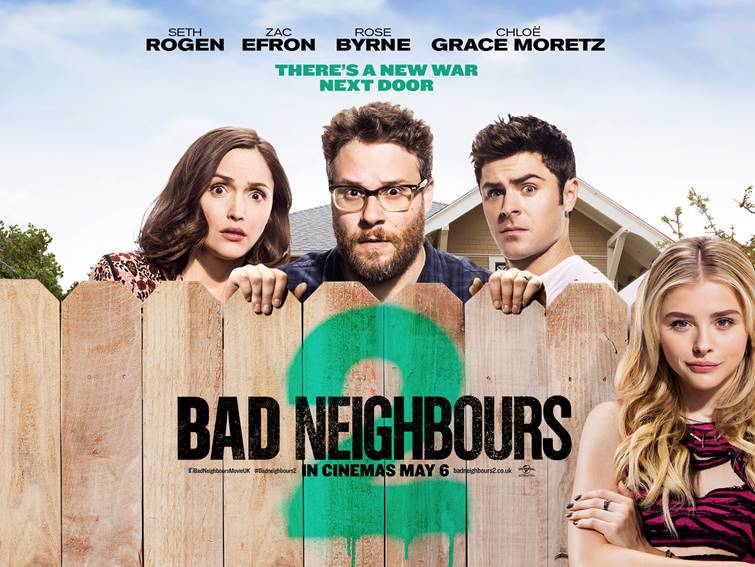
Mac Radner (Seth Rogen) and his wife Kelly (Rose Byrne) are expecting their second daughter so decide to put their house on the market and move into the suburbs. A married couple with a young child place an offer putting the property into escrow – for the next 30 days the potential buyers can drop in at any time and have any inspections they wish undertaken before they confirm their buying of the property. For the next 30 days Mac and Kelly need for everything to stay the same, no big changes which will scare off the buyers. What’s more than unfortunate is that their new neighbours move in on day 1 of 30 – and their neighbours are the college’s newest sorority. Kappa Nu has been newly founded by Shelby (Chloë Grace Moretz), Beth (Kiersey Clemons) and Nora (Beanie Feldstein). The trio united and formed the new sorority as they disagree with sexist legislation that prevents the existing sororities form having parties  and were disgusted by the sexist antics of the fraternity party they attended. War is soon declared between the ‘old’ couple and the sorority girls, with ex-Frat boy Teddy Sanders (Zac Efron) leading the girls into battle. 

In the mid 2000s the term ‘Frat Pack’ was coined to describe a group of Hollywood actors – this group included Ben Stiller, Owen Wilson, Jack Black, Vince Vaughn etc.Then came the “Apatow Chapter” (named after writer/director/producer Judd Apatow) which Bad Neighbours 2 lead actor Seth Rogen was a part of. The majority of the films generated from these unholy alliances could not/should not be labelled as displaying any feminist traits. In fact one would be hard-pressed to name just one of these films that featured a single positive representation of women. That’s part of the surprise that comes from watching Bad Neighbours 2.

Many of the early parts of the film, and intermittently throughout, discuss modern issues of equality in an outstandingly sympathetic and understanding manner. The double standards of the rules about sororities not having parties is not actually fictionalised by the film – it’s not a actual law but it is a national mandate decided by those who govern the nation’s leading sororities (read this excellent Washington Post article for further insight). This film appears to be Hollywood’s attempt to address the issue and it does so rather well. The female trios decision to form their own society in which they can go against the system is reinforced when they attend a Frat party – a party in which they see sexist treatment of women being accepted as a norm with an atmosphere akin to that of a hunting ground with men stalking what they view as walking vaginas. It’s a cleverly written scene which is nowhere near as heavily-handed written as it could have been. 

The issue soon takes the backseat for the battle between the two generations/neighbours – during which very little that is new or of much interest. But what does remain on screen are portrayals of women who have a certain spark, a fight within them, that most Hollywood comedies assigns to its male characters. Ordinally the female figures on the screen are resigned to being love interests or purveyors of gratuitous nudity. As annoying as Shelby gets, and she does get pretty annoying, she remains a character who is female, who is interesting and possesses some semblance of a personality. It is scary to reflect on how rarely such a female figure makes  it onto the big screen. Bryne is also given a role that is rather atypical for Frat Pack movies – a wife who is not presented as some sort of shrieking harpy. She appears to be as fun-loving as her husband and they comes across as equals in their relationship – they are proper partners in crime.

Aside from the ensuing pontification on equality, I did release a fair few chuckles watching this film. Some of Efron’s speeches were delightful, his dancing rather exquisite and his slapstick guffaw-inducing. At only 92 minutes long the film is a more than amusing way to while away an afternoon or evening. Plus the more conversations it stirs up about portrayals of gender the better!

stars

Florence Foster Jenkins

Further proof that films are like buses

Occasionally, more frequently than a blue moon but not as often as a full moon, two films about the same topic will come out at around the same time. The most famous example would be 1998’s apocalyptic clash between Michael Bay’s Armageddon and Mimi Leder’s Deep Impact (to save you from speculating, I prefer the latter). And now, in 2016, we have two films about ‘the world’s worst opera singer’ Florence Foster Jenkins. Mme Jenkins was born in 1868 and spent many of the latter years of her life as part of New York’s aristocratic music scene. Renowned for being a very generous benefactor of ‘struggling’ artists she was unsurprisingly popular, so much so her inner circle were able to put up with her recitals – recitals which recordings prove were devoid of tone, rhythm, pitch and sustainment of a single note.  Last month’s magnificent Marguerite was inspired by Florence Foster Jenkins infamous legend – transplanting the character to 1920s France. Now we have one of the grand dames of acting playing her in a biopic of her life in a production that is difficult to avoid comparison to its wonderful European spiritual counterpart

.After an incredibly well-received production in front of a gathering of her various women’s groups, most of which she chairs, Florence Foster Jenkins (Meryl Streep) decides she wants to get back into the swing of regular rehearsing again – ideally culminating in a grand performance. She sets her loving husband St Clair Bayfield (Hugh Grant) on the case. During auditions they find the perfect candidate in the form of Cosme McMoon (Simon Helberg). McMoon rehearses with Florence daily and swiftly becomes part of the furniture for Florence. Things aren’t as easy for McMoon as he must deal with the fact that he employer is the worst singer he has ever heard, something Florence’s British ex-thespian husband does not appear to acknowledge. Then again neither of them acknowledge the fact he lives in an apartment in the city with his mistress Kathleen (Rebecca Ferguson)…

As I have stated previously it is very hard to separate this from Marguerite which I enjoyed tremendously. It seems bitterly unfair to draw a comparison between two films that, subject matter aside, would never have been compared in terms of place of origin, cast or budget. However, and I have no qualms in admitting this,  I think Marguerite is the superior of the two. I really struggled when watching Florence Foster Jenkins for a multitude of reasons, reasons which have not really been addressed by the majority of reviews which shine the film’s praises.

I found the tone rather one-note (ironic considering the focus of the film!) with a plot that meandered between events and scenes. Streep’s characterisation at times bordered on pastiche. Could it be that Streep prefered to let her character reach for the high notes without providing the filler? However during the film’s quieter moments Streep really brings the character to life with some much needed depth with a revelation about 30 minutes in that does provoke a much-needed shift in tone. Admittedly this can be a common problem with ‘true story’ films as often truth can be stranger than fiction, making the truth rather difficult to believe. And yes, in case you were wondering, the singing is as bad as you’d think it would be. How the film portrays this singing is another aspect I found quite bristling when watching as I felt that the audience are called on more frequently to laugh at her rather than with her. As opposed to presenting her as a woman with a passion that truly gave her a purpose for living (*ahem* Marguerite) the film has would could almost be perceived as a mean streak as it laughs at her delusions instead.

This is not helped by the rather hollow archetype Grant portrays as her husband who spends most of his time maintaining Florence’s facade – that’s when he’s not entertaining his mistress. The reasoning for her presence is scarcely explained and results in Ferguson being vastly underused. Helberg (best known for playing Howard in The Big Bang Theorygrates profoundly as a camp closeted wannabe man about town.  The fact he spends the majority of the film with a fixed expression of embarrassed bewilderment only reinforces the sentiment that Florence is a figure of fun as opposed to one who requires understanding.

The film’s message is decidedly unclear.Many reviews refer to the affectionate and heartfelt treatment the film gives its title character. Instead the film feels light on charm, instead possessing a simplistic plot that is full of encouragement to point and laugh at a rather vulnerable figure.

2 stars

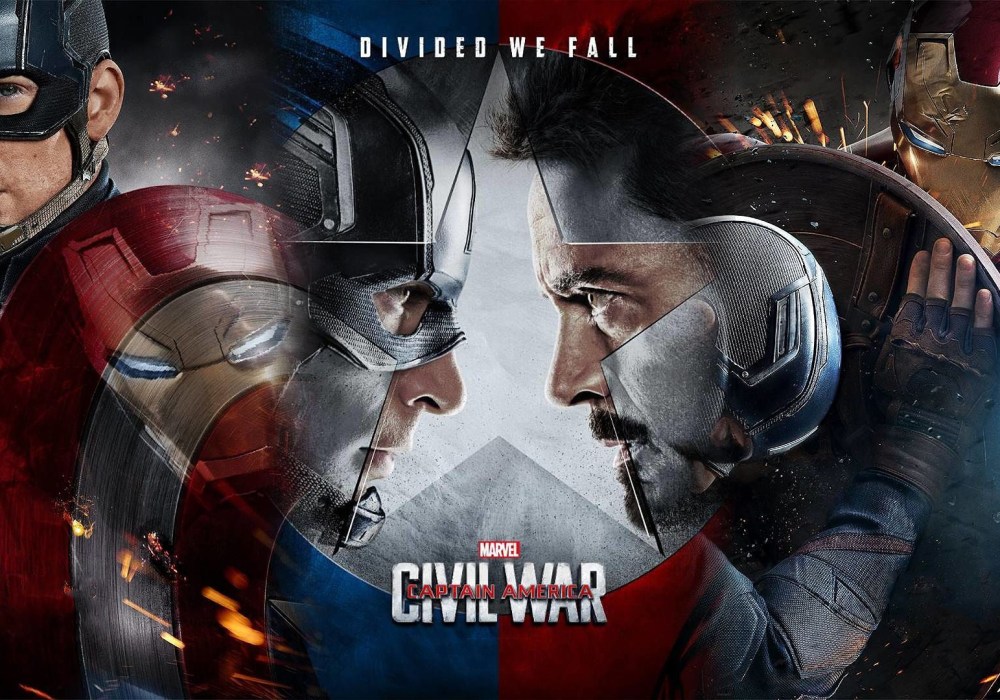
Captain America: Civil War

Is this Marvel’s greatest hour?

To start, let’s kick off with a bit of a retrospective. In 2008 Iron Man surprised the world – a superhero film packed with action, warmth and wit was a relatively new concept. The fact this one had a brilliant storyline along with making a hero most people outside of comic book fandom did not know/care about into someone they wanted to see even more of – that was the truly incredible thing. Skipping ahead several movies we then arrive at Avengers in 2012 which managed to bring the Earth’s mightest heroes together in a way that gave the entire ensemble space to shine. Captain America: Winter Soldier shook things up in 2014, showing that comic book movies could be more than just punch ups. They could come a espionage thriller editions too. Last year’s Age Of Ultron was ultimately a disappointment (though not in terms of box office) as it was too po-face and side piece-y. Now, one week ahead of the USA, we have Civil War. Civil War fixes the problems of Age Of Ultron, takes the smarts of Winter Soldier, the high-stakes suspense of Avengers and the character driven focus of Iron Man. In many ways it is one of the best Marvel movies yet, but is it really the five star perfection the majority of reviews are touting?

One year after the events in Sokovia – Steve Rodgers/Captain America (Chris Evans), Natasha Romanoff/Black Widow (Scarlett Johansson), Wanda Maximoff/Scarlet Witch (Elizabeth Olsen) and Sam WIlson/Falcon (Anthony Mackie) are in Nigeria trying to prevent the theft of a biological weapon. In the process Wanda  loses control of her powers and a building is destroyed, killing several people. It’s the final straw and the governments of nation’s from around the world demand that the Avengers be held accountable for their actions. The United Nations puts forward the Sokovia Act which would put a governing body in charge of monitoring and policing the world’s growing inhuman population. Tony Stark/Iron Man (Robert Downey Jr.) is in favour of signing that act as he has become all too aware of the consequences of their past actions. Steve, having become distrustful of government after the fall of S.H.I.E.LD, firmly disagrees. When Bucky Barnes/Winter Soldier (Sebastian Stan), Steve’s childhood friend who was tortured by H.Y.D.R.A and forced to become an assassin, becomes involved what was once a a fracture becomes a break – forcing the Avengers to take sides. United they stood tall but when divided who will be left standing?

This film is pretty superb. It balances humour with action, characterisation with big set pieces, superpowers with humanity. The end product is pure cinematic escapism, with some big questions being posed along with some laugh-out-loud gags. For instance that age old mantra from Spiderman’s Uncle Ben ‘With great power comes great responsibility’ – if you are the one in possession of great power and you do not use it (however unintentionally) responsibly, who should you be accountable to? If you are capable of destroying cities, constantly having to make life or death decisions, should you have permission? All of Marvel’s past films have led to this point, where tough unanswerable questions slot in with huge/gigantic/speculator action sequences.

However, going somewhat against the tide here, I don’t think it’s perfect. Though its ambition is admirable and mostly successful it is a watching experience akin to going to your favourite restaurant, having your favourite meals but for some reason there is a delay between courses. There are some wonderful/brilliant/extraordinary moments, but then there is a bit of waiting around before the next wonderful/brilliant/extraordinary moment. In many ways this just goes to show just how could the wonderful/brilliant/extraordinary moments are, that they are of such a high caliber that the momentum cannot be maintained. It could also be a by-product of the film’s running time, which clocks in at 147 minutes. Going back to my eating-out analogy perhaps the portion size is overly large, the chef’s eyes were bigger than my belly, and that skimming a bit off the plate may have made for a more satisfying experience.

Saying that does not ignore or take the shine away from the incredible fest that this film offers. It may just be Marvel’s most mature film yet, displaying its spectacle and smarts with great confidence. The central debate is hugely topical – so much so that Batman V Superman featured simillar just a few weeks back. But this film is the antithesis of the fatally flawed BVS:DOJ (which confused dark with murky). Civil War has an edge to it – the Airport fight-out sequence between the two newly-split allegiances easily earns a place in top five scenes in a Marvel movies. Then there’s the new depths added to RDJ’s Tony Stark, a man who seems to be enjoying the continuing evolution of his character. His authority plays a role in his relationships with his fellow Avengers, in his fraternal alliance with Steve Rodgers and most excitingly hints at what looks to be a legendary rapport with the latest incarnation of Spiderman (Tom Holland). Holland is a breath of fresh air to the franchise – he’s cheeky and full of energy, a blend of nerd and cool which neither of the previous film versions seemed to capture. The brewing mentor/mentee relationship between he and Tony Stark is one to truly get excited about. 

Without question this is the best Avengers movie yet – even if the name itself doesn’t lend itself to that. By having the pre-colon say Captain America it almost implies it is a stand-alone movie. It’s not. Although it is Cap’s conflicted conscience which drives the majority of the plot the film is made by the ensemble. Is it the best Marvel movie yet? Instinctively, after great internal battle, I have to say no. In terms of viewing experience I rank Guardians of the Galaxy  far higher and in terms of cerebrality Winter Soldier wins. However, this does not take away from what a spectacular is for the most part. It never feels overstuffed, joyfully introduces new heroes and pays great tribute to our existing heroes.

4.5


Miles Ahead

The man, a fair bit of myth and a whole lotta legend

It what may be my favourite bit of description from the year so far director/co-writer/lead Don Cheadle describes ‘Miles Ahead’ as being a ‘metaphorical’ biopic of Miles Davies. Fact and fiction are rather skillfully blended to pay tribute to an incredible musician, a leader of the genre that should be called ‘social music not jazz’. For better or for worse (depending on your view) this is not a typical music biopic – it’s free from the cliches that come with it – instead favouring a magnificent mooch-like approach in exploring the lives and loves of a true musical legend.

It’s 1979 and Miles Davies (Don Cheadle) has been a recluse for five years. A rumoured comeback – not that Davies himself would call it that – is being heard on the grapevine. Having lost this muse Frances (Emayatzy Corinealdi) and his ‘lip’ thanks to self-medicating a variety of drugs, word gets around that Miles has actually recorded some new music – only he’s refusing to give it to his record label Columbia. That’s when Rolling Stone journalist Dave Brill (Ewan McGregor) literally comes a-knocking on his door. The attempted interview between the pair quickly descends into utter chaos – involving drug deals, shootouts, car chases, stolen records and a few trips into memory lane.

The greatest thing about this film is the fact that when watching it it is clear that you are watching a passion project. The adoration that Cheadle clearly feels towards Miles Davis pays off completely and shines through every mannerism or rasping of dialogue. Even when high as a kite or desperately searching for his next hit he is shown to be a true man of sharp-suited cool. And even when slightly darker sides of his personality come out – such as in the flashbacks of his relationship with Francis – he is still a character we can connect with even when we may not like him at that particular moment. His self-destruction is portrayed with such affection by Cheadle – it shines through his eyes in every scene.

The events of the film are mostly fictional, inspired by the past as opposed to retelling. It’s a unique touch, a very ambitious touch at that, and one which mostly pays off in how well it reflects its subject. This is also emphasised by the construction of the film, with neat little choices of direction allowing for the present to seamlessly blend into the past. It’s not typical ‘day in the life’ fayre, nor is it rise and fall narrative. Instead the film drifts, swaggers if you will, from one moment to the next.

Like Davis the film is smooth, if occasionally rather frustrating in terms of its storytelling. It is hugely enjoyable and incredibly well-acted. And, like the man himself, never boring.

stars 

Bastille Day

Remove brain and enjoy the stupid

To put it simply, there is nothing clever about this film. It’s too po-faced about going about its business to be a parody even when the film really feels like it’s parodying ‘the maverick detective’ genre – our ‘maverick’ is even introduced via a CIA briefing where a prior report described him as ‘reckless and prone to violence’, he does things that are so against the rule book that he’s ‘own his own’ and he punches or shoots everyone he comes into contact with. Aside from this not a single character has any actual characterisation, each one simply remains a job title or character trait. Yet somehow, and if you really try not to think too hard, this film has enough charisma and talent to actually be rather entertaining… for the most part.

Zoe Naville (Charlotte Le Bon) is persuaded by the man she thinks she loves to walk into the office of a political party candidate after hours and leave behind a bomb. He promises her that it’s safe, the office will be empty and no-one will get hurt. When Zoe finds the office to be full of cleaners she ends up being stuck in the middle of Paris with a literal ticking time bomb. That’s when con artist and thief Michael Mason (Richard Madden) spots an opportunity and steals her bag without knowing the contents. After stealing her phone he drops the back of at a bin – time has run out and the bomb explodes. Michael survives but CIA surveillance now implicates him as the instigator of the bomb so they put their best rogue lone-wolf officer on the case, Sean Briar (Idris Elba). Once Mason proves his innocence and his masterful skill of pick-pocketing the pair team up to find out the truth and stop any further lives being taken by the terrorists, who are soon found to be part of the French police force. – but just how high up does this conspiracy go? 

Again, I reiterate, there is nothing genre-defying or genre-defining here. The plot is riddled with more bullet holes than actually feature in the film – which is really saying something as every single character appears to try to shoot their way out of every single situation. Considering the main issue at hand is terrorism there is nothing logical about how any of the involved parties handle the situation.  The terrorist use a hashtag for their exploits, which magically transforms all the citizens of Paris into Bastille Day warriors. I’m sure there are many social media advertising companies who would love to know their secret.

Their ‘secret’ may just be Idris Elba who genuinely saves this film from being utter dross. He manages to droll lines which are so poorly manufactured and cliche-ridden that other actor would need to do the whole ‘nudge-nudge wink-wink’ to the camera. Instead Elba can say utterly farcical fare in such a way that you still get the joke and can laugh at multiple people’s expense. His charisma and sheer screen presence make the film as enjoyable as it is. That and the fact the film is a lean 90-odd minutes, no plot device or scene out stays its welcome and there is more than enough action. If you can ignore the utter waste of Kelly Reilly‘s talent and some of the film’s complicated (read: flawed) ideas about numerous topics then you’re good to go. 

It’s cheesy and hackneyed and only saved by Idris Elba. But, if you make sure you switch off both your phone and your brain at the start of the film, then you’ve found an entertaining enough way to while away 1.5 hours.

2 stars

The Jungle Book

It’s really a Bare Necessity that you see it!

For reasons somewhat unknown and potentially puzzling for many fans, Disney has decided to make a series of live-action versions of their animated classics. Apparently there are even 15 currently being planned. If they are all even half as good as this one then it’s not something to worry over. The Jungle Book (2016) is a marvelously wonderful adaptation that is both true to the original 1968 film yet with enough of its own nuances for a fresh-feel.

Mowgli was only a baby when he was found alone in the jungle by Bagheera the black panther (Ben Kingsley). Bagheera took Mowgli to the group of animals in the jungle who would best be able to care for him and protect him – the wolf pack. Raised by surrogate mother Raksha (Lupita Nyong’o) and pack leader Akela (Giancarlo Esposito) and bought up alongside their wolf cubs Mowgli learns the ways of the wolves, but as he is getting older Mowgli’s (Neel Sethi) progress is starting to lag behind his wolf siblings. One day, during the dry season, all the animals of the jungle are gathered to drink what remains of The Water Truce when Bengal tiger Shere Khan (Idris Elba) makes a reappearance after years away. Shere Khan smells Mowgli’s scent and warns the wolfpack to get rid of him or face the consequences. Bagheera offers to escort Mowgli back to the land of the man but the pair get separated on the journey. A close encounter with an enormous Indian python called Kaa (Scarlett Johansson) leads to Mowgli meeting Baloo the bear (Bill Murray). A true friendship begins to form between them but how long can it last with Shere Khan still desperate to hunt and kill Mowgli?

There are three key things that have been perfected to make this film as good as it is. Hopefully one of the things you noticed as you read the above plot summary is the cast. Firstly, how good is that cast!?! Look at the incredible group of actors that were brought together. Then look individually at each actor and the character they play. It’s not often you get to say that every casting choice is perfect within a movie and it’s something that you can say applies to this film. Kingsley provides the necessary paternal warmth hidden under layers of no-nonsense concern. Nyong’o as Raksha is a wolf fiercely protective and not afraid to speak out when it’s needed. Elba is fantastic, a properly scary villain, who growls around the land. Johansson’s Kaa is suitably seductive and hypnotic. But the award for most outstanding vocal contribution has to go to Bill Murray providing a performance that is un-bear-ably endearing and amusing in equal measure. How young newcomer Neel Sethi manages to hold his own is an incredible feat which he appears to do with ease. Let alone the fact he spends the film acting alongside CGI animals…

Leading to the second area in which this film excels – the visuals. I’m on the fence about 3D usually. After seeing too many films which claim 3d status yet do little to warrant it I tend not to be overly excited when having to choose between 2d and 3d showings.The Jungle Book is the first film in an age where I’ve been so glad I booked that 3d ticket. The depth of the frame, the landscape, the animals fur, the movement of the water and the curse of the red flower. All of these aspects are superbly enhanced by the 3d. Whilst aware of the cost it can add to a cinema visit I would firmly recommend seeing this film in 3d to access the added textures and wondrous depths it provides. The animals themselves are beautiful and almost life-like in how they look and move.I now desperately want to cuddle a baby wolf and sit upon a giant bears stomach as we float through the river.

Thirdly there’s the direction.Director Jon Favreau ensure first and foremost that this is a children’s movie whilst avoiding any pandering or talking down to the children. The film has enough darkness to give it bite – mildly frightening as opposed to truly scary. There’s even a lesson or two to be learned along the way. Unlike the original animation this film is not a musical but two of the classic songs are included – ‘The Bare Necessities’ is sung by Mowgli and Baloo during the aforementioned river floating sequences and Christopher Walken talk-sings his way through ‘Wanna Be Like You’ in such a wonderfully charming yet ultimately threatening manner – that feel like a natural fit as opposed to being shoe-horned in.

This may just be the most enchanting film of the year so far. It’s a marvellous visual spectacle told with wit and warmth. A treat for the eyes, ears and heart.

4 stars


Eye in the Sky

A powerful and reflective examination of the cost of warfare. 

Very few films are this good. It’s well-acted by a truly terrific cast, impeccably shot with a thrillingly taut script. It also poses such incredibly cerebral and difficult questions without copping out and providing easy answers. Then again, war itself doesn’t provide any easy answers.

Colonel Katherine Powell (Helen Mirren) arrives at a military base in Sussex to oversee a high-level mission, to capture Al-Shabaab extremists who are meeting at a safe-house in Nairobi. Jama Farah (Barkhad Abdi) is one of numerous undercover Kenyan field agents on the scene using covert surveillance. In Nevada USAF pilot Steve Watts (Aaron Paul) takes his seat alongside rookie Carrie Gershon (Phoebe Fox) to provide aerial surveillance (the Eye in the Sky). Lt. General Frank Benson (Alan Rickman) arrives at his work, an office in London, taking the seat at the head of a table with members of the government to oversee the operation. What starts of as a seemingly routine capture mission soon becomes deeply complicated when it’s discovered the extremists are preparing to send two suicide bombers into the busy city streets. The only option appears to be to drop a hellfire missile on the safe house, but a little girl is out on the street nearby who would be fatally injured in the process. Those involved are deeply conflicted about what to do, and time is quickly running out.

I do not say this words lightly, but I firmly believe that everyone should see this film. Far beyond the fact that it is superbly acted and written, things I will discuss shortly, few films about war are this suspenseful and affecting.. The very term ‘collateral damage’ is a term complicated enough when you reflect on the fact it is a label used for human beings  caught in the crossfire but having the film truly immersing the audience debate generates a new level of soul searching. This is a genuine nail-biting thriller, with moments of true edge-of-your-seat-ness and wringing your hands in despair.

The cast for this film is awe-worthy and all of their performances justify completely justify that awe. This is one of two posthumous roles for Alan Rickman and serves as a reminder of what a genuine talent we lost this year. His iconic tone and manner are both fully in display here, truly serving his character and the film itself very well indeed. Helen Mirren is wonderful and fully believable as the stoic Colonel who watches her mission escalate from out of her control yet never losing her calm or nerve in the process. Aaron Paul is extraordinary as a man with two years experience in the job who is finally being told to pull the trigger, torn between duty and morality. Barkhad Abdi is one of the characters we know least about yet the strength and depth of his performance allows the audience to truly understand his role in events.

The script, cinematography, sound and performances of Eye in the Sky align to make this easily one of the best movies of the year so far. A riveting, fully entertaining yet equally chilling study of the morality of warfare. The questions it raises are not and cannot be truly answered yet will continue to haunt long after the credits roll.

This needs to be seen by all.

five star

The Huntsman: Winter’s War

A fantasy with just enough farce to make it fun

I doubt there are many people who have spent the past four years desperately counting down until the sequel of the rather mediocre Snow White and the Huntsman. The film was lacking entertainment and personifies Hollywood’s serious issue with getting ‘dark’ confused with ‘murky’ and deeply frowning viewed as the only way to articulate inner torment. Now we have the prequel/sequel sans Snow White aka. Kristen Stewart (after a certain scandal involving the film’s director Rupert Sanders) who realistically is not much of a loss as she spent most of the film biting her lip. A new threat befalls the kingdom and the Huntsman is called in to help, after we learn more about his mysterious backstory.

Many years ago evil queen Ravenna (Charlize Theron) murdered her way through the land to rule the kingdoms, with her powerless sister Freya (Emily Blunt) by her side. Freya falls in love, something her sister is against as love is a foolish distraction, and has a daughter. When tragedy strikes Freya’s powers are activated (think Elsa-from-Frozen-type powers) and she moves away to take control of her own land. She decides that she must have her own unique army and orphans the children of a village. The children are brought to her castle and taught the one commandment of her rule, that love is a sin. Years pass as the children are trained and moulded into true Huntsman but two children, her two best, break her one rule and fall in love. Eric (Chris Hemsworth) and Sara (Jessica Chastain) marry and try to flee but are caught in the process. Freya the Frost, as she is now known, places a great wall of ice between the pair to separate them. Sara appears to be murdered and Eric is thrown into a nearby river to be swept away. Seven years later, after the events of the previous film when Snow White killed Ravenna, Eric is called on by Snow White’s close friend William (Sam Claflin) to stop the Mirror being intercepted by Freya. 

You do not go into films like this with a closed mind. They require a deep suspension of disbelief, with any concepts of logic or reason needing to be locked away for 114 minutes. If you do this you will find this film to be a serviceable and entertaining lark. It would be easy to list all of the flaws within this film but doing so would ignore how relatively entertaining it is.The script is truly mediocre, full of boulder-sized clunky exposition and mawkish sentiments. In fact a bingo or drinking game could be formed based on all the lines/phrases that are uttered about love (‘love is a sin’ ‘love doesn’t conquer all’ ‘love is not a fairytale’ ‘you reek of love’ etc.) There’s a line about wet-never regions which shows how uncertain the filmmakers are about who their audience actually is.  Liam Neeson is on needless and grating omniscient narrator duties.

If you can ignore that, which I know is asking for rather a lot, what is left is a host of charming performances going above and beyond to make the lifeless script fun. Chastain is a fantastic new addition, being far more kick-ass than her running in heels stint in Jurassic World. Hemsworth is as charming as we now expect from him, mugging about and having fun. I doubt there is little I wouldn’t watch if he was in it. Blunt and Theron are solid and borderline-stirring in their villainous portrayals, making some truly dreadful lines sound half-way believable.  Complex issues aside about people playing dwarves the four dwarves who aide the Huntsman on his journey (Nick FrostRob BrydonAlexandra Roach and Sheridan Smith) are great fun and a joy to watch.

It’s not going to win any awards and will most likely be forgotten by the end of the month. It also does not deserve nor need a sequel (instead I would propose a new series called ‘Let’s watch Chris Hemsworth do things’ where we watch Hemsworth do a variety of activities and charm us all). BUT, it is an entertaining enough farce with just enough camp and laughs to fill a dull afternoon/evening.

 2 stars

Victoria

A true feat of film-making. Truly extraordinary.

To put it simply, a ‘take’ refers to the period between a director saying ‘action’ and ‘cut’. It’s up to them or the cinematographer how long this period is. Typically the longer the take the more difficult the film-making process is as it requires actors to be in the right place, saying the right lines, nothing else interrupting the shot etc. Alfred Hitchcock experimented with this in 1948 making Rope which clocked in at 80 minutes and comprised of only 10 takes, the majority of which were shot in such a way to make the cuts seem seamless. It was an ambitious project which paid of in most regards, the murder and the main characters fear of being caught out in only heightened by the prolonged takes. The character cannot escape and neither can the audience. 68 years later we have Victoria which was filmed two years ago and rejected by many of Europe’s film festivals as they believed the filmmakers were lying on the submission sheet. What lie did they think the filmmakers were proclaiming? Well the film-makers claimed that Victoria, which is 2 hours and 18 minutes long, was shoot using only one take. The most unbelievable thing about this? It’s the truth.

Victoria (Laia Costa) moved from her hometown of Madrid to Berlin three months ago. She works in a coffee shop for less than minimum wage and doesn’t really know anyone in her new city. In the hours before her early morning shift she decides to go clubbing and dances alone quite happily. On her way out of the club she bumps into a group of four men – informal group leader Sonne (Frederick Lau) who Victoria feels an instant spark with, Boxer (Franz Rogowski), Blinker (Burak Yigit) and Fuß (Max Mauff) – who promise to show her ‘real Berlin’. Victoria agrees and what first follows is a fun night for Victoria, seeing parts of Berlin she had never seen before and connecting quickly with Sonne. When Boxer receives a phone call and claims that the group need Victoria’s help.  It is her connection with Sonne that prompts her to make the first in a series of bad decisions and things take a dark turn before spiralling out of control.

I repeat. The entire film is only one take long. It cannot be overemphasised how incredible this is, what a triumph of filmmaking it is and what an astounding experience of film-watching it creates as a result. It’s breath-taking, wondrous, exhilarating and utterly compelling. As it is shot though one-take it is shot in real-time. This is important to note as it adds to the authenticity, we watched events play out and escalate. We cannot question how we got from the first frame to the last as we witnessed very moment and decision which lead the characters there. And these moments don’t just take place in one room – the characters travel all over the city, up ladders, jammed into cars and lifts, dancing across the street and running across it too – and the camera is always there watching and following. Incredibly this also manages to feel gimmick-free. Instead we feel like we’ve tagged along for a night out, been immersed in the spontaneity and intensity of this world, then kicked out of the club  and ditched at the end of the film. There is a reason that the cinematographer Sturla Brandth Grøvlen receives first credit ahead of director and writer Sebastian Schipper as Victoria is an example of true technical mastery. The camerawork is dazzling ambitious, pulsating and gripping.

The performances are mostly improvised, which only adds to the feeling of authenticity and believability. This is next level realism as we get to experience this world as it happens. It’s a huge credit to the relatively inexperienced cast that they only had to shoot the film three times, this being version two. It’s only after seeing the film, when you see what they had to achieve and endure, that you can truly appreciate the level of skill being utilised here.

It’s divine. A sensational watch. It needs to be seen.


Disorder

An intense and intimate voyeuristic thriller

How many films are there that feature a character with PTSD (post-traumatic-stress-disorder)? Then, let’s narrow it down, how many of the those films are about PTSD sufferers who fought in Afghanistan?  Finally, how many of those films use the PTSD to shape the storytelling process, making the story as unreliable as it’s narrator? I suspect that Disorder may be alone in this regard which makes for a mostly refreshing if at times nerve-splintering film-watching experience.

Vincent (Matthias Schoenaerts ) is a French Special Forces soldier who is currently back from a tour of Afghanistan. His latest health check-up indicates that it will be his last as due to his various  health problems his doctor will not be recommending him for service, something that he appears to be in denial about. He and a group of his friends are hired by Jessie (Diane Kruger), the wife of a rich Lebanese  businessman, to provide security at a party they are holding at her villa. Vincent starts to develop a strange fascination with Jessie, whilst at the same time starting to suspect a dangerous threat is going to target her and her young son, and he begins to be consumed by paranoia. Is there really a threat, or is it a result of his disorder?

A month ago, in my review for A Bigger Splash I talked about Matthias Schoenaerts and said “He is currently one of the most interesting and underappreciated supporting actors in cinema at the moment, and I greatly look forward to seeing more of his (admittedly rather beautiful) self.” After seeing Disorder, I stand by what I said. Schoenaerts carries this movie, his scowl/brooding combination is utilized to excellent effect. His mannerisms subtly display his inner turmoil, he never needs to clearly state ‘I am suffering from PTSD’ (in fact that is something his character who never admit) but it’s clear from every single scene that this is a man who is suffering. Vincent’s innate paranoia served with a side of voyeurism makes for an unnerving central character who is haunted but hunky. In fact whilst watching his performance I remembered some of the minor backlash that James Norton received for Happy Valley with a (thankfully small  minority) saying that he was ‘too good-looking to be a murderer’. It’s a stupendously flawed logic to have, implying that attractiveness and committing crime share a correlation. Yes Schoenaerts is attractive, but that does not enhance nor detract from his performance here. His performance is wonderful, if that adjective can be used to describe something so unsettling, and the best thing about the film.

A close-tied second place would be the soundtrack and the cinematography. The former is throbbing, jarring and frequently atonal (like Vincent’s mental state) whilst the latter is ambiguous, swamped by shadows and at times unhinged (again like Vincent’s mental state). Aside from these aspects, the film itself is rather slow with a rather porous plot that fizzles out. Worth seeing for Schoenaerts latest in an uninterrupted run of solid and charismatic performances, but rather forgettable.

An outstanding central performance in a good/mediocre film. Don’t put it too high on your ‘must-see list’ but worth a try.