Julieta

Brooding, sentimental and utterly charming

I think I’ve only given five stars twice this year. This will now be the third as ‘Julieta‘ is unquestionably a five star movie. The entire film has an air of intrigue which smothers the viewer and draws them into a grief-tainted realm of love and loss. There’s much brooding meditation on universal themes such as fate and guilt – how yearning and regret can torture generations.

Julieta (Suárez) is about to move away from Madrid to Portugal with Lorenzo (Grandinetti). When she goes on her final errands she has a chance encounter with Beatriz (Jenner) who was the childhood best friend of Julieta’s daughter Antia. Beatriz tells Julieta about how she had bumped into Antia the week prior, about how well she was looking and how she meet Antia’s children. It’s a casual encounter and yet it forces Julieta to face her past. She tells Lorenzo that she will not be moving to Portugal with him but she doesn’t tell him the reason – that she needs to confront the events that led up to the decades-long estrangement of her and her daughter. 

jul3

One of the film’s great successes it how it instantaneously hooks the viewer in whilst revelling very little. We can observe much about Julieta and her relationship with Lorenzo – we see how happy and doubt free she appears to be about the move- and how this shifts entirely by to what would appear to bystanders as smalltalk-laden chance encounter. We witness how her moving forward with her life is swiftly halted as she is ejected back into her past. Not only is she inevitably forced back to the past mentally and emotionally, she then returns to living in the apartment block she lived in with Antia in the hope of manifesting ghosts of her past into present figures. The letter she then begins to write to Antia serves as the frame of the story, the letter starts at the beginning and we are then placed their – in the 1980s with a twenty-something Julieta played by a different actress (Ugarte).

What follows could then be categorised as a lengthy flashback and yet it doesn’t quite fit nor feel like that. Assigning that label makes it sound like a laborious or arduous watch – it wholeheartedly isn’t.  We, the viewer, live the memories just as Julieta is reliving them. We follow Julieta as she meets Antia’s father Xoan (Grao), her relationship with him, Antia’s birth and the seemingly fated separation that occurs with both of them. Julieta is a specialist in Classics and an air of Greek mythology lingers over the events – a prevailing sense of tragedy and predestiny, decision and consequence, fate and regret.

jul2

As we face in our own lives some of the events in Julieta’s life come as a quick and devastating surprise whilst others are drawn out, almost suffocating in their inevitability. Both Ugarte and Suárez are truly excellent in their joint role – each providing so much depth to Julita, each equally and superbly moving as they endure unresolved personal heartbreak. This, of course, would not be possible were it not for the master behind the camera.  Almodóvar reminds us, were it needed, that he is one of cinema’s greatest living directors. He tells the story in a way that is both fractured yet whole- just like Julieta – muted yet melodramatic. Many moments within the film are gasp-inducing in their blend of beauty and tragedy, but none more so than the switch from younger to older Julieta. It’s a tradition that is the epitome of seamless yet utterly shattering. 

Extraordinarily stylish on the eye, food for your soul, heartbreaking yet heart-mending. Extraordinary.

five star

Dir:Pedro Almodóvar

Cast: Adriana UgarteRossy de PalmaEmma SuárezMichelle JennerInma CuestaDaniel GraoDarío Grandinetti.

 Country: Spain                                 Year: 2016                         Run time: 99 Minutes

Julieta is in UK cinemas now. 

When Marnie Was There

A quietly moving and melancholic outsider tale

There are many reasons this film will leave you sobbing. First of all this may just be Studio Ghibli’s last film, at least for long while, if not ever. What an extraordinary note to go out on. When Marnie Was There is prime Ghibli, top-standard and the epitome of the brilliance the Japanese anime powerhouse is capable of. It also happens to be their most understated film yet.

Read More

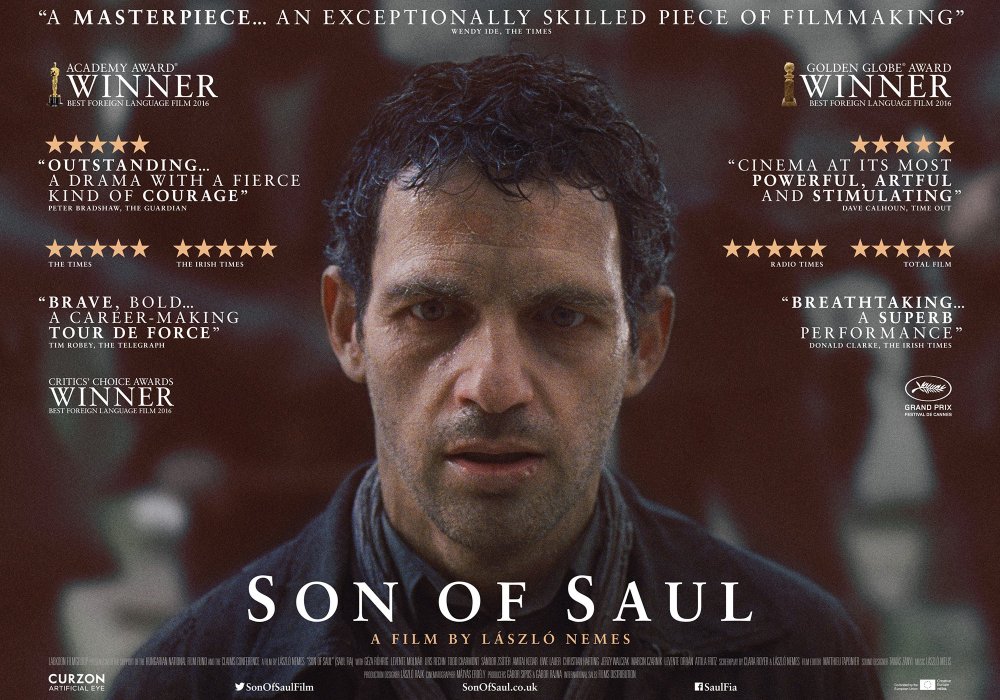
Son of Saul

A Masterpiece

When I left the mid-day screening of this film it was sunny outside. Bright rays gleamed upon the cinema and I glared at them. As I walked home there was a busker singing ‘Walking on Sunshine’. I glared at him. As I passed through a heaving farmers market I glared at the merry people chomping away. I couldn’t work out why I was reacting in this way. Ordinarily I would be thrilled by walking out of the cinema into sun. I would beam at a busker singing Katrina and the Waves 1983 seminal feel-good classic. And I’d probably only side-eye the hipsters filling the farmers market. Why was I so angry at everything? It seemed obvious that it was most likely my  response to the film and the horrors it entailed. But these were not horrors that were new to me – I hadn’t learnt anything new and the events of the film were horrifically familiar.

That’s when I fully grasped just how masterful ‘Son of Saul’ is. It’s almost a rethink of how to portray the Holocaust – by not showing it at all. Gone are any attempts at glamorization, of showy melodrama or noble heroism. Instead we are shown pieces of events – snippets of the evil that took place only feature in the side of or outside of the frame. Overt dramatization is replaced by close-up and over-the-shoulder shots with shallow focus on our central characters face. We hear the events but we don’t see them – leaving the spectator’s imagination to join the dots and fill in the gaps.  As Alfred Hitchcock said, “A glimpse into the world proves that horror is nothing other than reality.”.

It is 1944. Saul (Géza Röhrig) is a Hungarian-Jewish prisoner at Auschwitz who is part of the Sonderkommando unit. He is forced, under threat of death, to work for the Nazis in removing the “‘pieces” (the term used for bodies) from the gas chambers. Although the job delays his death it is only a temporary pardon – the job, and therefore his life, has an expiry date of five months which he is fast approaching. When clearing out the chambers post-gassing he finds a still-breathing boy that he believes to be his son. The Nazi doctors swiftly suffocate the boy and decide to have an autopost performed on him to find out how he survived. Saul desperately endeavours to stop the autopsy and find a Rabbi to lead a proper burial for the boy. 

 The events that follow are unforgettable in terms of content and portrayal – relentless and horrifying yet the carnage is skillfully implied as opposed to being explicitly shown. The two hours spent watching this film are two hours spent being a spectator in Hell. Death is not shown but instead resides off-frame – an omnipotent and omnipresent force haunting the frame. Just as one should not look directly into the sun we cannot look directly into the face of evil.

The opening sequence must be forever acknowledged in its audacity and its viscerality. We observe Saul as a sheepdog figure, one of many leading herds of bewildered people into what appears to be a changing room. An off-screen voice offers reassuring sentiments they are going for a shower and offers promises of what will follow. Our focus never leaves Saul’s face as we swiftly realise with unbearable inevitability what will happen next. We don’t see the people enter the gas chamber. We don’t see them die. But we do hear them die.

Rohrig’s performance is truly exceptional – his Saul is haunted and hollow. Grizzled by the unspeakable horror, his jaw is rigid with determination and his eyes are empty. We can only wonder how he keeps on living. The fact this is Rohrig’s first performance, as it is the director’s first feature, only adds to the remarkability of this film.

It is unbearably difficult to write this review – every word or phrase seems inadequate to fully describe the soul-altering experience of watching. It leaves you so numb you can no longer cry. Unlike any other Holocaust film there is nothing here to sweeten the devastating blow of watching this film – no beautiful musical score, no magical rescue and no story of redemption. It’s an intense and immersive experience with a the visceral immediacy it provokes that is ultimately necessary. Truly unforgettable.

five star


Our Little Sister

A quietly touching family drama

Our Little Sister is a wonderful example of a sentimental yet ultimately subtle delight of a film. Watching it is a bit like being in a 128 minute-long embrace, warm and imitate with undercurrents of deep emotion. There’s no real melodrama – no dramatic shouting matches, intensive confrontations or shocking revelations – it’s far more real than that. We start the film with the character being total strangers to us then end the film feeling as if we are part of the family.

15 years ago a father left his wife and three young daughters behind. Soon after his heartbroken wife left the daughters in the care of her mother and left the town. 15 years later and the three, now fully grown, receive a phone call that their father has died, leaving behind his 14-year-old daughter who nursed him until the end. The trio – 29 year old Sachi (Haruka Ayase), 22 year old Yoshino (Masami Nagasawa) and 19 year old Chika (Kaho) – travel to his funeral and to meet their little sister Suzu (Suzu Hirose). The girls make an offer to the now orphaned Suzu, that she could come and live with the three of them in their big house in Kamakura. 

What is so effective about this film as it doesn’t require a big overarching plot – there’s no big problem or issue to solve. Instead we watch the three women over a period of about a year as they bond and face different issues within their own personal lives. Days blend into weeks with only a few references to dictate how much time has passed – at one point the three tell their little sister that in six months they’ll be able to undertake the family tradition of making plum wine, later in the film they do so etc. This alone with the absence of a melodramatic narrative instead presents a more realistic portrayal of family life by choosing to instead use what is essentially a series of interconnected vignettes. Each of the girls faces different issues in their lives, typically resulting around love or work, some are returned to and resolved and others are not as they do not need to be.

The film plays a magical spell as you watch it, drawing you into the lives of four young women who are each dealing with the grief of a departed parent in different ways. All four girls are fully sketched out and wonderfully characterised by both positive and negative traits, each as charming at the movie itself. How the story is shown is as extraordinary as it is told, finding beauty in even the smallest of moments – such as the way a plum floats in a jar of plum wine – and within the landscape itself – with the ‘tunnel’ of cherry blossoms being a personal favourite.

Few family-based dramas whisper instead of shout. This is one of them. A film that is quietly powerful and immensely appealing.

4 stars

Victoria

A true feat of film-making. Truly extraordinary.

To put it simply, a ‘take’ refers to the period between a director saying ‘action’ and ‘cut’. It’s up to them or the cinematographer how long this period is. Typically the longer the take the more difficult the film-making process is as it requires actors to be in the right place, saying the right lines, nothing else interrupting the shot etc. Alfred Hitchcock experimented with this in 1948 making Rope which clocked in at 80 minutes and comprised of only 10 takes, the majority of which were shot in such a way to make the cuts seem seamless. It was an ambitious project which paid of in most regards, the murder and the main characters fear of being caught out in only heightened by the prolonged takes. The character cannot escape and neither can the audience. 68 years later we have Victoria which was filmed two years ago and rejected by many of Europe’s film festivals as they believed the filmmakers were lying on the submission sheet. What lie did they think the filmmakers were proclaiming? Well the film-makers claimed that Victoria, which is 2 hours and 18 minutes long, was shoot using only one take. The most unbelievable thing about this? It’s the truth.

Victoria (Laia Costa) moved from her hometown of Madrid to Berlin three months ago. She works in a coffee shop for less than minimum wage and doesn’t really know anyone in her new city. In the hours before her early morning shift she decides to go clubbing and dances alone quite happily. On her way out of the club she bumps into a group of four men – informal group leader Sonne (Frederick Lau) who Victoria feels an instant spark with, Boxer (Franz Rogowski), Blinker (Burak Yigit) and Fuß (Max Mauff) – who promise to show her ‘real Berlin’. Victoria agrees and what first follows is a fun night for Victoria, seeing parts of Berlin she had never seen before and connecting quickly with Sonne. When Boxer receives a phone call and claims that the group need Victoria’s help.  It is her connection with Sonne that prompts her to make the first in a series of bad decisions and things take a dark turn before spiralling out of control.

I repeat. The entire film is only one take long. It cannot be overemphasised how incredible this is, what a triumph of filmmaking it is and what an astounding experience of film-watching it creates as a result. It’s breath-taking, wondrous, exhilarating and utterly compelling. As it is shot though one-take it is shot in real-time. This is important to note as it adds to the authenticity, we watched events play out and escalate. We cannot question how we got from the first frame to the last as we witnessed very moment and decision which lead the characters there. And these moments don’t just take place in one room – the characters travel all over the city, up ladders, jammed into cars and lifts, dancing across the street and running across it too – and the camera is always there watching and following. Incredibly this also manages to feel gimmick-free. Instead we feel like we’ve tagged along for a night out, been immersed in the spontaneity and intensity of this world, then kicked out of the club  and ditched at the end of the film. There is a reason that the cinematographer Sturla Brandth Grøvlen receives first credit ahead of director and writer Sebastian Schipper as Victoria is an example of true technical mastery. The camerawork is dazzling ambitious, pulsating and gripping.

The performances are mostly improvised, which only adds to the feeling of authenticity and believability. This is next level realism as we get to experience this world as it happens. It’s a huge credit to the relatively inexperienced cast that they only had to shoot the film three times, this being version two. It’s only after seeing the film, when you see what they had to achieve and endure, that you can truly appreciate the level of skill being utilised here.

It’s divine. A sensational watch. It needs to be seen.