london

Brotherhood
A fitting end to a solid British trilogy

Kids In Love

Absolutely Fabulous: The Movie
Alternative Title: Reasonably Fabulous
Ab Fab first aired on the BBC in 1992 (ha, I’m the same age as the show!) until 1995, then show the show aired sporadically as series or special until 2012. Four years on, our ever-glamourous and self-indulgent duo has made it onto the big screen. Has the film broken to the small to big screen curse? Sort of. Whilst it’s no Bad Education movie (click here for review) it still doesn’t shake off the feeling this is little more than a bloated and extended episode.
Edina Monsoon (Jennifer Saunders) and Patsy Stone (Joanna Lumley) are still living the life of luxury, though the money is beginning to run out. Edina’s PR company is failing and her rival, Claudia Bing (Celia Imrie), is taking all the glory. Edina is in need of a miracle and one does arrive – Kate Moss is just fired her PR and is need of a replacement. The wooing of Kate goes wrong however, when Edina manages to push Kate Moss into the Thames. Kate is presumed dead and Edina becomes Britain’s enemy no.1, deciding escape is her only option she flees to France ,in the hope of finding fortune, taking granddaughter Lola (Indeyarna Donaldson-Holness) and Patsy with her. The police are on the hunt, as are Edina’s daughter Saffron (Julia Sawalha) and new boyfriend Nick (Robert Webb).
For fans of the show this film will either fill the void or slightly disappoint. Everything you loved about the tv series is present and correct – the humour and the characters are just how you remembered them. For those who are not so keen or aware of the show this will disappoint or even frustrate. For one thing, if you’ve seen the trailer you’ve seen most of the main gags.
Then there’s the fact the film takes the approach of adding in celebrities, loads of them – everywhere and in every scene there’s a cameo. Some of these work – Gwendoline Christie, Rebel Wilson & Jon Hamm to name but three- and some just flopped – Jerry Hall and Jean-Paul Gaultier displayed beyond awful ‘acting’ ability. However, instead of enhancing the story, they make-up the story. When watching it feels as if the celebrities were called in, or called in themselves asking for a role, and the storyline was manufactured from there. A join-the-dots approach to create a story with little substance.
What little there is of a story is archetypal for an extended sitcom episode- taking the characters we love to another country. Gasp! Let’s watch them engage in the customs of the land. Chuckle! Although it is evident the film was made with love for the characters, who we get to observe in their unabashedly badly behaved glory, it isn’t as funny as it could have been. At times it feels lazy and far too celebrity obsessed. Yes, this may be an accurate reflection of our main characters, but it also feels tired and out-dated. Like a relic from a past era it relies on in-jokes and cliches. And yet this didn’t bother me so much as my surroundings when watching the film were perfect for the occasion – 7pm at Picturehouse Central. The 90% capacity screen was made up with middle-aged amazonian women and groups of immaculately made-up men, this was clearly their show; laughs and cheers were constant throughout.
Saunders and Lumley play their characters with perfection but the written material isn’t there to make this a swansong that is absolute or fabulous. It’s not vintage Bolly but it will be a respite for the sport-weary and a reunion with old friends for those who loved the show.


Now You See Me: The Second Act
A sequel that will hopefully disappear into thin air
After being persuaded (read: forced!) by my friend Sam to watch ‘Now You See Me’ I was pleasantly surprised – the cast were charismatic enough, the tricks they pulled off were entertaining and, aside from a plot twist that made no sense whatsoever, it was a nice slice of fantasy entertainment. 24 hours later, after coming out of its sequel, I felt no such positivity. ‘Now You See Me: The Second Act’ is bland, boring and blithely bloated. You come out of the cinema not feeling fooled or tricked – but scammed for giving up 129 minutes of your life for such maddening rubbish.
One year on since they outwitted the FBI and the Four Horsemen have become Three – J. Daniel Atlas (Jesse Eisenberg), Merritt McKinney (Woody Harrelson) , Jack Wilder (Dave Franco) – as the ‘lady horseman’ grew tired of waiting around for further instructions from the Eye. Dylan Rhodes (Mark Ruffalo) is still working at the FBI, doing all he can to keep the Horsemen in hiding and under the radar. He sets the Horsemen a new mission to hijack the launch party of a new software, inviting Lula (Lizzy Caplan) to join them. The mission gets hijacked by Walter Mabry (Daniel Radcliffe) who kidnaps the Horseman and forces them to use their skills to go steal a data-mining device. Dylan has no idea where the Horseman are so breaks Thaddeus Bradley (Morgan Freeman) to help find them. What are the chances that vengeance-seeking Arthur Tressler (Michael Caine) may be involved somehow?
Writing the above paragraph was exceptionally difficult in the attempt to avoid being convoluted as that is what the film is – a far too convoluted series of ‘tricks’ that make no sense whatsoever. Whereas the first film was fun and flashy this one gets bogged down by attempts at pathos. Much of the plot is devoted to Ruffalo’s character mourning the death of his magician father 30 years on. This wouldn’t be so bad a plot point were it not for the fact that Dylan is not a likeable enough character for the plot to hinge on and the fact it doesn’t go anywhere. There’s also an overwhelming sense when watching these sequences that the filmmakers are hoping for a third movie with a seemingly impossible reunion.
If magic is entertaining the masses with the impossible this film is the opposite – entertaining no one with the improbable. Very rarely does the story actually make sense – with the twists, trickery and questionable character motivations trying so hard to be clever they end up failing. That’s also true of some of the dialogue which regularly made no sense whatsoever. Ordinarily I’d then quote of one these lines as evidence but they must have been that ridiculous that my frontal lobe totally rejected storing them for future reference.
These crimes against cinema would be somewhat forgivable if the characters were likeable or the cast were enjoyable to watch. Sadly that is not a saving grace here. My disdain for characters played by Jesse Eisenberg continues, Dave Franco is unbearably vanilla and Radcliffe is supremely irritating. Harrelson would be the film’s saving grace were it not for the fact he ends up playing a dual role as the evil twin brother of his character. He’s so stereotypically camp that it’s offensive, his costume horrendously cheap and played so hammily you can’t quite believe what you’re seeing. Lizzy Caplan is a welcome addition – as she is to everything she stars in – yet is still stuck in a one-dimensional role as a manic pixie girl type chasing after Dave Franco’s character. Although she is given some rather meta dialogue – about being the ‘lady horseman’ and who will be playing the ‘floozy’ when they go undercover – these are not admirable additions by the script writer. More the least they could do by using such one dimensional characterisation.
Although there is one impressive set piece (the heist to steal the data chip) and it was more than thrilling to see my ‘ends on the big screen (hello Greenwich!) the rest of the film is lacking in warmth, wit and, well, magic. It’s short on logic and right now seems to represent this year’s very dull summer of blockbusters.


High-Rise
‘Where are those happy days, they seem so hard to find.”
41 years after its publication, J. G. Ballad’s High-Rise proves itself to be scarily accurate in its predictions of the then-future and our now-present. The film adaptation is equally brutal and dark, tinted with the blackest of humours. Deciding to set it in the time period in which it was written, director Ben Wheatley succeeds in using Ballad’s bleak hypothesises of societal hierarchy to transform the big screen into a mirror reflecting our darkest innermost fears. This review comes from the preview screening and Q&A session I attended at the British Library (Hello to Galia, Alison and Alex…)
London. 1975. Dr Robert Laing (Tom Hiddleston), a psychologist, movies into a high-rise building having been seduced by the lifestyle it would bring with it. The building itself is isolated from the rest of London and is so self-contained with a supermarket, gym and swimming pool that, aside from work, there is little reason for the residents to leave. They are cut off from the rest of society in their luxury tower block. The higher your floor the higher your status – Laing takes up residence on floor 25, his new friend Charlotte Melville (Sienna Miller) is on floor 26 and the architect of the building, Anthony Royal (Jeremy Irons) and his wife Ann (Keeley Hawes), take up the entire top floor. Laing also comes into contact with a family relegated to the second floor, BBC documentary-maker Richard Wilder (Luke Evans), his heavily pregnant wife Helen (Elisabeth Moss) and their two children. When Wilder becomes so embittered by the social hierarchy he decides it will be the focus of his next project. A dangerous situation develops causing a domino effect which leads to the fragmentation of the residents and formulation of violent tribes.
Where to start when reviewing this film? It’s excellent, terrific and truly haunting in equal measures. Like many of Ben Wheatley’s films High-Rise is of the ‘well-that-escalated-quickly’ genre. However, this film does not require a suspension of belief for the dissention into madness. Whilst accelerated the resulting horrors stems from social resentment that has been apparent since time immemorial. History showcases time and time again society’s that form then self-destruct that little exposition is required in High-Rise to explain why things get so bad so quickly (not that I can really imagine Wheatley wanting to spoon-feed us in this way). The script is bitterly funny, laden with comments that are iceberg-en in terms of depth. Social commentary is rarely this sharp-tongued, appalling yet absurdly funny.
Wheatley doesn’t waste a shot in the telling of this story; countless viewings would be required to access even half of the detail and imagery it possesses. And practically every shot could be printed out as a still and put on a wall, for the cinematography and mise-en-scene is otherworldly in its beauty. There’s the generic, unbranded supermarket made of quadrilaterals in primary colours, the kaleidoscopic parties of the various factions, the riding of a white house across the luminescent greenery of the rooftop garden and the seemingly innocent shades of grey of a certain floor 25.The blend of lighting and framing makes for sequences that are fraught, depraved and agitating. This is only exasperated by the incredible soundtrack, with two appearances of ABBA’s ‘S.O.S’ (hence the subheading of this review) that bring chills in way that one would never have though possible. At one point the BAFTA award makes a cameo, which Wheatley later explained he chose to include as it ‘would be the closest he’d ever get to an actual BAFTA’. It would be an utter travesty if for visuals and soundtrack alone High-Rise is not recognised and justifiably awarded.
Speaking of awards, there’s then the performances of the cast. Hiddelston as Dr.Laing, a self-contained possessor of wide-eyed optimism and underlying volcanic rage, is a match made in heaven. Wheatley spoke of his having Hiddelston’s ‘photo on the fridge’ during pre-production and casting as they (they being Wheatley and wife Amy Jump who wrote the script) viewed him as the perfect candidate. But, whilst Moss, Miller, Hawes and Irons are all good in equal measure it is Luke Evans performance that is stand-out to that of Hiddelston’s. If Laing is untapped rage cloaked in a suit, then Evans as Wilder is the untamed man. Evans must have come close to the edge in making this film, for his character is a powerhouse of bitterness and injustice whose raging against the machine is awash with inevitable destruction.
With so many reasons to see High-Rise; the performances, the script, the visuals are just three broad reasons which should justify you’re purchasing a ticket upon the film’s release next week.
Go see it and be haunted for days afterwards.

The Lady In The Van
British Cinema at its finest
This film is so warm, kind-hearted and endearing. Whilst on the surface it looks to be a meek and mild comedy about a nutty old lady it is so much more than that. It’s full of witty observations about society – the lens is pointed firmly at liberals who have earned enough to become middle class yet feel a degree of guilt about their new-found wealth – and how we do/don’t look after each other. Maggie Smith as the eponymous ‘Lady’ is magnificent, bringing a richness and poignancy to a fiercely opinionated powerhouse of a figure. Should this be 80-year old Smith’s last leading role, it is one to be proud of. Her performance in this ‘Mostly True Story’ both perverse and profound in equal measure.
In the 1970s playwright Alan Bennett (Alex Jennings) moved into an affluent street in Camden. He swiftly became acquainted with his neighbours and the nomadic interloper Ms Shephard (Maggie Smith) known by many as the infamous ‘Ms Camden’. Ms Shepard, as Alan insists on calling her, lives in a van. The neighbours do not know why she lives in the van, or even who she is. Is she called Mary or Margret. What they do know is that she is homeless and prone to dictatorial ravings. Due to a mixture of guilt and territorial conviction they protest little (at least to her face) as she drives around and parks up where ever she fancies. However, after council and double yellow line interference, she can no longer continuing temporarily pitching up where she choses. Loathe to offer too much help to the cantankerous old woman Alan lets her use his drive temporarily to park her Van. 15 years pass, with an often-reluctant Alan slowly-forming a bond with Ms Shepard. As time passes and takes its toll on Ms Shepard Alan begins to learn of the past that continues to consume her.
This is the type of story that could only be true, it would be nigh-on impossible to create a character like Ms Shepard. The majority of her views were left in the dark ages and the way she treats those who try to help her is often despicable. And yet, when personified by Dame Maggie Smith, she is made almost loveable. Her hidden pain and turmoil often explaining some of her brusque character traits. Jennings is superb as her friend and foil, presenting the conflicted feelings Bennett himself had towards helping the formidable Shepard. The supporting cast are also extraordinary: Frances De La Tour, Jim Broadbent and Claire Foy to name just three, all bring various degrees of support to the grande dame of squalor that is Ms Shepard. The slow and tragic realization that Ms Shepard was more sinned against than a sinner is heart-breaking yet handled with such caution and care.
Considering the topic matter this film is ultimately uplifting, almost joyful in its exploration of what draws people to care and look out for one another.

Burnt
A rather overcooked romantic dramedy
Does anyone these days aspire to be Gordon Ramsey? Do they wish to control a kitchen as their lair, spewing and spouting swearwords and insults as they prowl? Ramsey had his peak popularity in the mid-noughties, which is probably when this film was first placed on the boil. It then got forgotten about, rushed to be finished with all of its ingredients past sell their best before date.
Adam Jones (Bradley Cooper) is in New Orleans shucking oysters, noting down the amount as he does so. He hits one million, downs his tools and walks out despots protestations of his employer. Those million oysters were his penance for his past indiscretions, now complete he can have a second chance. He goes to London to reunite his crew, although there is much bad blood between them. Adam was a rock star chef in 90s Paris – renowned for his ability and persona. However Adam was also a drugs, alcohol and sex addict who managed to burn all of his bridges who was forced to flee Paris and go into hiding. He must be forgiven by his old friends and new (Sienna Miller’s Helene) to his dream of three Michelin stars.
The film’s main ingredient (when will the cooking puns end?!?) is Bradley Cooper. Considering the fact the film’s main plot is so outdated it is perhaps the only reason people will go to see the film. However his character is so unappealing and unsympathetic that you’ll feel had. His character’s closest real-life counterpart is Gordon Ramsey, swearing continuously and having frequent blow-ups about food, with every other character either swooning over his apparent but unproven genius or admonishing him for wasting said-genius. There is genuinely no reason to like his character, which is this film’s fatal flaw. As the narrative limbers from one ‘disaster’ to a next tension is supposedly created by our concern on how he will cope/survive. If we don’t like the character enduring the trials then we don’t really care. This isn’t helped by the lack of realism within these trials – he is hounded by drug lords for the money he owes them. These drug lords are immensely polite, turning up occasionally to speak to him away from other people, and only visiting once or twice to hound him for the large amount he owes them. We are meant to care about Cooper’s character – experience concern that he may not achieve his ambition for three Mitchelin stars. Instead we experience disinterest or distain for such an ass-hat of a character.
Sienna Miller however is gutsy, transforming herself into a tattooed, pierced and partly shaven-haired single mother sous chef. Her character is far appealing than Cooper’s. Yet she is forced to endure conversations with Cooper’s character of the nature of food and eating. These conversations are nauseating to watch, not because they are hunger-inducing but for the sheer pretentiousness of their proclamations. ‘We eat to stop eating.’ – That’s sooo deep! The rest of the friendship group are entertaining if one-note; the ex-prisoner, the novice, the daddy issues, the rival etc. The script is bland, drifting from one drama to another, and filled with stupid lines about how John Adams used to be an addict and how he hurt people when he was an addict. It’s all so ridiculous and bordering-on fluff.
If you’re seeing this for Bradley Cooper then don’t waste your time. If you’re seeing it for the food, just re-watch an episode of Hell’s Kitchen. An incredibly dated waste of a movie.
Kill Your Friends
How to succeed in business without any sense of morality
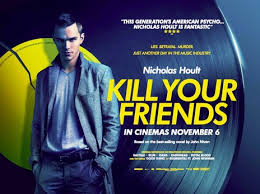
With a title like that, the content of this film really shouldn’t surprise you. We have copious usage of drugs and alcohol, some rather legendary use of swearing (‘Do these shoes look like the shoes of someone who gives a fuck about The Velvet Underground?’) and of course the aforementioned killing of friends. Why? Well it’s set in 1997 and it’s about the music industry. You don’t need to be musicophile to have a rough idea what the music industry was like in the 1990’s. The people at the top possessed little musical talent themselves and gave little care to whether the artists they were choosing to spend their thousands on were ‘good’ artists or in fact whether they were producing ‘art’. Could this unsigned act make me a fortune? Yes, well sign here on the dotted line. So you four girls can’t actually sing or dance, but you’re all rather fit..? Well The Spice Girls are big right now, so we’ll take you. We’ll just get recording artists to sing your music which you’ll mime, and we’ll give you a really crappy basic routine for everyone to copy. You’re hired! This is the sole focus of Kill Your Friends, a study in the middle management wanting to become the top dog focusing less on making good music but more on making lots and lots of money…
It’s 1997 and Britpop is ruling the airwaves. Twenty-seven year old A&R man Steven Stelfox (Nicholas Hoult) doesn’t like Britpop, or any other type of music at all actually. He’s not in the job for the music, he is far from a music puritan. He’s just in it for the money, lots and lots of money. Considering he works in an industry ‘no one knows anything’ there is little stability. Every deal you offer an act is make or break. If an act doesn’t sell, your career is broken. Fuelled by greed, ambition and Class-A drugs he craves the promotion to Head of A&R at his record label and will refuse to let his opposition, his ‘friends’, take the job from him. His calculating approach to manoeuvring the music industry will be taken to a murderous new level.
First things first – substitute music for Wall Street and 90s for 80s and this sounds rather like another film doesn’t it? There have been lots and lots of the reviews for Kill Your Friends that make a comparison between it and this other film. Let’s be straight, this is not the new American Psycho. Instead of a critique of the works of Huey Lewis and The New we have a reflection on the writing prowess of Paul Weller. Whilst is may sound like it, and makes some very noble steps to try and replicate it – Kill Your Friends is the inferior product by quite a long way. Having not read either books, I cannot comment on the book-to-film transition. However I can say from a film point of view American Psycho utilises filmic elements to greater effect, particularly in the representation of the central character which makes the audience question if the murderous acts actually happened or where in his mind. Kill Your Friends does not do this, and presents Steven’s homicidal behaviour with seemingly little consequences. It should also be said just how repellent Steven Stelfox is. He is horrific. Cold and calculating, with malice seeping from every pore, the audience is forced to spend 103 minutes with him. With no redeeming qualities whatsoever, it does become an endurance test. Whilst it should be stated that this is somewhat of a success on Hoult’s part, especially considering how likeable many of his other roles have portrayed him to be, the lack of bite or satire in the script rather ill-serves him.
That is the fatal flaw of this film. It doesn’t question the ethics, lack therefore of, of these corporate men. It doesn’t poke fun at them, nor glorify it. As I stated in the start, if you even have a passing knowledge of the music industry, you’ll know what sort of scenes crop up in this film. There’s nothing new or particularly fresh. Whilst what is shown is good and well-acted, there are no surprises. The storyline follows Steven negotiating through one drama to the next. Considering how little we care about his character we are not really going to care if he gets caught. In fact considering the nature of his crimes, there is a degree of audience desire that is hoping he does get caught.
This film is joyless, grubby and gruelling. See at your peril.
Spectre
Is it Spectre-ular..?
This will probably read as a rather unique review of the latest James Bond release, as I have to make the admission that I have never actually seen a James Bond movie at the cinema. In fact, I have never seen the entirety of a James Bond movie. From bits I’d seen and tropes that have entered cultural infamy (cars, women, booze, guns and repeat) I had somewhat written them off. But – if you have forgiven this near-heresy and are still reading this – you may be pleased to hear that I may be willing to admit I was wrong. Well, a tiny bit. All of the factors that put me off are present by are portrayed in a way that is almost self-referential, lovingly poking fun at the Bond mythology without crossing into the boundary of satire. The tone is almost playful, with nods and winks instead of revelling in history. Yet, whilst reliant on what I can ascertain to be the well-established 007 formula, Spectre is a compelling and exhilarating movie. The fact it manages to maintain viewer interest when clocking in at 2.5 hours is no mean feat…
James Bond (Daniel Craig) is in Mexico during Día de Muertos (Day of the Dead). Bond’s order is to kill an assassin who was previously unknown to him. Upon returning to London, as a result of his actions in Mexico, Bond is placed on leave by the current M (Ralph Fiennes). But, believing there to be more to his mission than he initially realised, he must rely on the help of Moneypenny (Naomie Harris) and Q (Ben Whishaw) uncover threats both personal and that could destroy the 00 programme forever.
Bond and his helpers are incredibly well-played. Craig is a balance of head-strong and charming, playing his Bond as rather self-aware. His rapport with Q, Moneypenny, M and the Bond girls is whip-crack smart and believable. The main threat to his current way of existence is C (Andrew Scott), who believes the 00 programme to be out-dated – that the only way countries can monitor national threats is through constant surveillance and sharing of information between countries. Scott uses his experience as Moriarty in the BBC series Sherlock to great effect – creating a seemingly sinister and smarmy character. Mr. Hinx (Dave Bautista) is a fantastically malicious force, though with little dialogue he manages to have truly terrifying screen presence. Franz Oberhauser (Christoph Waltz) is a rather great Bond villain – essentially presented with less obvious malice than Bautista’s Hinx, he is swiftly revealed to be a true threat.
The opening sequence of the film, set in Mexico during Día de Muertos, is a stand-out sequence. Well-paced and action-packed it hooks the viewer in. The amount of extras is extraordinary, literally thousands all dressed in astonishingly beautiful costumes. It is then followed by a truly weird titled sequence, with a use of octopuses that seemed akin to a certain genre of Hentai. Perhaps an attempt to ensure the Japanese box office..? In this – admittedly rather bizarre context – the song works. Sam Smith’s Writings on the Wall sets up the films bittersweet tinge. The film that then proceeds has enough twists to entertain, big set pieces set all across the world and is solidly good. Perhaps on the overlong side, Spectre is a solid packed with enough punches to ensure that you’re paying attention, and filled with some excellent cast performances.
It’s good. As good as you’d exSpectre…
 Charlotte Sometimes