Pete’s Dragon

A truly affecting and oh-so-lovely modern fairytale.

I saw this yesterday with my friend Galia. I think we both went in thinking, eh this will just be a kids movie. We both left the cinema post-film as hot messes having cried, a lot. Having not seen the original movie from 1977 and choosing not to look up the film beyond the trailer I expected to be entertained. I hadn’t expected to be so completely moved. Few films are this much of a treat to watch and even fewer will leave you feeling so drained yet consumed by a happy glow. A cinematic gem with little equal!

Five year-old Pete (Oakes Fegley) was orphaned by a car accident. Lost and alone in the woods it looks certain that he will not survive for long. However help, and friendship, comes in the most unlikely and unbelievable of places – a dragon who lives in the woods. Pete names his new friend Elliot and six years of undisturbed friendship follow. However after spying on a of lumberjacks a series of events results in Pete being discovered and taken away by park ranger Grace (Bryce Dallas Howard). She, and the rest of the town, cannot believe that Pete survived six years on his own in the woods. Yet Pete is insistent he wasn’t alone, though he struggles to explain who/what Elliot actually is. Maybe Grace’s father (Robert Redford), who has claimed for decades that he once meet a dragon in the very same woods, will be able to help?

It’s actually a real struggle to explain just how wonderful, marvellous, fantastic this movie is without repeatedly using the aforementioned adjectives. It’s just so ruddy lovely! Part of this surprise and pleasure comes from how unexpectedly brilliant the film is. Considering how certain disappointments (again I’m going to name and shame Suicide Squad here) have been advertised non-stop for months Pete’s Dragon quietly got on. Some beautiful posters here and a very well-done trailer there a quiet buzz was created as opposed to some enormous fiery roar. Whilst this certainly works in the film’s favour it’s the quality of what on over here that truly casts a wondrous spell over the audience.

Few films, be that kids movies or otherwise, are this captivating and beautiful. For the visuals alone are gorgeous – the settings are spectacular and the special effects of a certain friendly dragon are fantastic. The character’s are brilliant as are the actor’s performances. Bryce Dallas Howard (who I found rather problematic in last year’s Jurassic World) is warm and delightful as Grace. Redford is a charming old codger, a likeable grandfather-figure with that certain twinkle in his eyes.  Wes Bentley is more than fine as Grace’s fiancee, Karl Urban is yet again a treat to watch (his second great role of this year after Star Trek Beyond) as his gung-ho  brother and Oona Laurence gives a really lovely performance as Jack’s daughter and Pete’s new-found friend.

Yet the two stars of this movie have to the the eponymous duo. Fegley as Pete is so captivating and heartfelt to watch. His backstory, which opens the film, is as dark and emotional as that of Bambi (1942). His performance is so natural and carefree that he is a real to joy to watch. The fact his main screen companion is a product of computer animation provides him with no trouble (just as Neel Sethi in this year’s The Jungle Book) and he convinces us with ease. My maternal instinct really made regular appearances as we watch his various emotional turmoils. I also fell in love with Elliot the dragon – so much so I’ve got a niggling need to buy this plushie from the Disney Store. He’s a magnificent cinematic creation, fully developed with a great balance between goof, charm and undivided loyalty. It says so much about the developments in cinema that a computer generated character such as Elliot fits in seamlessly. Elliot looks, sounds and moves like a real creature – something I desperately wish for! 

‘Pete’s Dragon’ is a true pleasure to watch for both children and adults. It’s completely charming, sincerely soulful and magnificently mystical. Unlikely to be beaten for the title of family movie of 2016.

4.5

Pete’s Dragon is in UK cinemas now. 


Finding Dory

W.W.D.D: What would Dory do?

13 years on from the incredible Finding Nemo and our fish friends are back – but this time Dory is the focus. Our favorite Paracanthurus (Blue Tang) is back. The phrase above is not just my new mantra for living, it’s the motto of the movie. At one point a character even asks himself, What Would Dory Do? For Dory is one of Pixar’s greatest creations – truly lovely, totally optimistic with a tenacious heart of gold. What is truly Pixar about both her onscreen features is how her having memory loss is handled – it is not her main character trait nor is it treated as a problem that needs ‘fixing’. It is part of who Dory is, yet something she does not allow to completely control her. Her much awaited sequel really does not disappoint.

Read More

When Marnie Was There

A quietly moving and melancholic outsider tale

There are many reasons this film will leave you sobbing. First of all this may just be Studio Ghibli’s last film, at least for long while, if not ever. What an extraordinary note to go out on. When Marnie Was There is prime Ghibli, top-standard and the epitome of the brilliance the Japanese anime powerhouse is capable of. It also happens to be their most understated film yet.

Read More

Adult Life Skills

British indie at its finest

This film sums up what we Brits do well – a somewhat melancholic story told with warmth and humour. An unsentimental tale told with compassion. Also, puns. There is so much to love about this film that I suspect I’ll be championing it a long while yet.

Anna (Jodie Whittaker) is one week away from her thirtieth birthday. She works at a nature resort in a middle-of-nowhere part of Northern England, lives in the shed at the end of her mum’s garden and enjoys making films featuring her thumbs with smiley faces on them talking about nihilism. Due to the relatively recent death of her twin brother (Edward Hogg) she can’t face talking about her birthday, yet it seems everyone from mum Marion (Lorraine Ashbourne) and Grandma Jean (Eileen Davies) to her best friend Fiona (Rachael Deering) and Fiona’s sister Alice (Alice Lowe) to the boy who used to annoy her at school Brendan (Brett Goldstein) want to talk about both her Birthday and where her life is going. 

Although the setting, the majority of the characters and their circumstances may not initially appear universal they really are. The film acts as a reflection on loss, self-isolation and the struggle to find who you are. Yes, as a 23 year old female that may appear more relevant to me than many others it’s relevant to us all. We all have experienced – be that aged 3, 23, 33,53 or 83 – a loss that derailed us, that either out of choice or not, took us on a course we never intended. Grief lasts far longer than the funeral and for some we wake up years later and look at metaphorically derelict path we ended up on. Anna’s self-loathing may be a concept I am all too aware of through personal experience, yet the battle to regain self-confidence is a ubiquitous challenge many of us have/will face. The fact we see such likeable and familiar-seeming characters facing this in ‘Adult Life Skills’ makes for a deep and visceral experience.

I apologise if the above paragraph made the film sound boring and serious. It really isn’t boring but it is somewhat serious, in terms of its themes not how it is told. It is properly funny quite often and whilst I did cry (I think it was at least three times) I did guffaw at least double that and left the screen grinning.

I loved every single one of the characters. I really felt like Anna became a friend whilst watching the film, she’s so well-rounded both in characterisation and performance. I’ve loved watching Whittaker in everything I’ve seen her in (Good Vibrations is my personal favourite) and her performance her is no exception. Fiona is brilliant as the best friend desperately trying to help her lost friend. Brett Goldstein, who was wonderful in  last year’s little known indie flick SuperBob, is just as good here. He is great at playing a logical figure to Anna’s less-than-logical thought processes, providing a truly earnest performance. Pus the man is an expert at eyebrow acting.

‘Adult Life Skills’ is now easily in my top five films of the year so far.  Whilst Mother’s Day (click here to read my review) may be filling cinema screens with a national release, profiting on cheap and disingenuous sentiment,  it is films like this we should be rooting for.  When the film ended it felt like I was saying goodbye to newfound friends. Yesterday’s preview was the first of my many watches of it.

4.5

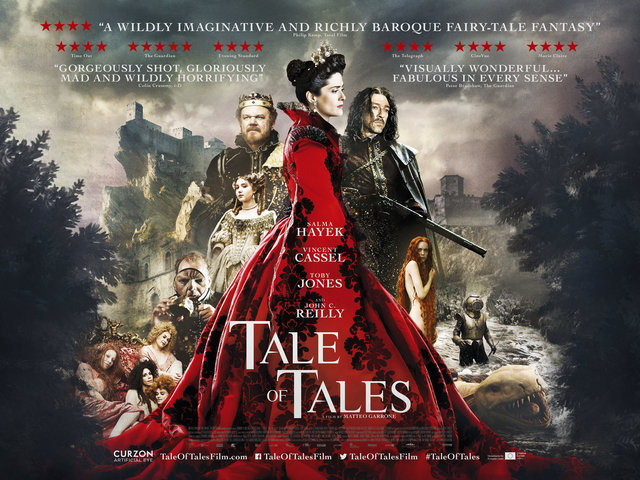
Tale Of Tales

A twisted take on twisted tales

I bloody loved this film. It has everything I love in one place- fairytale s (the dark kind), kings & queens, tricks & spells, deals & plots, oaths & secrets, love & betrayal and tales of the unexpected. It’s all told so well, with so much love and care, with everything looking absolutely gorgeous. Last week I criticized Alice Through The Looking Glass for many things (see my review here)  but the main one was for being a ‘film which feels like it was made by people who read a book called ‘Pretending To Be Weird For Dummies”. Those ‘people’ need to go see this because this is how you do it. If you’re looking for strange, dark and morbidly entertaining tales then look no more!

The Queen of Longtrellis (Salma Hayek) is desperate to have a child but everything she and her husband (John C. Reilly) try fails to work. When a mysterious stranger, a necromancer (Franco Pistoni), visits the castle he offers a risky solution. They need to find a sea monster, kill it and then have its heart cooked by a virgin which the Queen must eat. She will fall instantly pregnant. The necromancer warning that this will be at the cost of a life – a warning the Queen ignores. 

The King of Highhills (Toby Jones) befriends a flea that appears to be able to follow instructions. A friendship soon blossoms and the flea grows and grows. When the now extremely and unbelievably large flea dies the King uses  the flea’s skin as part of a game – whoever can guess the what animal the skin belonged to will get to marry his only daughter. Such a shame for Princess Violet (Bebe Cave) that it’s an ogre who guesses correctly. 

The sex-obsessed King of Strongcliff (Vincent Cassel) hears the voice of an angel whilst prowling his kingdom. He pursues the voice and demands to seduce her, not knowing the voice belong to an elderly woman Dora (Hayley Carmichael) who lives with her equally elderly sister Imma (Shirley Henderson). Dora intends to lead the King along, knowing that she is putting her’s and her sister’s life in danger. A chance meeting with a witch provides her heart’s greatest desire – but is it too good to be true?

That’s only the beginning of each tale. There’s so much more for you to see – so much of which is unexpected, some of which is slightly scary, and all of which is a true pleasure to watch. It’s a feast for the eyes, the brain and the heart. The performances are all solid and utterly believable. There’s depth within each character, a reason and motivation rooted in their decisions. Hayek is stand-out, as is Toby Jones as a man who shifts from arrogance (‘ha ha they’ll never guess what animal it is and I’ll keep my daughter forever’) to devastation (‘Now my son-in-law is an ogre!’) in truly sympathetic manner. Even Cassel’s lustful pursuit manages to be bizarrely sympathetic for all parties involved.

The three tales are interwoven, tentatively linked within the story but fully linked in terms of message. The three tales are based on stories from a 17th Century anthology, they are La Cerva Fatata (The Enchanted Doe), La Pulce (The Flea), La Vecchia Scorticata (The Flayed Old Lady)- but they have been freely adapted with elements of other tales by Giambattista Basile, as well as a touch of artistic license. Although set in a medieval Italy it does feel that their are messages being targeted the audiences today – about consequences of decisions and the nature of family.

The costumes are jaw-dropping, the monsters Kafkaesque, the settings breath-taking, the soundtrack haunting yet never overwhelming and the performances totally memorable. Films like this don’t come around very often so see it whilst you can!

4.5


Love & Friendship

An exquisitely elegant Austen adaptation

Love & Friendship is an adaptation of a Jane Austen novella entitled Lady Susan, written in 1794 but not published until 1871. Almost impossibly for a work by Austen it has never been adapted before. After seeing Love & Friendship the viewer will be left with two thoughts, 1) Why on Earth has such a brilliant story not made it to the screen before? and 2) Thank goodness it hadn’t as that version was absolutely perfect!  Love & Friendship is an absolute treat of a film and a gem of a must-see.

Lady Susan Vernon (Kate Beckinsale) is a widow and notorious flirt. Infamous for her ways of manipulation yet so utterly charming, magnetic and witty that most of society adores her. Seeking refuge after scandalous rumours spread about her private life, about a suspected relationship with married Lord Manwaring (Lochlann O’Mearáin), she arrives at her in-laws relying on their forced generosity. Whilst there she must continue her desperate search to find her daughter Federica (Morfydd Clark) a suitable husband and an even better match for herself. Seduction, deception, broken hearts and lots and lots of gossip ensue. 

There are so many wonderful things to say about this film. The way the story is told is extraordinarily brilliant. Originally an epistolary novella (a story told as a series of letters) writer-director-producer Whit Stillman turns monologues into dialogue with perfection. The editing is what truly makes this a success – hopping between people, places and things – nothing needless is shown and nothing is needlessly reshown. As opposed to an hours-long epic the period drama is reinvigorated with this 90 minute self-conscious comedic romp. The threads are skillfully interwoven with many outcomes that you may surprise and will definitely amuse. The dialogue is wonderfully written, snappy and lively, serving as a great reminder of just how funny Austen was. The fact the film has an age certification of ‘U’ just goes to show how well-written the script is: never have such brutal takedowns been so politely and eloquently written. 

The characterisation is superb with every character, no matter how facetious or self-indulgent, managing to be immensely likeable. Beckinsale as Lady Susan is a revelation –  a character who knows nothing nor cares little for either love or friendship yet knows just how to manipulate other’s feelings about both. Lady Susan’s manipulations are extraordinary and so skillful that you can’t help find her likeable and end up rooting for her.  She’s nasty and self-centered, others distrust of her and resentment of her status is fully understandable as is their envy of her, yet the viewer is spellbound by her. Some of her best moments are when she is scheming with the American Alicia (Chloë Sevigny) when the conversation becomes a biting satire of late 18th Century aristocracy. 

The entire cast are just as brilliant, there are no weak links here, but it is Bennett’s James Martin that almost steals the show. His performance is so earnest and well-meaning as a character who is unable to utter a sentence without creating moments of sheer awkwardness. In a film full of laugh-inducing moments, I don’t think I’ve laughed this often in ages, it is his character who has two of the biggest chuckle/chortle/tear-inducing funny moments, moments which I have been quoting constantly since.

The costumes, sets and visual style are all extraordinary. The entire cast an acting masterclass. A script and storyline that make hilarious an understatement. Easily one of the best films we will see this year (it’s not even June yet). Go see it. Now!

five star

Sing Street

1980s. Dublin. New Romantics.

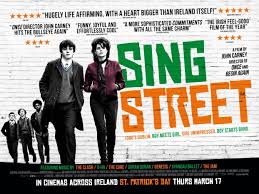
If the prospect of those three words being combined into a film does not fill you with glee I’m not sure how well we’re going to get on or how well you’re going to get on with this film. If you haven’t jumped ship  and are still reading – then this film may just be for you! From John Carney, the writer-director-producer of  Once and Begin Again, comes another musical tale about love and friendship. But this time our main characters are teenagers and they are forming a band The Commitments-style. The result is one of the most rewarding, enjoyable and grin-inducing films of the year so far.

It’s 1985. Like all epic stories it started with money problems and a girl. Connor (Ferdia Walsh-Peelo) is forced to leave his expensive fee-paying school and attend the local state school Synge Street CBS. The family has little money coming in as patriarch Robert (Aidan Gillen) is finding his architecture practice is not really required during a financial crisis. It’s at his new school, well on the school’s doorstep, that Connor first meets Raphina (Lucy Boynton). Raphina is an older lady, one year older, and is the most glamorous/gorgeous/extraordinary woman Cosmo has ever seen. New-found friend and wanna-be entrepreneur Darren (Ben Carolan) explains the school gossip that Raphina is a model who will soon be moving to England to make her fortune. Connor bravely introduces himself to Raphina and offers her a job that weekend to star in his band’s music video. After a bit of charming she agrees to take the job. Except Connor doesn’t actually have a band – yet. With audiophile elder brother Brendan (Jack Reynor) to guide him surely it’ll all be easy, won’t it..?

There are so many reasons to love this film – many of which I don’t want to discuss in too much detail or give away as it’s discovering them for yourself that only add to the brilliance. However I will briefly give the headlines of the reasons for my adoration. For favourite character I am torn between Brendan and bespeckled multi-instrumentalist Eamon (Mark McKenna). The soundtrack will undoubtedly be one of the best of the year – the classics are superbly chosen and the original songs (such Riddle of the Model) are wonderful tributes with some infectiously catchy riffs. The storyline is told with great empathy and sympathy. This is a film that truly cares about its characters. The music videos the band makes are both hilarious and nostalgia-inducing (even for those of us who were not alive in 1985!) I full enjoyed the references to The Cure, Duran Duran and Spandau Ballet to name just three – I can only imagine the depth of the enjoyment for those who leaved and breathed this music scene. The friendship between the newly-formed band is heart-warming and believable thanks to some fantastic chemistry between them. The film also manages to cover lots of ‘big’ topics – mental health, adultery, abuse – sensitively and appropriately. There’s a great balance here between pathos and humour. 

My main criticism would be the treatment of Raphina. Boynton does an excellent job with the material she is given but the presentation/treatment of her character is far too Maniac Pixie Dream Girl. For the most part we only learn about Raphina through what Connor (whom Raphina later renames Cosmo) sees and hears. She doesn’t transcend being his figure of worship and far too much screen time is dedicated to his male-gaze watching her. Whilst the dialogue of most of the characters is rooted in a degree of realism or believability Raphina’s craic is over-rehearsed. Arguably this could be a reflection of her personality as a character but for the most part her dialogue rarely lands as effectively like the other characters. Any film that focuses on a romantic crush, be that of a man or woman, must deal with the universality of the story arc as a duel-edged sword.  Whilst it makes for an accessible storyline, as the majority of the world’s population would have had a romantic crush at some point or another,  it means we then have to believe in the crush and that all the turmoil it brings our lead character is worth it. Is Raphina worth it?

Aside from my ponderings on potentially dubious representation, I truly loved Sing Street. So much so I think a rewatch in the new few weeks will be in order. It tickles the funny bone whilst tugging at the heart strings. It’s an old-fashioned story told with great warmth and will great skill. And, for New Romantics at heart like me, it’s chance to feel immersed in and nostalgic for a lifetime I never lived.

4.5


Our Little Sister

A quietly touching family drama

Our Little Sister is a wonderful example of a sentimental yet ultimately subtle delight of a film. Watching it is a bit like being in a 128 minute-long embrace, warm and imitate with undercurrents of deep emotion. There’s no real melodrama – no dramatic shouting matches, intensive confrontations or shocking revelations – it’s far more real than that. We start the film with the character being total strangers to us then end the film feeling as if we are part of the family.

15 years ago a father left his wife and three young daughters behind. Soon after his heartbroken wife left the daughters in the care of her mother and left the town. 15 years later and the three, now fully grown, receive a phone call that their father has died, leaving behind his 14-year-old daughter who nursed him until the end. The trio – 29 year old Sachi (Haruka Ayase), 22 year old Yoshino (Masami Nagasawa) and 19 year old Chika (Kaho) – travel to his funeral and to meet their little sister Suzu (Suzu Hirose). The girls make an offer to the now orphaned Suzu, that she could come and live with the three of them in their big house in Kamakura. 

What is so effective about this film as it doesn’t require a big overarching plot – there’s no big problem or issue to solve. Instead we watch the three women over a period of about a year as they bond and face different issues within their own personal lives. Days blend into weeks with only a few references to dictate how much time has passed – at one point the three tell their little sister that in six months they’ll be able to undertake the family tradition of making plum wine, later in the film they do so etc. This alone with the absence of a melodramatic narrative instead presents a more realistic portrayal of family life by choosing to instead use what is essentially a series of interconnected vignettes. Each of the girls faces different issues in their lives, typically resulting around love or work, some are returned to and resolved and others are not as they do not need to be.

The film plays a magical spell as you watch it, drawing you into the lives of four young women who are each dealing with the grief of a departed parent in different ways. All four girls are fully sketched out and wonderfully characterised by both positive and negative traits, each as charming at the movie itself. How the story is shown is as extraordinary as it is told, finding beauty in even the smallest of moments – such as the way a plum floats in a jar of plum wine – and within the landscape itself – with the ‘tunnel’ of cherry blossoms being a personal favourite.

Few family-based dramas whisper instead of shout. This is one of them. A film that is quietly powerful and immensely appealing.

4 stars

Marguerite

A tragicomedy filled with laughs and tears

Strangely, and I hate to be one of those people, but I’m going to start of by drawing comparison with this film and Eddie the Eagle . Though this may not initially be an obvious comparison, Eddie is English and obsessed with skiing whilst Marguerite is French and obsessed with opera singing, the overriding link is the very obsession which drives them. Both characters NEED that one activity that makes them feel alive, makes them feel free and makes them feel joy unlike any other. Both are based on true stories, with Marguerite being loosely based on  the life of Florence Foster Jenkins (a Meryl Streep-staring biography is out later this year). The crucial difference, however, is that Eddie could ski and had only practised ski jumping a year prior to entering the 1988 Winter Olympics in Calgary. Marguerite has apparently been singing all of her life and cannot sing. It’s not just that she cannot sing, every single note she produces is so off-key and categorically awful, and she doesn’t even know it. All Margurite knows is the joy she feels when releasing the notes, not the fact they are atonal and truly, utterly dreadful. Her husband and friends, either out of loyalty, shame or amusement have kept the truth from her. This tension leads to the aforementioned tragedy and comedy.

Lucien Beaumont (Sylvain Dieuaide), an infamous newspaper critic, has gatecrashed a party escorted by his Dadaist artist friend Kyrill Von Priest (Aubert Fenoy). His attention is immediately taken by aspiring singer Hazel (Christa Théret) who performs as warm-up to the host. Baroness Marguerite (Catherine Frot) sweeps into the reception room in her large manor home, her room filled with guests for her charity recital. France’s finest and mightest, who all belong to the exclusive Amadeus club which she is a part of, are all there to see her. Marguerite breezes through the room, practically gliding through her audience, escorted by her loyal manservant Madelbos (Denis Mpunga) whilst desperately searching for her husband Georgeos (André Marcon) in the audience. Upon reaching the stage which is filled with her orchestra she turns to face them, her eyes sparkling with sheer and utter joy, her face is set and ready for that first note. Her mouth widens, forming that first note. What comes out of her mouth is unlike anything Lucien has heard before – it’s awful. Marguerite is not singing, she’s screeching, her voice is the embodiment of  nails on a chalkboard or a cat screaming. Unbeknownst to Marguerite children run under tables away from her noise, many of the man sneak into a private room away from the horror. Lucien must restrain himself from laughing, Kyrill believes he has found modernist art  and Hazel tries to hide her embarrassment from the poor woman. Finally Marguerite stops and her audience erupt into applause and admiration, flowers are thrust upon her and her talent is heralded. Lucien is bemused – she clearly does not know as her small aristocratic society has not told her – and feels compelled to write a review which is ladden in euphemism and  backhanded sentiment. Marguerite does not read into it and is filled with joy at having her talent recognised. Events start to spiral, with a public concert planned. How will Marguerite cope when she discovers the truth? 

I should point out that the above paragraph covers roughly the first 15 minutes of the film, leaving a solid 1 and 3/4 for you to discover on your own. I’ve not even discussed the role of the clown and the bearded lady! Marguerite is not always easy to watch, at times her singing or the events that it leads to are utterly mortifying. However it must be acknowledging that the mortification we feel on her behalf  is due to how well the story is told to allow us to connect with Marguerite and possible even empathise with her. It would be so much easier to have a film about a bad singer and laugh at her bad singing. Instead what we have here is so much more complex, layered and pleasurable to watch. We root for Marguerite, we hope for her and we fear for her – whether that be about a performance or comments that are about to be made about her.

Marguerite devoids herself to her craft, she spends everything on collecting props, music sheets, attending performances and supporting new talent. She has an all-consuming need to perform, which leads to unspoken clashes with her seemingly-cold and adulterous husband. Never has a film character been so in need of a hug. There’s something so child-like about Marguerite, something so amusing yet bitterly sad. It’s a true tribute to the talent of the filmmakers and the actress herself that we connect with her the way we do, encouraging her even though we easily recognise how talented she is in her chosen field.  Then somehow, throughout all this, we ultimately feel uplifted watching her journey. We all have something we pursue or like to believe we are really good at, even when we’re not At this point I’m really hoping you’re not thinking, ‘Ha! Yeah you are your film reviews”, but then Marguerite suggests that the opinion that others have about your talent should not be the one that is heralded, it should be your own and how it makes you that counts. And if how I feel about writing these reviews, and you out there hopefully reading them, is only a fraction of how singing makes Marguerite feel then I fully understand her.

It feels too overly simplistic to say this film is painful yet funny or that it is hilarious yet heartbreaking. It’s soul-baring exploration of passion. Exquisite.

Anomalisa


‘What is it to be human?’

Anomalisa is a masterpiece of cinema – a tale about the human condition told by puppets that is the most real movie in years.  We’ve all had awkward encounters – be that with ex-partners, conversations with strangers in a lift or the force-fed wisdom of a brusque taxi driver. We’ve all (hopefully) had a moment where you meet someone who, somehow and somewhere deep inside of yourself, you innately know that ‘this person is important to my future’. Now imagine a film that has the later as its main storyline but is layered with lots and lots of the former. That’s Anomalisa. It’s hilarious and sad at the same time, just like life, whilst reflecting on how bitterly lonely existence can be. Artistic greatness channelled through stop-motion puppetry.

It’s 2005. Michael Stone (David Thewlis), customer service consultant extraordinaire, is travelling to Cincinnati for a convention at which he is due to speak. To Michael everyone else on the planet appears to have the identical voices and faces. He is just spending one night at the hotel before travelling back home to his wife (Tom Noonan) and child (Tom Noonan. He decides that, as he’s in the area and plagued by self-hate, he’ll call up his old flame Bella (Tom Noonan) in the hope that Bella will help him find out what is wrong with him. Things do not go well, but upon retreating to his hotel room he hears a voice that is different from everyone else. He searches desperately and finds Lisa Hesselman (Jennifer Jason Leigh. Michael is instantly enraptured by her different voice and face, desperately hoping that she will cure his crippling loneliness.

This film, written and co-directed by Charlie Kaufman, does not have to try hard to be strange. Everything about it is strange, but that’s not criticism when you really reflect on how strange life often is. The most obvious ‘strange’ aspect is the fact the entire world is only voiced by three people – Thewlis as our lead, Jason Leigh supporting and Noonan as everyone else. Have one actor voicing 98% of this world has the most wondrously bleak effect, allowing for everyone else to blur in the background. They are unimportant therefore there characters are not defined, which is how our protagonist Michael Stone views the world. Few central characters are this self-hating, haunted by guilt and bad memories. Did the voices always sound the same, or has life for Michael etched away its beautiful nuances?

The interactions with both strangers and those who are supposedly the closed to him are all so affecting in there believability – many of them of the concealing-your-eyes-as-you-watch variety. But it is Michael’s interactions with Lisa that are the most beautiful and the most heart-breaking. Lisa is the exact opposite of Michael, Lisa is insecure and desperately lacking in confidence, yet is just as lonely as he is. Lisa is a great admirer or Michael’s and an obsessive reader of his book which helped her increase work ‘productivity by 90%’!  The beginning of their courtship is so tenderly handled, and perhaps the most human we’ll see on the big screen this year. Lisa’s serenading Michael with a cover of ‘Girls Just Wanna Have Fun’ will fill your eyes with tears. The film’s title stems from this point of the movie, when Lisa reveals she has always felt like an ‘anomaly’ which Michael then teams with ‘Lisa’ to form her self-appointed nickname ‘Anomalisa’. This conversation alone personifies their relationship, Michael and the film itself. Is he laughing at her by giving her this name, or showing just how much he understands?

Watching Anomalisa is almost like watching an autopsy or listening to a psychiatrist’s evaluation –   cutting apart our very psychology, our brains and being, then showing us how they work. Like The Matrix it’s up to you whether you take the blue or red pill.

Breathtakingly beautiful and bitter in equal measure; dare you see it?