Our Little Sister

A quietly touching family drama

Our Little Sister is a wonderful example of a sentimental yet ultimately subtle delight of a film. Watching it is a bit like being in a 128 minute-long embrace, warm and imitate with undercurrents of deep emotion. There’s no real melodrama – no dramatic shouting matches, intensive confrontations or shocking revelations – it’s far more real than that. We start the film with the character being total strangers to us then end the film feeling as if we are part of the family.

15 years ago a father left his wife and three young daughters behind. Soon after his heartbroken wife left the daughters in the care of her mother and left the town. 15 years later and the three, now fully grown, receive a phone call that their father has died, leaving behind his 14-year-old daughter who nursed him until the end. The trio – 29 year old Sachi (Haruka Ayase), 22 year old Yoshino (Masami Nagasawa) and 19 year old Chika (Kaho) – travel to his funeral and to meet their little sister Suzu (Suzu Hirose). The girls make an offer to the now orphaned Suzu, that she could come and live with the three of them in their big house in Kamakura. 

What is so effective about this film as it doesn’t require a big overarching plot – there’s no big problem or issue to solve. Instead we watch the three women over a period of about a year as they bond and face different issues within their own personal lives. Days blend into weeks with only a few references to dictate how much time has passed – at one point the three tell their little sister that in six months they’ll be able to undertake the family tradition of making plum wine, later in the film they do so etc. This alone with the absence of a melodramatic narrative instead presents a more realistic portrayal of family life by choosing to instead use what is essentially a series of interconnected vignettes. Each of the girls faces different issues in their lives, typically resulting around love or work, some are returned to and resolved and others are not as they do not need to be.

The film plays a magical spell as you watch it, drawing you into the lives of four young women who are each dealing with the grief of a departed parent in different ways. All four girls are fully sketched out and wonderfully characterised by both positive and negative traits, each as charming at the movie itself. How the story is shown is as extraordinary as it is told, finding beauty in even the smallest of moments – such as the way a plum floats in a jar of plum wine – and within the landscape itself – with the ‘tunnel’ of cherry blossoms being a personal favourite.

Few family-based dramas whisper instead of shout. This is one of them. A film that is quietly powerful and immensely appealing.

4 stars

The Jungle Book

It’s really a Bare Necessity that you see it!

For reasons somewhat unknown and potentially puzzling for many fans, Disney has decided to make a series of live-action versions of their animated classics. Apparently there are even 15 currently being planned. If they are all even half as good as this one then it’s not something to worry over. The Jungle Book (2016) is a marvelously wonderful adaptation that is both true to the original 1968 film yet with enough of its own nuances for a fresh-feel.

Mowgli was only a baby when he was found alone in the jungle by Bagheera the black panther (Ben Kingsley). Bagheera took Mowgli to the group of animals in the jungle who would best be able to care for him and protect him – the wolf pack. Raised by surrogate mother Raksha (Lupita Nyong’o) and pack leader Akela (Giancarlo Esposito) and bought up alongside their wolf cubs Mowgli learns the ways of the wolves, but as he is getting older Mowgli’s (Neel Sethi) progress is starting to lag behind his wolf siblings. One day, during the dry season, all the animals of the jungle are gathered to drink what remains of The Water Truce when Bengal tiger Shere Khan (Idris Elba) makes a reappearance after years away. Shere Khan smells Mowgli’s scent and warns the wolfpack to get rid of him or face the consequences. Bagheera offers to escort Mowgli back to the land of the man but the pair get separated on the journey. A close encounter with an enormous Indian python called Kaa (Scarlett Johansson) leads to Mowgli meeting Baloo the bear (Bill Murray). A true friendship begins to form between them but how long can it last with Shere Khan still desperate to hunt and kill Mowgli?

There are three key things that have been perfected to make this film as good as it is. Hopefully one of the things you noticed as you read the above plot summary is the cast. Firstly, how good is that cast!?! Look at the incredible group of actors that were brought together. Then look individually at each actor and the character they play. It’s not often you get to say that every casting choice is perfect within a movie and it’s something that you can say applies to this film. Kingsley provides the necessary paternal warmth hidden under layers of no-nonsense concern. Nyong’o as Raksha is a wolf fiercely protective and not afraid to speak out when it’s needed. Elba is fantastic, a properly scary villain, who growls around the land. Johansson’s Kaa is suitably seductive and hypnotic. But the award for most outstanding vocal contribution has to go to Bill Murray providing a performance that is un-bear-ably endearing and amusing in equal measure. How young newcomer Neel Sethi manages to hold his own is an incredible feat which he appears to do with ease. Let alone the fact he spends the film acting alongside CGI animals…

Leading to the second area in which this film excels – the visuals. I’m on the fence about 3D usually. After seeing too many films which claim 3d status yet do little to warrant it I tend not to be overly excited when having to choose between 2d and 3d showings.The Jungle Book is the first film in an age where I’ve been so glad I booked that 3d ticket. The depth of the frame, the landscape, the animals fur, the movement of the water and the curse of the red flower. All of these aspects are superbly enhanced by the 3d. Whilst aware of the cost it can add to a cinema visit I would firmly recommend seeing this film in 3d to access the added textures and wondrous depths it provides. The animals themselves are beautiful and almost life-like in how they look and move.I now desperately want to cuddle a baby wolf and sit upon a giant bears stomach as we float through the river.

Thirdly there’s the direction.Director Jon Favreau ensure first and foremost that this is a children’s movie whilst avoiding any pandering or talking down to the children. The film has enough darkness to give it bite – mildly frightening as opposed to truly scary. There’s even a lesson or two to be learned along the way. Unlike the original animation this film is not a musical but two of the classic songs are included – ‘The Bare Necessities’ is sung by Mowgli and Baloo during the aforementioned river floating sequences and Christopher Walken talk-sings his way through ‘Wanna Be Like You’ in such a wonderfully charming yet ultimately threatening manner – that feel like a natural fit as opposed to being shoe-horned in.

This may just be the most enchanting film of the year so far. It’s a marvellous visual spectacle told with wit and warmth. A treat for the eyes, ears and heart.

4 stars


Eye in the Sky

A powerful and reflective examination of the cost of warfare. 

Very few films are this good. It’s well-acted by a truly terrific cast, impeccably shot with a thrillingly taut script. It also poses such incredibly cerebral and difficult questions without copping out and providing easy answers. Then again, war itself doesn’t provide any easy answers.

Colonel Katherine Powell (Helen Mirren) arrives at a military base in Sussex to oversee a high-level mission, to capture Al-Shabaab extremists who are meeting at a safe-house in Nairobi. Jama Farah (Barkhad Abdi) is one of numerous undercover Kenyan field agents on the scene using covert surveillance. In Nevada USAF pilot Steve Watts (Aaron Paul) takes his seat alongside rookie Carrie Gershon (Phoebe Fox) to provide aerial surveillance (the Eye in the Sky). Lt. General Frank Benson (Alan Rickman) arrives at his work, an office in London, taking the seat at the head of a table with members of the government to oversee the operation. What starts of as a seemingly routine capture mission soon becomes deeply complicated when it’s discovered the extremists are preparing to send two suicide bombers into the busy city streets. The only option appears to be to drop a hellfire missile on the safe house, but a little girl is out on the street nearby who would be fatally injured in the process. Those involved are deeply conflicted about what to do, and time is quickly running out.

I do not say this words lightly, but I firmly believe that everyone should see this film. Far beyond the fact that it is superbly acted and written, things I will discuss shortly, few films about war are this suspenseful and affecting.. The very term ‘collateral damage’ is a term complicated enough when you reflect on the fact it is a label used for human beings  caught in the crossfire but having the film truly immersing the audience debate generates a new level of soul searching. This is a genuine nail-biting thriller, with moments of true edge-of-your-seat-ness and wringing your hands in despair.

The cast for this film is awe-worthy and all of their performances justify completely justify that awe. This is one of two posthumous roles for Alan Rickman and serves as a reminder of what a genuine talent we lost this year. His iconic tone and manner are both fully in display here, truly serving his character and the film itself very well indeed. Helen Mirren is wonderful and fully believable as the stoic Colonel who watches her mission escalate from out of her control yet never losing her calm or nerve in the process. Aaron Paul is extraordinary as a man with two years experience in the job who is finally being told to pull the trigger, torn between duty and morality. Barkhad Abdi is one of the characters we know least about yet the strength and depth of his performance allows the audience to truly understand his role in events.

The script, cinematography, sound and performances of Eye in the Sky align to make this easily one of the best movies of the year so far. A riveting, fully entertaining yet equally chilling study of the morality of warfare. The questions it raises are not and cannot be truly answered yet will continue to haunt long after the credits roll.

This needs to be seen by all.

five star

The Huntsman: Winter’s War

A fantasy with just enough farce to make it fun

I doubt there are many people who have spent the past four years desperately counting down until the sequel of the rather mediocre Snow White and the Huntsman. The film was lacking entertainment and personifies Hollywood’s serious issue with getting ‘dark’ confused with ‘murky’ and deeply frowning viewed as the only way to articulate inner torment. Now we have the prequel/sequel sans Snow White aka. Kristen Stewart (after a certain scandal involving the film’s director Rupert Sanders) who realistically is not much of a loss as she spent most of the film biting her lip. A new threat befalls the kingdom and the Huntsman is called in to help, after we learn more about his mysterious backstory.

Many years ago evil queen Ravenna (Charlize Theron) murdered her way through the land to rule the kingdoms, with her powerless sister Freya (Emily Blunt) by her side. Freya falls in love, something her sister is against as love is a foolish distraction, and has a daughter. When tragedy strikes Freya’s powers are activated (think Elsa-from-Frozen-type powers) and she moves away to take control of her own land. She decides that she must have her own unique army and orphans the children of a village. The children are brought to her castle and taught the one commandment of her rule, that love is a sin. Years pass as the children are trained and moulded into true Huntsman but two children, her two best, break her one rule and fall in love. Eric (Chris Hemsworth) and Sara (Jessica Chastain) marry and try to flee but are caught in the process. Freya the Frost, as she is now known, places a great wall of ice between the pair to separate them. Sara appears to be murdered and Eric is thrown into a nearby river to be swept away. Seven years later, after the events of the previous film when Snow White killed Ravenna, Eric is called on by Snow White’s close friend William (Sam Claflin) to stop the Mirror being intercepted by Freya. 

You do not go into films like this with a closed mind. They require a deep suspension of disbelief, with any concepts of logic or reason needing to be locked away for 114 minutes. If you do this you will find this film to be a serviceable and entertaining lark. It would be easy to list all of the flaws within this film but doing so would ignore how relatively entertaining it is.The script is truly mediocre, full of boulder-sized clunky exposition and mawkish sentiments. In fact a bingo or drinking game could be formed based on all the lines/phrases that are uttered about love (‘love is a sin’ ‘love doesn’t conquer all’ ‘love is not a fairytale’ ‘you reek of love’ etc.) There’s a line about wet-never regions which shows how uncertain the filmmakers are about who their audience actually is.  Liam Neeson is on needless and grating omniscient narrator duties.

If you can ignore that, which I know is asking for rather a lot, what is left is a host of charming performances going above and beyond to make the lifeless script fun. Chastain is a fantastic new addition, being far more kick-ass than her running in heels stint in Jurassic World. Hemsworth is as charming as we now expect from him, mugging about and having fun. I doubt there is little I wouldn’t watch if he was in it. Blunt and Theron are solid and borderline-stirring in their villainous portrayals, making some truly dreadful lines sound half-way believable.  Complex issues aside about people playing dwarves the four dwarves who aide the Huntsman on his journey (Nick FrostRob BrydonAlexandra Roach and Sheridan Smith) are great fun and a joy to watch.

It’s not going to win any awards and will most likely be forgotten by the end of the month. It also does not deserve nor need a sequel (instead I would propose a new series called ‘Let’s watch Chris Hemsworth do things’ where we watch Hemsworth do a variety of activities and charm us all). BUT, it is an entertaining enough farce with just enough camp and laughs to fill a dull afternoon/evening.

 2 stars

Victoria

A true feat of film-making. Truly extraordinary.

To put it simply, a ‘take’ refers to the period between a director saying ‘action’ and ‘cut’. It’s up to them or the cinematographer how long this period is. Typically the longer the take the more difficult the film-making process is as it requires actors to be in the right place, saying the right lines, nothing else interrupting the shot etc. Alfred Hitchcock experimented with this in 1948 making Rope which clocked in at 80 minutes and comprised of only 10 takes, the majority of which were shot in such a way to make the cuts seem seamless. It was an ambitious project which paid of in most regards, the murder and the main characters fear of being caught out in only heightened by the prolonged takes. The character cannot escape and neither can the audience. 68 years later we have Victoria which was filmed two years ago and rejected by many of Europe’s film festivals as they believed the filmmakers were lying on the submission sheet. What lie did they think the filmmakers were proclaiming? Well the film-makers claimed that Victoria, which is 2 hours and 18 minutes long, was shoot using only one take. The most unbelievable thing about this? It’s the truth.

Victoria (Laia Costa) moved from her hometown of Madrid to Berlin three months ago. She works in a coffee shop for less than minimum wage and doesn’t really know anyone in her new city. In the hours before her early morning shift she decides to go clubbing and dances alone quite happily. On her way out of the club she bumps into a group of four men – informal group leader Sonne (Frederick Lau) who Victoria feels an instant spark with, Boxer (Franz Rogowski), Blinker (Burak Yigit) and Fuß (Max Mauff) – who promise to show her ‘real Berlin’. Victoria agrees and what first follows is a fun night for Victoria, seeing parts of Berlin she had never seen before and connecting quickly with Sonne. When Boxer receives a phone call and claims that the group need Victoria’s help.  It is her connection with Sonne that prompts her to make the first in a series of bad decisions and things take a dark turn before spiralling out of control.

I repeat. The entire film is only one take long. It cannot be overemphasised how incredible this is, what a triumph of filmmaking it is and what an astounding experience of film-watching it creates as a result. It’s breath-taking, wondrous, exhilarating and utterly compelling. As it is shot though one-take it is shot in real-time. This is important to note as it adds to the authenticity, we watched events play out and escalate. We cannot question how we got from the first frame to the last as we witnessed very moment and decision which lead the characters there. And these moments don’t just take place in one room – the characters travel all over the city, up ladders, jammed into cars and lifts, dancing across the street and running across it too – and the camera is always there watching and following. Incredibly this also manages to feel gimmick-free. Instead we feel like we’ve tagged along for a night out, been immersed in the spontaneity and intensity of this world, then kicked out of the club  and ditched at the end of the film. There is a reason that the cinematographer Sturla Brandth Grøvlen receives first credit ahead of director and writer Sebastian Schipper as Victoria is an example of true technical mastery. The camerawork is dazzling ambitious, pulsating and gripping.

The performances are mostly improvised, which only adds to the feeling of authenticity and believability. This is next level realism as we get to experience this world as it happens. It’s a huge credit to the relatively inexperienced cast that they only had to shoot the film three times, this being version two. It’s only after seeing the film, when you see what they had to achieve and endure, that you can truly appreciate the level of skill being utilised here.

It’s divine. A sensational watch. It needs to be seen.


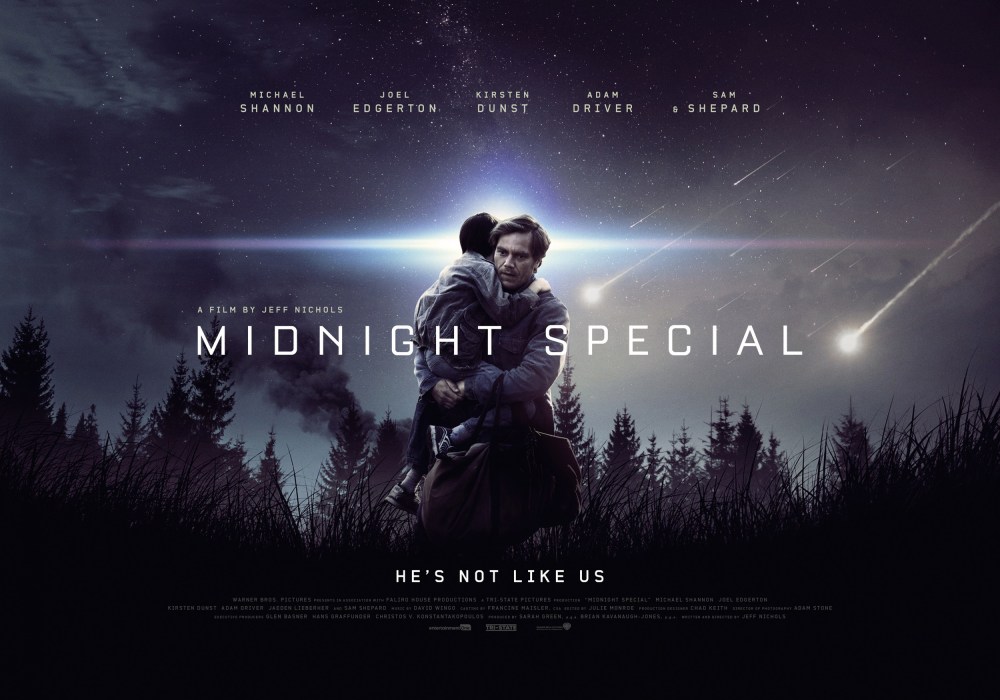
Midnight Special

Messiah or weapon? Or something else entirely?

Imagine a science fiction movie that focuses less on the fictional powers and more on the human emotions, the cost behind the power. Imagine a science fiction movie that allows you to marvel at the mystery rather than hand-feed you the plot. Imagine a science fiction movie that is a road trip/chase movie that challenges the value of belief. Now stop imagining as Midnight Special is all three of those things and much more. It is a wonderfully strange blend of genres, full of complexity and sentiment. A parable about love and extraordinary ability.

Roy (Michael Shannon) and his eight-year-old son Alton (Jaeden Lieberher) are on the run from both the government and religious extremists. Alton appears to possess special abilities, from being able to effortlessly infiltrate classified government signals  to bringing down a satellite from outer-space. A religious cult formed around Alton who, as National Safety Agent Paul Sevier (Adam Driver) discovers,  turned his encoded words into gospel. His supernatural powers so badly altered by daylight that all of the cult  became nocturnal. Upon making eye contact with people Alton’s eyes glows and show visions of unknown lands. Having fled the cult, and with the help of childhood friend Lucas (Joel Edgerton) and Alton’s mother (Kirsten Dunst),  Roy must get Alton to specific location for a specific time. Will, as everyone fears and some hope, a celestial and world-changing event take place? 

This is not your typical science fiction film. Compared to typical box office fairings Midnight Special is slow, with far more questions than answers, and a narrative that is impossible to stay ahead of. Those are not criticisms, just an acknowledgment that this film is not for everyone. In the preview screening I attended yesterday many of the audience members seemed frustrated or unfulfilled by the film. I was not in agreement with them for the film I had just witnessed was so riveting and magical. Rarely is science fiction this personal and emotive. Yes, a beginners guide to film criticism will show  you that Steven Spielberg’s films are about father-son relationships,  but what we see here is a different realm. What director and writer Jeff Nichols manages to achieve is a film which places greater emphasis of the consequences of supernatural power rather than the benefits of it, prompting the reflection that more is lost than gained in such extraordinary circumstances. Few storytellers are this damn magical.

The acting by the entire cast is wondrous, each cast member providing a wondrous blend of awe, fear and honesty. Roy’s love for his son is so deep and unconditional, a level of paternal concern rivalling that of great Epics. Lieberher’s performance here suggests that Room child star Jacob Tremblay may have a rival for Hollywood’s current greatest child actor. Egerton’s performance allows us to give loyalty to a character we know little about, believability to a man who has only known Alton for three days but is willing to give everything to the boy’s journey. Dunst is subtle yet heartbreaking as a mother who fears she will have to give up her son once more.

The cinematography is marvellous, as is the soundtrack and the storytelling. Of particular favourite is the Easter Egg of the Superman-starring comic book that Alton is reading in the back of the car. Any in depth analysis of the parallels between Superman and Alton would be spoilerific, but the very fact both are outsiders with great power is a wonderfully subtle touch. Just like the entire film it’s an allusion to other sci-fi works, but something that is so uniquely individual and riveting.

Some may say slow. I say spellbinding, sincere and utterly superb.

Disorder

An intense and intimate voyeuristic thriller

How many films are there that feature a character with PTSD (post-traumatic-stress-disorder)? Then, let’s narrow it down, how many of the those films are about PTSD sufferers who fought in Afghanistan?  Finally, how many of those films use the PTSD to shape the storytelling process, making the story as unreliable as it’s narrator? I suspect that Disorder may be alone in this regard which makes for a mostly refreshing if at times nerve-splintering film-watching experience.

Vincent (Matthias Schoenaerts ) is a French Special Forces soldier who is currently back from a tour of Afghanistan. His latest health check-up indicates that it will be his last as due to his various  health problems his doctor will not be recommending him for service, something that he appears to be in denial about. He and a group of his friends are hired by Jessie (Diane Kruger), the wife of a rich Lebanese  businessman, to provide security at a party they are holding at her villa. Vincent starts to develop a strange fascination with Jessie, whilst at the same time starting to suspect a dangerous threat is going to target her and her young son, and he begins to be consumed by paranoia. Is there really a threat, or is it a result of his disorder?

A month ago, in my review for A Bigger Splash I talked about Matthias Schoenaerts and said “He is currently one of the most interesting and underappreciated supporting actors in cinema at the moment, and I greatly look forward to seeing more of his (admittedly rather beautiful) self.” After seeing Disorder, I stand by what I said. Schoenaerts carries this movie, his scowl/brooding combination is utilized to excellent effect. His mannerisms subtly display his inner turmoil, he never needs to clearly state ‘I am suffering from PTSD’ (in fact that is something his character who never admit) but it’s clear from every single scene that this is a man who is suffering. Vincent’s innate paranoia served with a side of voyeurism makes for an unnerving central character who is haunted but hunky. In fact whilst watching his performance I remembered some of the minor backlash that James Norton received for Happy Valley with a (thankfully small  minority) saying that he was ‘too good-looking to be a murderer’. It’s a stupendously flawed logic to have, implying that attractiveness and committing crime share a correlation. Yes Schoenaerts is attractive, but that does not enhance nor detract from his performance here. His performance is wonderful, if that adjective can be used to describe something so unsettling, and the best thing about the film.

A close-tied second place would be the soundtrack and the cinematography. The former is throbbing, jarring and frequently atonal (like Vincent’s mental state) whilst the latter is ambiguous, swamped by shadows and at times unhinged (again like Vincent’s mental state). Aside from these aspects, the film itself is rather slow with a rather porous plot that fizzles out. Worth seeing for Schoenaerts latest in an uninterrupted run of solid and charismatic performances, but rather forgettable.

An outstanding central performance in a good/mediocre film. Don’t put it too high on your ‘must-see list’ but worth a try.


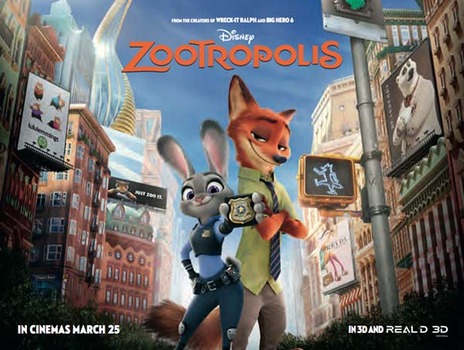
Zootropolis/Zootopia

We may be evolved, but deep down we are still animals.”

Anthropomorphism, Disney and animation have a long history. As early as Walt Disney’s first feature film Snow White (1937), in which all the woodland creatures appeared to have various personality quirks, attributing human characteristics to cartoon animals has been a way of enhancing a story. Then, with numerous Disney classics, it became the way to tell a story. In 1995, with Toy Story, Pixar began to add to the Disney magic by giving characteristics along with pathos to the inanimate objects and animals. Now, in 2016, with Zootropolis (released nearly everywhere else as Zootopia) we see this enhanced to the max with an animated film that features anthropomorphism whilst also serving multiple layers about diversity and racism, all told by Disney with just a smidge of Pixar wit. It’s funny, sweet and far deeper than it first appears.

During a school play in front of her parents, her peers and their parents, a young bunny called Judy Hopps (Ginnifer Goodwin) declares that when she grows up she wants to be a police officer. Many people laugh at her, one person even beats her up for the audacity of saying it and both her parents are a blend of supportive-but-unsure. But Judy proves them all wrong.  She’s the first bunny first to enter the police academy and the first bunny to actually join the police force. Her first posting is Zootropolis, a nearby metropolitan city. Her parents can’t believe it and neither can her new boss, an African buffalo by the name of Chief Bogo (Idris Elba), who assigns her the role of parking duty. Day one on the job seems to be going well, until she is tricked by con artist fox Nick Wilde (Jason Bateman). However the two are soon forced to work together by Mayor Lionheart (J.K. Simmons) and assistant-mayor Bellwether (Jenny Slate) to help solve a case involving a series of missing animals. Can what were once predator and prey ever work together, possibly even become friends, or is nature stronger that nurture?

It may be slightly too early to say, but Zootropolis has all the potential to be as-well regarded both critically and commercially as last year’s Inside Out. The jokes are really really funny and the drama is really really emotional. My personal favourite joke from the film has to be when fellow police officer Clawhauser (Nate Torrence) first meets Judy Hopps and calls her ‘cute’. Judy winces then carefully explains that “only a bunny can call another bunny cute”. Cue many belly laughs from the cinema screen. That gag is also an example of the kind of humour that has become prevalent in animation since Shrek (2001). The humour of these animations is almost two-layered. To explain on a very basic level, there’s the slapstick jokes for kids and the jokes for their parents that go way over their heads. It makes taking a child to the cinema a far more enjoyable experience for their parents, as opposed to having to endure some brain-dead-only-aimed-at-children romp.

The animals are very well characterised, both matching their animal types whilst also being well-rounded. Judy is fierce, dedicated and ambitious – a solid role model. Nick the fox is sly and alarmingly charming for a fox, though that may just be my personal feelings for Jason Batemen having an effect here… Idris Elba is hilarious as the imposing yet ultimately caring chief who just happens to be a buffalo. Shakira even appears as Zootropolis’ biggest star, Gazelle.

Then there’s the story itself, well-told with a solid twist. There are some fantastically inventive set pieces, be that the sloths working at the DMV or the practically word-for-word Godfather tribute. The story also has a lot you can sink your teeth into (sorry, pardon the pun!) Though the two groups of predator and prey may appear united in the metropolitan city of Zootropolis, it is a delicate union. One which is weighed down by tension and borderline-hostility. Although prey and predator may be neighbours very few are actually friends and few would choose even to be nice to each other. Some restaurants even refuse to serve certain types of customers. When it becomes clear that all the missing animals in the case are in fact predators it looks set to force the bubbling undercurrent of tension to the surface. The film is far from subtle in reflecting our own society’s tensions and forcing a degree of reassessment, yet that is no criticism. Considering the current global climate, with regards to refugees and a certain toupee-wearing president wanna-be whose delusions of grandeur reveal the current state of institutional racism, Zootropolis is perfectly-timed and well in need of watching.

This is ‘proper’ Disney with the beating heart and talking mouth of Pixar. Witty, warm and well worth seeing. A fable for 2016.

Anomalisa


‘What is it to be human?’

Anomalisa is a masterpiece of cinema – a tale about the human condition told by puppets that is the most real movie in years.  We’ve all had awkward encounters – be that with ex-partners, conversations with strangers in a lift or the force-fed wisdom of a brusque taxi driver. We’ve all (hopefully) had a moment where you meet someone who, somehow and somewhere deep inside of yourself, you innately know that ‘this person is important to my future’. Now imagine a film that has the later as its main storyline but is layered with lots and lots of the former. That’s Anomalisa. It’s hilarious and sad at the same time, just like life, whilst reflecting on how bitterly lonely existence can be. Artistic greatness channelled through stop-motion puppetry.

It’s 2005. Michael Stone (David Thewlis), customer service consultant extraordinaire, is travelling to Cincinnati for a convention at which he is due to speak. To Michael everyone else on the planet appears to have the identical voices and faces. He is just spending one night at the hotel before travelling back home to his wife (Tom Noonan) and child (Tom Noonan. He decides that, as he’s in the area and plagued by self-hate, he’ll call up his old flame Bella (Tom Noonan) in the hope that Bella will help him find out what is wrong with him. Things do not go well, but upon retreating to his hotel room he hears a voice that is different from everyone else. He searches desperately and finds Lisa Hesselman (Jennifer Jason Leigh. Michael is instantly enraptured by her different voice and face, desperately hoping that she will cure his crippling loneliness.

This film, written and co-directed by Charlie Kaufman, does not have to try hard to be strange. Everything about it is strange, but that’s not criticism when you really reflect on how strange life often is. The most obvious ‘strange’ aspect is the fact the entire world is only voiced by three people – Thewlis as our lead, Jason Leigh supporting and Noonan as everyone else. Have one actor voicing 98% of this world has the most wondrously bleak effect, allowing for everyone else to blur in the background. They are unimportant therefore there characters are not defined, which is how our protagonist Michael Stone views the world. Few central characters are this self-hating, haunted by guilt and bad memories. Did the voices always sound the same, or has life for Michael etched away its beautiful nuances?

The interactions with both strangers and those who are supposedly the closed to him are all so affecting in there believability – many of them of the concealing-your-eyes-as-you-watch variety. But it is Michael’s interactions with Lisa that are the most beautiful and the most heart-breaking. Lisa is the exact opposite of Michael, Lisa is insecure and desperately lacking in confidence, yet is just as lonely as he is. Lisa is a great admirer or Michael’s and an obsessive reader of his book which helped her increase work ‘productivity by 90%’!  The beginning of their courtship is so tenderly handled, and perhaps the most human we’ll see on the big screen this year. Lisa’s serenading Michael with a cover of ‘Girls Just Wanna Have Fun’ will fill your eyes with tears. The film’s title stems from this point of the movie, when Lisa reveals she has always felt like an ‘anomaly’ which Michael then teams with ‘Lisa’ to form her self-appointed nickname ‘Anomalisa’. This conversation alone personifies their relationship, Michael and the film itself. Is he laughing at her by giving her this name, or showing just how much he understands?

Watching Anomalisa is almost like watching an autopsy or listening to a psychiatrist’s evaluation –   cutting apart our very psychology, our brains and being, then showing us how they work. Like The Matrix it’s up to you whether you take the blue or red pill.

Breathtakingly beautiful and bitter in equal measure; dare you see it?

High-Rise

‘Where are those happy days, they seem so hard to find.”

41 years after its publication, J. G. Ballad’s High-Rise proves itself to be scarily accurate in its predictions of the then-future and our now-present. The film adaptation is equally brutal and dark, tinted with the blackest of humours. Deciding to set it in the time period in which it was written, director Ben Wheatley succeeds in using Ballad’s bleak hypothesises of societal hierarchy to transform the big screen into a mirror reflecting our darkest innermost fears. This review comes from the preview screening and Q&A session I attended at the British Library (Hello to Galia, Alison and Alex…)

London. 1975. Dr Robert Laing (Tom Hiddleston), a psychologist, movies into a high-rise building having been seduced by the lifestyle it would bring with it. The building itself is isolated from the rest of London and is so self-contained with a supermarket, gym and swimming pool that, aside from work, there is little reason for the residents to leave. They are cut off from the rest of society in their luxury tower block. The higher your floor the higher your status – Laing takes up residence on floor 25, his new friend Charlotte Melville (Sienna Miller) is on floor 26 and the architect of the building, Anthony Royal (Jeremy Irons) and his wife Ann (Keeley Hawes), take up the entire top floor. Laing also comes into contact with a family relegated to the second floor, BBC documentary-maker Richard Wilder (Luke Evans), his heavily pregnant wife Helen (Elisabeth Moss) and their two children. When Wilder becomes so embittered by the social hierarchy he decides it will be the focus of his next project. A dangerous situation develops causing a domino effect which leads to the fragmentation of the residents and formulation of violent tribes.

Where to start when reviewing this film? It’s excellent, terrific and truly haunting in equal measures. Like many of Ben Wheatley’s films High-Rise is of the ‘well-that-escalated-quickly’ genre. However, this film does not require a suspension of belief for the dissention into madness. Whilst accelerated the resulting horrors stems from social resentment that has been apparent since time immemorial. History showcases time and time again society’s that form then self-destruct that little exposition is required in High-Rise to explain why things get so bad so quickly (not that I can really imagine Wheatley wanting to spoon-feed us in this way). The script is bitterly funny, laden with comments that are iceberg-en in terms of depth. Social commentary is rarely this sharp-tongued, appalling yet absurdly funny.

Wheatley doesn’t waste a shot in the telling of this story; countless viewings would be required to access even half of the detail and imagery it possesses. And practically every shot could be printed out as a still and put on a wall, for the cinematography and mise-en-scene is otherworldly in its beauty. There’s the generic, unbranded supermarket made of quadrilaterals in primary colours, the kaleidoscopic parties of the various factions, the riding of a white house across the luminescent greenery of the rooftop garden and the seemingly innocent shades of grey of a certain floor 25.The blend of lighting and framing makes for sequences that are fraught, depraved and agitating. This is only exasperated by the incredible soundtrack, with two appearances of ABBA’s ‘S.O.S’ (hence the subheading of this review) that bring chills in way that one would never have though possible. At one point the BAFTA award makes a cameo, which Wheatley later explained he chose to include as it ‘would be the closest he’d ever get to an actual BAFTA’. It would be an utter travesty if for visuals and soundtrack alone High-Rise is not recognised and justifiably awarded.

Speaking of awards, there’s then the performances of the cast. Hiddelston as Dr.Laing, a self-contained possessor of wide-eyed optimism and underlying volcanic rage, is a match made in heaven. Wheatley spoke of his having Hiddelston’s ‘photo on the fridge’ during pre-production and casting as they (they being Wheatley and wife Amy Jump who wrote the script) viewed him as the perfect candidate. But, whilst Moss, Miller, Hawes and Irons are all good in equal measure it is Luke Evans performance that is stand-out to that of Hiddelston’s. If Laing is untapped rage cloaked in a suit, then Evans as Wilder is the untamed man. Evans must have come close to the edge in making this film, for his character is a powerhouse of bitterness and injustice whose raging against the machine is awash with inevitable destruction.

With so many reasons to see High-Rise; the performances, the script, the visuals are just three broad reasons which should justify you’re purchasing a ticket upon the film’s release next week.

Go see it and be haunted for days afterwards.