Elvis & Nixon

Yep. Actually a true, and very funny, story.

Upon seeing the trailer you may have felt a ‘Woah, that’s weirdly brilliant!’ feeling. That feeling lasts the entirety of watching the film itself.  The meeting of two of America’s then most famous/infamous men did actually occur in 1970. In many ways the men were actually quite simillar, seemingly rooted by their conservative values and working class upbringing. Yes, Elvis was the hip-swinging, gyrating King of Rock’n’Roll and Nixon was, well, Richard Nixon. but they did have some shared interests. Or, at least, Elvis thought they did and desperately pursued a meeting with the then President of the United States. The film follows Elvis on his quest and the subsequent meeting, to much audience amusement.

1970, Graceland.  Elvis Presley (Michael Shannon) is watching television on his three television screens. He isn’t happy at what he sees. He sees lots of drugs, lots of protest and lots of unnecessary deaths. He decides that he can do something about it, using his celebrity for good and decides to become an undercover agent in the Bureau of Narcotics and Dangerous Drugs. He just needs to meet with President Nixon (Kevin Spacey) first to get it all organised. Luckily he’s got friends Jerry (Alex Pettyfer) and Sonny (Johnny Knoxville) to do that. Nixon’s underlings Krogh (Colin Hanks) and Chapin (Evan Peters) are more than keen, but it looks like their boss will need a lot of persuading. 

The film uses the seemingly unlikeliness of the situation/s to advantage. Quite often (arguably too often) the laughs arise from the ‘No way! I don’t believe it.’ school of comedy. Yet that isn’t such a bad thing when you look at just how good the source material and it’s adaptation to screen is. The gags are good, well written and paced and told with great delivery.

I am a huge fan of Michael Shannon (Midnight Special was an underrated gem, click here of review) and he soars in this comedic-yet-not-really-comedic role. At times I had to remind myself I wasn’t actually watching Elvis Presley, not necessarily due to his look but due to his personality, exuding the aura and charisma of one of music’s true greats.

What helps is the film’s moments where he interacts with us mere mortals. The expressions of those he comes across, the mystification and disbelief, do not get old or less funny. His foe-turned-friend Nixon, as played by Kevin Spacey, also creates a truly memorable and hilarious persona, behaving in a way that certainly seems Nixon-esque. Shannon does steal the show though with the best lines and the fact he can truly pull of huge medallions and a massive gold belt.

The film also utilizes its supporting cast to great effect. I loved both Peters and Hanks as the acting-older-than-their-age young suits, their scenes with Spacey were standout. I also rather enjoyed an unrecognisable Knoxville in his brief but memorable role as Elvis’s close friend. Pettyfer, as Elvis’s BFF, was the only disappointment. He should have been a character played with warmth and wit. Instead he was a bit of a charisma vacuum.

All in all, Elvis & Nixon is fun to watch based on a true story movie that is more than a little bit amusing. Worth a watch.

stars

Love & Friendship

An exquisitely elegant Austen adaptation

Love & Friendship is an adaptation of a Jane Austen novella entitled Lady Susan, written in 1794 but not published until 1871. Almost impossibly for a work by Austen it has never been adapted before. After seeing Love & Friendship the viewer will be left with two thoughts, 1) Why on Earth has such a brilliant story not made it to the screen before? and 2) Thank goodness it hadn’t as that version was absolutely perfect!  Love & Friendship is an absolute treat of a film and a gem of a must-see.

Lady Susan Vernon (Kate Beckinsale) is a widow and notorious flirt. Infamous for her ways of manipulation yet so utterly charming, magnetic and witty that most of society adores her. Seeking refuge after scandalous rumours spread about her private life, about a suspected relationship with married Lord Manwaring (Lochlann O’Mearáin), she arrives at her in-laws relying on their forced generosity. Whilst there she must continue her desperate search to find her daughter Federica (Morfydd Clark) a suitable husband and an even better match for herself. Seduction, deception, broken hearts and lots and lots of gossip ensue. 

There are so many wonderful things to say about this film. The way the story is told is extraordinarily brilliant. Originally an epistolary novella (a story told as a series of letters) writer-director-producer Whit Stillman turns monologues into dialogue with perfection. The editing is what truly makes this a success – hopping between people, places and things – nothing needless is shown and nothing is needlessly reshown. As opposed to an hours-long epic the period drama is reinvigorated with this 90 minute self-conscious comedic romp. The threads are skillfully interwoven with many outcomes that you may surprise and will definitely amuse. The dialogue is wonderfully written, snappy and lively, serving as a great reminder of just how funny Austen was. The fact the film has an age certification of ‘U’ just goes to show how well-written the script is: never have such brutal takedowns been so politely and eloquently written. 

The characterisation is superb with every character, no matter how facetious or self-indulgent, managing to be immensely likeable. Beckinsale as Lady Susan is a revelation –  a character who knows nothing nor cares little for either love or friendship yet knows just how to manipulate other’s feelings about both. Lady Susan’s manipulations are extraordinary and so skillful that you can’t help find her likeable and end up rooting for her.  She’s nasty and self-centered, others distrust of her and resentment of her status is fully understandable as is their envy of her, yet the viewer is spellbound by her. Some of her best moments are when she is scheming with the American Alicia (Chloë Sevigny) when the conversation becomes a biting satire of late 18th Century aristocracy. 

The entire cast are just as brilliant, there are no weak links here, but it is Bennett’s James Martin that almost steals the show. His performance is so earnest and well-meaning as a character who is unable to utter a sentence without creating moments of sheer awkwardness. In a film full of laugh-inducing moments, I don’t think I’ve laughed this often in ages, it is his character who has two of the biggest chuckle/chortle/tear-inducing funny moments, moments which I have been quoting constantly since.

The costumes, sets and visual style are all extraordinary. The entire cast an acting masterclass. A script and storyline that make hilarious an understatement. Easily one of the best films we will see this year (it’s not even June yet). Go see it. Now!

five star

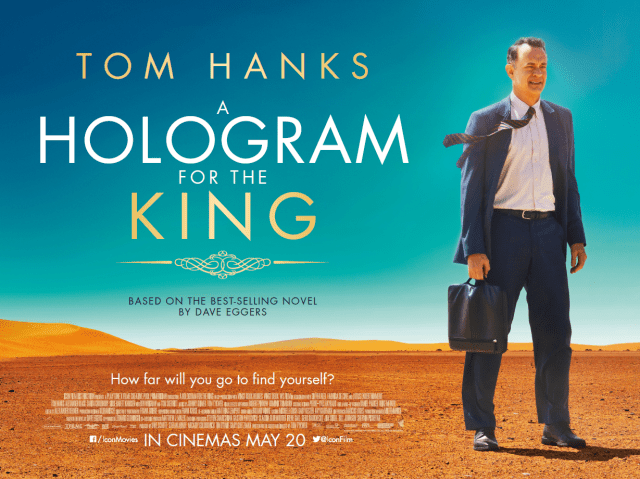
Hologram for the King

A film that seems as lost as its main character

It is a fact universally acknowledged, that Tom Hanks is watchable in anything. He’s one of the great stalwarts of Hollywood – an actor who the audience can rely on for a great movie. Aside from regular debates with my younger brother on Forest Gump (he’s pro and I’m anti – a debate which should hopefully finally be settled when we watch it together during the Summer) Hanks has had an incredible career littered with successes. His last release Bridge of Spies, directed by fellow great Steven Spielberg, led to a spectator experience equivalent to sitting in a really comfy leather armchair. Safe, secure and captivating. This film? He’s the best thing in it.

American Business man Alan Clay (Tom Hanks) was once on top of the world, CEO of Schwinn bikes – the bikes that every kid in America wanted to own. Now he’s a washed-up IT salesman who has been sent to Saudi Arabia to secure a contract with the King of Saudi Arabia for his massive new complex. Alan’s boss has made it clear that this is his last chance with the company, everyone is relying on the huge contract and if he doesn’t secure it then he’s out. Running late on day one due to jet lag he’s provided with a driver called Yousef (Alexander Black). Arriving on site it is clear that things are not as clear as they appeared back in America, with the complex nowhere near being completed.. Things begin to spiral for Alan and his health appears to be suffering, which is how he comes into contact with Dr Zahra (Sarita Choudhury). In a foreign country with a culture hugely different to his own how is Alan supposed to cope, let alone sell a contract to an absentee monarch? 

“And you may find yourself living in a shotgun shack /And you may find yourself in another part of the world/ And you may find yourself behind the wheel of a large automobile/ And you may find yourself in a beautiful house, with a beautiful wife/ And you may ask yourself/ Well…How did I get here?” The film starts of with Hanks reciting these lyrics to the epic Talking Heads ‘Once in a Lifetime‘ accompanied with a short montage which alludes to Alan’s current state of well being (read: not good). It successfully sets up the tone that will fellow, of quirk and occasionally surreal.  It’s one of the best bits of the movie, a high that it struggles to replicate. For a film that is essentially about a man having a mid-life crisis the film itself also lacks an identity. It’s not a comedy nor is it a drama.

There are too many allusions to some BIG topics – Saudi Arabia’s view on women’s rights, conflicts within the country and offshoring of industry – that prevent the film from being feelgood. Yet the film seems to desperate to provide a positive message that it tries to either ignore or forget about these features. The cast are all fantastic with the material they are provided with, all three main characters are memorable and well-rounded. Alan’s burgeoning friendship with Yousef and his budding romance with Zahra are joyful to watch. Both dynamics are sweet, endearing and rather believable considering the circumstances.

However Alan’s storyline about his business contract is less successful and his relationship with his daughter is also underdeveloped. The film also attempts then appears to shy away from making comments on the previously mentioned BIG topics. Instead of allowing them to provide a degree of darkness to the story they are treated as some sort of distraction. A sequence which in the space of less than 30 seconds sees Alan observe great poverty and then great wealth deserved to have been treated with more comment or reflection as opposed to metaphorically being pushed under the carpet. The best way to describe this film it that it’s like eating salted caramel – at times it’s sweet and at times it’s savoury – yet when you’re finished it doesn’t want to leave that as an aftertaste. It wants to wash it away with saccharin and a tacked-on ending. It’s as if the film-makers decided from the outset the ending they wanted – one about new beginnings, fresh starts and eternal hope –  and chose to  ignore anything that has gone on before that contradicts it.

The film itself is a fine enough watching experience. Hanks is typically cast as the American Everyman. It’s good to see him tackle something darker and with anxiety. Yet the film itself is rather bland, pleasant enough yet nowhere near his most memorable film.

2.5

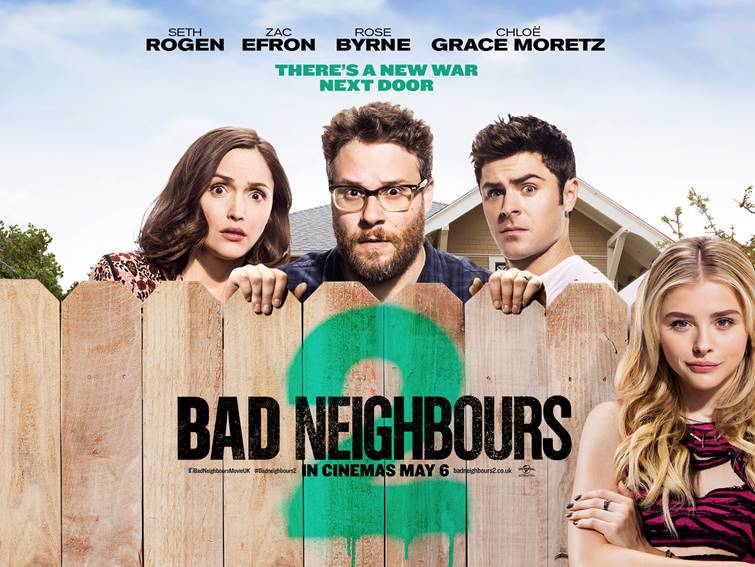
Bad Neighbours 2

A surprisingly knowledgeable and at times rather progressive comedy

It started with a tweet. On Thursday evening movie magazine Little White Lies tweeted about its review for Bad Neighbours 2. The review as written by Elena Lazic with  the tweet reading ‘I went long on the unexpectedly progressive, feminist and funny Bad Neighbours 2’. Now, as anyone who knows me, that’s the kind of click-bait that gets me hooked into reading. The review itself is wonderfully written – very reflective and articulate. Hopefully this review lives up to the one that inspired the film-watching and subsequent review! Post-watching I firmly agree with Miss Lazic’s review – for Bad Neighbours 2 is full of surprises. Most of them good and approvingly well-informed of gender politics.

Mac Radner (Seth Rogen) and his wife Kelly (Rose Byrne) are expecting their second daughter so decide to put their house on the market and move into the suburbs. A married couple with a young child place an offer putting the property into escrow – for the next 30 days the potential buyers can drop in at any time and have any inspections they wish undertaken before they confirm their buying of the property. For the next 30 days Mac and Kelly need for everything to stay the same, no big changes which will scare off the buyers. What’s more than unfortunate is that their new neighbours move in on day 1 of 30 – and their neighbours are the college’s newest sorority. Kappa Nu has been newly founded by Shelby (Chloë Grace Moretz), Beth (Kiersey Clemons) and Nora (Beanie Feldstein). The trio united and formed the new sorority as they disagree with sexist legislation that prevents the existing sororities form having parties  and were disgusted by the sexist antics of the fraternity party they attended. War is soon declared between the ‘old’ couple and the sorority girls, with ex-Frat boy Teddy Sanders (Zac Efron) leading the girls into battle. 

In the mid 2000s the term ‘Frat Pack’ was coined to describe a group of Hollywood actors – this group included Ben Stiller, Owen Wilson, Jack Black, Vince Vaughn etc.Then came the “Apatow Chapter” (named after writer/director/producer Judd Apatow) which Bad Neighbours 2 lead actor Seth Rogen was a part of. The majority of the films generated from these unholy alliances could not/should not be labelled as displaying any feminist traits. In fact one would be hard-pressed to name just one of these films that featured a single positive representation of women. That’s part of the surprise that comes from watching Bad Neighbours 2.

Many of the early parts of the film, and intermittently throughout, discuss modern issues of equality in an outstandingly sympathetic and understanding manner. The double standards of the rules about sororities not having parties is not actually fictionalised by the film – it’s not a actual law but it is a national mandate decided by those who govern the nation’s leading sororities (read this excellent Washington Post article for further insight). This film appears to be Hollywood’s attempt to address the issue and it does so rather well. The female trios decision to form their own society in which they can go against the system is reinforced when they attend a Frat party – a party in which they see sexist treatment of women being accepted as a norm with an atmosphere akin to that of a hunting ground with men stalking what they view as walking vaginas. It’s a cleverly written scene which is nowhere near as heavily-handed written as it could have been. 

The issue soon takes the backseat for the battle between the two generations/neighbours – during which very little that is new or of much interest. But what does remain on screen are portrayals of women who have a certain spark, a fight within them, that most Hollywood comedies assigns to its male characters. Ordinally the female figures on the screen are resigned to being love interests or purveyors of gratuitous nudity. As annoying as Shelby gets, and she does get pretty annoying, she remains a character who is female, who is interesting and possesses some semblance of a personality. It is scary to reflect on how rarely such a female figure makes  it onto the big screen. Bryne is also given a role that is rather atypical for Frat Pack movies – a wife who is not presented as some sort of shrieking harpy. She appears to be as fun-loving as her husband and they comes across as equals in their relationship – they are proper partners in crime.

Aside from the ensuing pontification on equality, I did release a fair few chuckles watching this film. Some of Efron’s speeches were delightful, his dancing rather exquisite and his slapstick guffaw-inducing. At only 92 minutes long the film is a more than amusing way to while away an afternoon or evening. Plus the more conversations it stirs up about portrayals of gender the better!

stars

Florence Foster Jenkins

Further proof that films are like buses

Occasionally, more frequently than a blue moon but not as often as a full moon, two films about the same topic will come out at around the same time. The most famous example would be 1998’s apocalyptic clash between Michael Bay’s Armageddon and Mimi Leder’s Deep Impact (to save you from speculating, I prefer the latter). And now, in 2016, we have two films about ‘the world’s worst opera singer’ Florence Foster Jenkins. Mme Jenkins was born in 1868 and spent many of the latter years of her life as part of New York’s aristocratic music scene. Renowned for being a very generous benefactor of ‘struggling’ artists she was unsurprisingly popular, so much so her inner circle were able to put up with her recitals – recitals which recordings prove were devoid of tone, rhythm, pitch and sustainment of a single note.  Last month’s magnificent Marguerite was inspired by Florence Foster Jenkins infamous legend – transplanting the character to 1920s France. Now we have one of the grand dames of acting playing her in a biopic of her life in a production that is difficult to avoid comparison to its wonderful European spiritual counterpart

.After an incredibly well-received production in front of a gathering of her various women’s groups, most of which she chairs, Florence Foster Jenkins (Meryl Streep) decides she wants to get back into the swing of regular rehearsing again – ideally culminating in a grand performance. She sets her loving husband St Clair Bayfield (Hugh Grant) on the case. During auditions they find the perfect candidate in the form of Cosme McMoon (Simon Helberg). McMoon rehearses with Florence daily and swiftly becomes part of the furniture for Florence. Things aren’t as easy for McMoon as he must deal with the fact that he employer is the worst singer he has ever heard, something Florence’s British ex-thespian husband does not appear to acknowledge. Then again neither of them acknowledge the fact he lives in an apartment in the city with his mistress Kathleen (Rebecca Ferguson)…

As I have stated previously it is very hard to separate this from Marguerite which I enjoyed tremendously. It seems bitterly unfair to draw a comparison between two films that, subject matter aside, would never have been compared in terms of place of origin, cast or budget. However, and I have no qualms in admitting this,  I think Marguerite is the superior of the two. I really struggled when watching Florence Foster Jenkins for a multitude of reasons, reasons which have not really been addressed by the majority of reviews which shine the film’s praises.

I found the tone rather one-note (ironic considering the focus of the film!) with a plot that meandered between events and scenes. Streep’s characterisation at times bordered on pastiche. Could it be that Streep prefered to let her character reach for the high notes without providing the filler? However during the film’s quieter moments Streep really brings the character to life with some much needed depth with a revelation about 30 minutes in that does provoke a much-needed shift in tone. Admittedly this can be a common problem with ‘true story’ films as often truth can be stranger than fiction, making the truth rather difficult to believe. And yes, in case you were wondering, the singing is as bad as you’d think it would be. How the film portrays this singing is another aspect I found quite bristling when watching as I felt that the audience are called on more frequently to laugh at her rather than with her. As opposed to presenting her as a woman with a passion that truly gave her a purpose for living (*ahem* Marguerite) the film has would could almost be perceived as a mean streak as it laughs at her delusions instead.

This is not helped by the rather hollow archetype Grant portrays as her husband who spends most of his time maintaining Florence’s facade – that’s when he’s not entertaining his mistress. The reasoning for her presence is scarcely explained and results in Ferguson being vastly underused. Helberg (best known for playing Howard in The Big Bang Theorygrates profoundly as a camp closeted wannabe man about town.  The fact he spends the majority of the film with a fixed expression of embarrassed bewilderment only reinforces the sentiment that Florence is a figure of fun as opposed to one who requires understanding.

The film’s message is decidedly unclear.Many reviews refer to the affectionate and heartfelt treatment the film gives its title character. Instead the film feels light on charm, instead possessing a simplistic plot that is full of encouragement to point and laugh at a rather vulnerable figure.

2 stars

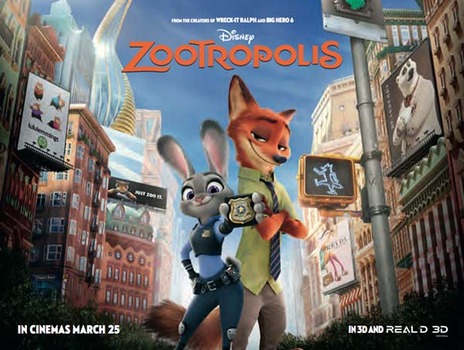
Zootropolis/Zootopia

We may be evolved, but deep down we are still animals.”

Anthropomorphism, Disney and animation have a long history. As early as Walt Disney’s first feature film Snow White (1937), in which all the woodland creatures appeared to have various personality quirks, attributing human characteristics to cartoon animals has been a way of enhancing a story. Then, with numerous Disney classics, it became the way to tell a story. In 1995, with Toy Story, Pixar began to add to the Disney magic by giving characteristics along with pathos to the inanimate objects and animals. Now, in 2016, with Zootropolis (released nearly everywhere else as Zootopia) we see this enhanced to the max with an animated film that features anthropomorphism whilst also serving multiple layers about diversity and racism, all told by Disney with just a smidge of Pixar wit. It’s funny, sweet and far deeper than it first appears.

During a school play in front of her parents, her peers and their parents, a young bunny called Judy Hopps (Ginnifer Goodwin) declares that when she grows up she wants to be a police officer. Many people laugh at her, one person even beats her up for the audacity of saying it and both her parents are a blend of supportive-but-unsure. But Judy proves them all wrong.  She’s the first bunny first to enter the police academy and the first bunny to actually join the police force. Her first posting is Zootropolis, a nearby metropolitan city. Her parents can’t believe it and neither can her new boss, an African buffalo by the name of Chief Bogo (Idris Elba), who assigns her the role of parking duty. Day one on the job seems to be going well, until she is tricked by con artist fox Nick Wilde (Jason Bateman). However the two are soon forced to work together by Mayor Lionheart (J.K. Simmons) and assistant-mayor Bellwether (Jenny Slate) to help solve a case involving a series of missing animals. Can what were once predator and prey ever work together, possibly even become friends, or is nature stronger that nurture?

It may be slightly too early to say, but Zootropolis has all the potential to be as-well regarded both critically and commercially as last year’s Inside Out. The jokes are really really funny and the drama is really really emotional. My personal favourite joke from the film has to be when fellow police officer Clawhauser (Nate Torrence) first meets Judy Hopps and calls her ‘cute’. Judy winces then carefully explains that “only a bunny can call another bunny cute”. Cue many belly laughs from the cinema screen. That gag is also an example of the kind of humour that has become prevalent in animation since Shrek (2001). The humour of these animations is almost two-layered. To explain on a very basic level, there’s the slapstick jokes for kids and the jokes for their parents that go way over their heads. It makes taking a child to the cinema a far more enjoyable experience for their parents, as opposed to having to endure some brain-dead-only-aimed-at-children romp.

The animals are very well characterised, both matching their animal types whilst also being well-rounded. Judy is fierce, dedicated and ambitious – a solid role model. Nick the fox is sly and alarmingly charming for a fox, though that may just be my personal feelings for Jason Batemen having an effect here… Idris Elba is hilarious as the imposing yet ultimately caring chief who just happens to be a buffalo. Shakira even appears as Zootropolis’ biggest star, Gazelle.

Then there’s the story itself, well-told with a solid twist. There are some fantastically inventive set pieces, be that the sloths working at the DMV or the practically word-for-word Godfather tribute. The story also has a lot you can sink your teeth into (sorry, pardon the pun!) Though the two groups of predator and prey may appear united in the metropolitan city of Zootropolis, it is a delicate union. One which is weighed down by tension and borderline-hostility. Although prey and predator may be neighbours very few are actually friends and few would choose even to be nice to each other. Some restaurants even refuse to serve certain types of customers. When it becomes clear that all the missing animals in the case are in fact predators it looks set to force the bubbling undercurrent of tension to the surface. The film is far from subtle in reflecting our own society’s tensions and forcing a degree of reassessment, yet that is no criticism. Considering the current global climate, with regards to refugees and a certain toupee-wearing president wanna-be whose delusions of grandeur reveal the current state of institutional racism, Zootropolis is perfectly-timed and well in need of watching.

This is ‘proper’ Disney with the beating heart and talking mouth of Pixar. Witty, warm and well worth seeing. A fable for 2016.

Eddie the Eagle

May Eddie the Eagle fly at the box office

One thing that really grinds my gears is when people my age say to justify a gap in their knowledge is, ‘Huh! Well that’s from before my time I guess.’ That is then proceeded with a slightly awkward shoulder shrug. For someone who often reckons that music peaked around 1985 I think it’s often used as a silly filler line. However, in a rather hypocritical move, I am going to say that the rise and soar then laughing stock of British skier Eddie “the Eagle” Edwards is ‘from before my time I guess.’ Occasionally he would pop up on various panel shows and people would poke fun, and I’d be vaguely confused and envious that a man with such an awesome nickname was being used for laughs (what can I say, I was a thoughtful child…) Anyway, I’ll save the rest of that for my therapist.

My slightly convoluted point here is that I had no idea what the man had done to achieve such levels of infamy and mockery. Then, when I heard of the film, I thought ‘Yeah…good luck with that one!’ Time passed by and the trailer was released which made me realise that the film was my kind of film. Then I got invited by Den of Geek to attend a preview screening and Q&A with the director, Dexter Fletcher, at The Courthouse Hotel (a 5* hotel with unbelievably fancy toilets) and that takes us right up to now. Three days on from seeing the film and it still makes me smile. It’s a truly wonderful movie and I beg you to go and see it. Now (and if you’re still with me after that preamble I declare) to you my utter love and gratitude for sticking with me) let me tell you why it’s so damn good.

Eddie Edwards (Taron Egerton) has wanted to be an Olympian for as long as he can remember. He was always the last to get picked for teams, spent a year in hospital due to the poor state of his knees and never quite seemed good enough for anything. He almost gave in and followed in his dad’s (Keith Allen) footsteps of becoming a plasterer until he found skiing, a hobby for which he had his mother’s (Jo Hartley) total support. He even made it to try-outs for the Olympic team before being told by the panel (lead by Mark Benton and Tim McInnerny) that he wasn’t Olympic material. That’s when Eddie decided that not only would he try on his own to make  Team GB for the 1988 Winter Olympics, he’d teach himself how to Ski Jump by decamping to a training camp in Germany. Either being ignorant or in denial about the fact that most Ski Jumpers start aged 5/6 (Eddie being 22) he proceeds to train solo with great resilience both from injury and belittlement from the experienced jumpers. That’s when alcoholic ex-ski jumper Bronson Perry (Hugh Jackman) steps in to help Eddie from death by training. A friendship/brotherhood quickly forms between the pair, under the shadow of Perry’s ex-mentor Warren Sharp (Christopher Walken). Will Eddie become skilled enough to join Team GB or will his dreams die again once more?

This film is totally and utterly brilliant; an utter joy to watch. Though it’s not a state I often occupy, I felt so patriotic after seeing this movie. Partly because it’s a British movie, and it’s the kind of movie we do so, but mainly because Eddie’s journey and how it’s told is so unique to British cinema. Yes, other countries do underdog movies, but so few do them in this way. Eddie’s journey is so lacking in glory, so real (grey-area term as some of the movie is fictionalised) that he reflects each and every one of us. It’s an important reminder not to give up on your dreams, and the power of self-belief. It’s also bloody hilarious, that blend of slapstick and deadpan and sarcasm that makes British cinema so comparatively unique. I giggled, I laughed and I even snort-laughed. It was glorious.

Taron Egerton is already on the up-and-coming, cusp-of-greatness list of actors and this film cements it. Firstly, a post-viewing google showed how similar Egerton looks to 1988-era Eddie along with how scarily accurate the expressions and mannerisms are. He’s also such a great actor to watch, his handling of the pathos and comedy of the character is extraordinary. You do well and truly root for Eddie. Hugh Jackman is great in his mentor role, forming a great rapport with Edgerton. Allen and Hartley are little seen but add much to the impact of the film. Then, with a brief cameo, Christopher Walken sasses the hell out of two lines of dialogue.

There’s also a wonderful 80s soundtrack, as uplifting and smile-inducing as the film itself, brilliant use of sets on such a small budget and some hilarious character actors in supporting roles. Eddie the Eagle is being released into the wild on March 28th, the same weekend as Batman Vs Superman. So why not give some home-grown talent some love and go see it. I promise you it’s worth the money.

We may only be a quarter of the way into the year, but this may just be THE feel-good movie of the year. Go see it.

Deadpool

The Merc with a Mouth has a big heart, and an excellent first film.

Few films produce the level of antici…pation that Deadpool had prior to release. Even fewer films meet, let alone exceed, the eager expectation of its future audience. Deadpool is, thankfully, on of those films. It even led to a reshuffle of my top five Marvel-related films (as of 14/02/16: 1) Guardians of the Galaxy, 2) Deadpool, 3) Winter Soldier, 4) Ant Man and 5) Thor). The film is filthy, frantic and feverish. I can see (if I squint and put on my reflective hat) that those three reasons for why I love it so much are the same three reasons why a small minority may hate it (if you are in the later category I will *try* not to judge). However, the film is exactly my kind of humour and, heck, it’s my name in the blog title (chica chica!) Even my overuse of brackets in this paragraph (sorry, no sorry!) would indicate the fourth wall breaks/sidebars of the film. Anyway, I’ve rambled on enough here… let’s get cracking!

The film opens with a truly hilarious montage of Deadpool (Ryan Reynolds) in an overturned car with some villains (soundtracked to ‘Angel Of The Morning’ by Juice Newton). Through an array of flashbacks and flashforwards we learn about the past and present of the man behind the mask. Wade Wilson was a bad guy who was paid to hurt even badder guys. He was definitely *not* a hero. One night, after a successful job, he meets Vanessa (Morena Baccarin). They have simillar senses of humour and the connection between them is electric. One date leds to one year of happiness – a year than ends with Wade being diagnosed with terminal cancer. He’s offered a solution: to join a secret program that will get rid of his cancer and grant him superpowers. Ajax/Francis (Ed Skrein) is the man running the program and injects Wade with a secret serum, teaming up with Angel Dust (Gina Carano) to torture Wade for weeks on end in an effort to trigger a mutation. One torture in successful in triggering the mutation, providing with the power of healing that is so great he is essentially immortal,  but in the process leads to Wade being totally disfigured. Once escaped Wade seeks out the man who destroyed his life, desperate for revenge and a cure. 

Where to begin with reasons for why I love this film so greatly, without turning this review into a stream of consciousness? Ryan Reynolds is utterly fantastic in this role, creating a character who is nuanced and full of depth whilst also making cock jokes. Reynolds has not been given the opportunity to  show of his funny bone for so long, and having spent ten years getting this show on the road, the fact it is a clear passion product for him really illuminates just how good he is.

Often with superhero films the mask is a barrier between the ‘hero’ and the audience. In this case the barrier is shattered literally by having Deadpool talk directly to the audience (just like in the comic books)  and through his use of facial expressions. Even with the red mask on we can see the facial expressions, the eyebrow raises, glaring, moments of surprise and amusement. With regards the jokes, not every joke lands but there are so many that when one does fall flat there will be two more in the next 30 seconds to get you laughing again.

His take on Deadpool is also the required level of sexy. I don’t just mean fanciable (though, yes.) But his interactions with Vanessa are sparky, sweet yet erotic. When you really think about it, how many superheros in film adaptations are given that side to their character? Batman is rather caste and crippled by his past, Superman looks great but is too noble for that, Captain America too innocent and Ironman is implied – all talk and no action (though admittedly Stark’s conquests occur in films rated 12/12A). Wade Wilson has a fully-functioning relationship with Vanessa , raunchy  yet founded-in love. Which sums up the whole films ethos really – it may parody the entire genre but is done so with love and thus still honouring it. One way of doing this is with the treatment of its big baddie.

Skrein makes a fantastic villain, reaching towards (though no equal to) the heights of Tom Hiddleston’s Loki. Ajax/Francis is a nasty man, who ‘enjoys’ causing others man and misery yet he’s so charming in the process. We want Wade to get the vengeance he is so desperately wants, which means we get to see more Ajax/Francis in the process (a total win-win). His cool, calm borderline-psychopath-at-the-core sit he perfect contrast to the maniac ‘talker’ that is Wade Wilson. Their onscreen rapport brings the best out of both characters.

Baccarin is good, if slightly underused, as Wilson’s girlfriend. Brianna Hildebrand is awesome as Negasonic Teenage Warhead, the X-Men trainee who is shadowing Stefan Kapicic‘s Colossous. Using such little-known and under-valued X-men was a great idea, bringing out the best from Wade Wilson. Including some of the films stand-out gags… 

This may be the perfect Valentine’s Day film. There’s romance, sex, dirty jokes, lots and lots of killing (think Kick-Ass or Kingsmen level violence) and more dirty jokes.

I’m seeing it for the third time this week. Go see it!

Zoolander No.2

Another example of a sequel that is a poor imitation of the original.

In 2001 (15 years ago!) the world was posed a question, a question for the ages, “Have you ever wondered if there was more to life, other than being really, really, ridiculously good looking?” Derek Zoolander found the answer by the end of the film (spoiler alert!) with family, friends and a charity project running “The Derek Zoolander Center For Kids Who Can’t Read Good And Wanna Learn To Do Other Stuff Good Too.” Within the first three minutes of the sequel all of that resolution is turned on it head, then burned to the ground and thrown away. If the intent was to then set up the sequel as being completely different, and ‘fresh’ compared to the original, then the fatal flaw in that plan is writing a film that’s funniest (and only) laugh-inducing moments are references to the original…

Justin Bieber is dead. After running away from assassins on motorbikes (having displayed some serious parkour moves) he is shot countless times. In his dying moments he manipulates his face into Blue Steel and takes a selfie, then gives into his fatal injuries. He is the latest in a long line of celebrities to be assassinated, taking a Derek Zoolander-themed selfie before dying. The fashion division of Interpol need his help but no-one knows where he is. Seven years ago, after the death of his wife and losing custody of his child, he decided to become a ‘Hermit Crab’ and go into hiding. Only one man can bring him out of his slump…

From the opening sequence alone you can tell how the rest of the ‘humour’ of the film will play out. An opening sequence is so key to a film, so crucial for setting the tone and level of the rest of the film. In this case? Well, it’s such a pandering sequence – ‘Hey! You average Joe, you hate Justin Bieber right? So we’re going to kill him off to make you laugh. We can make your dreams a reality. Love us!’ It’s a problematic choice for multiple reasons.

1) Hating Justin Bieber seems so last year/s. He’s had a bit of a renaissance in the past 18 months so the hate has become, for most, either ambivalence or embarrassed adoration. Therefore the slightly dated nature of the script becomes apparent. He’s also an easy target, one of many that are used to minimal effect, within a script seemingly tailored from social media circa 2013/4.

2) It’s an overlong sequence. Stretching out the humour becomes a motif of the film. Pacing of jokes never really seemed an issue with the first film (queue my rewatching it ASAP) but it is a real issue here. The ratio between gag build-up and punchline is definitely off.

3) Having Bieber appearing to do parkour, then being shot at least 30 times before taking a selfie before dying demonstrates how overblown and tacky the film will be. Zoolander No.2 presumably has a bigger budget, gladly and gawdly shows this fact off.

4) He is one of the countless celebrities to be shoehorned into an overwrought and clunky script. Though his role in the events of the story is clear (if rather ineffective) many others are not. A few stand out in terms of strange but also strangely funny (I’m looking at you here Benedict Cumberbatch and Kiefer Sutherland) but others are borderline pitiful (Anna Wintour and your crew, you didn’t, to quote Tim Guun, ‘make it work!’) 

Zoolander No.2 is a difficult watching experience for fans of the original. The plot is thin, the jokes humiliate rather than delight and the frivolity leaves the film rather throwaway. Like its eponymous character, Zoolander No.2 is empty and full of air. It may be filled of those who are ‘really really ridiculously good-looking’ but it’s forgotten that there’s more to life than that.

I hope they had more fun making the film that I had watching it. Disappointing.

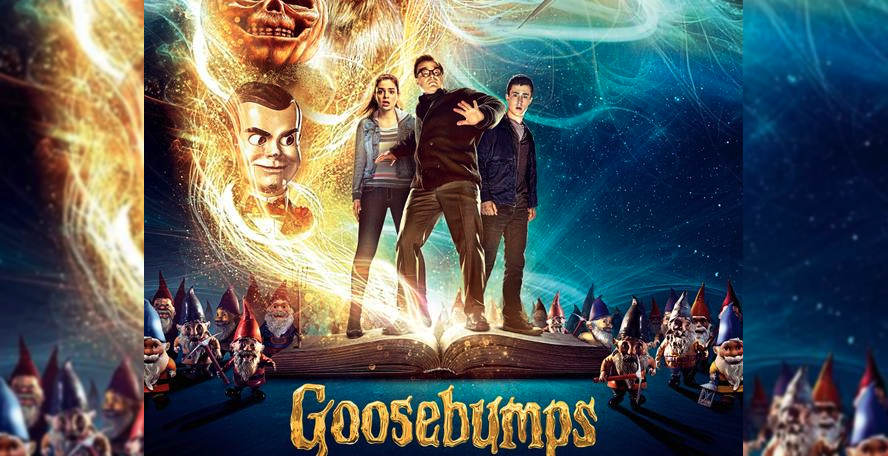
Goosebumps

“Viewer beware, you’re in for a scare!”

It’s easy to be a book snob. It’s easy to tell children which books are good to read and which books are bad to read. What constitutes a bad book for children? If it inspires just one child’s imagination,  gives them fears and feels in equal measure,  then surely a book can’t be bad? I’ve read Wilde, Dickens and both Poe. But I’ve also read Rowling, Wilson and Stein. Those six authors, along with countless authors, formulated my literary past and thus set the foundations for books to be read in the present and the future. J.K.Rowling may have figuratively taken me to Hogwarts and made me lament not receiving my letter when I was 11 (obviously during that period the ministry of magic was busy with other matters…), but it was R.L Stein that gave me a taste for ghouls, goblins and gore. Watching ‘Goosebumps’ felt like a risk, either prompting rage from my inner adolescent or transformative nostalgia. I’m very happy to report it’s the latter. Through a blend of live-action and animation the film manages to capture the goosebump-inducing fear of the books whilst also being rather light-hearted and funny.

A year after his dad has died, Zach Cooper (Dylan Minnette) and his vice-principal mother (Amy Ryan) move from New York to Madison, Delware. Though frustrated at his new small-town surroundings he knows that his mother’s new job will good for her, and the change in scenery may be good for both of them. When moving in, and having a box fall apart on him, he meets his new home-schooled neighbour (Odeya Rush). But their brief introduction is halted by Hannah’s grumpy and rather scary father, a man who may or may not be R.L. Stein (Jack Black). Hannah manages to sneak out and spend a day with Zach, but upon getting caught by her father she is punished. When Zach goes to rescue her, bringing along loveable loser sidekick (Ryan Lee), he stumbles across a bookshelf filled with what appear to be manuscripts for every Goosebumps story every written. However, after opening the manuscript of ‘The Abominable Snowman of Pasadena’ [side note: it is in my top ten Goosebumps] the Abominable Snowman itself comes out of the book. After a series of exciting events, manufactured by the Dummy of ‘Night of the Living Dummy [side note: definite top five contender] all of the manuscripts are opened, bringing all the monsters that Stein has ever written to live and bringing havoc among their town. Stein, Zach, Hannah and Champ must get all of them back in their books, where they belong. But things won’t be easy, and not everything is as it appears…

I really like this movie for numerous reasons, and in fact have a rather big soft spot for it. First of all, it brings all the monsters that once haunted my imagination to life. During the big crowd sequences I desperately searched the crowd for the familiar faces of the guests who overstayed their welcome in my nightmares. Going back to my opening point, I think it’s important that child can read books that scare them, and then show them how to defeat these fears. For children, and adults of a nervous disposition, this film does have rather spooky moments. There are one or two jumpy moments, and few monsters that are rather unsettling, but these are well contained moments and are more fun than fearful.

This leads me onto my second point, how surprisingly funny the film is. There are jokes for the children, and then there are jokes that will go over their heads and will crack up the adults in the audience. My three personal favourite jokes, which led to the emittance of loud laughter from many at the screening I attended, were a gag about the suffix –phile, a discussion about Stein verses Stephen King and a joke about domestic sales of books. Those three jokes (which I have intentionally poorly paraphrased) were well written, as are many others within the film.

The characterisation is good, with each character being more than likeable. In quite a nice shift, Hannah is the braver one whereas Zach and Champ are both rather jumpy in comparison. The animation is well-placed, never jarring with how it fits into the live-action, which is rather laudable. The music is never interfering, subtlety and successfully building the tension and fear. The pacing is also good, the 1hr 40mins never dragging and filled with more than enough twists and turns. This film is what family cinema should be. It shouldn’t patronise the younger members of the audience, or pander the humour towards them. It should engage them, spook them a little and excite them, just as Stein’s books did for me all those years ago.

If you’re looking for a light-hearted movie with a bit of bite, or something to entertain your children that won’t melt your brain, this is it. A very pleasant surprise.