Hunger Games Mockingjay Part 2

The least ‘Hunger Games’ of the ‘Hunger Games’ Franchise 

After 7 years it is time to say goodbye to Katniss Everdeen and the dystopian post-apocalyptic nation of Panem. Suzanne Collins mega-success trilogy was given what shall hereby be known as ‘The Harry Potter Treatment’ and had its final book split into two films *cough for more money cough*. How successful that decision actually was will divide audiences. Part two picks up straight after part one, literally straight after, with Katniss awakening from her reunion/fight with love-interest Peeta.

[2/3 of this review will be spoiler-free, the final 1/3 entitled ‘Ugly’ will not be]

Katniss (Jennifer Lawrence) awakens with injuries both physical (damaged vocal chords, swelling and bruising around her neck) and mental (having witnessed her once-fiancee’s resulting psychotic break after mental torture). Aware that the gentle and warm Ying to her brusque and cold Yang has been tortured, possibly beyond repair, her endeavour to destroy the totalitarian regime of President Snow (Donald Sutherland) is stronger and more determined than ever. Whilst continuing to undertake the P.R stunts set for her by President Coin (Julianne Moore) Katniss decides to set her own agenda by sneaking into the Capital and wreak her own personal vengeance against Snow. 

The Good

The acting in this film is absolutely top-class. Lawrence is continually astounding as Katniss, playing her with a believable and engaging distance. Katniss has seen and done to many horrific things – Jennifer manages to present this in such a way that the audience still manages to connect with Katniss even when Katniss disconnects herself from everyone on-screen. Moore is fantastic as President Coin, presenting a character with understated depth. Woody Harrelson is as enjoyable as ever as Haymitch, as is Elizabeth Banks as Effie. Though have far less to do in this than the three other films their roles are still scene-stealing. Donald Sutherland is so good at being bad, presenting Snow almost as Nero watching Rome burn. The stand-out has to be Plutarch as played by Phillip Seymour Hoffmann (who sadly passed away on Feb 2nd 2014, mid-way through filming this movie). Although Hoffmann’s presence in the film is not unexpected, he was present in the previous two films, there is still a slight and devastating surprise at seeing him on-screen. The success of his character is a staunch reminder of what a great loss he was.

The Bad

For many, ‘Mockingjay’ is the weakest of the literary trilogy. Tonally it is very different from the other two books, less ‘Battle Royale’ and more political assassination. With the film adaptations ‘Mockingjay Part One’ was rather exposition-heavy, a lot of talking and borderline critique of politics. This film is almost-stoppy starty in tone, with time often needlessly given to scenes which did not require quite-so-much screen time. There are many sequences in the film which are stand-out. When the Games themselves are brought into the Capital there are some real frights.  However there are many scenes which almost drag-along, talking about what characters are going to do next then showing them as opposed to getting straight into the action. The whole ’76th Hunger Games’ aspect is cut too-short far too-soon. There is also too much screentime given to pontifications on leadership and power, speeches which become rather mawkish after a certain amount of time.

The Ugly (Herebe the Spoilers!)

The ending. When referring to the ending I don’t mean the final face-off between Katniss and Snow, or Katniss’s decision over her love interests. I mean that final 2 minute long sequence with Katniss five years into the future. It’s exactly how the book ended, though that was set further into the future and was perhaps reduced to minimize any necessity for  Harry Potter epilogue-esque aging make-up, so arguably it’s the source material which is being questioned here as opposed to the film-makers.  It is truly hard to really feel comfortable with ‘that’ ending (with Katniss, Peeta and their two young children sat in a field). For a film which prides itself on it’s strong female lead, who was not laden with any limiting feminine attributes and could truly hold her own on a battlefield, then ending with the ‘reward’ of children and a nuclear family. On the one hand it could be read as symbolic, thanks to the actions of their parents these two children will not have to undergo the horrors of the Hunger Games. Yet it could easily be read as a patriarchal return, shedding her warrior status for frumpily-dressed mother. Either way, the ending is less than a bang and more of a whimper.

If you’ve seen the previous three films it makes sense to see the finale on the big screen. But lower your expectations, set them to’ very slightly disappointing’ and embrace the film for what it is. Whilst it may have uneven pacing, the ensemble cast present a masterclass in acting. Focus on enjoying the stand-out sequences and saying goodbye to some fantastic characters.

No Escape

Escape from [insert name of fictional Asian city here]

Considering the plot, characterisation and cinematography this film contains, it is not difficult to imagine it being made in the 1980’s (with Harrison Ford replacing Owen Wilson as the lead hero) or even the 1950’s (starring Jimmy Stewart). This is not a way of complimenting the film and suggesting it is timeless, anything but. This film is dreary, predictable and exceptionally dated. It’s portrayal of foreign conflict and politics is extremely problematic, a one-sided view of global issues that is almost xenophobic in presentation. The only thing that separates No Escape from a B-movie shown on the dark and misty unknown entities of Sky Movies channels after channel 315 is it’s talented cast, who are severely let down by the dross of a screenplay. Having not stayed for the end credits (in my desperation to leave the cinema)  I can only presume my hunch that the ‘research’ for this film was the greatest hits of The Daily Mail is in fact true…
Jack (Owen Wilson), an American engineer, leaves behind a failed business to drag his family to 
Southeast Asia to head his water manufacturing company’s new plant there. When they get there; they seem to be having problems, the electronics don’t work and rarely any cars are seen in the streets. When he goes to the market the next morning, he finds himself caught in the middle of a violent rebellion headed by armed rebels executing foreigners. Unbeknownst to Jack, just days before these armed rebels assassinated their prime minster. Jack must get back to the hotel and with the help of a mysterious British “tourist” (Pierce Brosnan), must get his family to the American Embassy in the midst of the chaos. But is there any escape? 
Firstly, the family. Jack is the archaic kind of hero of cinema long ago. He’s the Everyman. A husband. A father. By agreeing to this new job he has uprooted his family and doesn’t appreciate how they might feel, so he must learn his lesson through enduring this hero’s journey. He has a jarringly good range of survival skills; he knows instantaneously how to survive the most incredible and most ridiculous situations without having to think about it. Most depressingly of all, he is intentionally presented as all charmness and niceties whereas his wife Annie (Lake Bell) spends most of the film crying or with her face contorted into fear/outrage.  And, as bad as it will sound, their children are unbearably annoying. The majority of hurdles the family face are either caused by the children or severely complicated by the children. Pierce Brosnan enters, exits and reenters the film to little effect. His presence here echos something Micheal Caine declared when once asked about his role in Jaws: The Revenge,’ I have never seen it, but by all accounts it is terrible. However, I have seen the house that it built, and it is terrific.’ That must be the only reason that Brosnan is here giving a throwaway performance as a mysterious lothario Cockney.
The film’s biggest error is its portrayal of the ‘enemy’, The way the armed rebels are presented could have been an intelligent examination of ISIS or other militant groups. Instead they reflect the sentiments of those who use the term ‘swarm’ to label those currently seeking European asylum. They are characiatures: nameless, faceless and brainless. They are zombies, an epidemic the hero must save his family from.
No Escape mistakes creating tension by instead creating frustration. It’s one-part popcorn movie to two-parts shameless exploitation.

We Are Your Friends

You’ll Never Be Alone Again!

If you did not find yourself singing along when you read the above sentence, or are not aware of how that sentence links to the film’s title, this may not be the film for you. (Answer – it’s the central lyric to Justice Vs Simian’s 2008 hit ‘We Are Your Friends) The film is aimed squarely at Generation Y, bringing remnants of a traditional coming-of-age narrative together with modernity and scoring it with electronica. And it really works. Surprisingly so. It’s released at the perfect time, at the tail end of the summer, as the film reflects the comedown and bittersweetness this time of year brings. It’s the last party of the summer, are you in?

Cole (Zac Efron) is a 23-year old struggling DJ who lives in the San Fernando valley, the urbanised area on the other side of the Hollywood Hills, and dreams of becoming a world-renowned record producer. Cole’s three closest friends also dream of something big, something more than the lot they have been handed. Thursday night socials are the highlight of their week. The foursome spend the day hustling a crowd for nightclub, then reap the small rewards in the night with free drinks, the attention of women and the possibility of a small sum. During these night’s Cole gets to perform a set to warm-up the crowd for the headline act. It’s the only time he really feels alive. One night that headline act is James (Wes Bentley), a celebrity DJ who is losing the battles against his demons. He fears that he has lost his talent and relies on alcohol to push such thoughts away. His assistant and girlfriend Sophie (Emily Ratajkowski) loves him but is hurt to see him struggle in this way. James quickly becomes Cole’s mentor, becoming a big part of his life. So does Sophie, who Cole forms a connection with, which will force him into making difficult decisions about his future. 

Based on the trailers for We Are Your Friends it would have been easy to rule it out as an Entourage for the millennials. Cole’s crew is made up of similar archetypes as Entourage– the ‘hot head’, the ‘hustler’, the ‘brains’ and with Cole as the ‘talent’. Yet several aspects of the film prevent it from deserving this status, and in fact elevate it above it. Specifically the direction and cinematography. Directed and co-written by Max Joseph (one of the co-hosts of MTV’s Catfish) the film’s tone echoes the world it is set in: the humidity of LA, the tense uncertainty of their environment and the sheer unadulterated escapist joy that music can bring. Joseph makes some unique choices along the way with some stand-out sequences including the blend of live action and animation at the art gallery after-party and Cole’s scientific explanation of how to truly get the party started.  It’s the twist 2/3 into the film, along with a sleazy sub-plot, that brings the film back to Earth and makes this a far more realistic tale than the overindulgence and consumerist pornography of Entourage. We Are Your Friends is the Boulevard of Broken Dreams’ to the ‘Holiday’ of Entourage; this is a life in which the party isn’t always worth the resulting hangover.

Zac Efron excels in his role as lead. He brings an engaging mix of ambition and drive, retaining our sympathies throughout each difficult decision.  This film marks Emily Ratajkowski’s leading role (after rising to prominence in the music video for ‘Blurred Lines’) and she’s reasonably good with the material she has been given, stuck in a relationship in which she must watch her partner indulging in excess whilst having feelings for Cole. However in this film she does have an annoying habit of pouting after each utterance, and spends most of the film frowning. This could be an attempt at characterisation, but there could have been more done with the role of the enchanting muse.

The film, like it’s soundtrack, is pulsive and hypnotic. Watch this if you want to prolong your Summer for that little bit longer, or if you want to see a genuine feel-good movie.

Man From U.N.C.L.E

A light-hearted and immensely entertaining spy caper

Finally, we get a proper Hollywood summer movie (admittedly slightly belatedly as the week of British summer time appears to have drawn to a close…) Nevertheless, this is the kind of film you’d expect to see, a fizzling and refreshing take of a much-loved genre. The story might not be the most original, or particularly remarkable, but the immensely charismatic performances of its stars make it a hilarious romp that is well-worth seeing.

It’s 1963. In the midst of a global stand-off, with the world on the on the cusp of nuclear war, ex-con turned leading C.I.A agent Napoleon Solo (Henry Cavill) is tasked with tracking down and rescuing Gabby Teller (Alicia Vikander). Her father, who is currently missing, was a Nazi scientist who worked for the U.S government due to his specialism of nuclear weaponry. Solo finds Gabby easily enough, but was being pursued by leading KGB agent Illyra Kuryakin (Armie Hammer) who is also on a mission to locate Gabby. A chase sequence follows, with Solo managing to get Gabby over the Berlin wall into West Berlin and leaving Illyra on the other side of it. That’s not the last the trio will see of each other, as the next day Solo’a American handler and Illyra’s Russian counterpart bring them to a meeting and announce that they will be working together to stop a pair of former Nazi’s who are forcing Gabby’s father to create their own personal nuclear weapon.  They must go undercover and work together to find Gabby’s father, however, Solo and Illyra are given private orders from their seniors to steal the data from the project for their respective governments.

What follows is a breezy, stylisation and oh-so elegant production. It’s an affectionate tribute to the Bond series and other espionage classics; a fun and frivolous, and even rather fresh, take on a much-worn genre. With a sparky soundtrack, gorgeous costumes and speedy editing to set the tone you’ll be kept engage from frame-to-frame. These features, along with the magnetic leads, make for a charming ride of a movie. Vikander is scintillating as a German mechanic who becomes embroiled in matters of international performance. Hammer is incredibly endearing as a Russian spy who may have a sweet heart within his looming psychique. Then we have Cavill whose charm, wit and suave emulates the pre- Daniel-Craig-era Bond.

It’s nothing particularly new, but with a few inventive twists and turns this makes for a laugh out loud cinematic gem.

Jurassic World

The park has grown into a world – but bigger doesn’t always mean better.

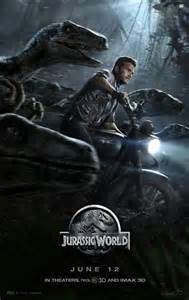
jpIt’s been twenty-two years since Jurassic Park came out. (At this point I’ll pause for a second to let that sink in/ get over the shock/let you sit down if you are standing!) Few blockbusters have the same amount of loyalty or produce the same levels of nostalgia from its fans or have so many iconic moments. From that music, to the shot of the water vibrating in a glass building to the introduction of the T-Rex, the raptors in the kitchen and the wonder that is Jeff Goldblum. As a consequence the makers of Jurassic World had a difficult task – to pay homage to the origins whilst also developing without being accused of trying to reinvent the wheel. In some ways they are successful, aspects of this film are incredibly entertaining and equal the original. On the other hand, some aspects are jumbled, flawed and disappointing.

The film reflects real-time, set 22 years after Jurassic Park was forced to close. Jurassic World is one of the world’s most popular theme parks – just as one would take their family to Disneyland they live in a world where it’s normal to go somewhere to see dinosaurs. In fact, it has become so normal that operations manger Claire Dearing (Bryce Dallas Howard) has been put in charge by the park owner to oversee the upcoming new exhibit. It’s a breed of dinosaur that has never been seen before – literally as it didn’t exist before. The ‘Indominous Rex’ is a product of genetic modification – a hybrid of different species. Although her nephews are currently spending a week at the Jurassic World – who arrived with the intent of spending time with her – she has been unable to do because of this indomitable project. Her nephews go off exploring the theme park with her assistant for company, whilst Claire deals with issues regards the new beast. She is forced to turn to Owen Grady (Chris Pratt, playing an oh-so-common ex-military/ leading velociraptor expert and trainer) for help. If you haven’t guess what happens next (SPOILER ALERT) it escapes. How will Claire and Owen prevent the treat of a beast that has never existed before? A breed whose genetic origins are being withheld from them? What will happen to Claire’s nephews? Will Owen and Claire have an inevitable romance? Will these film avoid obvious character types?

I’ll only provide an answer to the last of those questions – no. Whilst no-one would turn to Jurassic World or it’s predecessors looking for realism, it would be nice to have an action-adventure movie in which the events do not overshadow the characters. In fact, can you imagine a world where a 3D movie action-adventure has 3D characters? Jurassic World is not that kind of world. The dinosaurs are given more developed characters than the humans. In Jurassic World we have:

– Owen Grady, the bad-ass bloke who has no time for society’s bullshit or human being’s bullshit. He wants to live in peace and hang out with his raptor buds alpha-style. He is an attractive man, and knows it. He uses humour to defuse awkward situations or to make his point. (Think Indiana Jones, with less charm.)

– Claire Dearing, the work-obsessive who cares more about her work than family. She is deemed cold and calculating when compared to the male hero. All she cares about is money, order and routine. Luckily the events of the film will show her that this is wrong, and will fix her evil corporate ways. She is living proof that it is impossible to be successful and also care about other people. Runs around in heels. (Think every stereotype of working women that exists in film)

– Zach Mitchell, the older of Claire’s nephews, thinks he is a ladies-man. Stares at lots of young women because he is a ladies man. Turns out that this is all a front to hide his caring-side, and he actually does love his little brother.

– Gray Mitchell, Zach’s younger brother. Shown to have obsessive tendencies through his encyclopaedic knowledge of dinosaurs.

– Vic Hoskins, a man who wants to use Owen’s raptors for evil. Does evil-ish things.

Without any interesting heroes to really root for, the film falls slightly flat, and we end up feeling more sympathy for the dinosaurs. Yes, there are some fantastic set-pieces – some sequences are genuinely frightening and rival the original film. Yes, there are some lovely and subtle tributes to the original film. Yes, it is rather entertaining and somewhat worthy of awe. But it is a film which seems so uncertain of itself with some cheesiness worthy of Skarknado. It simultaneously pokes fun at action movie tropes but then utilises others, with a side order of predictability. All of this results in a vanilla-bland popcorn movie.