The Huntsman: Winter’s War

A fantasy with just enough farce to make it fun

I doubt there are many people who have spent the past four years desperately counting down until the sequel of the rather mediocre Snow White and the Huntsman. The film was lacking entertainment and personifies Hollywood’s serious issue with getting ‘dark’ confused with ‘murky’ and deeply frowning viewed as the only way to articulate inner torment. Now we have the prequel/sequel sans Snow White aka. Kristen Stewart (after a certain scandal involving the film’s director Rupert Sanders) who realistically is not much of a loss as she spent most of the film biting her lip. A new threat befalls the kingdom and the Huntsman is called in to help, after we learn more about his mysterious backstory.

Many years ago evil queen Ravenna (Charlize Theron) murdered her way through the land to rule the kingdoms, with her powerless sister Freya (Emily Blunt) by her side. Freya falls in love, something her sister is against as love is a foolish distraction, and has a daughter. When tragedy strikes Freya’s powers are activated (think Elsa-from-Frozen-type powers) and she moves away to take control of her own land. She decides that she must have her own unique army and orphans the children of a village. The children are brought to her castle and taught the one commandment of her rule, that love is a sin. Years pass as the children are trained and moulded into true Huntsman but two children, her two best, break her one rule and fall in love. Eric (Chris Hemsworth) and Sara (Jessica Chastain) marry and try to flee but are caught in the process. Freya the Frost, as she is now known, places a great wall of ice between the pair to separate them. Sara appears to be murdered and Eric is thrown into a nearby river to be swept away. Seven years later, after the events of the previous film when Snow White killed Ravenna, Eric is called on by Snow White’s close friend William (Sam Claflin) to stop the Mirror being intercepted by Freya. 

You do not go into films like this with a closed mind. They require a deep suspension of disbelief, with any concepts of logic or reason needing to be locked away for 114 minutes. If you do this you will find this film to be a serviceable and entertaining lark. It would be easy to list all of the flaws within this film but doing so would ignore how relatively entertaining it is.The script is truly mediocre, full of boulder-sized clunky exposition and mawkish sentiments. In fact a bingo or drinking game could be formed based on all the lines/phrases that are uttered about love (‘love is a sin’ ‘love doesn’t conquer all’ ‘love is not a fairytale’ ‘you reek of love’ etc.) There’s a line about wet-never regions which shows how uncertain the filmmakers are about who their audience actually is.  Liam Neeson is on needless and grating omniscient narrator duties.

If you can ignore that, which I know is asking for rather a lot, what is left is a host of charming performances going above and beyond to make the lifeless script fun. Chastain is a fantastic new addition, being far more kick-ass than her running in heels stint in Jurassic World. Hemsworth is as charming as we now expect from him, mugging about and having fun. I doubt there is little I wouldn’t watch if he was in it. Blunt and Theron are solid and borderline-stirring in their villainous portrayals, making some truly dreadful lines sound half-way believable.  Complex issues aside about people playing dwarves the four dwarves who aide the Huntsman on his journey (Nick FrostRob BrydonAlexandra Roach and Sheridan Smith) are great fun and a joy to watch.

It’s not going to win any awards and will most likely be forgotten by the end of the month. It also does not deserve nor need a sequel (instead I would propose a new series called ‘Let’s watch Chris Hemsworth do things’ where we watch Hemsworth do a variety of activities and charm us all). BUT, it is an entertaining enough farce with just enough camp and laughs to fill a dull afternoon/evening.

 2 stars

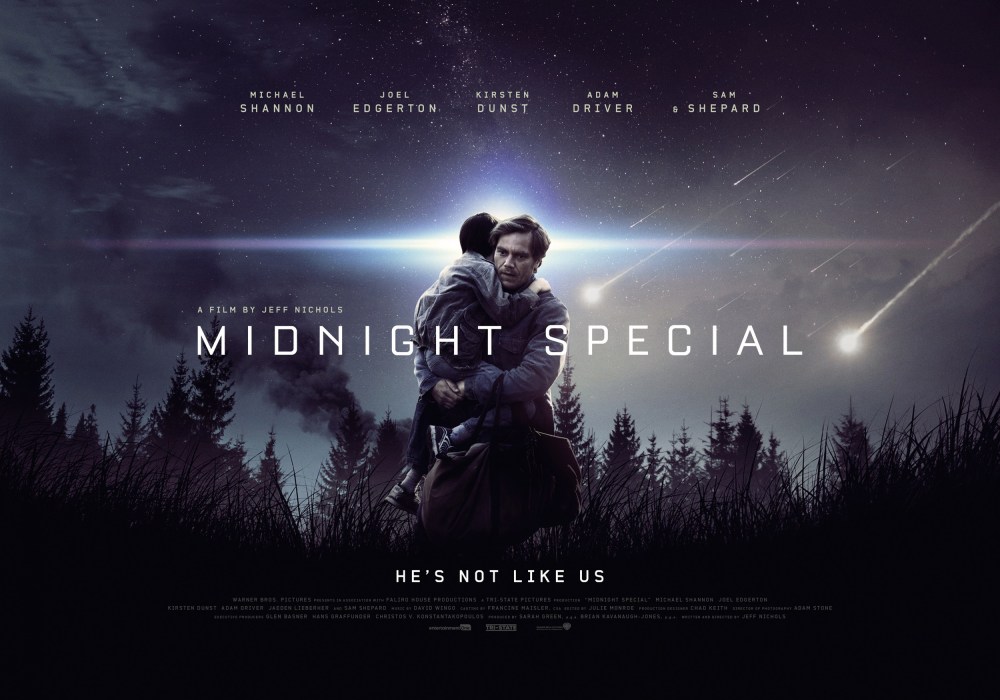
Midnight Special

Messiah or weapon? Or something else entirely?

Imagine a science fiction movie that focuses less on the fictional powers and more on the human emotions, the cost behind the power. Imagine a science fiction movie that allows you to marvel at the mystery rather than hand-feed you the plot. Imagine a science fiction movie that is a road trip/chase movie that challenges the value of belief. Now stop imagining as Midnight Special is all three of those things and much more. It is a wonderfully strange blend of genres, full of complexity and sentiment. A parable about love and extraordinary ability.

Roy (Michael Shannon) and his eight-year-old son Alton (Jaeden Lieberher) are on the run from both the government and religious extremists. Alton appears to possess special abilities, from being able to effortlessly infiltrate classified government signals  to bringing down a satellite from outer-space. A religious cult formed around Alton who, as National Safety Agent Paul Sevier (Adam Driver) discovers,  turned his encoded words into gospel. His supernatural powers so badly altered by daylight that all of the cult  became nocturnal. Upon making eye contact with people Alton’s eyes glows and show visions of unknown lands. Having fled the cult, and with the help of childhood friend Lucas (Joel Edgerton) and Alton’s mother (Kirsten Dunst),  Roy must get Alton to specific location for a specific time. Will, as everyone fears and some hope, a celestial and world-changing event take place? 

This is not your typical science fiction film. Compared to typical box office fairings Midnight Special is slow, with far more questions than answers, and a narrative that is impossible to stay ahead of. Those are not criticisms, just an acknowledgment that this film is not for everyone. In the preview screening I attended yesterday many of the audience members seemed frustrated or unfulfilled by the film. I was not in agreement with them for the film I had just witnessed was so riveting and magical. Rarely is science fiction this personal and emotive. Yes, a beginners guide to film criticism will show  you that Steven Spielberg’s films are about father-son relationships,  but what we see here is a different realm. What director and writer Jeff Nichols manages to achieve is a film which places greater emphasis of the consequences of supernatural power rather than the benefits of it, prompting the reflection that more is lost than gained in such extraordinary circumstances. Few storytellers are this damn magical.

The acting by the entire cast is wondrous, each cast member providing a wondrous blend of awe, fear and honesty. Roy’s love for his son is so deep and unconditional, a level of paternal concern rivalling that of great Epics. Lieberher’s performance here suggests that Room child star Jacob Tremblay may have a rival for Hollywood’s current greatest child actor. Egerton’s performance allows us to give loyalty to a character we know little about, believability to a man who has only known Alton for three days but is willing to give everything to the boy’s journey. Dunst is subtle yet heartbreaking as a mother who fears she will have to give up her son once more.

The cinematography is marvellous, as is the soundtrack and the storytelling. Of particular favourite is the Easter Egg of the Superman-starring comic book that Alton is reading in the back of the car. Any in depth analysis of the parallels between Superman and Alton would be spoilerific, but the very fact both are outsiders with great power is a wonderfully subtle touch. Just like the entire film it’s an allusion to other sci-fi works, but something that is so uniquely individual and riveting.

Some may say slow. I say spellbinding, sincere and utterly superb.

The Danish Girl

A heartbreaking story about Lili, a transgender pioneer.

‘The Danish Girl’ and ‘Joy’ were both released on January 1st 2016 in  the U.K. Though the films have relatively little in common otherwise they do share one primary similarity- both are a blending of fact and fiction. Both stories are about real life people, with a degree of dramatic license for supposed cinematic development. However it is in this area that ‘Joy’ somewhat stumbles whereas ‘The Danish Girl’ soars. A brief bit of post-film research will identify these aspects of fiction, yet it is an act that is perhaps unnecessary as any and all fabrications in ‘The Danish Girl’ add to moving story that unfolds.

Portrait artist Gerda Wegenger (Alicia Vikander) and popular landscape artist Einar (Eddie Redmayne) have been married for six years. They have a comfortable life in the cultural bourgeois heart of Copenhagen. Their friends in the arts note with a degree of envy about how happy they are, how well suited they are together and how lucky they were to find each other. It’s true, they balance each other out perfectly. When their dancer friend Ulla (Amber Heard) cancels a sitting for Gerda at the last minute, Gerda asks her husband to pose instead. The act of posing as a female figure appears to cement something, an awareness that Einar has had for sometime, and  marks his progression of leaving behind the identity of Einar.  Tentatively at first, yet soon quite rapidly, Einar begins to progress in his lifelong identification of being a woman, becoming Lili Elbe. 

Lili Elbe was one of the first identifiable recipients of gender reassignment surgery, with her first operation in the process have taken place in Germany in 1930. Her personal letters and diary entries which record her journey, were published under the title “Man Into Woman” (1933) which was one of the first texts to draw a distinction between homosexuality and transexuality. Though ‘The Danish Girl’ is being billed as a ‘true story’, some of its primary details are proven to not be, yet arguably can it be viewed as a ‘true story’ as it accesses an inner-truth?

Redmayne’s portrayal as Einar is heartbreaking, as we watch a conflicted person finally accept themselves whilst all too-aware of the devastation it could cause the love of their life..His portrayal as Lili is just as emotive, as we observe a person joyous at finally being comfortable in their own skin yet restrained by an era that is not ready and cannot provide provision nor understanding. Vikander’s Gerda is sublime, conveying so much with a subtle yet equally devastating performance.Her want for her love to be happy clashes with her want with him to stay her love, a turmoil that emits from every expression and  mannerism. The third star of the film has to be the cinematographer Danny Cohen, whose use of the camera makes the beautiful sets look lush and the beautiful leads look vibrant.

Overall the story itself seems rather familiar, offering little that is perhaps surprising. But this is not a criticism, in fact rather something of a compliment as a more ambitious narrative may have taken away from the film’s central core in its observing of Einar’s journey. Though perhaps the story could have gotten under the character’s skin slightly more and not have seemingly polished some of the darker edges of the character’s stories. However, if you’re looking for a poignant and caricature-free look at one person’s struggle for acceptance within themselves and their community, this is a great place to start.

The two compelling lead performances deserve to be watched.