I, Daniel Blake

“It’s a monumental farce isn’t it. Looking for nonexistent jobs and all it does it humiliate me.”

The most powerful aspect of cinema is that not only can it suit every mood it can fulfill many different functions. It can engage, entertain and expose. It can also fill a need. Ken Loach has filled a need with this film. As a society we need this film. We need to watch this film and do something about the bureaucracy that is endangering and ending people’s lives. They need us to see it.

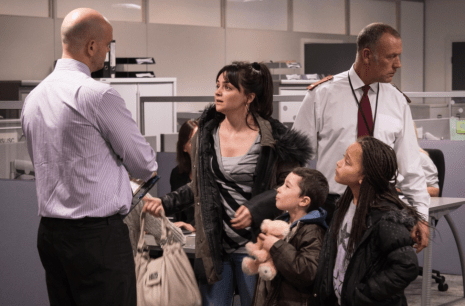
Daniel Blake (Johns) had a massive heart attack whilst at work. He’s been off work for weeks and his doctor’s are insistent that he is still not fit for work which means he’s in need to state welfare. But getting the help he is entitled to is far from easy – it involves endless assessments, meetings and form-filling. Single mother Katie (Squires) is in a simillar need herself – she was so in need of housing that she left London and everything they knew so they could finally escape the homeless shelter they had lived in for two years. Both soon realise that negotiating the red-tape of bureaucracy is an impossible challenge.

idan2

It’s hard to phrase just how truly heart-wrenching this film is. By its finish I felt utterly devastated and dumbfounded at the farce-like awfulness that must be the cruel reality for many. I then stomped around Brighton town centre like some sort of social-warrior, embittered and empowered by what I had just seen. Countless headlines of certain newspapers (I feel no need to name or shame here – we all know to which ‘reputable’ establishments I refer to) that constantly flaunt headlines about benefits ‘scroungers’.

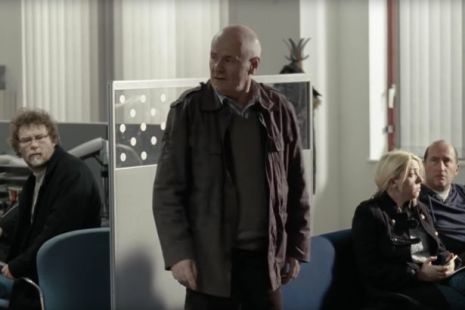
I do not question the fact there are some people who abuse the system. What I do question is the nature of the system, and the current tightenings that seem to occur daily, that is letting people fall through the gap. These people, as represented by Daniel and Katie, need the help. Help is seemingly available and yet the path to this help is not a path at all. It’s a hellish exercise in patience and waiting – not being able to speak to an actual human being (literally and metaphorically) and filling in paperwork in a multitude of formats without help and delayed response. The relatively minor character of Sheila (Percy) epitomises this. I’ve seen many powerful films this year and I’ve spent some cinematic time with a far few villains. The swift deep hatred I felt for Sheila will rank highly – her manner and tone seemed to aggravate me on a truly innate level. I had to remind myself that she was only an actress to try and lower my rage levels.
idan3

Thanks to the script and direction this would be a powerful story on it own. It’s thanks to the performances that it is so memorable and moving. Dave Johns is so likeable as Daniel, a man who would do anything for anyone yet is being utterly demoralised by his desperate and ignored pleas for help. Hayley Squires is also phenomenal as she finds herself being emotionally and mentally destroyed with each pitfall the administration puts in her way. There’s a simple message here that needs to be remembered – we are all just one or two steps away from the position the characters find themselves in. Those who find themselves trapped in the labyrinthian trappings of bureaucracy deserve our help not our disdain. We all have the choice to be the person who ignores Daniel as he makes his peaceful protest or the person who joins him.

The film is blunt, honest and shrewd – emphatic with its focus and Dickensian with its critique. Forgot ‘must-watch, this is ‘need-watch’.

4.5

Dir:Ken Loach

Country:  UK         Year: 2016               Run time: 100 minutes

Cast:Dave JohnsHayley SquiresSharon PercyBriana ShannDylan McKiernan

 I, Daniel Blake opens in UK cinemas on October 21st. 
Julieta

Brooding, sentimental and utterly charming

I think I’ve only given five stars twice this year. This will now be the third as ‘Julieta‘ is unquestionably a five star movie. The entire film has an air of intrigue which smothers the viewer and draws them into a grief-tainted realm of love and loss. There’s much brooding meditation on universal themes such as fate and guilt – how yearning and regret can torture generations.

Julieta (Suárez) is about to move away from Madrid to Portugal with Lorenzo (Grandinetti). When she goes on her final errands she has a chance encounter with Beatriz (Jenner) who was the childhood best friend of Julieta’s daughter Antia. Beatriz tells Julieta about how she had bumped into Antia the week prior, about how well she was looking and how she meet Antia’s children. It’s a casual encounter and yet it forces Julieta to face her past. She tells Lorenzo that she will not be moving to Portugal with him but she doesn’t tell him the reason – that she needs to confront the events that led up to the decades-long estrangement of her and her daughter. 

jul3

One of the film’s great successes it how it instantaneously hooks the viewer in whilst revelling very little. We can observe much about Julieta and her relationship with Lorenzo – we see how happy and doubt free she appears to be about the move- and how this shifts entirely by to what would appear to bystanders as smalltalk-laden chance encounter. We witness how her moving forward with her life is swiftly halted as she is ejected back into her past. Not only is she inevitably forced back to the past mentally and emotionally, she then returns to living in the apartment block she lived in with Antia in the hope of manifesting ghosts of her past into present figures. The letter she then begins to write to Antia serves as the frame of the story, the letter starts at the beginning and we are then placed their – in the 1980s with a twenty-something Julieta played by a different actress (Ugarte).

What follows could then be categorised as a lengthy flashback and yet it doesn’t quite fit nor feel like that. Assigning that label makes it sound like a laborious or arduous watch – it wholeheartedly isn’t.  We, the viewer, live the memories just as Julieta is reliving them. We follow Julieta as she meets Antia’s father Xoan (Grao), her relationship with him, Antia’s birth and the seemingly fated separation that occurs with both of them. Julieta is a specialist in Classics and an air of Greek mythology lingers over the events – a prevailing sense of tragedy and predestiny, decision and consequence, fate and regret.

jul2

As we face in our own lives some of the events in Julieta’s life come as a quick and devastating surprise whilst others are drawn out, almost suffocating in their inevitability. Both Ugarte and Suárez are truly excellent in their joint role – each providing so much depth to Julita, each equally and superbly moving as they endure unresolved personal heartbreak. This, of course, would not be possible were it not for the master behind the camera.  Almodóvar reminds us, were it needed, that he is one of cinema’s greatest living directors. He tells the story in a way that is both fractured yet whole- just like Julieta – muted yet melodramatic. Many moments within the film are gasp-inducing in their blend of beauty and tragedy, but none more so than the switch from younger to older Julieta. It’s a tradition that is the epitome of seamless yet utterly shattering. 

Extraordinarily stylish on the eye, food for your soul, heartbreaking yet heart-mending. Extraordinary.

five star

Dir:Pedro Almodóvar

Cast: Adriana UgarteRossy de PalmaEmma SuárezMichelle JennerInma CuestaDaniel GraoDarío Grandinetti.

 Country: Spain                                 Year: 2016                         Run time: 99 Minutes

Julieta is in UK cinemas now. 

The Shallows

Just when you thought it was finally safe to go back in the water…

Jaws (1975) revolutionised cinema in three ways. 1) It established the career of a certain well-known director by the name of Steven Spielberg. 2) It was one of the first, if not the first, Blockbuster movie. 3) It made sharks seem really really scary, continuing to turn generation after generation into galeophobics (those with an intense fear of water due to sharks). 41 years later (yep, just take a minute to ponder that!) The Shallows comes along, using a great white shark to once more terrify audiences. Does it work? For the most part yes it really does!

Shortly after the death of her mother medical student Nancy (Blake Lively) decides to take a break from college and go travelling. She’s decided to retrace her mother’s steps and has travelled to a secret beach in Mexico to surf. Her favourite photo of her mother is her being stood on the beach, surfboard in hand, just after finding out she was pregnant with Nancy. Kind local Carlos (Óscar Jaenada) drives Nancy to the beach and drops her off. Nancy proceeds to surf for hours, first alongside two local residents and then on her own. After sensing a commotion in the water she travels a little further out when a great white shark attacks. A badly wounded Nancy drags herself to a pile of rocks roughly 200m from the shore, but the beast is circling and stopping her from reaching the shore. What will follow is a test of wills between man and nature – will Nancy survive?

In the 41 years since Jaws (again, can you believe it?!?) about 83 movies (yep, I counted) featuring killer sharks have graced big, small and non existent screens. For every Jaws there’s been at least ten Jaws:The Revenge. Thankfully The Shallows  is more like the former than the latter.

There’s a few reasons The Shallows has the makings of something of a modern masterpiece. There’s the fact it’s a bottle thriller – a movie set solely in one small location, think Buried (2010), Moon (2009) and 127 Hours (2010)- is an excellent decision. Bottle movies play us right in the situation the characters are in , we the audience cannot escape just as the character we are watching cannot. Having Nancy trapped on a small pile of rocks, that are soon to disappear with the tide, really ratchets up the tension. It allows us to connect with the tension she is feeling and develop our own sympathy tension. Even though we have only just meet her we know quite a chunk about her and we are desperate for her to pull through, no matter how unlikely that regularly seems.

This, however, would not be as effective were it not for Lively’s performance. It is not hyperbolic or oversimplified to say she carries this film. For the majority of the film, aside from a temporary companion seagull she names Steven, she is alone on screen. At least 60 minutes pass where she has no-one to communicate with and no-one to help her. Lively excels in communicating every emotion – from the pain of her energy, the horrendous worry over her situation to her savvy quick mindedness as she handles each situation. Should it have really been warranted Lively truly proves her skill as a fine actress.

Her excellent performance is immensely well served by the cinematography. The sequences of the shark attacking are as chilling as you’d hope/expect/want. The scenes where the shark cannot be seen, when we know it is lurking, are equally-wracking. An excellent balance is used between showing the beauty of this secluded and breath-taking beach along with the horror that lurks beneath the surface. There’s also an effective integration of social media/mobile phones early on which whilst highlighting this is a modern movie also had to the believability of the situation and of Nancy as a character.

The only negative has to be the final 5 minutes/ ending which really test the realms of believability.

All in all The Shallows has plenty of thrills and chills, with scares that will compel  most of the audience. And, at less than 90 minutes long, it’s a taut and lean thriller. Well worth a watch.

3.4

‘The Shallows‘ is in cinemas now. 

Lights Out

Be aware of things that lurk in the dark…

If, like me, you are afraid of both the dark and mannequins you will pretty much be done in by the opening sequence. If they’d also included spiders I probably would have walked out… Anyway ‘Lights Out’ is a feature film adaptation of a rather successful short film (https://www.youtube.com/watch?v=tOI4bJ0-IrY). On the whole it is a very effective horror movie, utilising old-fashioned fears and old-fashioned scares to great effect.

Rebecca (Teresa Palmer) left the family home a long time ago. She now lives in an apartment on her own, far away from her mother Sophie (Maria Bello) and half-brother Martin (Gabriel Bateman). She’s been dating Bret (Alexander DiPersia) for eight months but struggles with the concept that he is her ‘boyfriend’ – these issues with relationships stem from her turbulent past with her mother that lead her to leave home as soon as she could. Several months have past since the mysterious death of her step-father Paul (Billy Burke) when her brother gets back in touch. It appears their mother, who has a history of mental illness, is struggling again. But when Martin explains some of the strange ongoings in the house, including their mother talking to a friend called Diane when she is actually talking to herself  and strange things being seen in the dark, Rebecca becomes desperate to unlock the truth and soon comes face-to-face with a terror that haunts the shadows. 

Horror is not exactly one of my favourite genres. Honest admission time: I’m easily scared by some of the most ridiculous things and really don’t take pleasure from being scared. Attending this preview screening at The Soho Hotel (which genuinely has the fanciest toilets in London, a comment unrelated to the fact I saw a horror film there!) seemed like a stupid notion, especially as I was going on my own, and yet I went. And I actually really enjoyed the film. Admittedly I clutched the armrest of my chair  (very comfy/fancy seat I hasten to add!) for the entire running time and watched a good third of the movie through my fingers…yet I was somewhat surprised at how much I appreciated the film. Impressively for all the terror I felt I underwent I laughed a lot to, with the film not at it. It easily passed the six laugh test with intentional gags.

At just under 90 minutes long it’s taut, no time is wasted on unnecessary scenes or information. The pacing is strong and unrelenting. The story itself takes familiar tropes of horror films (‘Don’t go in the basement!’ ‘Why are you going on your own?!?’ etc.) and plays around with them. Some moments do not surprise and some moments really do. Whilst there are some rather obvious elements to the story, and a rather problematic use of mental illness to explain character behaviours/story, there is enough freshness to everything that make these issues less jarring.

This is also helped by some excellent acting by the cast. The central trio are definitely three actors to look out for. Eleven year old Bateman, playing Martin, is fantastic as one of the leads. He conveys an excellent amount of emotion and really holds his own amongst the cast. Palmer as Rebecca was certainly convincing balancing her desperate need to know with an adequate amount of logic and cynicism. DiPersia as her boyfriend was a magnetic presence on the screen and suitably charming. The only issues I had with their ‘relationship’ was the obviousness of their characters – both being dressed in black, her music choices and the themes of the posters decorating her apartment. It felt obvious what they were trying to say about her character and yet needless as this an element of the story that was not explored. Maria Bello did a good job with what she was given, although it felt undermined by the flawed use of mental illness to explain away her character and certain elements of the story.

And then there’s Diana, our villain of the story. Having a villain who can only appear in the dark is an inventive idea, one that is used to great and very effective effect. The places that she manages to pop up in..! And then there’s the noises we quickly come to associate with her – whenever she approaches the noise of fingers against a chalkboard pierces the air. Then, when she makes an attack, her roar (she literally roars) it’s actually really terrifying! Most of my deciding to watch some scenes through my fingers came from those noises. My only problem with her as a villain as how undefined her powers were, she seems to suddenly have a skill for every means and possess multiple superpowers. These skills come with no explanation or discussion and soon become convenient rather than believable. And yet she still managed to unnerve me so greatly I did sleep the following night with my bedside lamp on. Just in case.

‘Lights Out’ is a more than solid horror movie, providing thrills and chills within a neat less than 90 minute running. A great way to spent the evening watching, then much of the night trying to forget!

stars

‘Lights Out’ is in UK cinemas from August 19th. 


When Marnie Was There

A quietly moving and melancholic outsider tale

There are many reasons this film will leave you sobbing. First of all this may just be Studio Ghibli’s last film, at least for long while, if not ever. What an extraordinary note to go out on. When Marnie Was There is prime Ghibli, top-standard and the epitome of the brilliance the Japanese anime powerhouse is capable of. It also happens to be their most understated film yet.

Read More

Tale Of Tales

A twisted take on twisted tales

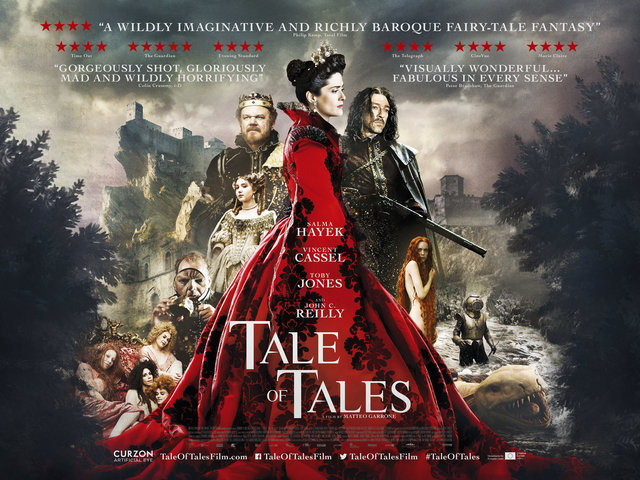
I bloody loved this film. It has everything I love in one place- fairytale s (the dark kind), kings & queens, tricks & spells, deals & plots, oaths & secrets, love & betrayal and tales of the unexpected. It’s all told so well, with so much love and care, with everything looking absolutely gorgeous. Last week I criticized Alice Through The Looking Glass for many things (see my review here)  but the main one was for being a ‘film which feels like it was made by people who read a book called ‘Pretending To Be Weird For Dummies”. Those ‘people’ need to go see this because this is how you do it. If you’re looking for strange, dark and morbidly entertaining tales then look no more!

The Queen of Longtrellis (Salma Hayek) is desperate to have a child but everything she and her husband (John C. Reilly) try fails to work. When a mysterious stranger, a necromancer (Franco Pistoni), visits the castle he offers a risky solution. They need to find a sea monster, kill it and then have its heart cooked by a virgin which the Queen must eat. She will fall instantly pregnant. The necromancer warning that this will be at the cost of a life – a warning the Queen ignores. 

The King of Highhills (Toby Jones) befriends a flea that appears to be able to follow instructions. A friendship soon blossoms and the flea grows and grows. When the now extremely and unbelievably large flea dies the King uses  the flea’s skin as part of a game – whoever can guess the what animal the skin belonged to will get to marry his only daughter. Such a shame for Princess Violet (Bebe Cave) that it’s an ogre who guesses correctly. 

The sex-obsessed King of Strongcliff (Vincent Cassel) hears the voice of an angel whilst prowling his kingdom. He pursues the voice and demands to seduce her, not knowing the voice belong to an elderly woman Dora (Hayley Carmichael) who lives with her equally elderly sister Imma (Shirley Henderson). Dora intends to lead the King along, knowing that she is putting her’s and her sister’s life in danger. A chance meeting with a witch provides her heart’s greatest desire – but is it too good to be true?

That’s only the beginning of each tale. There’s so much more for you to see – so much of which is unexpected, some of which is slightly scary, and all of which is a true pleasure to watch. It’s a feast for the eyes, the brain and the heart. The performances are all solid and utterly believable. There’s depth within each character, a reason and motivation rooted in their decisions. Hayek is stand-out, as is Toby Jones as a man who shifts from arrogance (‘ha ha they’ll never guess what animal it is and I’ll keep my daughter forever’) to devastation (‘Now my son-in-law is an ogre!’) in truly sympathetic manner. Even Cassel’s lustful pursuit manages to be bizarrely sympathetic for all parties involved.

The three tales are interwoven, tentatively linked within the story but fully linked in terms of message. The three tales are based on stories from a 17th Century anthology, they are La Cerva Fatata (The Enchanted Doe), La Pulce (The Flea), La Vecchia Scorticata (The Flayed Old Lady)- but they have been freely adapted with elements of other tales by Giambattista Basile, as well as a touch of artistic license. Although set in a medieval Italy it does feel that their are messages being targeted the audiences today – about consequences of decisions and the nature of family.

The costumes are jaw-dropping, the monsters Kafkaesque, the settings breath-taking, the soundtrack haunting yet never overwhelming and the performances totally memorable. Films like this don’t come around very often so see it whilst you can!

4.5


Green Room

An intelligent and electrifying horror

Usually me and horror don’t mix particularly well. Almost two months on and I am still occasionally haunted by visions of Black Phillip the goat from The Witch and I still feel a bit twitchy when I think about what I would do if I were to be trapped in a basement 10 Cloverfield Lane – style (is it normal to worry about that as a hypothetical scenario..?) But then again, Green Room isn’t your typical horror film. Yes there is gore (I’ve become very aware of my hands for the past hour since watching) but it is never overused. Whilst the narrative follows a ‘well-that-escalated-quickly’ structure it is founded in a series of cause-and-effect plot points that seem both believable and terrifying in equal measure. Then when you chuck in the superb pacing, swift editing, nerve-shredding soundtrack and  some superb character performances…well you’re in for a great time!

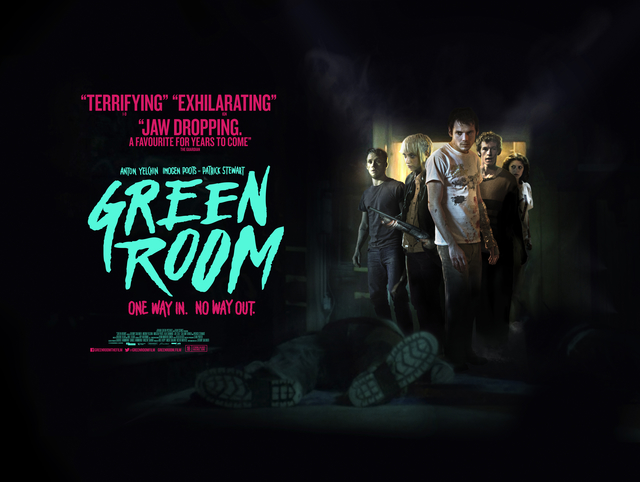
“The Ain’t Rights” are a punk band who are travelling through the Pacific Northwest, playing gigs and scrummaging whatever they can to get by.  The band – formed of Pat (Anton Yelchin), Sam (Alia Shawkat), Reece (Joe Cole) and Tiger (Callum Turner) – end up playing a gig in rural Seaside, Oregon to a club filled with Neo-Nazi skinheads.Upon seeing their Anti-Semitic surroundings Pat jokingly suggests they play a cover of The Dead Kennedys “Nazi Punks Fuck Off!” The band play the song during their set to  a less than receptive audience. Set over and cash in hand they make a move to leave, a move which the show organiser hastens to speed up, when Pat has to run back to grab the band’s mobile which they left charging. He stumbles across the scene of one of the skinheads leaning over the body of a young female punk with her still-alive friend Amber (Imogen Poots) rendered numb in disbelief. The band are then locked in the green room with the pair and the dead body. Reinforcements are called in the form of club owner Darcy (Patrick Stewart). The band have seen too much. Will any of them make it out alive?

There are so many reasons to like this movie. I want to say enjoy but considering the subject matter and content the verb ‘enjoy’ seems in rather poor taste. Semantics aside this is a cracking horror film. The slow-build of tension, the overwhelming sense of inevitability and the shock factor of many of moments. This is a film made with an equal blend of style and substance. The film looks damn good – the shots are well chosen with some excellent lighting choices that make for truly memorable sequences.

All of these factors would be pointless were it not for the excellent performances that drive the story. The characters are presented in a way that is a balance between wanting them to live but not really knowing them well enough to mourn any losses that occur on the way. You experience a degree of ‘oh no!’ because you care about them when certain things may or may not happen but are detached enough from them to not feel too aggrieved should/when something happens to them. Yelchin is superb as the accidental leader of punk trope. Poots is truly kick-ass as a female character who is not just cast to the sidelines, doesn’t spend the entirety of the film in shades of hysteria and who is capable of holding her own in certain situations. This is definitely/hopefully  showing a changing of the tide in Hollywood horror as her character is in line with that of Mary Elizabeth Winstead in the aforementioned 10 Cloverfield Lane. And then there’s Patrick Stewart as a properly scary baddie – whose calm and collected demeanor is unbearably (in a good way) unnerving to watch.   

Tense and taut (clocking in at 94 minutes) with some powerfully acted performances along with an admirably well-written script that is black humour laden this is definitely worth a watch.

4 stars

Son of Saul

A Masterpiece

When I left the mid-day screening of this film it was sunny outside. Bright rays gleamed upon the cinema and I glared at them. As I walked home there was a busker singing ‘Walking on Sunshine’. I glared at him. As I passed through a heaving farmers market I glared at the merry people chomping away. I couldn’t work out why I was reacting in this way. Ordinarily I would be thrilled by walking out of the cinema into sun. I would beam at a busker singing Katrina and the Waves 1983 seminal feel-good classic. And I’d probably only side-eye the hipsters filling the farmers market. Why was I so angry at everything? It seemed obvious that it was most likely my  response to the film and the horrors it entailed. But these were not horrors that were new to me – I hadn’t learnt anything new and the events of the film were horrifically familiar.

That’s when I fully grasped just how masterful ‘Son of Saul’ is. It’s almost a rethink of how to portray the Holocaust – by not showing it at all. Gone are any attempts at glamorization, of showy melodrama or noble heroism. Instead we are shown pieces of events – snippets of the evil that took place only feature in the side of or outside of the frame. Overt dramatization is replaced by close-up and over-the-shoulder shots with shallow focus on our central characters face. We hear the events but we don’t see them – leaving the spectator’s imagination to join the dots and fill in the gaps.  As Alfred Hitchcock said, “A glimpse into the world proves that horror is nothing other than reality.”.

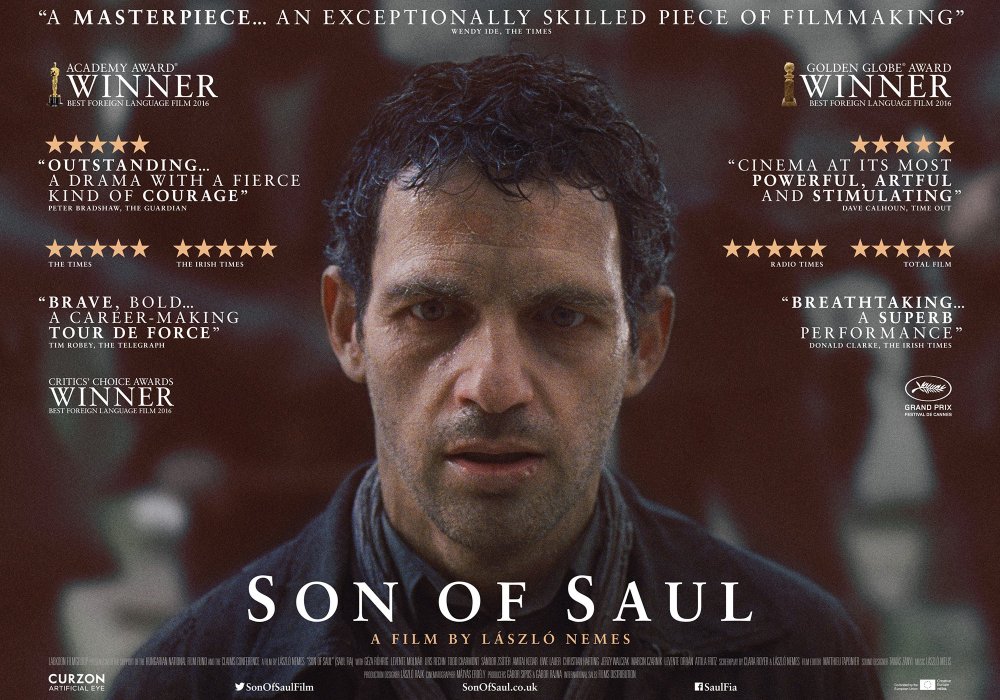
It is 1944. Saul (Géza Röhrig) is a Hungarian-Jewish prisoner at Auschwitz who is part of the Sonderkommando unit. He is forced, under threat of death, to work for the Nazis in removing the “‘pieces” (the term used for bodies) from the gas chambers. Although the job delays his death it is only a temporary pardon – the job, and therefore his life, has an expiry date of five months which he is fast approaching. When clearing out the chambers post-gassing he finds a still-breathing boy that he believes to be his son. The Nazi doctors swiftly suffocate the boy and decide to have an autopost performed on him to find out how he survived. Saul desperately endeavours to stop the autopsy and find a Rabbi to lead a proper burial for the boy. 

 The events that follow are unforgettable in terms of content and portrayal – relentless and horrifying yet the carnage is skillfully implied as opposed to being explicitly shown. The two hours spent watching this film are two hours spent being a spectator in Hell. Death is not shown but instead resides off-frame – an omnipotent and omnipresent force haunting the frame. Just as one should not look directly into the sun we cannot look directly into the face of evil.

The opening sequence must be forever acknowledged in its audacity and its viscerality. We observe Saul as a sheepdog figure, one of many leading herds of bewildered people into what appears to be a changing room. An off-screen voice offers reassuring sentiments they are going for a shower and offers promises of what will follow. Our focus never leaves Saul’s face as we swiftly realise with unbearable inevitability what will happen next. We don’t see the people enter the gas chamber. We don’t see them die. But we do hear them die.

Rohrig’s performance is truly exceptional – his Saul is haunted and hollow. Grizzled by the unspeakable horror, his jaw is rigid with determination and his eyes are empty. We can only wonder how he keeps on living. The fact this is Rohrig’s first performance, as it is the director’s first feature, only adds to the remarkability of this film.

It is unbearably difficult to write this review – every word or phrase seems inadequate to fully describe the soul-altering experience of watching. It leaves you so numb you can no longer cry. Unlike any other Holocaust film there is nothing here to sweeten the devastating blow of watching this film – no beautiful musical score, no magical rescue and no story of redemption. It’s an intense and immersive experience with a the visceral immediacy it provokes that is ultimately necessary. Truly unforgettable.

five star


Louder Than Bombs

What happens to a bomb that doesn’t explode?

My response to this film is surprisingly (well it would be to my past self) problematic. If I had reviewed it soon after watching yesterday I would have been rather damning of the film. Now, with roughly 28 hours worth of distance from seeing it, I feel slightly warmer towards it. (Only a few degrees mind – let’s not go crazy). With a level of retrospect I can admire the ideas and ambition of the film, something which I wouldn’t have been able to do initially after watching. However, whilst I may feel softer towards it I am still not a fan and think the film is largely unsuccessful it what it wants to achieve.

Three years ago famous war photographer Isabelle Reed (Isabelle Huppert) died in what most believed was a car accident. Now, as a museum retrospective of her life and works is fast approaching, her close friend is about to write an article about her in the New York Times and as he advises her widower Gene (Gabriel Byrne) he will mention in the article the fact that her death was most likely suicide. Gene must now find a way of telling his youngest son Conrad (Devin Druid) the truth before he finds out through other means. An opportunity to do so arrives when eldest son Jonah (Jesse Eisenberg leaves his wife and newborn daughter to come home and help look through his mother’s work space to find photos for the retrospective. Whilst home Jonah must find a way of coming to terms with the past in the form of ex-girlfriend, his brother’s difficult present and how his future role as a father may be shaped by his relationship with his own. 

It’s interesting that through writing the above plot summary I found myself again warmly engaging with the key ideas of the film. All of us have been touched by some sense of loss and each of us will handle the grief in different ways – some may mentally stay in the past with that person whilst others may push such thoughts aside and stay primarily focused on the present and future.

All of the actors do a fine job in subtly portraying grief. Byrne’s father trying to do the right thing for his two boys whilst watching his relationships with both fade away truly pulls at the heartstrings and occasionally at the bone. Druid plays the difficult emotionally stunted teen finely and somewhat reflecting the universal horror of adolescence. As difficult as my audience-actor relationship is with Eisenberg (forgiveness for his version of Lex Luthor is still far far away) but at times I did appreciate his character Jonah. I can say quite honestly that in the film’s opening sequence I even enjoyed watching him.

But it’s Huppert’s grief that is perhaps the most visceral, even though it is she that is being grieved by the family she left behind. It is a roughly two minute sequence about halfway through the film that really demonstrates this. The camera just focuses on her face in close-up for two minutes. For those two minutes nothing else happens. But as we know her character and we know the emotional battles she suffered (between her art and being a mother/wife) we read the metaphorical scars on her face. We look into her eyes and see the utter despair. We look behind her mask in a way we either chose or are unable to do with each other in real life.

All of this being said I think these ideas are stunted by execution. Though the pontification and using on the nature of grief is extraordinary and truly applaudable, either through intention or accident we are unable to connect with any of the characters – all are pretty unlikeable on various levels and for various reasons. It’s this aspect of the film that will and has been truly dividing audiences. Perhaps it is intention – that grief cannot and should not be sugarcoated, sometimes it will bring out the worst in each of us. However I am in the camp that views this as a flaw and something that prevents me from truly connecting with the film.

Whilst I well and truly admire the film’s sentiments and ideas by borderline disdain for it’s characters stops me from truly appreciating its merits. The fact the film takes a rather poetic storytelling approach, of drifting between moments, of days being indefinable, of present day being interchangeable with memory, did was not cohesive enough for me. In some ways I write this paragraph with a degree of apology, as someone who lost a relative (my uncle) in June and will soon be facing the prospect of that first anniversary without him. Sometimes I reflect on whether I am grieving ‘properly’, if I am approaching my grief ‘healthily’ and if I am ‘normal’ in my response. The film carefully weaves these ideas into it’s narrative but somewhat abandons them in favour of artistic statement and style.

Whilst full of poignant moments the film is ultimately too cold and reserved to provide the cathartic intimacy it appears to wish to provide.

2 stars