Alice Through The Looking Glass

Disney provides a sequel that no-one actually asked for

Alice Through The Looking Glass is, quite literally movie-making by numbers. The end-product is tick-boxing, almost as if it is following a guide called Pretending To Be Weird For Dummies, but it was only ever made due to the admittedly very large numbers of the first film. Six years ago Alice In Wonderland made a worldwide total of $1,025,467,110 at the box office. It currently ranks at number 23 of the highest grossing films worldwide. It’s therefore not unsurprising that this film was made, though the fact it took six years to get it done is and the fact its sequel film is equally mediocre is no excuse at all.  Interestingly Alice Through The Looking Glass was predicted to earn $55–60 million  from its opening weekend but instead earnt only $27 million. Alice In Wonderland earnt $116 million  in its opening, a difference with its sequel of 70%.  Considering it earnt so much money Alice In Wonderland had a frosty reception with critics and audiences alike. Clearly the people sat around the table who greenlit Alice Through The Looking Glass cared more about getting money out of its audience as opposed to actual enjoyment or satisfaction. Deciding to see ATTLG was due to curiosity and to quote the 1951 animated Alice In Wonderland, “Curiosity only leads to trouble.”

Alice (Mia Wasikowska) has spent the past three years sailing the high seas upon her father’s beloved ship ‘Wonder’. Alice returns home she finds that her family’s finances are so poor that they will have to either give up ‘Wonder’ or the family home. It’s at this point that Absolem (Alan Rickman) in the form of a butterfly calls her back to Wonderland. The Mad Hatter/ Tarrent Hightopp (Johnny Depp) believes that his family may actually still be alive. No-one else believes him which is causing him to fade away. Alice must use a time travelling device stolen from Time (Sacha Baron Cohen) to save Hatter. Old foe Red Queen (Helena Bonham Carter) wants the time travelling device for a different reason, to get revenge on her sister White Queen (Anne Hathaway). Will Alice succeed in her mission to save Hatter, will she be intercepted by Time or will Wonderland be destroyed forever through her trying to change time?

 SPOILER ZONE (SKIP THIS PARAGRAPH IF YOU WISH TO AVOID SPOILERS) The main problem with this film, its fatal flaw if you will, is that so much of it is so utterly pointless. Time tells Alice from the outset that she can’t change time. But she tries anyway, for an hour of the film’s running time, only to find out that she can’t and in the process may have destroyed Wonderland for ever. Not only does it lead to feelings towards Alice akin to my current view of Bran from Game Of Thrones ( I still can’t hear the phrase ‘Hold The Door’ without nursing an internal sob) but there’s also an ironic feeling of having had your time wasted. Time is established as a villain who accent-wise seems to be impersonating Arnold Schwarzenegger yet arguably (this may have come about due to my less than satisfied feelings towards this film) he was surely trying to do the right thing? Alice is the one who nearly destroyed everything, yet she is the one lauded and celebrated from stopping it happening..? 

Anyways…the big problem that Alice In Wonderland had was that it tried to be weird. The ridiculousness of Johnny Depp’s Mad Hatter personified this problem with a truly grating performance. Mercifully he has less screentime in this one but it is still enough to make you wince and feel slightly creeped out. It’s a combination of make-up, costume , performance and vocal choice that I just do not understand. Wasikowska is wonderful as Alice, an actual wonder to watch in a land filled of synthetic versions of it.In fact I’d argue the film’s best moments are when Alice is bringing that wonder into the real world – how society views her with such ill-regard and her brief stay in the ‘care’ of female hysteria speicliast Dr Bennett (an underused Andrew Scott) are moments when the film feels real fresh and lacking the self-consiousness that lingers of the rest of it.

A surprising appearance of Richard Armitage as King Oleren reminded me of Middle Earth and how Peter Jackson managed to create a fully fledged world that athough different from ours seemed equally real. That has not happened with AIW or ATTLG. Instead we’ve been given two films that try to be quirky and strange yet are truly not – neither film has heart to it – and are instead synthetic manifestations of it. The first film may have succeeded on trying to profiteer from the ‘strange’ but the huge defeat of its sequel suggests that people have learnt their lesson. On a grander scale it’s hard not to ponder what this huge loss means for future Disney films. Nearly all of Disney’s upcoming slate is of remakes or reimaginings as they seemed to be safe entities with a pre-sold audience. Just a few weeks ago with Jungle Book (click here to read my review)  Disney proved it could do it well. But after this, I’m not so sure now. Hollywood has taken an approach of putting all of its eggs (monies) into one safe basket (a film based on a book/previous film) yet the scale of ATTLG box office after numerous others may require a change in thinking.

A huge budget and elaborate sets yet no-one appears to have worried about the plot. It’s a mess.

1.5stars

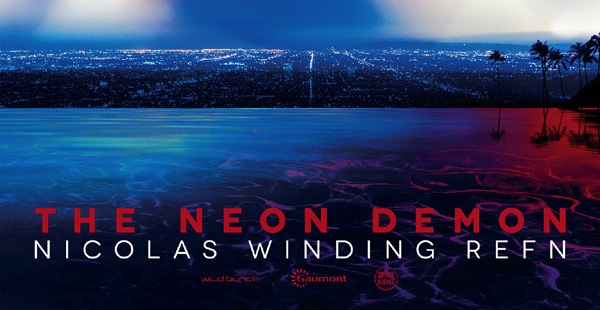
The Neon Demon

“Beauty isn’t everything. It’s the only thing.”

Where to start? Yesterday I had the privilege, courtesy of Little White Lies film magazine, to attend a preview screening of Nicolas Winding Refn‘s The Neon Demon, at the very schmancy Soho Hotel with my friend Galia. The film is not released until June 24th in the States and not until early July in the UK. However the film had its international premiere at Cannes last month which led to a substantial amount of reviews. As it stands on June 2nd the film has a rating of 6.8/10 on IMDB and 47% on Rotten Tomatoes. It’s looking like The Neon Demon is not going to be the new Drive (7.8/10 and 92% respectively) and there’s one really good reason for that. Refn’s return to LA is with a film that confuses depth with emptiness, mistakes meaning with vapidity and chooses style over substance. The result is an exploitation movie disguised as art, smothered with layers of pretension.

16 year-old Jessie (Elle Fanning) has just moved to Los Angeles. No-one appears to know or care that she is there. Jessie knows she is beautiful, She also knows that beauty is dangerous and that other women would kill for it. After her first photoshoot with amateur photographer and potential love interest Dean (Karl Glusman) Jessie is befriended by makeup artist Ruby (Jena Malone). Ruby offers to be the friend Jessie so desperately needs yet Ruby’s other two friends Gigi (Bella Heathcote) and Sarah (Abbey Lee), models only slightly older than Jessie, view Jessie instead as threat and competition rather than a new-found friend. It soon seems like everybody in LA wants a piece of Jessie, her beauty is admired and envied in equal measure – but what will it end up costing her?

What rather infuriates me reading back the plot summary I have just written is that I have made the film sound fun. It isn’t really. Moments of the film are, when the film casts a satirical eye on LA and the modeling industry, but when the film loses focus and Refn seems busy being self-congratulatory about his own brilliance – that’s when you see the film for what it really is. Vapid and empty. I’m sure it would be easy to argue that was intentional, a reflection of the 21st Century’s perception of models and beauty (blah blah yah yah)… but no.

13336104_10100855380438146_7474404562862228996_n (1)

Prior to the film’s screening its director and lead were invited to talk about the film and answer some questions (picture courtesy of Galia). Refn said, and not for the first time in the promo for this film, that ‘I wanted to make a film about the 16-year-old girl inside me’. This resulted in awkward stifled guffaws from an audience who hadn’t yet seen the film. For the first half of the film there are instances where you can see very loosely what he means by this. Jessie’s interactions with casting agents (Christina Hendricks), auteur photographers (Desmond Harrington) and wildly miscast ‘scary’ motel owners (Keanu Reeves) explore the vulnerability of the young in an industry that can be so parasitic and vampiric. It is during this period that the cast really shine. Fanning possessing an ethereality – an otherness that draws yet repels – Malone unnerving as a metaphorical wolf in friends clothing, Heathcote and Lee wonderfully cold as Jessie’s rivals.    

It is these more conventional moments that are some of the most engaging. They are intersected with moments that are more exploratory and ‘artistic’ (read: rather deluded and self-indulgent). These moments are overlong, assaulting the senses in a way that should be poetic but instead aggravate. However the soundtrack during the entire film is phenomenal – throbbing away and pumping tension into each scene. And, it must be said, the use of colour and lighting during these moments and the film in it entirety is truly extraordinary. Refn’s color blindness means that his use of colour must alway be in high contrast so he can see it (fact courtesy of Galia). The use of lighting and colour within each of these sequences establish then reflect the tone and ongoings in each sequence. It’s almost as if his use of colour reflects the dichotomy of the human experience…. (sorry I had to try at sounding like a proper film critic!)

It’s the film’s second half that gives into Refn’s epicureanism, resulting in the film becoming even less of a narrative (there wasn’t really one to start with) and more a spiral of ‘well that escalated quickly’. Things get weirder, even weirder, and then weirder yet. It is these moments that are the most problematic. I like weird. I am weird. But I need my weirdness in cinema to be purposeful. I don’t need to see a character deepthroating a knife without purpose nor a character performing necrophilia on a dead model again without purpose. Don’t even get me started on the shower sequence. I’m not the only one of the audience of about 50 of us who felt this way. The gasps and intensity of audience focus hugely shifted at this point, with the grosequeties accompanied by laughs of disbelief instead of the intended wonder.

These scenes have resulted in extreme horror from The Daily Mail (quelle surprise) with headlines such as “Coming soon to a cinema near you: Grim film featuring murder, cannibalism and lesbian NECROPHILIA that even shocked Cannes is now set for British screens” and “Has cinema ever been so depraved and the censors so amoral? CLARE FOGES on the extreme violence, cannibalism and lesbian necrophilia in new film The Neon Demon” These headlines are ridiculous for two reason. 1) I’m sure anyone who has seen a solid amount of film could name you films more graphic than this one. 2) Such headlines would give its pretentious twonk of a director an egotistical thrill and further fuel his perception of himself as some sort of revolutionary.  He’s not worth it.

The film favours an approach of Message over an actual storyline, choosing to drift between scenes as opposed to following a narrative and having loose outlines as opposed to actual characters. The more extreme moments are so needless they undercut everything that has occurred prior and throw any perception of The Message out of the window. If Refn wanted to criticise the modelling industry these scenes confuse The Message completely. Initially the film relies on the perverse pleasure of being voyeur of the voyeurs (we watch the watchers watching the watched) whilst pointing out the dark side of the industry. Yet once the aforementioned silliness occurs it is is almost like we see the film for what it really is – a mastabororty experiment where Refn gets to sadomasochistically annihilate his inner 16-year-old girl.

There are images and messages galore on offer within The Neon Demon, but the majority of these are like gaudy baubles. Beautiful to look at but totally empty.

2.5

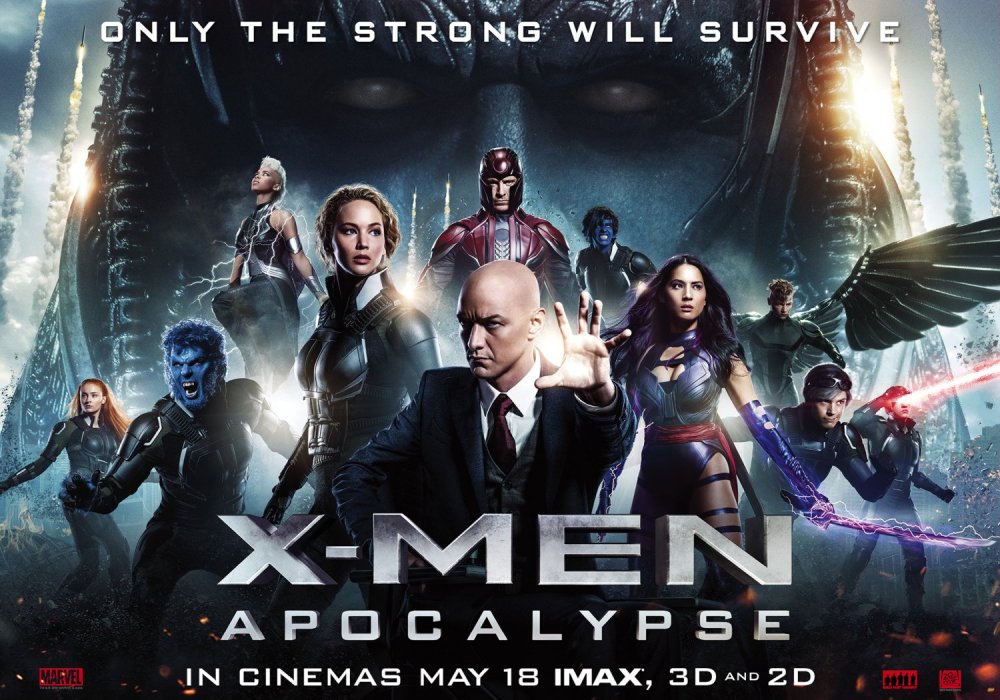
X-Men: Apocalypse

“At Least We Can All Agree The Third One Is Always The Worst”

The above line is uttered by Jean Grey (Sophie Turner) about halfway through the movie, when she and a few other character leave a cinema screening of Return of the Jedi. It’s one of numerous strange self-aware moments within the film. If this had come out a year after Deadpool it could easily be assumed to be a rip-off of the superior film’s meta sense of humour. Instead it comes across as strangely self-satisfied and almost arrogant. Considering her character is telepathic it almost feels like she was reading this viewer’s mind…

10 years after the stand-off with the Sentinel prototypes at White House the X-men have never been so far apart from each other yet have never been so strong individually. Charles Xavier’s School for Gifted Youngsters is full of mutants, with Professor Xavier himself (James McAvoy) and second is command Hank Mccoy (Nicholas Hoult)  keeping a close watch on telepathic protegee  Jean Grey (Sophie Turner) and new recruit  Scott Summers (Tye Sheridan) as both re struggling to control their powers. Raven (Jennifer Lawrence) has become a loner/nomad/mercenary helping other mutants.  Erik Lehnseer(Michael Fassbender) is now a married man with a young daughter. But when immortal physic mutant Apocalypse (Oscar Isaac) rises from a millennia -long sleep  his awakening will have consequences for the world’s population of humans and mutants alike. 

How do you like your squash? I personally like it strong and full of flavour. I don’t like it weak – diluted and lacking in flavour.  That’s my problem with this film. To use this clunky analogy for all it’s worth the cordial (the good stuff) is diluted by too much water (i.e characters, plot and action). Although the ‘too-many-characters-may-spoil-the-broth’ did cause Civil War a bit of a stumble, in the case of this film it forces the film to fall flat on its face. Repeatedly.

Fatal Flaw Time: Characterization is almost completely abandoned in favour of action and set pieces. For fans of the franchise, or any of its other incarnations, we witness one dimensional versions of the characters we know and love. Lawrence as Raven/Mystique spends the majority of the film either wearing a pinched expression of exasperated  discontentment. McAvoy’s dialogue is reduced to  platitudes and mawkish ponderings. Sheridan does little to win favour for Cyclops in the versus Wolverine debate. Turner is okay as Jean Grey but her American accent quickly steals audience focus for all the wrong reasons. And, alhough it was great to see a cool AF version of Jubilee (Lana Condor) hanging around I’d rather her not even have been there as she is bitterly unused. Talk about how to (metaphorically) prick-tease a Fan-Girl!

Then there’s the villains. Fassbender has some incredibly emotionally and engaging sequences but is then too frequently forced to fade into the background. Isaac is criminally wasted, hidden under rubbery prosthetics with a character whose character and abilities are far from defined. The three new characters who join Magneto as the Four Horsemen are completely overwhelmed – Ben Hardy as Angel is ill-served, Olivia Munn as Psylocke weirdly reminded me of this sketch by Mitchell and Webb in terms of OTT villain-face and Alexandra Shipp as Storm seems more than interesting enough but underused. The villainous plot they hatch is of such a scale that is almost becomes bland (think the final 30 minutes of Man Of Steel) and completes overwhelms its characters.

Though, in fairness it’s so overstuffed with characters  it’s almost unsurprising, although not forgivable. The motivation of the characters is devoid of reason and the plan itself lacking real purpose. The plot is also so full of holes (talking Swiss cheese territory here) that it becomes incoherent. There’s nothing new or interesting with the plot, it takes some irritatingly familiar paths, that this film feels tired and bloated in comparison to its counterparts. It’s also so unbearably serious, akin to SvS:DoJ in terms of getting ‘dark’ confused with ‘murky’. 

In fact, upon reflection, the only franchise contribution I enjoyed and I am truly thankful for is that of Kodi Smit-McPhee as Kurt Wagner/Nightcrawler. He is given some of the film’s funniest, sweetest and most moving moments. He’s a real joy to watch and probably the only reason I would risk the (inevitable) follow-up. What I can’t forgive the film for is a sequence that occurs just after the Jean Grey’s line about trilogies. After a rather wonderful and emotional sequence that has been delicately woven the tension is completely destroyed, totally sledgehammered, by a shift in tone that is so jarring it is unbearably stupid.  It’s a sequence involving Peter Maximoff/Quicksilver (Evan Peters – who totally stole the show in Days of Future Past  in the space of 10 minutes of screentime) that I would have undoubtedly loved at any other point in the film. But, straight after such a well-executed and pathos-filled sequence, it is utterly wasted and even made me resent his character. By the end of the film my faith in him was somewhat restored though my love for him has been somewhat tainted. Such an inconsistent moment reflects the very nature of the entire film.

As a teacher I’ve found the true power of saying the following phrase and it’s the only phrase I can find that fully articulates my feelings towards this film. It’s not that I’m angry X-Men:Apocalypse – I’m just disappointed.

2 stars


Louder Than Bombs

What happens to a bomb that doesn’t explode?

My response to this film is surprisingly (well it would be to my past self) problematic. If I had reviewed it soon after watching yesterday I would have been rather damning of the film. Now, with roughly 28 hours worth of distance from seeing it, I feel slightly warmer towards it. (Only a few degrees mind – let’s not go crazy). With a level of retrospect I can admire the ideas and ambition of the film, something which I wouldn’t have been able to do initially after watching. However, whilst I may feel softer towards it I am still not a fan and think the film is largely unsuccessful it what it wants to achieve.

Three years ago famous war photographer Isabelle Reed (Isabelle Huppert) died in what most believed was a car accident. Now, as a museum retrospective of her life and works is fast approaching, her close friend is about to write an article about her in the New York Times and as he advises her widower Gene (Gabriel Byrne) he will mention in the article the fact that her death was most likely suicide. Gene must now find a way of telling his youngest son Conrad (Devin Druid) the truth before he finds out through other means. An opportunity to do so arrives when eldest son Jonah (Jesse Eisenberg leaves his wife and newborn daughter to come home and help look through his mother’s work space to find photos for the retrospective. Whilst home Jonah must find a way of coming to terms with the past in the form of ex-girlfriend, his brother’s difficult present and how his future role as a father may be shaped by his relationship with his own. 

It’s interesting that through writing the above plot summary I found myself again warmly engaging with the key ideas of the film. All of us have been touched by some sense of loss and each of us will handle the grief in different ways – some may mentally stay in the past with that person whilst others may push such thoughts aside and stay primarily focused on the present and future.

All of the actors do a fine job in subtly portraying grief. Byrne’s father trying to do the right thing for his two boys whilst watching his relationships with both fade away truly pulls at the heartstrings and occasionally at the bone. Druid plays the difficult emotionally stunted teen finely and somewhat reflecting the universal horror of adolescence. As difficult as my audience-actor relationship is with Eisenberg (forgiveness for his version of Lex Luthor is still far far away) but at times I did appreciate his character Jonah. I can say quite honestly that in the film’s opening sequence I even enjoyed watching him.

But it’s Huppert’s grief that is perhaps the most visceral, even though it is she that is being grieved by the family she left behind. It is a roughly two minute sequence about halfway through the film that really demonstrates this. The camera just focuses on her face in close-up for two minutes. For those two minutes nothing else happens. But as we know her character and we know the emotional battles she suffered (between her art and being a mother/wife) we read the metaphorical scars on her face. We look into her eyes and see the utter despair. We look behind her mask in a way we either chose or are unable to do with each other in real life.

All of this being said I think these ideas are stunted by execution. Though the pontification and using on the nature of grief is extraordinary and truly applaudable, either through intention or accident we are unable to connect with any of the characters – all are pretty unlikeable on various levels and for various reasons. It’s this aspect of the film that will and has been truly dividing audiences. Perhaps it is intention – that grief cannot and should not be sugarcoated, sometimes it will bring out the worst in each of us. However I am in the camp that views this as a flaw and something that prevents me from truly connecting with the film.

Whilst I well and truly admire the film’s sentiments and ideas by borderline disdain for it’s characters stops me from truly appreciating its merits. The fact the film takes a rather poetic storytelling approach, of drifting between moments, of days being indefinable, of present day being interchangeable with memory, did was not cohesive enough for me. In some ways I write this paragraph with a degree of apology, as someone who lost a relative (my uncle) in June and will soon be facing the prospect of that first anniversary without him. Sometimes I reflect on whether I am grieving ‘properly’, if I am approaching my grief ‘healthily’ and if I am ‘normal’ in my response. The film carefully weaves these ideas into it’s narrative but somewhat abandons them in favour of artistic statement and style.

Whilst full of poignant moments the film is ultimately too cold and reserved to provide the cathartic intimacy it appears to wish to provide.

2 stars

Disorder

An intense and intimate voyeuristic thriller

How many films are there that feature a character with PTSD (post-traumatic-stress-disorder)? Then, let’s narrow it down, how many of the those films are about PTSD sufferers who fought in Afghanistan?  Finally, how many of those films use the PTSD to shape the storytelling process, making the story as unreliable as it’s narrator? I suspect that Disorder may be alone in this regard which makes for a mostly refreshing if at times nerve-splintering film-watching experience.

Vincent (Matthias Schoenaerts ) is a French Special Forces soldier who is currently back from a tour of Afghanistan. His latest health check-up indicates that it will be his last as due to his various  health problems his doctor will not be recommending him for service, something that he appears to be in denial about. He and a group of his friends are hired by Jessie (Diane Kruger), the wife of a rich Lebanese  businessman, to provide security at a party they are holding at her villa. Vincent starts to develop a strange fascination with Jessie, whilst at the same time starting to suspect a dangerous threat is going to target her and her young son, and he begins to be consumed by paranoia. Is there really a threat, or is it a result of his disorder?

A month ago, in my review for A Bigger Splash I talked about Matthias Schoenaerts and said “He is currently one of the most interesting and underappreciated supporting actors in cinema at the moment, and I greatly look forward to seeing more of his (admittedly rather beautiful) self.” After seeing Disorder, I stand by what I said. Schoenaerts carries this movie, his scowl/brooding combination is utilized to excellent effect. His mannerisms subtly display his inner turmoil, he never needs to clearly state ‘I am suffering from PTSD’ (in fact that is something his character who never admit) but it’s clear from every single scene that this is a man who is suffering. Vincent’s innate paranoia served with a side of voyeurism makes for an unnerving central character who is haunted but hunky. In fact whilst watching his performance I remembered some of the minor backlash that James Norton received for Happy Valley with a (thankfully small  minority) saying that he was ‘too good-looking to be a murderer’. It’s a stupendously flawed logic to have, implying that attractiveness and committing crime share a correlation. Yes Schoenaerts is attractive, but that does not enhance nor detract from his performance here. His performance is wonderful, if that adjective can be used to describe something so unsettling, and the best thing about the film.

A close-tied second place would be the soundtrack and the cinematography. The former is throbbing, jarring and frequently atonal (like Vincent’s mental state) whilst the latter is ambiguous, swamped by shadows and at times unhinged (again like Vincent’s mental state). Aside from these aspects, the film itself is rather slow with a rather porous plot that fizzles out. Worth seeing for Schoenaerts latest in an uninterrupted run of solid and charismatic performances, but rather forgettable.

An outstanding central performance in a good/mediocre film. Don’t put it too high on your ‘must-see list’ but worth a try.


Zoolander No.2

Another example of a sequel that is a poor imitation of the original.

In 2001 (15 years ago!) the world was posed a question, a question for the ages, “Have you ever wondered if there was more to life, other than being really, really, ridiculously good looking?” Derek Zoolander found the answer by the end of the film (spoiler alert!) with family, friends and a charity project running “The Derek Zoolander Center For Kids Who Can’t Read Good And Wanna Learn To Do Other Stuff Good Too.” Within the first three minutes of the sequel all of that resolution is turned on it head, then burned to the ground and thrown away. If the intent was to then set up the sequel as being completely different, and ‘fresh’ compared to the original, then the fatal flaw in that plan is writing a film that’s funniest (and only) laugh-inducing moments are references to the original…

Justin Bieber is dead. After running away from assassins on motorbikes (having displayed some serious parkour moves) he is shot countless times. In his dying moments he manipulates his face into Blue Steel and takes a selfie, then gives into his fatal injuries. He is the latest in a long line of celebrities to be assassinated, taking a Derek Zoolander-themed selfie before dying. The fashion division of Interpol need his help but no-one knows where he is. Seven years ago, after the death of his wife and losing custody of his child, he decided to become a ‘Hermit Crab’ and go into hiding. Only one man can bring him out of his slump…

From the opening sequence alone you can tell how the rest of the ‘humour’ of the film will play out. An opening sequence is so key to a film, so crucial for setting the tone and level of the rest of the film. In this case? Well, it’s such a pandering sequence – ‘Hey! You average Joe, you hate Justin Bieber right? So we’re going to kill him off to make you laugh. We can make your dreams a reality. Love us!’ It’s a problematic choice for multiple reasons.

1) Hating Justin Bieber seems so last year/s. He’s had a bit of a renaissance in the past 18 months so the hate has become, for most, either ambivalence or embarrassed adoration. Therefore the slightly dated nature of the script becomes apparent. He’s also an easy target, one of many that are used to minimal effect, within a script seemingly tailored from social media circa 2013/4.

2) It’s an overlong sequence. Stretching out the humour becomes a motif of the film. Pacing of jokes never really seemed an issue with the first film (queue my rewatching it ASAP) but it is a real issue here. The ratio between gag build-up and punchline is definitely off.

3) Having Bieber appearing to do parkour, then being shot at least 30 times before taking a selfie before dying demonstrates how overblown and tacky the film will be. Zoolander No.2 presumably has a bigger budget, gladly and gawdly shows this fact off.

4) He is one of the countless celebrities to be shoehorned into an overwrought and clunky script. Though his role in the events of the story is clear (if rather ineffective) many others are not. A few stand out in terms of strange but also strangely funny (I’m looking at you here Benedict Cumberbatch and Kiefer Sutherland) but others are borderline pitiful (Anna Wintour and your crew, you didn’t, to quote Tim Guun, ‘make it work!’) 

Zoolander No.2 is a difficult watching experience for fans of the original. The plot is thin, the jokes humiliate rather than delight and the frivolity leaves the film rather throwaway. Like its eponymous character, Zoolander No.2 is empty and full of air. It may be filled of those who are ‘really really ridiculously good-looking’ but it’s forgotten that there’s more to life than that.

I hope they had more fun making the film that I had watching it. Disappointing.

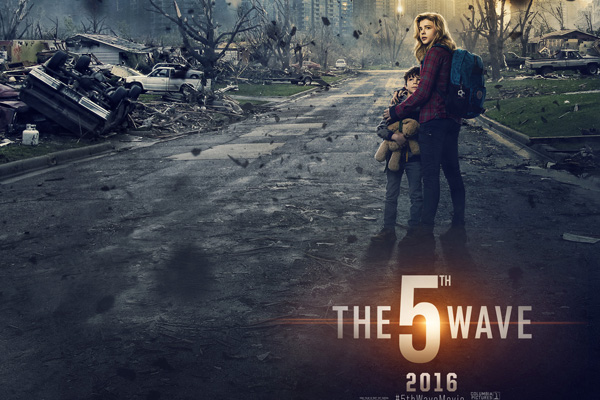
The 5th Wave

The worst film of 2016 (well, 23 days in at least…)

Did you know that discount retailer Poundland (for those outside the UK it’s a shop where everything costs £1, which is roughly 1.32 euro or 1.43 dollars) stocks its own brand of Lego Star Wars? It’s called Battle of the Galactic. It’s an incredibly cheap and tacky-looking rip off of the original. That is what ‘The 5th Wave’ is to franchises like ‘The Hunger Games’ or even ‘Maze Runner’ and ‘Divergent’. It’s cheapily made, poorly constructed and steals the best bits from other films/books then regurgitates them into a mediocre mess. What makes this film even more ‘impressive’ is that it is not even ‘so bad it’s good’. It’s just really really bad and remarkably boring.

Cassie Sullivan (Chloë Grace Moretz) was a ‘super normal teenage girl’. She had friends, went to parties, had a 2.2 family and had a crush called Ben Parish (Nick Robinson) who she spent most of her time day-dreaming about. But then… ‘it’ appeared. Some sort of alien space ship came from nowhere and started hovering above America. For ten days nothing happened. On the tenth day the first attack happened (the 1st wave) and destroyed all electric currents, followed shortly after by waves 2, 3 and 4. Most of the Earth’s population has been killed, with Cassie going with her family to a refugee camp. It’s at the camp that she is separated from her young brother Sammy (Zackary Arthur).  Nobody knows when the Fifth Wave will strike, or in what from it will strike, but it will happen. Against a backdrop of mistrust and fear Cassie makes a desperate journey to find her little brother, on the way meeting mysterious stranger Evan (Alex Roe) who may just be her only hope.

I would like to apologise in advance if, when you read that plot summary above you thought ‘Hey! This doesn’t sound quite so bad!’ Upon rereading it I have made the film sound far more interesting than it actually is. Between each of those events there is so much talking, needless and endless mundane talking, and dire reflecting. Whenever the action picks up it’s then forced to slow again by some pitifully-lacking, poorly-scripted, cliche-ridden sentiments.  For a film that is supposedly the end of the world, the world it features is so dreary and mind-numbingly boring that you do end up wishing for armageddon to happen so the film will end and you can go home.

Considering this film is a 15 (Hunger Games interestingly is a 12A) there is little to warrant it. The action here is so minimal, so bland and lacking in emotion compared to the superior franchise. The set pieces the film possess are so ineffective, clunky and predictable that there is little chance for escapism. The film becomes more and more absurd with each mind-numbingly boring sequence, yet remains utterly lacking in enjoyment. There is an occasional some-what amusing joke that gets shoe-horned into the narrative, but these moments are few and far between.

However, there was one factor about this film that was really reassuring – that will allow me to sleep a little lighter at night. The one thing I did learn from this film was that no matter how bad the alien apocalypse gets, I can still get my beauty products. There’s Moretz’s survivalist with the perfect hair, the sergeant (Maria Bello) with the perfect lipstick/foundation combo, and the smoky kohl-rimmed eyes (a pretty bad-ass Maika Monroe). It’s immensely reassuring to know that no-matter how desperate my battle for survival may get, my look will still be on-point. 

This film is not entertaining enough to hate-watch, or to watch ironically. There’s not even enough to make a drinking game out of it. I can’t even be bothered to turn this into a film rant. It’s just bad. It’s cheapily made, lazily shot with adequate-enough acting. The obvious intention is for this to be the start of a new franchise, one which nobody will want. In a week where I got to see ‘The Revenant’, a film which proved the potential power that film can have, I endured this film which shows that not everyone can handle the responsibility that the great power of cinema can have.

Watch it. Or don’t. Either way – it’s bad.


Burnt

A rather overcooked romantic dramedy

Does anyone these days aspire to be Gordon Ramsey? Do they wish to control a kitchen as their lair, spewing and spouting swearwords and insults as they prowl? Ramsey had his peak popularity in the mid-noughties, which is probably when this film was first placed on the boil. It then got forgotten about, rushed to be finished with all of its ingredients past sell their best before date.

Adam Jones (Bradley Cooper) is in New Orleans shucking oysters, noting down the amount as he does so. He hits one million, downs his tools and walks out despots protestations of his employer. Those million oysters were his penance for his past indiscretions, now complete he can have a second chance. He goes to London to reunite his crew, although there is much bad blood between them. Adam was a rock star chef in 90s Paris – renowned for his ability and persona. However Adam was also a drugs, alcohol and sex addict who managed to burn all of his bridges who was forced to flee Paris and go into hiding. He must be forgiven by his old friends and new (Sienna Miller’s Helene) to his dream of three Michelin stars.

The film’s main ingredient (when will the cooking puns end?!?) is Bradley Cooper. Considering the fact the film’s main plot is so outdated it is perhaps the only reason people will go to see the film. However his character is so unappealing and unsympathetic that you’ll feel had. His character’s closest real-life counterpart is Gordon Ramsey, swearing continuously and having frequent blow-ups about food, with every other character either swooning over his apparent but unproven genius or admonishing him for wasting said-genius. There is genuinely no reason to like his character, which is this film’s fatal flaw. As the narrative limbers from one ‘disaster’ to a next tension is supposedly created by our concern on how he will cope/survive. If we don’t like the character enduring the trials then we don’t really care. This isn’t helped by the lack of realism within these trials – he is hounded by drug lords for the money he owes them. These drug lords are immensely polite, turning up occasionally to speak to him away from other people, and only visiting once or twice to hound him for the large amount he owes them. We are meant to care about Cooper’s character – experience concern that he may not achieve his ambition for three Mitchelin stars. Instead we experience disinterest or distain for such an ass-hat of a character.

Sienna Miller however is gutsy, transforming herself into a tattooed, pierced and partly shaven-haired single mother sous chef. Her character is far appealing than Cooper’s. Yet she is forced to endure conversations with Cooper’s character of the nature of food and eating. These conversations are nauseating to watch, not because they are hunger-inducing but for the sheer pretentiousness of their proclamations.  ‘We eat to stop eating.’ – That’s sooo deep! The rest of the friendship group are entertaining if one-note; the ex-prisoner, the novice, the daddy issues, the rival etc. The script is bland, drifting from one drama to another, and filled with stupid lines about how John Adams used to be an addict and how he hurt people when he was an addict. It’s all so ridiculous and bordering-on fluff.

If you’re seeing this for Bradley Cooper then don’t waste your time. If you’re seeing it for the food, just re-watch an episode of Hell’s Kitchen. An incredibly dated waste of a movie.

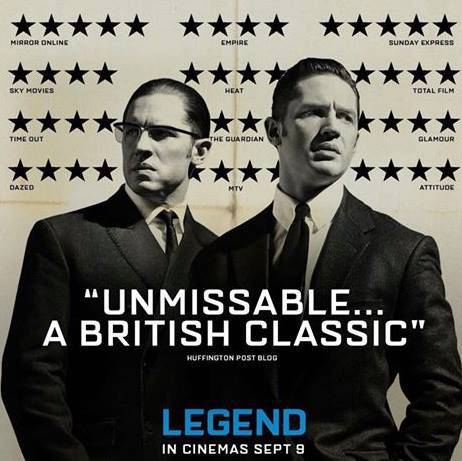
Legend

Two Tom Hardy’s don’t make for a Legend-ary film

On paper, this film seems like a great idea. The Kray twins were London’s most notorious gangsters – two men who both enjoyed being gangsters and what it entailed. Having Tom Hardy, one of cinema’s men of the moment, felt like a logical next step. After Armie Hammer successfully played the Winklevoss twins in The Social Network, having Hardy playing the central dual role didn’t seem outlandish. In practice, his performances do work. It’s the rest of the film that really doesn’t. With a wealth of material out there on the Krays, with so much of the truth being better than fiction, it’s frustrating how much Legend misses the mark.  Although the film is marked as charting ‘the true story of the rise and fall’ it does no such thing. The ‘true’ bit is questionable after some post-screening research, and ‘the rise and fall’ is false-advertising. The film opens when the Krays are comfortably on the rise (so much so they are under constant police surveillance) and ends just before the start of the fall. The decision to pick these two periods as plot-points seems questionable, as a narrative they are not the most engaging, nor do they provide the audience with enough information to get them engaged. Audience members will be left with countless unanswered questions, no information about how the pair actually achieved this ‘rise’ nor the events or the aftermath of the ‘fall’. It seems ridiculous for a film with a 130 minute running time  to have such serious gaps, even more so when it is filled with such needless fluff that make the film feel boring and far longer than the actual running time.

Our entry character into the world of the Krays is Frances Shea (Emily Browning). Frances meets Reggie Kray (Tom Hardy) as her brother (Colin Morgan) works for Reggie as a driver. It’s heavy-handedly alluded that Frances has a history of mental illness, she’s ‘fragile’ and just returned home after ‘being away’. Little more information or film time is given to this, which is unfortunate as it could have increased the impact of France’s characterisation. It’s also doubly unfortunate as it could have created a nice parallel with the character plotting of Ronnie Kray (also, Tom Hardy). In the film’s single funniest sequence we witness Reggie visiting his twin, whose prison sentence resulted in being institutionalised and being declared certifiably insane. During this sequence we are informed that whenever Ronnie was uncertain or confused by what people said he would respond ‘interesting’. It’s a quirky touch that could have been utilised for greater effect. Their reunion is intercut with a conversation with a Kray heavy negotiating with a physiatrist for an all-clear for Ronnie. Ronnie is released from the mental hospital, leaving Reggie to start balancing loyalties to the two most important people in his life – Frances and his brother. These relationships are the main focus of the film, not the brother underworld careers. If you were looking for a ‘proper gangster’ (a phrase of Ronnie’s) movie, you’ve come to the wrong movie.

Frances and Reggie date for an unspecified amount of time, then become engaged for an unspecified amount of time and then marry for an unspecified amount of time. Not having a timeline for this period is frustrating, and furthers the sense of the film drifting from one sequence to another. This is a fatal flaw for two reasons. Firstly, the film appears to have strived to place character development over story arc yet there is no stand-out antagonist, rarely a clear motivation for character’s actions, and often no clear link between sequential scenes.. The film tries to restrict itself to how these events impacted the relationship between Frances and Reggie. This leads to the film’s second major fault, which makes Legend such a muddled and convoluted mess. If Frances was our entry point, and the focus is on her viewpoint on events, why are we shown events that she was not at and would never have known about? Reggie and Ronnie attend events and confrontations that would have been concealed from France’s knowledge as, in their eyes, she would not have needed to know what was going on. This flawed decision is empathised with the use of voiceover narration, with Frances narrating the majority of events. The use of voiceover narration in Legend is not used to great effect, it’s cloying and sentimental. The fact she narrates over events that would have been unknown to her confuses whether her viewpoint is truly restricted, as it would have been during the time of the actual events, or has been promoted to omniscient which then undercuts the themes and tone of the film.

Watching Legend makes for an exasperating cinematic experience. The cast do a truly fantastic job with the material they have been provided with – Hardy is suitably magnetic as Reggie though a bit of a caricature as Ronnie, Browning gives her best performance to date and Taron Egerton steals every scene as Teddy Smith – but that material is banal and structurally incoherent. Disappointing.

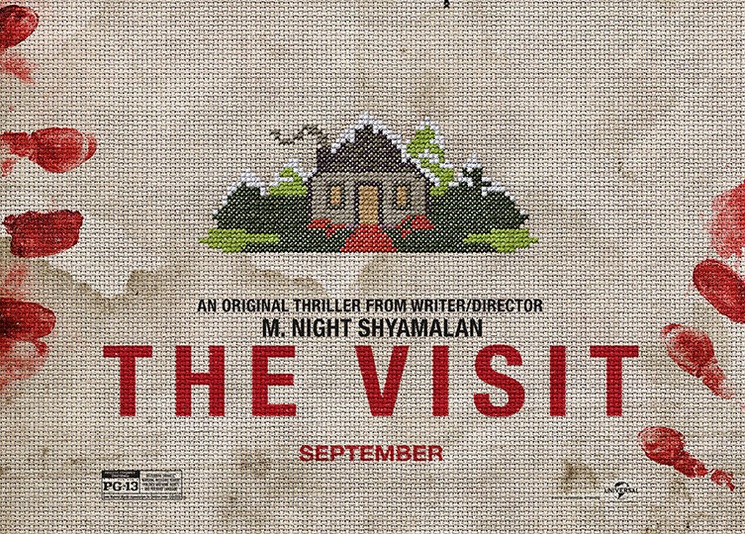
The Visit

Spoilers. Spoilers. Spoilers.

Aged nineteen a small town girl, living in a lonely world, ran away with a substitute English teacher. Her parents had tried to persuade her that it was an awful idea. They had begged her to stay. On that afternoon, before she fled, something ‘awful’ happened during that confrontation, which led to the relationship between her and her parents being severed. The girl and her now-husband had a baby girl shortly after, followed two years later by a baby boy. Ten years later the substitute English teacher ran away with another woman, leaving behind his wife and two young children. A difficult five years followed, with the three still struggling to come to terms with the abandonment. That’s when a message arrives from her parents, who found them online. They acknowledge that it may be difficult to re-establish their relationship with their daughter, but would love to start one with their grandchildren. The grandchildren agree and beg to visit their grandparents. The mother reluctantly agrees, sending them off to her old hometown, whilst she herself goes on holiday with her new partner.

The grandchildren make their own way there by train, and are met at the station by their anxiously waiting grandparents who are holding a banner decorated with welcomes. They drive back to the family home, and a mutual fondness is formed. The grandparents dot on the grandchildren and their quirks, and the grandchildren are bemused by these old folks whose bedtime is 9:30pm. At 10.15pm the granddaughter leaves her bedroom to be greeted by her grandmother pacing the downstairs in a trance and projectile vomiting. The next day this is explained away by a tummy bug.

For the rest of their week-long stay the grandchildren realise that there is more than just character quirks going on here, something is seriously wrong. What makes them think this? The grandfather stores hundreds of used adult diapers in the shed. The grandmother runs around the house naked at night scraping the walls and crawling around the floor. She sits in a rocking chair cackling to herself whilst staring at the wall. She chases them underneath the house. She has a breakdown whilst discussing ‘that afternoon’ and also spends one night waiting outside the grandchildren’s room holding a knife.

When having a conversation via Skype with their mother they hold the camera towards the grandparents and the plot twist is revealed – those are not actually their grandparents. The mother tells them to try to escape and that she is on their way. The grandchildren are trapped into playing a game of trivial pursuit, during the course of which all is revealed. For when the granddaughter escapes into the basement she find the bodies of an elderly couple – a framed photograph beside them reveals that they were her grandparents. The imposters are escaped mental patients, who wanted to pretend to have a family just for a week. They were jealous of the actual grandparents, who were volunteer therapists. In fact, the fake-grandmother had actually drowned both of her own children.

Two confrontations happen, with fake-grandfather rubbing a used diaper in the face of the grandson and the fake-grandmother chasing the granddaughter around a locked bedroom. The granddaughter kills the fake-grandmother with shards of a broken mirror. The grandson, with the aid of his sister, kills the fake-grandfather by slamming his head in the fridge doors multiple times. The mother then arrives and takes them to safety; the final scene has the mother revealing the ‘awful’ events of that afternoon fifteen years ago. She had slapped her mother and her father had slapped her in return. Fade to black.

There are so many issues with this film it is hard to start. So instead of a normal review, which would instead become an incomprehensible and lengthy rant, I will instead use bullet points to divide these issues into sections.

  • Child Safety: The fact the mother does not actually check the children have been collected by the right people. Yes, she has not seen or spoken her parents for fifteen years who explain her reluctance to do so, but surely any parent would want to perform some sort of check? This aspect then undermines and already ridiculous plot twist. During the week the mother tries to explain away the oddness of the grandparents by stating that they elderly. But, realistically, the problems that the grandchildren are describing cannot be explained by that when considering how old the grandparents should be. If the mother was nineteen when she had the children, the oldest of which is now fifteen, her parents really couldn’t be much older than seventy. When her children describe these incidents to her, wouldn’t she be shocked that her parents were acting in such a way?
  • Plot twist: After a week of increasingly terrifying antics from the grandparents – which they attempt to explain away with a night-induced form of sleep disorder as well as a– to explain be explained away by the fact ‘well, they were crazy’ is so flawed and archaic that it’s offensive. Considering this is 2015, to have a portrayal of escaped mental patients is already asking for trouble, but to then assign them traits such as staring into the distance at nothing, an obsession with bodily functions, homicidal tendencies (involving knives, hammers and ovens), crawling along floors, scrapping at walls and screaming is disturbing in its facileness. The fact that both grandparents try to explain away their behaviours with varying excuses such as dementia and Alzheimer’s may anger some, let alone the fact the children do not question whether these things could actually be related to the frightening behaviour of their grandparents, is also problematic.
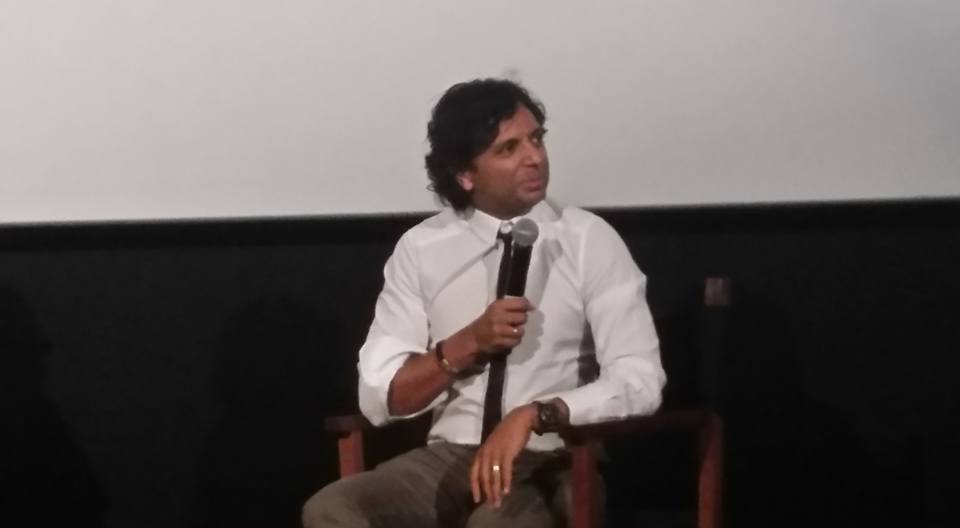
  • Storytelling: This is yet another M Night Shyamalan film that depends on a twist. The Sixth Sense is viewed as his best attempt at this, though that film only holds up for two viewings maximum before the novelty is shed. Interestingly, at the preview screening I attended Shyamalan was asked whether he wrote the plot twist first then filled in the rest. Shyamalan vehemently denied this, claiming he wrote stories about people and the twist followed. There is no evidence of this claim upon watching The Visit. Unlike The Sixth Sense, few will inflict a repeat viewing upon themselves. The film hinges on the twist, and your opinion on the twist will depend on whether you actually care about the main characters.
  • Characterisation: The grandchildren will divide audiences. 15-year-old Beca is a profoundly pretentious wanna-be documentary maker, who views life as a series of moments that she could record if they have the correct lighting and naturalistic elements. 13-year-old Tyler is a wanna-be rapper who tries to make up for his pre-pubescent features with attempts at charm and swagger. He likes to freestyle rap. They are each given a character trait which the film deems in need of ‘fixing’. Beca has low self-esteem and cannot look at herself in the mirror. Tyler is a germaphobe. Again, if you end up caring about the characters who may consider this important. Or, you may think it’s a waste of time.
  • Shaky Cam: Used to tell the entire film. Overused and nausea-inducing.
  • Genre mash-up: A blending of genres can work. This one doesn’t. Shyamalan explained that he wanted to blend family drama with the horror elements, along with comedy. The result is a film which is confused about what it actually wants it to be. It creates tension, sheds it to try to make you laugh, then tries for a quick scare.
  • Ending: Five people die during the film. By having a final sequence with the mother recounting the events of that afternoon fifteen years ago, reconnecting with herself and her past, then suggests that this was the entire purpose of the movie. That everything her children endured, and that those five people died for, was to allow her to come to terms with the events and herself. The fact the actual events of that afternoon remain secret creates tension that is bound for anti-climax. For what could be as awful as what her children endured, or the fact both her parents are now dead? Yes, the fact she hit her mother and her father retaliated was awful, but if one were to rank awful events during this film it would not own the number one place. The fact we are not given many opportunities prior to develop sympathy for her, reduces the emotional response that is supposed to be generated.

The Visit is only roughly ninety minutes long, but it feels like so much more. It’s bloated with ridiculousness, flawed ideas and frustrating characters.

M Night Shyamalan explaining his 'craft'

M Night Shyamalan explaining his ‘craft’