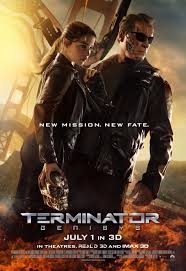
Terminator Genisys

Terminator Genisys isn’t terminal,  but isn’t exactly healthy either…
termin

At the start of the year, should you have browsed a cinema listing of upcoming releases, you may have found yourself feeling confused as to what year it was. With Hollywood continuing to indicate a depletion of original ideas by reinventing its back catalogue it is easy to become cynical at these ‘new’ releases. In the past few weeks alone we’ve had Mad Max and Jurassic Park to name but two. And now, 31 years after Arnie first graced our screens as the Austrian-accented cyborg assassin, he is back; as he promised Sarah Connor all those years ago.

Before commencing this review, I do need to acknowledge the amount of bad reviews that have already come out about this film. I will state quite clearly this is not a good film (Sam, if you’re reading this, deal with it!) However, I do not think it deserves the savagery that has been aimed at it. Upon viewing this film one could argue that it has become a target of film – with so much vanilla being shown in cinemas at the moment and the first two Terminator films being so iconic, it is easy and fun to pull this film to shreds. But is it so necessary? In fact, arguably, the ‘issues’ being identified with Genysis are many action movies – overreliance on clichés, dodgy script and pacing, set-pieces as opposed to a story arc, gratuitous nudity and more miss-than-hit jokes. Cinematic blasphemy aside, surely most of the venom in these reviews stems from the fact the original films hold such status and the loyal fans have been wounded enough by mediocre sequels? Agreed, watching this film is a bit like watching a cover band plays the hits of your favourite artist and it is a rather unmemorable movie – but it’s not an awful one.

Plot-wise we have a modern rehash of what has gone before. John Connor (Jason Clarke) sends Kyle Reece (Jai Courtney) back in time to help protect his mother Sarah (Emila Clarke) and, unbeknownst to Kyle, partake in John’s conception. However, when Kyle arrives back in the 1980s he arrives in a world that is strange both to us and Kyle; for Sarah is not the damsel-in-distress Kyle had been expecting to meet and defend. Instead she is, supposedly, an ass-kicking battle maiden. How has this happened? Because of her father figure Pops – previously known as the T-800 (Arnold Schwarzenegger) who has trained her, protected her and reminded her of her pre-designed fate since the age of nine. It’s an interesting idea and in its application it’s given a good effort, but in reality It does play out like fan fiction. It’s as if the script writer’s said, ‘Well we have pissed off the fans a lot with two crappy sequels, so let’s trawl the web and see what they want to see and we’ll just shove that into the script!’ Arnie’s T-800 was the original films USP and by pushing the reset button the audience will be split in two. You opinion on this aspect will be defined by your response to hearing Kyle Reece say of T-800, ‘He Loved you.’ Yep. He now comes with feelings. Perhaps not an upgrade all fans would want.

This decision to adapt his characterisation is clearly an attempt to put a new stamp on things, and a hug-able T-800 is not the only alteration. By the end of the film the timeline has been completely changed, with a new mythos and ideology. In fact, considering the entire film appears to be a fable warning against the perils of technology and internet safety, you’d be forgiven for forgetting that this a Terminator movie at all. For Sarah, Kyle and Pops (he is only referred to T-800 once compared to the countless times he is called Pops) must yet again stop Judgement Day – but judgement day is in brand new packaging here. Society knows a big event is coming; they even have a countdown for it, except they don’t know what the countdown is for. They believe that when the clock gets to zero computer software Genysis will be activated, software that will allow them to become fully connected – all their technology joined together. Instead it is when Genysis, an AI descendent of Hal from 2001: Space Odyssey in the form of Matt Smith (of Doctor Who fame), will assert his control of humanity and destroy it.

Our trio’s journey to stop this will obviously not be smooth, and there are many entertaining set pieces along the way with the special effects that are superb and often tension-inducing. However, as a whole the plot is a bit of a slog and the repetitiveness of the set pieces soon becomes rather tedious. The performances of the actors are rather stilted and wooden. If this film had not tried to induct itself into the Terminator franchise it would be regarded as an entertaining Friday night spectacle. Instead, by trying to reinvent things, they have lost and even angered the original fans by creating a pale imitation of a franchise.  For those who are not big fans of those films I’d recommend this movie if you want some easy entertainment. For the die-hard fans out there avoid it – you’ll spend the film disappointed and haunted by the ghosts of movies past.

Mr Holmes

No Deerstalkers or pipes to be found here…

Mr_-Holmes-Poster-900x1334

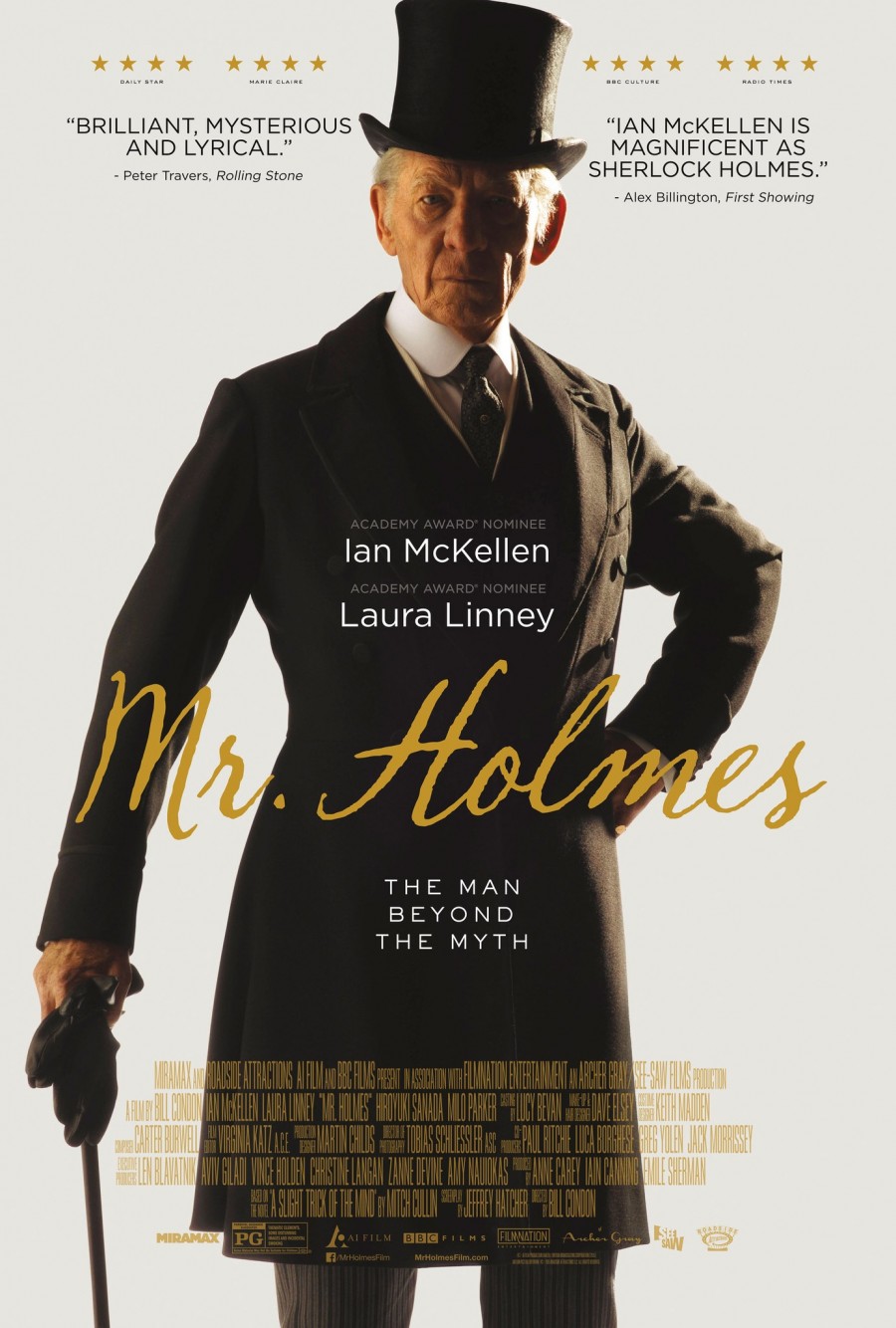
In recent years, courtesy of Benedict Cumberbatch and Robert Downey Jr, the man/myth/legend that is Sherlock Holmes has enjoyed some of a renaissance. New generations have been introduced, in shining and action-filled packaging, to the stories and the iconic character. Yet the Mr. Holmes presented here is unlike either of those two portrayals. In fact, he is rather unlike any version we have seen before.

Ian Mckellan opens the film as 93-year-old Sherlock, on his way back to East Sussex from Japan after trying to find a mysterious substance to aid his failing memory. The location of his visit and reason for visiting are not initially transparent, but teased gradually during the early minutes. The very notion of a Sherlock without possession of an immaculate memory and infamous intuitive instincts poses the prospect of a very un-Holmes esque story.

This is true to some extent, the story itself does not follow the tradition of a who-dunnit or a ‘watch-as-he-expertly-solves-another-case.’ Instead, in a mirroring of the trauma and chaos of his growing senility, the plot jumps between three strands; present day (home from Japan), the distant past (30 years prior, working on his last case before self-enforced retirement) and the recent past (the trip to Japan). Each thread is interwoven, unable to be separated or developed due to it’s unestablished attachment to the others.

What is remarkable is how well Mckellan pulls this off in his performance. There is little/no need for a title to inform us of the year change, it is apparent from his performance (and some rather fantastic make-up work). His 93 year old Holmes manages to reflect our fears of the trauma of old age, without descending into characticture. We watch him move with melancholy and lose himself in a spiral of increasingly forgotten memories.  His 63 year old Sherlock has the wit, charm and sharp senses as we would expect, though as the film develops we watch cautiously in await of the unravelling that cause the loss of his ruthless logic. What will he find when he start unravelling? Mckellan demonstrates all of this with such affection, grace and warmth as we are treated to two different investigations; the final case in his detective career and that of the self when all that is familiar is no longer certain.

London Road

The citizens of London Road will talk-sing their way to a brighter tomorrow!

london rd

In 2006, in different locations across Ipswich and over a period of roughly three months, the bodies of five prostitutes were found. The murderer, Steven Wright, was identified and arrested. A resident of (you guessed it!) London Road, the discovery of his crimes led to the street being given a reputation and haunted his unknowing neighbours. The film follows the residents through; the period of uncertainty of a serial killer being on the loose: the identification of the murderer: his arrest, trial and convictions for all five crimes; and the community trying to rebuild itself by hosting events culminating in a flower show in their front gardens. The fact that these are all real events that occurred is echoed by the construction of the film – the residents of London Road were interviewed by Alecky Blythe over a period of three years. Her questions focused on the wellbeing of the community were well-received by the interviews and resulted in the unburdening of some very honest and heartfelt opinions. These recording were then transferred to a theatre production which was produced in a verbatim style – with the spoken text being reproduced by the performers exactly as it was recorded. Everything from tone, meter, pitch, inflection and fillers were retained to create a ‘real’ reflection of what happened. The twist is that the dialogue is set to music to expedite the emotion – intensifying what is being spoken/sung.

This film is, as far as I can gather, a true stage-to-screen adaptation. The killer and his victims remain unseen, the focus staying with the neighbourhood as it tried to regenerate in the aftermath. In fact the only change appears to have been with regards casting. Instead of retaining a main ensemble cast of unknown, the film has made the use of stunt casting. We have Anita Dobson (of Golden-era Eastenders fame), Olivia Colman (she of everywhere-on-the-telly fame) and Tom Hardy. Yes, you did read that right, the Tom Hardy (of the-awesomeness-that-is-Mad-Max fame and loads more.) This is one of two aspects of the film I found rather difficult. I will be very honest at this point and admit I was rather looking forward to Tom Hardy’s appearance (A- cracking actor B- also rather attractive.) When he finally appeared (I guesstimate 15 minutes in) he was good, for the three minutes of running time he featured. He was clearly chosen (and given top billing!) to draw in a crowd (I shamefully admit to this…) and does a fantastic job of creating well-rounded creepy character. In fact considering the short screen-time this is very impressive indeed. But one cannot help but ask, was he really needed? Why not use an equally talented but lesser known actor? When the USP for this film is the authentic-ness, the realism of what is being shown and heard, why then hire a big star like Hardy? Why pull the viewer out of such an immersive play but using such a familiar face? Why spend so much effort creating a suspension of disbelief, only to return them to relate with his (very skilled but very recognisable) presence?

This leads on somewhat to my second difficulty with regards this film. 24 hours on, I am still not sure if I liked this film. Also, I am not sure how necessary it really is. Whilst is it does celebrate the restoration of a community – in a time of utter emotional devastation light is brought in to conquer the darkness – is there not a degree of profiteering of the deaths of five young women?  This is surely a matter of personal opinion, although I am yet to decide mine (slightly flawed review then perhaps!?!) Those in the former camp will revel in the engaging sincerity, dazzle in the niche display and chuckle along with the dark humour. Others, however, will feel unsettled by the plot, bored by the pacing and find the emotion cloying.

For the most part, I’m afraid, I am in most agreement with the second of the two opinions. Though I desperately tried to will myself to like it, to an almost feverish extent, I just didn’t ‘get it’. Whilst the intent is admirable, the execution is jarring. Considering the film is so claustrophobic, the overly optimistic ending undercuts the power of what has gone on before. An interesting but flawed experiment.

Phoenix

A film that burns as brightly as its mythical namesake

Phoenix_(2014_film)_POSTER

No, before you ask, this is not a film about the bearded woman of Eurovision infamy. Instead it is a subtle examination of one woman’s survival after being released from a concentration camp. My choice of words is key here, as there was no life after the imaginable horrors of the Holocaust – surviving not living.  All the characters retain an expression of shock, of disbelief, unable to process the past few years of devastation. Nothing and no-one is black or white, all lines are blurred. This theme is replicated in the narrative – the audience must piece together what they are seeing and are left to establish meaning for themselves.

It is June 1945. Nelly, a young German woman whose face has been horrifically disfigured from her time in the camp, returns home. What was once home at least. She is accompanied by Lene, a close friend from the pre-war days, who is by her side as she endures facial surgery to reconstruct her face. Nelly is warned that it will be impossible for the surgeon to restore her face to as it was before. As she slowly starts to heal she struggles to comprehend how her face and her life has changed. Her sense of identify has been lost so, against Lene’s warnings of concerns, she seeks out her centre – her husband Johnny – at the Jazz bar she thinks he’ll be playing at, Phoenix.  Johnny is the love of Nelly’s life, believing that finding him will restore some sense of normality, especially as her entire family has been murdered in the Holocaust. Johnny is convinced that his wife, too, is dead. So, when Nelly finally tracks him down, he recognizes nothing but an unnerving resemblance and doesn’t believe it could really be her. Hoping to secure her family’s inheritance, Johnny suggests to Nelly that she take on the identity of his late wife. Nelly agrees: therefore becoming her own imposter. She wants to know whether Johnny loved her – and whether he betrayed her. Nelly wants her old life back – but is this blinding her to the truth?

The plot of this film is pure melodrama, of desperation and devastation, more preposterous than realist. Yet somehow, in it’s execution, it’s incredibly and beautifully un-melodramatic. With aspects of an Hitchcockian thriller – think the doppelganger aspect of ‘Vertigo’ combined with the noir of ‘Suspicion’ and the ambiguity of ‘Rebecca – the film is an almost contradictory bleak yet hopeful examination of human trauma. As we watch Johnny train Nelly in how to be Nelly (unbeknownst to Jonny that it is his wife he is actually training) it starts to become clear who is manipulating who. Both Johnny and Nelly have clear motivations – Johnny wanting to train this strange woman to gain the large inheritance, Nelly wanting to be trained into the woman she once as – yet the levels of deceit make a happy ending seem unlikely. The tension builds to a truly captivating and stunningly executed finale. A must watch!

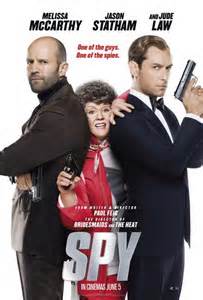
Spy

I ‘Spy’ with my little eye… a rather flawed comedy movie.

spymovie

The opportunity arose to attend a preview screening yesterday evening to see this film – four days prior to it’s nationwide release date. Upon further research it became apparent this was one of many preview screenings of the film within the past couple of weeks. Typically this can raise alarm bells with regards the film. Distributors (in this case 20th Century Fox) tend to increase the amount of preview screenings for a film if they are worried about the reaction of critics. By increasing preview screenings distributors are trying to increase the word-of-mouth feedback for a film, as opposed to reliance on film reviews, to ensure commerce. So far, however, this appears to have been an unwarranted concern. ‘Spy’ currently holds a rating of 95% freshness on Rotten Tomatoes (a website that counts positive and negative reviews and collates them to create a rating) and nearly all of the reviews for this film are overwhelming positive. But, in all honesty, I am uncertain as to why. In fact, I half-wonder if I saw the same film as these critics.

Brief recap for those of you who are not aware of the plot to the film – Susan Cooper (Melissa McCarthy) works for the CIA, but she is not a spy. She is the person behind the voice actual spy Timothy Fine (Jude Law) can hear through his earpiece. They are a team, until one day circumstances mean that McCarthy must step away from her desk and into the field as an agent. Whilst she has had all the training, is she really good enough?

When put like that the film does sound interesting, and rather different from most films out there. The Spy/Thriller genre is one that deserves much parody, and this should have been a fresh take on well-beaten path. Instead, for me at least, this film just didn’t seem to work. First and foremost I want to state just how good the cast are in this film.  McCarthy’s Susan is immensely likeable. Whilst she could have been a one-dimensional characticture, McCarthy ensures that she is played with warmth and affection with the audience willing her to succeed in even the most unlikely of circumstances. The rest of the ensemble are also well played – alongside Law there are other recognisable names/ faces in the form of Jason Statham (another CIA agent, parodying type), Rose Bryne (a Bulgarian villain), Miranda Hart (Susan’s BFF), Peter Serafinowicz (an Italian ally) and 50 Cent (as 50 Cent). Unfortunately they are all let down by the script – which tries far too hard for laughs that is often misses them completely. The majority of the gags are predictable and cheap – falling into the categories of stale, bad-taste or simply unfunny (often all at once.)

One big issue for me, which has seemingly gone unnoticed by the majority of reviews, was some of the gender politics within the film. Women are either represented as ‘beautiful skinny bitches’ (Bryne) or ‘awkward unattractive singletons’ (McCarthy and Hart.) Men are just varying levels of arrogance or perviness. Serafinowicz plays an Aldo, an Italian spy who has been roped in to help Susan when she is in Rome. This ‘help’ involves driving at high-neck speeds across the city – driving so fast he has to grab onto her breasts for support. The ‘joke’ here is that obviously he doesn’t need to, he’s just using the opportunity to grope her. Hahahaha – sexual assault is so funny!!! She keeps telling him to keep his hands to himself which he ignores. Again, unwanted molestation – hehehhehehe! (This is sarcasm, just in case it wasn’t clear…)

Later in the film (SPOILER ALERT) the pair are tied up and held prisoner in a basement. Susan asks Aldo to help untie her – which involves various aerobic gymnastics until he is in the right position (can you see we’re I’m going with this yet?) to help untie her (which involves his crotch resting upon her neck.) Once she is free she dabs at her neck, commenting on the damp patch he has left there. He responds with an over-the-top Italian style ‘Aw Shucks!’ The obvious implication is that he ejaculated on her neck in the process of untying her. Obviously this joke is bloody hilarious (it’s not.) Aldo spends the reminder of his screen-time attempting to seduce Susan, and other female characters, but obviously this is funny because he is harmless. In no way can his actions be misconstrued as the actions of a sexual predator.

It is hard not to think that if this scene had been reversed, with the female character helping untie the male character is the same fashion it would be played very differently in one of two ways. 1) If the female character was deemed ‘attractive’ it would be highly sexualised. 2) If the female character was deemed ‘grotesque’ it would be played for awkward laughs – at the expense of the female character. Instead, in ‘Spy’, Aldo faces no consequences for his predatory behaviour. At the end of the film Aldo reveals he is actually a British spy playing an Italian. Or is he?!? He crawls (not literally, I’m being intentionally hyperbolic) off screen promising to see Susan soon. Hahaha – that lovable creep Aldo. Not.

So, to conclude, ‘Spy’ is the example of a what could-have-been great ensemble cast let down by an ultimately flawed script.


Man Up

Proof that the phrase ‘Romantic Comedy’ shouldn’t always fill you with dread. 

manup

Being single, for the most part, sucks. It can really suck. It’s one of the few statuses that every human being has an opinion on. Well-meaning friends and family will offer advice – be that in the form of tips, well-wishes or sharing of their own stories (‘I know what it’s like! I’ve been there! I nearly gave up until she/he came along!’) Then there is the constant pushing along, making sure you are ‘out there’. And in modern day terms ‘out there’ comes in three common forms.

1) Getting chatted up in a public place: “Y’know I’m the perfect height for those…!” (The first, and only, words once tried on me by a 5ft 5in man. True story.)

2) Online dating: “Hey! Do you want me to be the prince to rescue you, Princess?  ;)” (Also a true story)

3) Friend of a friend: “You’re totally perfect for each other!” Then you met and wonder what your friend actually thinks of you. (Another true story.)

Then you meet someone vaguely interesting and go on a date, like a proper grown-up. You sit, you chat and try to akwardly form a connection. Then he asks if you take after your mum, and if your mum is single…(Okay, ignore that last part. Although, regrettably, that is another true story…)

Apologies for my veering into autobiography, but I thought it best to exemplify just how grim the world of modern dating can be. Now I can return back to the reason you are, probably/hopefully, reading this. ‘Man Up’ reflects all of these traumas and angst perfectly. In fact it is the only film I can currently think of which does not judge or condem the main character for her singledom. Yes, there are some rather overly famillar tropes used to demonstrate that Nancy (as played brilliant by Lake Bell) is single. She has two pet cats (a photo of which have pride of place in her purse),  she gives herself a pep talk in the mirror prior to a set-up and she has a (perhabs deservedly) world-wearly cynism about romance. However, she is also the most real heroine you will find in a modern day romcom. She has a fantastic sense of humour, has some awkward habits and gets food stuck in her teeth. She doesn’t always look immaculate or do all the right things. Therefore, she represents a very real everywoman – or at least my kind of everywoman. (She does have superb film taste afterall!)

In case you’ve not seen the trailer, Nancy is mistaken by Jack (Simon Pegg) for being his blind date whilst stood under the clock at Waterloo station. Instead of doing the oh-so-British thing of correcting him, she finds herself lying and pretending to be his date. The film follows them on their date, and the aftermath of it. The date is realistic, with the awkard pauses and moments of meeting a new person on a first date. It is easy to root for them – as both Jack and Nacy are well rounded characters. They are given depth, like and dislikes, and, most importantly, back stories.Using the jigsaw analogy used in the film – they are broken jigsaw puzzles who seem to be missing the blue bits.

There are many stand out scenes within the film. My two personal favourites are the danceposition (dance + exposition) to Duran Duran’s ‘Reflex’, which is hillarious – well scripted and choreographed. Also, the swapping of the Moleskine (obviously!) notebooks to share introduction lists. Jack’s favourite band is ‘Lloyd Cole and The Commotions’ (I recommend https://www.youtube.com/watch?v=fm5rMu3Wtr4) and his favourite drink is a Mojito. It has been statistically proven that a man who has two of these things cannot be a bad person (I am obviously lying, but they are pretty awesome favourite things).The chemistry between Nancy and Jack is fantastic, and watching them to get know each other is a joy.

At this point (Hi, if you’re still reading!) it must be clear to you that I liked this film. Really liked this film. Yes, it does veer on soppy at times. Certain elements are cliched or unlikely in real life. Yet, this didn’t stop me enjoying this film. Which, if you know me, should come as a huge surprise. In fact (queue mandatory eye roll!) it gave me hope. Just a little spark of hope, that all is not lost. Maybe, be that in via a meet-cute or online, I won’t die alone in a cinema with a bunch of cats (in-joke, apologies!)  Now, if you’ll excuse me I’m off to order my Moleskine notebook (Star Wars, obviously!). I’ll write out my list of favourite things, and I’ll try not to be so cynical. Maybe it’s finally time for me to Man Up…

Moomins on the Riviera

Is it Moomin’ marvellous? Well, yes and no…

Going into this film with no context of The Moomins is inadvisable. In fact, I would probably recommend this film only to big fans of the Moomins (shout out to Carrie ‘Cookie’ Turner-Gould and Matthew at this point!) Unfortunately, I am not a big fan of the Moomins. Although I have vague memories of the cartoon series, of strange hippo-looking creatures going on adventures, I do not really remember enough of the series to confirm that this film is merely a continuation onto the big screen. And I really did not remember The Moomins being so… strange…

The film opens with Snuffkin (yes I have got tabs open of Google and IMDB to help with this review!) strolling across Moomin Valley.In fact the entire opening sequence (3-5 mins) is of Snuffkin on his journey, of what and who he sees along the way. It is in this aspect the film really excels – the artwork and colouring is truly extraordinary. Every single frame could be printed off and used as artwork. The hand-drawn animation is truly glorious to watch on the big screen, and sets up a would could be described as a whimsical and quaint tone for the rest of the film. Or you could describe it as tedious. But I digress…

Finally, Snuffkin arrives at his journey. At the point the party (literally) gets started. Moominpappa makes a speech about how at this present moment he would not want to be anywhere else. He then plays a bit with fire then the party is over. Then we cut to the next day and a pirate ship is the distance (there is no transition or explanation, which may divide audiences) It starts to sink and the pirates escape – leaving behind their prisoners, Little My and her sister, who are tied up. They have also abandoned two treasures chests – one filled with gold and the other, seeds. The Moomins go to scavenge, accidentially rescuing the hostages in the process. The pirates come to collect their treasure chest from the Moomin family – who chose to collect books, fireworks and seeds instead. The pirates leave. The next day, whilst relaxing in the garden, they decide to go to the Riveria. They go to the Riveria. Various adventures happen. They go home.

And that is it in terms of the plot. It is incredibly simplistic and that both works, yet also doesn’t. Yes, it is a kids film but that doesn’t mean it has to be so simple or almost lackadaisical. Also, if this really is a kids film, I’m not so sure they would understand that many of the jokes or nuances. In fact the entire sequence in the Riveria is essentially a satire of a Monte Carlo- esque resort: about how ‘appearances can be deceptive’, to ‘be careful what you wish for’ and how ‘the grass isn’t greener on the other side’. Snorkmaiden is wooed by a charming celebrity man/dog/thing, who rivals Moomin in her afffections. It takes a fencing duel for her to realise the error of her ways. One character, the Marquis Mongaga, in fact personifies woes of consumerism completely. He spends most of the film charmed by the misadventures of Moominpappa (adventures I can only presume are recounted events from the comic strips?) until he feels bold enough to confess- he would give it all up to be a poor, struggling artist. Needless to say, he isn’t really suited to the lifestyle he has glamourised.  In this sense the film is quite clever, gently poking fun at bohemia and culture with some rather sharp gags. But this is done in a manner far too episodic for it to actually flow as a film.

This film, perhaps like marmite, will divide audiences totally. One side will leave the cinema describing it with adjectives including, ‘wistful’, ‘gentle’, ‘charming’, ‘mischievous’, ‘heartwarming’ and ‘eccentric’.

The other side will leave asking, ‘What did I just see..?’

Tomorrowland

Disney does dystopia – and it’s a rather dull world after all…

tomorrowland_ver5

With a running time of 2 hours and 10 minutes it is difficult when watching Tomorrowland to understand where that time goes. Unfortunately, this is not in the positive way of ‘time flies when you’re having fun!’ More like, ‘what took you guys so long?’ The film is so generic and vague with terms of the audience it is pitching to that it ends up appealing to no-one. The entire film feels like a set-up for a sequel – a sequel which, judging it’s current box office takings, will not happen. The film is a victim of scriptwriting – of safe, as opposed to lazy, scriptwriting.

All the expected tropes of a Disney film are here; a main character (Casey Newton, played by Britt Robertsonwith a unique ability that makes her an outcast (her instinctive knowledge of science, in case you didn’t work that out from the surname); a sibiling who acts older than their years (looks roughly 11 but has the wisdom on someone five times that); a single parent upbringing (mum died under mysterious circumstances, leaving behind an embittered genius scientist of a father); a British villian (Hugh Laurie); a call to arms (in the form of a mysterious young girl) and an opportunity to save the world (from it’s self – more on that later…) aided by a maverick elder figure (George Clooney).

All of this combined creates a film which we feel like we have seen before – arguably just with a new and futuristic setting. The idea is that we are aligned with Casey, as she is inducted into this world via a pin. The pin is delivered to her by an unknown source (unknown to her, we know it is Athena who has established links to Tomorrowland) which upon touching takes her to the ‘World Of Tomorrow’ (if you are a fan of Futurama you just got that reference and probably read it in your head in the appropriate tone of voice…) Casey spends two minutes (literally, as shown by the back of the pin) in Tomorrowland and is desperate to go back. Frank Walker (as played by George Clooney) is just the man to do it.

What procedes their meeting is the exciting set piece you have probably seen from the trailers, which have been front-loaded for the past few months. It is a fantastic set piece. It is also the best bit of the film. The rest is merely set up – conversations, discussions and fights which delay our arrival to Tomorrowland. Once we arrive the film’s messages, which have been not-so-subtly placed throughout the film, are then articulated in their entirety – obviously via the British villian giving a great speech. True, there are some important ideas being highlighted within this ‘great’ speech, but there are also some ideas which are either unnecessary or contradictory. It is hard to establish as a viewer whether I should be trying to fix my current world, or using my creativity to help establish a new and better one.

The film also has an important message about hope – of never giving up on one’s dreams. I hope that this film helps Hollywood realise it needs to get some original ideas…

No, not really George. Thanks for the offer though...

No, not really George. Thanks for the offer though…

The Age Of Adaline

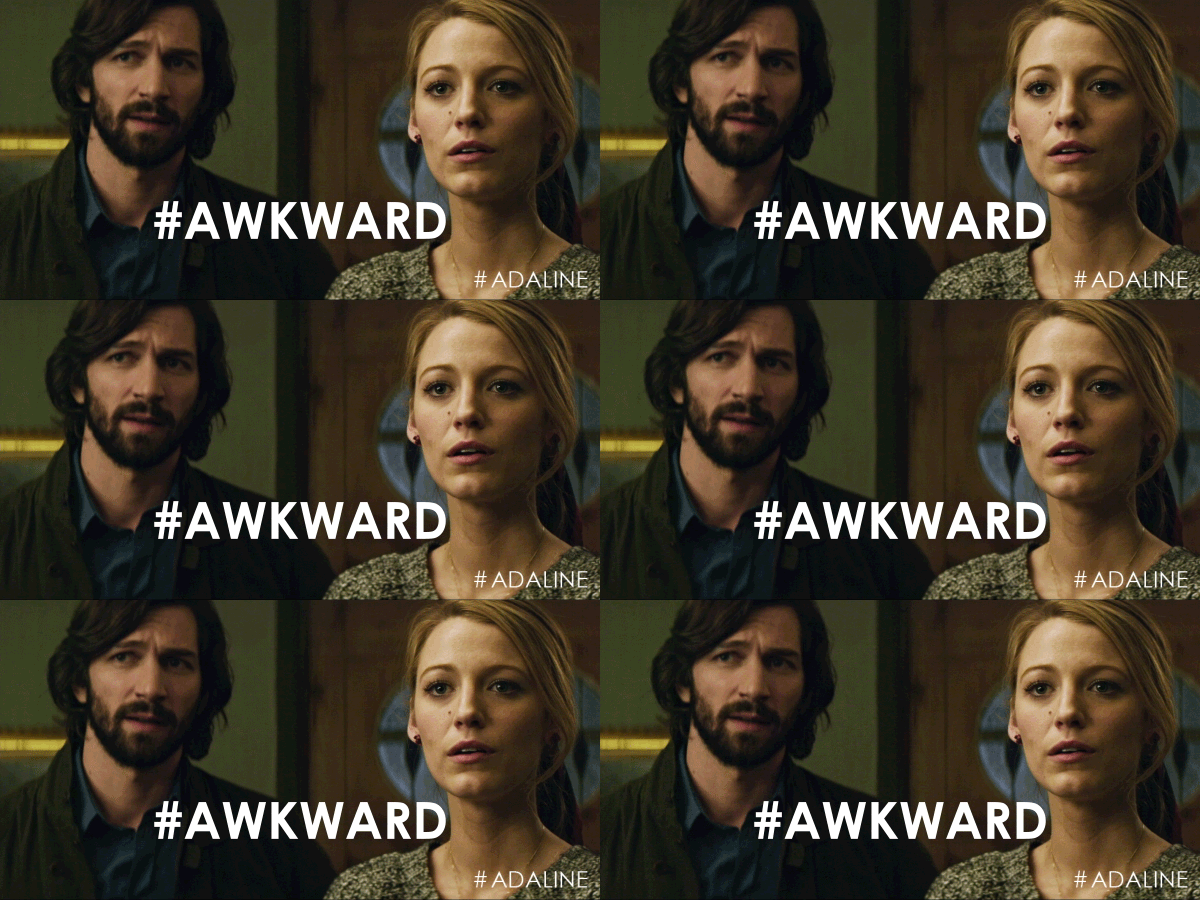
One of the taglines for this film is, ‘Love is timeless’. Having now watched this film I can also deduce that it also apparently twee, tedious and trite. Whilst I will openly admit that the Romance genre is not one I particularly enjoy watching (I will actively avoid anything based on the works of John Green and Nicholas Sparks) my lack of enjoyment of this film was not based on that. More the fact that it is awkward, cloying and image obsessed. What could have been an interesting idea, in a simillar vein to a Benjamin Button type-tale, became a frustrating cliched mess. Here be spoilers…

adalineThe film opens with a voiceover narration. Whilst I know it is a matter of personal opinion with regards the effectiveness of a voiceover narration, I do have a real affinity for them (if you disagree: go watch 500 Days Of Summer, then High Fidelity, and then Annie Hall, then come back and read this). In this case I was initially rather pleased, thinking it will then align itself with the previously mentioned films. It didn’t. With a patronising amount of retrospective, we are informed that Adaline (Blake Lively) is currently acquiring a new identity, which she does so freqently as she is apparently ageless. We are then shown intermittently via flashback how she acquried this miraculous ability, and told in heavy handed manner how this is not a good thing to have.

How Adaline gained her ability to ‘avoid the ravages of time’ was not through the use of anti-aging cream. Rather, on her drive home to her daughter, a recently-widowed Adaline is caught in a snow storm. This is amazing because it never snows where Adaline lives (Shock! Gasp! Not a total steal from Edward Scissorhands at all..) Her car crashes (obviously) and she falls into a lake. Our (gratually annoying) friend Mr Voiceover narrator returns to explain the process of dying – your heart slows as does your breathing apparently! Then she dies. But not for long, as the river gets struck by a bolt of lighting and she is brought back to life. The narrator then delivers some pseudo-science about how, because of the impossiblity of what happened, her cells will not age – she is alive but doesn’t get to age. What girl wouldn’t want that? But wait – that’s not a desirable thing at all. In fact you, young women in the audience,you should be thankful you age because it is going to be sooo hard for Adaline to be eternally beautiful. Just so difficult to live for decades looking like Blake Lively, being as slim as Blake Lively and having as much money as Blake Lively (she invests her saving in Xerox, a then unknown company). Because (amazingly!) she is not just mouth-dropping/men-fall-at-her-feet-like-flies gorgeous she is also clever! Gasp! She speaks multiple languages! She retains random facts about the first American president to be born in a hopsital! Swoon!

But Adaline cannot enjoy being young forever. Why? Because other women get jealous, and call her out for not ageing. Then an unknown goverment agency try to investigate her and she has to run away. Therefore she cannot stay and look after her daughter, as a proper American woman should! And that will unsettle her forever, until a man can stop her being free and fix everything with his love.

Because everything in life can be fixed with a bland love interest...

Because everything in life can be fixed with a bland love interest…

In case you didn’t realise from that section, like Adaline I am also well versed in other languages – aka sarcasm. This film has so many stupid and old-fashioned ideas about relationships and women’s beauty that it felt the entire feminist movement had been pushed back at least a couple of years. The idea of beauty being a burden is a difficult idea to portray in a sympathetic manner (google Samantha Brick for how not to discuss this idea…) and it really isn’t here. Also, it places the man as a saviour, which again doesn’t work. Love does not, and cannot, fix everything. As much as you could try, it just doesn’t. And the fact that Adaline is burdned with this not-so-superpower is contradicted by her representation in the film.

Her beauty is what raises her up beyond us mere mortals – men stop and stare at her. They freeze and their mouths drop open when they share a glance with her! The film tries everything to reinforce that ‘THIS IS NOT A GOOD THING’ but fails by continuing the cliched tripe in showing how the male characters respond to her. Her beauty is so great it will haunt them forever! They will never forget her! And then, when she is apparently 107, a new man appears in her life. First he stalks her, then forces her to go on a date with him. Luckily, as he is a handsome man this is fine and not creepy at all. They go on two dates, have sex, then go visit his parents for the weekend. Whilst in bed, at his parent’s home, he admits to her a week into their ‘relatonship’ that he has fallen in love with her. As we are not given enough reason as to why he has fallen in love with her, beyond her looks, the film retains it portrayal of love being interwoven with superficiality. In this manner the remainder of the film is utterly predictable. In fact to make the film more enjoyable to watch you could turn it into some sort of drinking game – how many more cliches can we include in this cloying romantic drama? Bet you can guess how it ends.

So, to conclude, I did not like this film. At all. Go see Mad Max instead.

akws

Mad Max: Fury Road

‘My name is max. My world is blood and fire.’
With these nine words we are inducted into the world of Mad Max. And what a truly and gloriously awful world that is. In a world where there is so little to live for – what little you have, you will fight to the death for.
MM
This film, like its protagonist, is fulled by adrenaline. Like the world it shows us, there are very few pauses or respites from the high octane pace. There is little information provided as to why the world has been destroyed.  Small snippets of information indicate that the fight over oil became a literal fight which resulted in the desolate landscape we are plunged into. Context is sacrificed to immerse the audience into the battle, no-one really knows why they are fighting or what they are fighting for – except to stay alive.
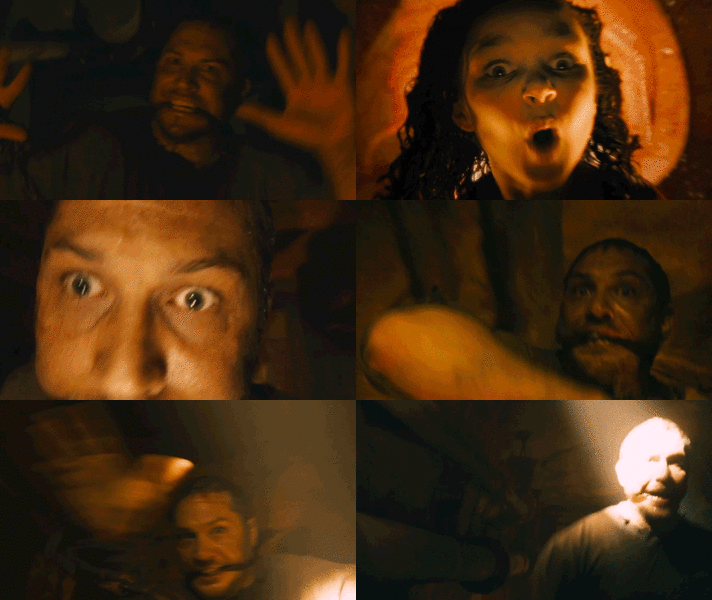
Tom Hardy as Max is excellent. He may utter few words but his physical prescence – his mannerisms and incredibly expressive reactions – create a character we feel like we know. Even though we really don’t.  He is Max. And it is uncertain whether he is broken, or everyone else is. His madness is not a hiderance, but perhaps his greatest ally. In times of utter peril; it is what keeps him alive.
madmax
However, the star of the show may in fact be Charlize Theron. One would be hard pressed to select a female character from an action movie who is so well develope. Far from being a weak damsel in distress, she is the closest Max has to an equal. Theron is incredibly watchable in this role, creating a character who is suprisingly sympathetic for someone we scarelecy know. What we do know is simple – she has stolen Ultimate Joe’s greatest possessions. As we know from a short sequence that Joe is a grotesque and probably evil dictator. We want her, aided by Max to succeed. However unlikely that, frequently, seems.
theron
All of this would not be possible, or nearly as memorable at least, without the combination of the holy trinity that is mise-en-scene, editing and cinematography. The composition of this film is truly incomparable. It is akin to watching a comic book – immersive and dominating visually – we are reliant only on what we can see. We are told so little that we must piece together what each frame may have to offer: mirroring how the characters grasp for every resource we take for granted in our society. There is no voiceover throughout the film to comfort us, inform us or nurse us. Like the characters it introduces then abandons, we spend the entire film adrift – devouring each morsel it bestows upon us.
Dystopian vouyerism has never been this pleasurable to watch. A big screen must see!