Pixels

This is not a film; it’s an endurance test.

The best simile to describe this film? It’s as if the writers of the film were like children on Halloween, though instead of pick’n mixing sweets they pick’n mixed pieces of a generation’s childhood nostalgia. Then, just like a child having a sugar rush before the inevitable crash and throwing up. The resulting technicolour vomit in this case is ‘Pixels’, which will leave you with the same feelings of regret and shame of a sweet-tooth binge. Throughout watching you’ll be left wondering who thought this mash-up of beloved video-games and crappy cinema was a good idea and why they spent $88 million making it. Before you carry on reading I will warn at this point that here be SPOILERS as this will not be a film review but will mostly become an essay on why this film is so bad and has had such negative reviews. Whenever one goes to see a film that has been as poorly received as this film, there is always a degree of hope that ‘Maybe it’s not as bad as the reviews say?’ or ‘Surely it has a couple of good moments!’ Prepare to be disappointed…

In case you’ve not seen the trailers, here is a plot summary. The film opens in the Summer of 1982, with 13-year olds Sam Brenner (later played by Adam Sandler) and Will Cooper (later played by Kevin James) excited by the opening of a video game arcade opening in their town. Both are naturals at the games, with Sam able to win most (but not all, hint hint!) games due to his innate ability to identify and memorise the formulas.  Will is good at crane machines (a skill momentarily useful later in the film, unsurprisingly). Will persuades Sam to enter the ‘Arcade Game Championships’ which their hometown is conventionally hosting, with Dan Aykroyd (WHY?!?) playing MC. He announces that a time capsule featuring aspects of the game championships is being launched into space (an example of the neon flashing exposition light I mentioned in my review yesterday!) They meet Ludlow Lamonsoff (later played by Josh Gad) who is opposed with a game character called Lady Lisa (more on this later) and befriend him as he is a kindred spirit. Sam breezes through the competition, but stumbles at the final hurdle when he loses playing Donkey Kong to Eddie Plant (later played by Peter Dinklage, another WHY?!?!).

The film then comes to the present day. Will is now president of the United States (no reason is given as to why this happened, how or what skills the man actually has to befit him of this title. He is a buffoon for the majority of the film, so maybe this is an attempt at satire?) It’s alluded that Sam never recovered from the loss, his second place status at a game championship scuppered his dreams of MIT and probable resulting success (because that is totally believable and not at all odd or regressive). Sam instead works for ‘Nerd’ a company who install electronics and software (because clearly a company supplying these skills had to be given that name). Whenever he arrives at a house for a job he must state, ‘Hello. I am a Nerd from Nerd Squad.’ (Yes, presumably someone got paid for this literary masterpiece.) At his latest job he meets a divorcee called Violet (Michelle Monaghan)  who lives with her son Matty. Sam bonds with Matty over video games (they are of seemingly similar maturity) and has a ‘moment’ with Violet where they almost kiss. Or, more accurately, he goes to kiss her and she refuses (of course, how dare she!) He berates her for being a snob as to why she din’;t kiss him (ignoring the fact he is a self-entitled man-child who is not the catch he seems to believe he is). He then throws back the killer line, ‘I’m a good kisser. All us nerd are. It’s because we’re so grateful.'( I, on the other hand, am grateful not to have meet such an arrogant arsehat.)

Sam gets a call from Will, telling him to get to the White House asap. He gets there and finds out that Violet wasn’t in fact following him in her care (because obviously he is such a catch that she will be so filled with regret for letting him go that she must follow and ensnare him) but is instead a Lieutenant Corporal. It turns out Earth has started been invaded by aliens using old video games to attack Earth (wonder who saw that coming from the opening? Maybe everyone?!?) They are told that first to three wins is the ultimate winner. If Sam and his arcade buddies loss, then it’s Game Over for Earth. After winning a level they are awarded a trophy, a ‘warrior’ from the opposition. After completing ‘Centipede’ in Hyde Park (overseen by Sean Bean. WHY?!?) then ‘Pac-Man’ in New York City they are awarded Q*bert (last seen in the far superior ‘Wreck It Ralph!) They then have a ball to celebrate (even though they still must complete one more challenge…) Sam and Violet bond (over her attractiveness and his infantility) when the aliens announce that Eddie, who had been released from prison (imprisoned for fraud. Surprising, as I thought a Lannister always paid their debts…sorry…not sorry.) to help the cause, had in fact cheated when playing ‘Pac-Man’. In fact Eddie even cheated during the championships, so Sam was the worthy winner that he always believed he was and spent the past 30 years brooding over (because that’s normal…) The aliens do not react will to that cheating, taking Matty as a trophy and sending their entire fleet to destroy Earth. However, they are given a reprieve within the invitation to enter the battleship and ‘meet the boss’ . The team split up. Violet, Sam and Will enter leaving behind Ludlow to ‘defend Earth’ (I wouldn’t hold out much for that.) He’s soon joined by Eddie, then Lady Lisa (the collection of pixels Ludlow had spent his life lusting over).

Meanwhile Sam, Eddie and Violet find out that the ‘boss’ is Donkey Kong. We are then given the unnecessary reminder that this is the only game Sam ‘sucks at.’ Yet, with the realisation that his 13-year-old self rightfully worn the world championships he is filled with enough confidence (as if he wasn’t inflated with enough of it) to beat Donkey Kong, rescue Matty and save Earth from annihilation. The aliens on Earth are destroyed, including Lady Lisa which devastates Ludlow. Yet somehow, during the awards ceremony for their ‘heroic’ efforts Q’bert transforms into Lady Lisa (no reason or explanation is given as to how or why). Fast forward to a year later, Ludlow and Lady Lisa are married and have five Q’bert children. THE END.

There are two main issues (of many) about this film that I really need to discuss. One, Lady Lisa. From the age of ten Ludlow worships her. Then she appears as a warrior for the opposition, but does not retain the pixel format of every other single alien and instead becomes human. She is incredibly attractive and Ludlow is overcome with emotion. Lady Lisa proceeds to fight Ludlow until he declares love for her. Obviously, as this is the kind of wish-fulfillment world this film is set in, his unrequited love and obsession with her is enough to persuade her to stop fighting him. Then when Ludlow announces to Eddie she is actually his fiancee she just smiles. When Q*bert then regenerates into her she is thrilled to see Ludlow. All of this is done without a single line from Lady Lisa herself, she does not utter a single word or do anything beyond looking gorgeous or briefly flailing a sword around. It’s the one of the more distressing negative stereotypes of ‘nerdom’, of obsessive and controlling lust and views of women as objects, brought to life.

Two, the film’s message is condescending garbage. The entire story-arch is to redeem Adam Sandler’s character, to give him the adulation and recognition he felt he always deserved. It’s as if they want him to represent every ‘nerd’ in the audience and try to clumsily reassure them that they aren’t actually wasting their lives playing videogames, you are actually heroes. It is this kind of ‘the geeks shall inherit the Earth’ bullshit narrative that is the waste of time, space and energy. It implies that anyone who thinks of themselves or is labelled as being anything considered ‘nerdy’ has this consuming desire to be appreciated for their niche skills asset or affirmation of self worth, which is total bollocks. f I want to spend hours playing zelda, Sims or song pop! Then that is my choice. I don’t need you patronising cockends telling me that’ll it’s fine and may even all for a greater cause. I know my ability of being able to guess an 80s song from 6 seconds of intro will never be called upon to help save the Earth, and I’ve no idea who these writers believe actually think in that way. Maybe themselves?

‘Pixels’ is a cynical and empty attempt to jump on the ‘nerdom’ bandwagon. A total misfire. A synthetic attempt which instead undermines and humiliates anyone who considers themselves ‘nerdy’.

The Gift (2015)

Dare you look inside?

This film is good. Really good. It’s wicked, smart and tense. So tense, you’ll be on the edge of your sheet for most of the film’s 1hr 50min running time. Few contemporary Hollywood films are able to hook in an audience so quickly, so subtly, and keep them gripped to the end credits. Belonging to the ‘thriller’ genre this film (written directed and starring Joel Edgerton) it manages to avoid all the perils of a bad thriller movie. Typically films of this genre are set up with a chunk of exposition, a boring and obvious way of introducing character and story. With ‘The Gift’ Egerton totally avoids this hurdle, instead he sprinkles exposition into dialogue. Twists and turns are set up in a way that it is only once they happen that you realise they were even set up in the first place. Not once does the film dip in tension or give any hints on what will happen next. If you’ve seen the trailer and thought you’d seen it all, you really haven’t!

Robin (Rebecca Hall) and Simon (Jason Batman) move from Chicago to California, to an area not far from Simon’s hometown. When shopping for new home supplies the pair are approached by ‘Gordo’ (Joel Edgerton) who identifies himself as being an old school friend of Simon’s. Gordo quickly establishes himself in their lives, dropping off gifts and making surprise visits at their home. Although Robin seems happy enough to maintain contact with the ‘socially awkward’ Gordo, Simon grows uneasy with Gordo’s behaviour and decides to ‘break-up’ with him and ends their friendship. Gordo does not let this go easily and continues to have a hold over the pair. Secrets from the past swiftly and menacingly threaten to ruin their seemingly idealistic life.

This film is both modern yet welcomingly old-fashioned. Its plot and pacing align it with Hitchcockian storytelling. The fact that much of the film focuses on Robin’s perspective is a throwback to the Gothics of the 1940s. Her doubts over Gordo, and as a result doubts about her husband, are never overblown or ‘too’ melodramatic but rooted in a degree of realism and with complete sympathy. What could be a one dimensional role is instead fully rounded with Hall’s nuances, her subtle discomfort apparent yet carefully and gradually revealed. Bateman is equally as good, barely recognizable in a role that goes far beyond type. All too often taking the role of fraught and downtrodden father figure, he places the role of Simon with ease as he carefully navigates the fine lien between charming and douchebaggery. Whilst we are swift to become uncertain of Gordo’s intent, we soon realise that we know just as little about Simon. His interactions with both Robin and Gordo remain intriguing and frequently unsettling from start to finish.

 But it is Edgerton who remains the star here, portraying the oddest and most secretive of the three leads. Often films like this will signpost, practically with flashing neon lights, what will happen next and who we can trust. Within his script, cinematography and characterisation Edgerton doesn’t do this. All of these dimensions are far too complex for that, refusing to let the viewer rest on their laurels or take a breather. Nothing is certain in this cinematic universe; no-one can be trusted.

A surprise of a movie, engrossing and unpredictable in equal measure. This is a fantastic directorial debut, a tense psycho-thriller and well worth seeing.

The Diary of a Teenage Girl

‘I had sex last night. Holy shit!’

From those opening lines, uttered by 15-year-old Minnie Goetze, the tone and content of the film is clear. It might not be to everyone’s taste but this film is a crucial and poignant portrayal of adolescence. It’s also one of the very few films which not only presents an honest deception of female sexulaity and desire, but makes it the primary focus of the film. It does not shy away from showing Minnie’s inner turmoil, and the lust which is consuming and controlling her. It’s isn’t scared to show how tumultuous sex, lust and love can for anyone, especially a fifteen-year old. Most importantly, this is done so in a truthful way told by a distinctive and unconventional voice.

As you may have gathered from the opening line, Minnie has just lost her virginity. Upon arriving home, after a rather self-satisfied strut around the park, she digs out her old voice recorder. Recent events have become so overwhelming for her she requires an outlet, one which will not judge her as friends and family might. For Minnie knows that her first sexual encounter, however good it felt, would not be considered ‘right’. This is because she slept with Monroe (Alexander Skarsgard), a man who is twenty years older than her. He is also dating her mother, Charlotte (Kristen Wiig). The film follows Minnie, in a non-linear fashion, as she rides out an affair with Monroe, lying to her mother and experimenting with her sexuliaty. This is all presented in a manner which is so frank and honest it’s almost wince-inducing at times, with a degree of candor that is refreshing but depressingly rare.

What is perhaps even more depressing is that this film has been given a ’18’ rating, 3 years older than its main protagonist, therefore cutting it off from the audience it deserves and the audience who most deserve it. It’s a frustrating decision, especially with the sex or sexual references that form the foundations of this film are more honest than glorified. The language Minnie uses, and the way her sex-life presented is no worse than what a few choice searches into google could unearth. In fact, the sex in this film is unfiltered in the way that the pornogrpahy that drowns the web isn’t. Our society complains openly, yet in hush-hush tones about the ‘epidemic’ that is sexualising our youth. But why not address the problem with a film like this, which presents these issues but also teaches the viewers how to learn from them. Hollywood is dominated with so many films with negative portrayals of women, who are presented simply as boobs/bums/faces (delete as appropriate) that it seems bitterly unfair that a film which ultimately has a valuable positive message, of self-worth, is restricted to those who may learn from and appreciate it the most.

Though at times the pacing of the film maybe uneven, with some of the plot threads either unexplored or abandoned, it is hugely worth seeing. Not only is it’s content insightful and important, but it’s cinematography is beautiful, mixing the real with the comic book art that dominates Minnie’s life. A totally convincing and refreshing take on a coming-of-age tale.

Inside Out

Pixar proving that it really does know us Inside Out…

This film is Pixar’s best outing yet. It’s so clever, moving and beautifully told – in the way only Pixar an master. An outstanding treat of a film for both kids and adults. Both silly yet serious, it manages to articulate the traumas of growing up in a way that both reflects them for the kids but prompts self-reflection from the adults. It cannot be emphasised enough how universal the film is, with a multitude of jokes that will appeal to all markets. It’s witty, yet warm and oh-so wise. Joy. Sadness. Fear. Disgust. Anger. These are all emotions that we feel, often simultaneously, yet this film makes us consider the true power of these emotions and how they are all equally important – in a manner that will make you giggle and possibly shed a tear or two.

11-year-old Riley lives in Minnesota with her mum and dad. For Riley, everyday is a great day. She loves her family, friends, hockey and goofing around. With Joy (Amy Poehler) at the helm in the Headquarters -Riley’s conscious mind- to influence Riley’s actions and memories. Joy, along with Fear (Bill Hader), Anger (Lewis Black) and Disgust (Mindy Kaling), use a control console to interact with Riley. Even after 11 years, they still cannot understand the purpose of Sadness (Phyllis Smith). Yet Riley’s life quickly changes, with her family moving to San Francisco for her dad’s work. Whilst Joy and the other three emotions are trying to negotiate Riley’s well-being upon moving, they most also deal with Sadness who has started to touch some of Riley’s happy memories, transforming them to be sad. When trying to fix one of these memories Joy and Sadness end up being transported away from Headquarters into the labyrinthian maze that is Riley’s mind.

It’s immensely hard to find the words to explain just how extraordinary this film is. In typical Pixar-style it has created a film with a premise that seems so obvious, the idea of our emotions having personalities, yet manages to create something so beautifully poignant, entertaining and moving. Riley’s turmoil is so well reflected, it will bring back evocative memories for all. For the parents of the audience it could only be doubly heartfelt – an opportunity to see inside your child’s mind!

How these aspects are converted onto the screen are what makes Pixar so innovative. We have the Train of Thought, Personality Islands and the dreaded Memory Dump. A stand-out sequence has to when Sadness, Joy and Bing-Bong (Riley’s long forgotten imaginary friend) stop by the production studio for Dreams. It’s just so meta, with the revelation that dreams are actually created in a movie studio style-operation, reflecting on the manufacturing and perception of moving image. All of this is incredibly astute, but told in a way that is accessible to all ages. But what really makes us care about the events of this film is the characterisation. All the characters are fully developed and three dimensional – Riley is portrayed as such a lovely kid going through a real crisis, her loving parents doing all they can to help and their bond is so endearing. The emotions do steal the show here – they each have nuances and quirks yet are all untied with their tender treatment of Riley.

If you decide to go to the cinema only once this Summer, this is the film to see. It’s conceptually daring in both emotion and intellect, so comforting and simple but also affecting and thoughtful. A masterpiece.

Mini-Review: Lava

lava

Like all Pixar movies this film starts with a short, a beautiful love story called ‘Lava’. Told through song, a lonely volcano expresses his need for a companion he can love. It’s a beautiful sequence, the colourings and textures of the island landscape with the camera panning over so elegantly create an almost mythical tone. It’s hard to believe how far, animation-wise Pixar and its technology has developed since ‘Knick-Knack’ (1989) one of its earliest and similarly themed shorts. A timeless and universal theme presented in a extraordinary setting and style – setting you up perfectly for the main picture.

Magic Mike XXL

Are you ready for ‘one last ride’..?

In 2012 Magic Mike was something of a surprise hit. Channing Tatum (playing our eponymous hero) used his pre-Hollywood experience as a ‘male entertainer’ (the apparently preferred term to strippers) to produce a movie which reflected both the sexiness and seediness of the industry. It also inspired millions of women to re-listen to ‘It’s Raining Men’ and be unable to separate it from Tatum’s… athletic… and memorable choreography. Earning $167 million at the box office, on only a $7 million budget, it’s unsurprising that we return back to Mike’s world of male entertainers. This time it’s XXL, and in this case size really does matter…

Magic Mike ended with Mike throwing in the thong and retiring, giving up the ‘glamour’  of the industry to fulfill his dream of setting up his own company (designing and customizing carpentry, obviously!) He also gave up all the perks of the job (money, drugs and lots of women) to settle down with one girl. The sequel starts three years into his retirement, his business is going as well as could be expected in this economic climate, yet Mike’s life is not particularly…well magical. So when he gets a phone call from his old crew, offering him the chance for ‘one last ride’ and reunite for a final performance at a stripping convention (sidebar – I have no idea if this is a real thing, but I intend to find out and attend if so…but I digress!) It’s an opportunity he accepts readily, after a nostalgia- inducing dance to ‘Pony’ whilst weltering one evening (what is it about Hollywood attempting to sexualise weltering?!?) The film follows the crew as they travel to the convention, following the typical journey narrative. Things go wrong on the way, the characters experience self-reflection and make a show-stopping final performance. Yet it’s still a cracking female entertainer of a film.

Whilst the first film was enjoyable enough it tried to hard to be more than it was. It tried to be an expose of the seedy underbelly of stripping, a reflection of broken dreams and addictions. The sequel has clearly learnt from this mistake, replacing the po-faced storytelling with fun. So. Much. Fun.

What is really enjoyable about this film, and what makes it not necessarily extraordinary  but at least note-worthy, is fact it accurately portrays and liberates female desire. The choreography is designed with female engagement in mind, the male entertainers want to please and excite women. They enjoy it. And unlike many recent Hollywood films, there is no grey area here about consent – the consent of both men and women is given and celebrated.  The men dance for crowds made up of all shapes, sizes and ages – there are no restrictions here. All women are beautiful and deserve to experience desire and be desired themselves. In fact many of the scenes explicitly state this (in a way that is almost Corny but manged not to cross the line) told through mini-story arcs where the men help the women (yeah, here’s that line) embrace themselves and their worth. The cloying nature of this is minimised with the presence of some strong and fierce female characters – Jada Pinkett Smith and Elizabeth Banks steal every scene they are in.

The soundtrack is also electric – this time round it will be impossible to separate Backstreet Boys ‘I want it that way’ and NIN’s ‘Closer’ from Joe Manganiello’s (Big Dick Ritchie’s) *inspiring* routines. This film is well worth seeing, ideally with a group of friends or a cinema screen filled with admiring women. Never has a cinema been filled with estrogen on this scale, or as many appreciative cackles…

Ant-Man

An elegANTly told origin story

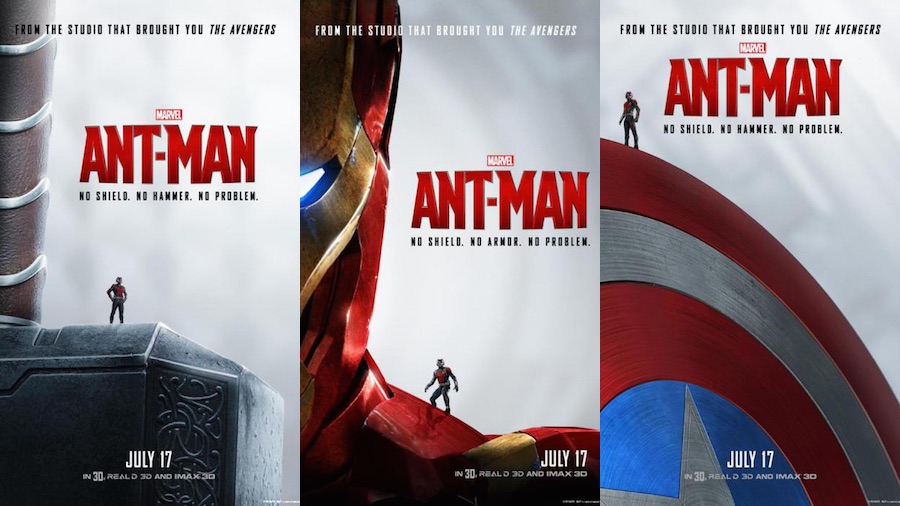
In 1962 Ant-Man made his comic book introduction – a brilliant scientist who invented a substance which allowed him to shrink size. Specifically to size of Ant (get it?!?) Along with his girlfriend, known as Wasp, they became a crime fighting duo who utilised their ability to shrink to the sizes of insects. In 1963 they were established as founding members of that little known superhero team, the Avengers. The chances are that this is all new information to you, for Ant-Man as a comic book series was not particularly popular. In fact he was not successful enough to even warrant his own series until relatively recently, mainly making appearances in ensembles as opposed to solo adventures.  The first you probably knew of Ant-Man was when the promo campaign started for this movie. You probably snorted, scoffed on your popcorn and sniggered at the ridiculousness thinking, ‘First Ironman, then Star-Lord now…Ant-Man!?!’  You may have laughed at one or two of the gags in the trailer and remained uncertain about the film. Don’t be fooled by his name, for in his cinematic debut Ant-Man confounds all expectations and proves that size is not everything. He may be small but this movie is gigantic in scope, laughs and pathos. In what could be viewed as its most outlandish adaptation yet, Marvel studios have created its most human movie yet.

Scott Lang (Paul Rudd) is a thief who has just been realised from a three year prison sentence. Struggling to find employment due to his checkered past and consequently unable to pay child support for his daughter he is a man desperate for a second chance at life. This is when Hank Pym (Michael Douglas) enters his life, a biophysicist who left the laboratory he founded under less than friendly-circumstances. Hank discovered a set of subatomic particles that made it possible to transform to the size of an ant, which his board members wanted to use for less than altruistic purposes. This, along with the mysterious disappearance of his wife, led to his estrangement from his daughter Hope (Evangeline Lily) Years after his quitting Pym technologies Hank needs Scott’s ‘unique set of skills’ to prevent his former-protégée turned possible evil genius Darren Cross (Corey Stoll) from using Hank’s research to create America’s next military weapon.  Scott must learn to use the ants, his own inner strength and skill-set, to plot the ultimate heist to save the earth.

This narrative is typical origin-movie stuff – a hero is given a call to arms, has an assistant who provides him with the help he needs and must defeat a villain who poses a mass threat – and in this manner may be Marvel’s most conventional narrative yet but it is also its most sublime. The sequences where Scott is ant-sized are superb, harking back to 50s sci-fi b-movies but with far better SFX. This is one of the few films that is released in 3d and is really worth watching in 3d. The humour along the journey is well-pitched and at times provides proper belly-laughs. If you found Avengers: Age of Ultron to be too dour then Ant-Man is your antidote. Paul Rudd’s Scott is pitched in the same manner as Chris Pratt’s Star Lord in Guardians of The Galaxy – the most unlikely of heroes can still be noble of heart and funny of tongue. A few of the quips made get lost in the action, but this is just a reason to re-watch the film. Although Edgar Wright left the film prior to filming, there are a few Wright touches here. Scott’s best friend Luis (Micheal Pena) is a scene-stealer and his flash-back narratives are told in Hot Fuzz stylee-editing to great effect.

Whilst the film is not perfect, with slightly too much of its running time spent on exposition and a few obvious twists, it is still an entertaining thrill-ride which suggests fantastic things to come. It’s an immensely likeable film with an equally likeable hero, proving that good things can come in small packages.

Terminator Genisys

Terminator Genisys isn’t terminal,  but isn’t exactly healthy either…
termin

At the start of the year, should you have browsed a cinema listing of upcoming releases, you may have found yourself feeling confused as to what year it was. With Hollywood continuing to indicate a depletion of original ideas by reinventing its back catalogue it is easy to become cynical at these ‘new’ releases. In the past few weeks alone we’ve had Mad Max and Jurassic Park to name but two. And now, 31 years after Arnie first graced our screens as the Austrian-accented cyborg assassin, he is back; as he promised Sarah Connor all those years ago.

Before commencing this review, I do need to acknowledge the amount of bad reviews that have already come out about this film. I will state quite clearly this is not a good film (Sam, if you’re reading this, deal with it!) However, I do not think it deserves the savagery that has been aimed at it. Upon viewing this film one could argue that it has become a target of film – with so much vanilla being shown in cinemas at the moment and the first two Terminator films being so iconic, it is easy and fun to pull this film to shreds. But is it so necessary? In fact, arguably, the ‘issues’ being identified with Genysis are many action movies – overreliance on clichés, dodgy script and pacing, set-pieces as opposed to a story arc, gratuitous nudity and more miss-than-hit jokes. Cinematic blasphemy aside, surely most of the venom in these reviews stems from the fact the original films hold such status and the loyal fans have been wounded enough by mediocre sequels? Agreed, watching this film is a bit like watching a cover band plays the hits of your favourite artist and it is a rather unmemorable movie – but it’s not an awful one.

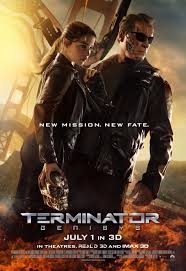
Plot-wise we have a modern rehash of what has gone before. John Connor (Jason Clarke) sends Kyle Reece (Jai Courtney) back in time to help protect his mother Sarah (Emila Clarke) and, unbeknownst to Kyle, partake in John’s conception. However, when Kyle arrives back in the 1980s he arrives in a world that is strange both to us and Kyle; for Sarah is not the damsel-in-distress Kyle had been expecting to meet and defend. Instead she is, supposedly, an ass-kicking battle maiden. How has this happened? Because of her father figure Pops – previously known as the T-800 (Arnold Schwarzenegger) who has trained her, protected her and reminded her of her pre-designed fate since the age of nine. It’s an interesting idea and in its application it’s given a good effort, but in reality It does play out like fan fiction. It’s as if the script writer’s said, ‘Well we have pissed off the fans a lot with two crappy sequels, so let’s trawl the web and see what they want to see and we’ll just shove that into the script!’ Arnie’s T-800 was the original films USP and by pushing the reset button the audience will be split in two. You opinion on this aspect will be defined by your response to hearing Kyle Reece say of T-800, ‘He Loved you.’ Yep. He now comes with feelings. Perhaps not an upgrade all fans would want.

This decision to adapt his characterisation is clearly an attempt to put a new stamp on things, and a hug-able T-800 is not the only alteration. By the end of the film the timeline has been completely changed, with a new mythos and ideology. In fact, considering the entire film appears to be a fable warning against the perils of technology and internet safety, you’d be forgiven for forgetting that this a Terminator movie at all. For Sarah, Kyle and Pops (he is only referred to T-800 once compared to the countless times he is called Pops) must yet again stop Judgement Day – but judgement day is in brand new packaging here. Society knows a big event is coming; they even have a countdown for it, except they don’t know what the countdown is for. They believe that when the clock gets to zero computer software Genysis will be activated, software that will allow them to become fully connected – all their technology joined together. Instead it is when Genysis, an AI descendent of Hal from 2001: Space Odyssey in the form of Matt Smith (of Doctor Who fame), will assert his control of humanity and destroy it.

Our trio’s journey to stop this will obviously not be smooth, and there are many entertaining set pieces along the way with the special effects that are superb and often tension-inducing. However, as a whole the plot is a bit of a slog and the repetitiveness of the set pieces soon becomes rather tedious. The performances of the actors are rather stilted and wooden. If this film had not tried to induct itself into the Terminator franchise it would be regarded as an entertaining Friday night spectacle. Instead, by trying to reinvent things, they have lost and even angered the original fans by creating a pale imitation of a franchise.  For those who are not big fans of those films I’d recommend this movie if you want some easy entertainment. For the die-hard fans out there avoid it – you’ll spend the film disappointed and haunted by the ghosts of movies past.

Mr Holmes

No Deerstalkers or pipes to be found here…

Mr_-Holmes-Poster-900x1334

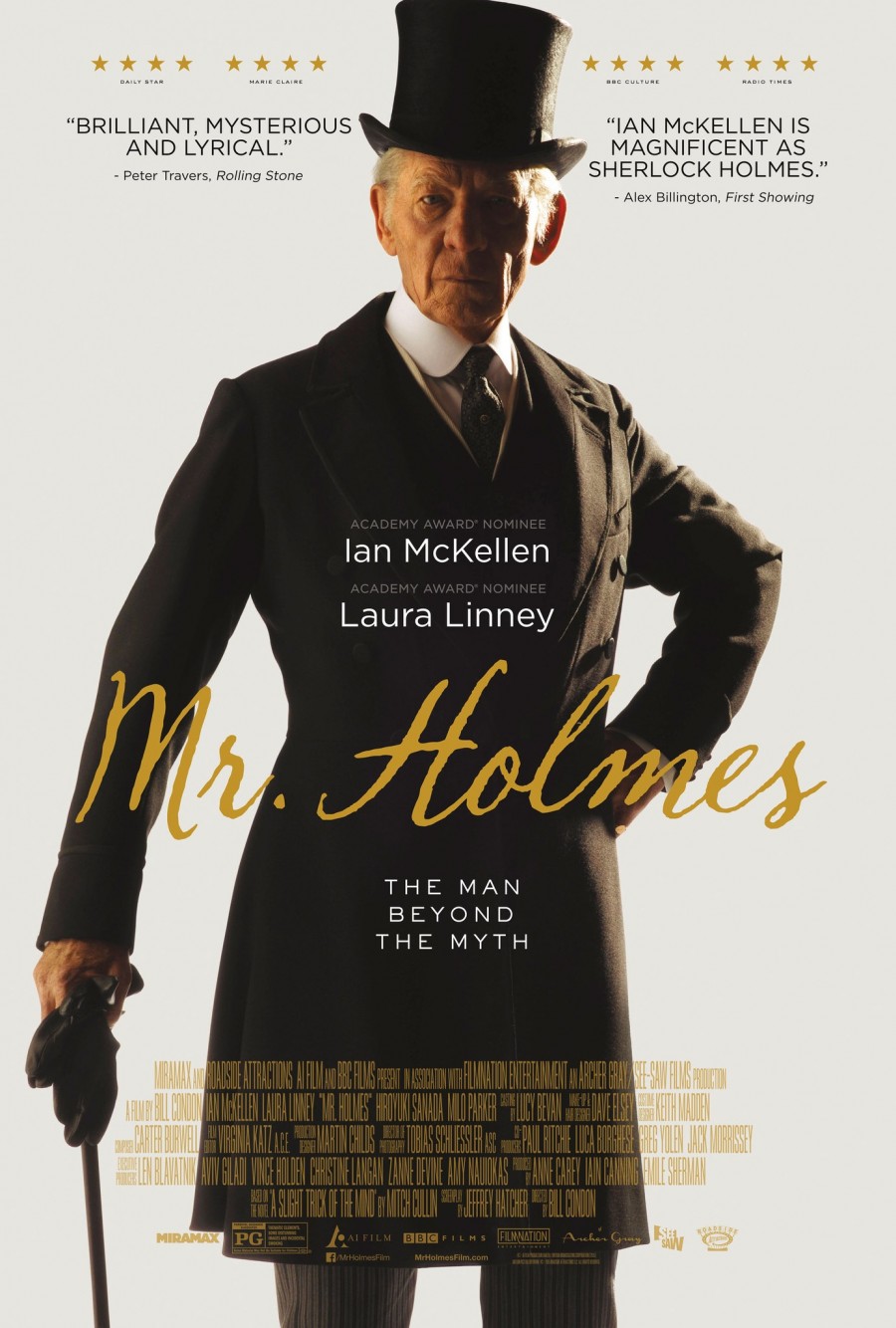
In recent years, courtesy of Benedict Cumberbatch and Robert Downey Jr, the man/myth/legend that is Sherlock Holmes has enjoyed some of a renaissance. New generations have been introduced, in shining and action-filled packaging, to the stories and the iconic character. Yet the Mr. Holmes presented here is unlike either of those two portrayals. In fact, he is rather unlike any version we have seen before.

Ian Mckellan opens the film as 93-year-old Sherlock, on his way back to East Sussex from Japan after trying to find a mysterious substance to aid his failing memory. The location of his visit and reason for visiting are not initially transparent, but teased gradually during the early minutes. The very notion of a Sherlock without possession of an immaculate memory and infamous intuitive instincts poses the prospect of a very un-Holmes esque story.

This is true to some extent, the story itself does not follow the tradition of a who-dunnit or a ‘watch-as-he-expertly-solves-another-case.’ Instead, in a mirroring of the trauma and chaos of his growing senility, the plot jumps between three strands; present day (home from Japan), the distant past (30 years prior, working on his last case before self-enforced retirement) and the recent past (the trip to Japan). Each thread is interwoven, unable to be separated or developed due to it’s unestablished attachment to the others.

What is remarkable is how well Mckellan pulls this off in his performance. There is little/no need for a title to inform us of the year change, it is apparent from his performance (and some rather fantastic make-up work). His 93 year old Holmes manages to reflect our fears of the trauma of old age, without descending into characticture. We watch him move with melancholy and lose himself in a spiral of increasingly forgotten memories.  His 63 year old Sherlock has the wit, charm and sharp senses as we would expect, though as the film develops we watch cautiously in await of the unravelling that cause the loss of his ruthless logic. What will he find when he start unravelling? Mckellan demonstrates all of this with such affection, grace and warmth as we are treated to two different investigations; the final case in his detective career and that of the self when all that is familiar is no longer certain.

Jurassic World

The park has grown into a world – but bigger doesn’t always mean better.

jpIt’s been twenty-two years since Jurassic Park came out. (At this point I’ll pause for a second to let that sink in/ get over the shock/let you sit down if you are standing!) Few blockbusters have the same amount of loyalty or produce the same levels of nostalgia from its fans or have so many iconic moments. From that music, to the shot of the water vibrating in a glass building to the introduction of the T-Rex, the raptors in the kitchen and the wonder that is Jeff Goldblum. As a consequence the makers of Jurassic World had a difficult task – to pay homage to the origins whilst also developing without being accused of trying to reinvent the wheel. In some ways they are successful, aspects of this film are incredibly entertaining and equal the original. On the other hand, some aspects are jumbled, flawed and disappointing.

The film reflects real-time, set 22 years after Jurassic Park was forced to close. Jurassic World is one of the world’s most popular theme parks – just as one would take their family to Disneyland they live in a world where it’s normal to go somewhere to see dinosaurs. In fact, it has become so normal that operations manger Claire Dearing (Bryce Dallas Howard) has been put in charge by the park owner to oversee the upcoming new exhibit. It’s a breed of dinosaur that has never been seen before – literally as it didn’t exist before. The ‘Indominous Rex’ is a product of genetic modification – a hybrid of different species. Although her nephews are currently spending a week at the Jurassic World – who arrived with the intent of spending time with her – she has been unable to do because of this indomitable project. Her nephews go off exploring the theme park with her assistant for company, whilst Claire deals with issues regards the new beast. She is forced to turn to Owen Grady (Chris Pratt, playing an oh-so-common ex-military/ leading velociraptor expert and trainer) for help. If you haven’t guess what happens next (SPOILER ALERT) it escapes. How will Claire and Owen prevent the treat of a beast that has never existed before? A breed whose genetic origins are being withheld from them? What will happen to Claire’s nephews? Will Owen and Claire have an inevitable romance? Will these film avoid obvious character types?

I’ll only provide an answer to the last of those questions – no. Whilst no-one would turn to Jurassic World or it’s predecessors looking for realism, it would be nice to have an action-adventure movie in which the events do not overshadow the characters. In fact, can you imagine a world where a 3D movie action-adventure has 3D characters? Jurassic World is not that kind of world. The dinosaurs are given more developed characters than the humans. In Jurassic World we have:

– Owen Grady, the bad-ass bloke who has no time for society’s bullshit or human being’s bullshit. He wants to live in peace and hang out with his raptor buds alpha-style. He is an attractive man, and knows it. He uses humour to defuse awkward situations or to make his point. (Think Indiana Jones, with less charm.)

– Claire Dearing, the work-obsessive who cares more about her work than family. She is deemed cold and calculating when compared to the male hero. All she cares about is money, order and routine. Luckily the events of the film will show her that this is wrong, and will fix her evil corporate ways. She is living proof that it is impossible to be successful and also care about other people. Runs around in heels. (Think every stereotype of working women that exists in film)

– Zach Mitchell, the older of Claire’s nephews, thinks he is a ladies-man. Stares at lots of young women because he is a ladies man. Turns out that this is all a front to hide his caring-side, and he actually does love his little brother.

– Gray Mitchell, Zach’s younger brother. Shown to have obsessive tendencies through his encyclopaedic knowledge of dinosaurs.

– Vic Hoskins, a man who wants to use Owen’s raptors for evil. Does evil-ish things.

Without any interesting heroes to really root for, the film falls slightly flat, and we end up feeling more sympathy for the dinosaurs. Yes, there are some fantastic set-pieces – some sequences are genuinely frightening and rival the original film. Yes, there are some lovely and subtle tributes to the original film. Yes, it is rather entertaining and somewhat worthy of awe. But it is a film which seems so uncertain of itself with some cheesiness worthy of Skarknado. It simultaneously pokes fun at action movie tropes but then utilises others, with a side order of predictability. All of this results in a vanilla-bland popcorn movie.

London Road

The citizens of London Road will talk-sing their way to a brighter tomorrow!

london rd

In 2006, in different locations across Ipswich and over a period of roughly three months, the bodies of five prostitutes were found. The murderer, Steven Wright, was identified and arrested. A resident of (you guessed it!) London Road, the discovery of his crimes led to the street being given a reputation and haunted his unknowing neighbours. The film follows the residents through; the period of uncertainty of a serial killer being on the loose: the identification of the murderer: his arrest, trial and convictions for all five crimes; and the community trying to rebuild itself by hosting events culminating in a flower show in their front gardens. The fact that these are all real events that occurred is echoed by the construction of the film – the residents of London Road were interviewed by Alecky Blythe over a period of three years. Her questions focused on the wellbeing of the community were well-received by the interviews and resulted in the unburdening of some very honest and heartfelt opinions. These recording were then transferred to a theatre production which was produced in a verbatim style – with the spoken text being reproduced by the performers exactly as it was recorded. Everything from tone, meter, pitch, inflection and fillers were retained to create a ‘real’ reflection of what happened. The twist is that the dialogue is set to music to expedite the emotion – intensifying what is being spoken/sung.

This film is, as far as I can gather, a true stage-to-screen adaptation. The killer and his victims remain unseen, the focus staying with the neighbourhood as it tried to regenerate in the aftermath. In fact the only change appears to have been with regards casting. Instead of retaining a main ensemble cast of unknown, the film has made the use of stunt casting. We have Anita Dobson (of Golden-era Eastenders fame), Olivia Colman (she of everywhere-on-the-telly fame) and Tom Hardy. Yes, you did read that right, the Tom Hardy (of the-awesomeness-that-is-Mad-Max fame and loads more.) This is one of two aspects of the film I found rather difficult. I will be very honest at this point and admit I was rather looking forward to Tom Hardy’s appearance (A- cracking actor B- also rather attractive.) When he finally appeared (I guesstimate 15 minutes in) he was good, for the three minutes of running time he featured. He was clearly chosen (and given top billing!) to draw in a crowd (I shamefully admit to this…) and does a fantastic job of creating well-rounded creepy character. In fact considering the short screen-time this is very impressive indeed. But one cannot help but ask, was he really needed? Why not use an equally talented but lesser known actor? When the USP for this film is the authentic-ness, the realism of what is being shown and heard, why then hire a big star like Hardy? Why pull the viewer out of such an immersive play but using such a familiar face? Why spend so much effort creating a suspension of disbelief, only to return them to relate with his (very skilled but very recognisable) presence?

This leads on somewhat to my second difficulty with regards this film. 24 hours on, I am still not sure if I liked this film. Also, I am not sure how necessary it really is. Whilst is it does celebrate the restoration of a community – in a time of utter emotional devastation light is brought in to conquer the darkness – is there not a degree of profiteering of the deaths of five young women?  This is surely a matter of personal opinion, although I am yet to decide mine (slightly flawed review then perhaps!?!) Those in the former camp will revel in the engaging sincerity, dazzle in the niche display and chuckle along with the dark humour. Others, however, will feel unsettled by the plot, bored by the pacing and find the emotion cloying.

For the most part, I’m afraid, I am in most agreement with the second of the two opinions. Though I desperately tried to will myself to like it, to an almost feverish extent, I just didn’t ‘get it’. Whilst the intent is admirable, the execution is jarring. Considering the film is so claustrophobic, the overly optimistic ending undercuts the power of what has gone on before. An interesting but flawed experiment.