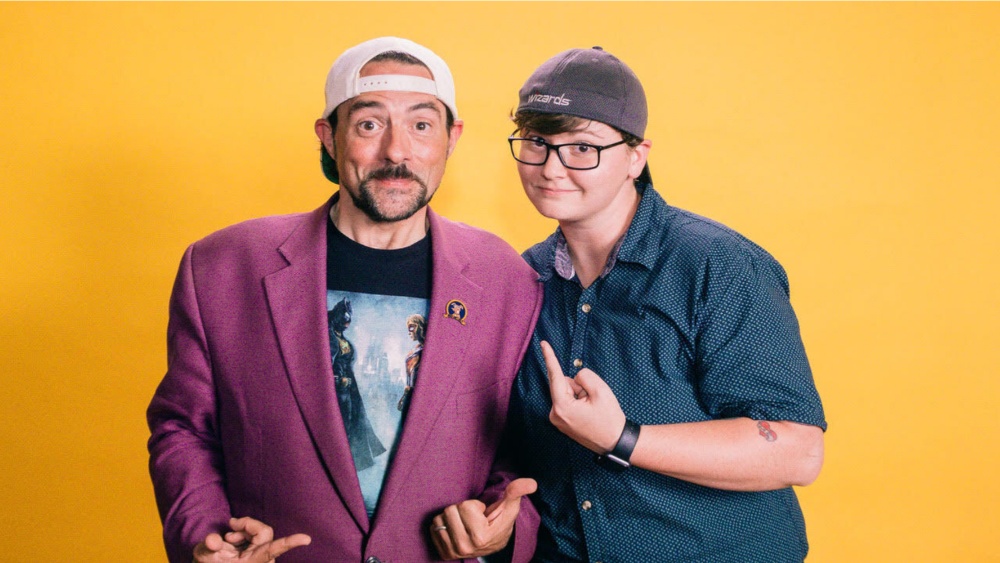
Chasing Chasing Amy
‘Life’s not about finding your heroes, it’s about finding yourself.’
Nearly everyone has a film that they consider their lifeboat film. They saw it at a crucial time in their lives and it made an inedible impression, it could have been life-saving in one way or another. Sometimes, however, with time, that film may not have aged as well as the person who loves it so much. That film may have become increasingly problematic, maybe having already been so from the outset, and that adoration face challenges from a complex legacy.
That’s the situation the writer-director-star of Chasing Chasing Amy faces. Sav Rodgers credits Kevin Smith’s 1997 film Chasing Amy with saving his life. It’s not hyperbole, as he explains in his 2018 TED Talk. Growing up in Kansas, as a queer person, Sav struggled with representation and limited positive LGBTQ+ role models. Having struggled with feeling isolated, facing abuse from his peers and fearing that these bleak feelings would be ever-permanent, a chance encounter with Chasing Amy changed his life and gave him hope.
Now, depending on how well you know that movie will impact your reaction to this declaration. For the story of Chasing Amy is a semi-biographical tale of Holden (played by Ben Affleck) who falls Alyssa (Joey Lauren Adams) but finds his hopes for romance crushed when he finds out she’s a lesbian. The film was reasonably well received on release, with Roger Ebert praising the film for being ‘moving and yet written with the skill of a screwball comedy’. And yet, in the 27 years since it’s release, it feels increasingly icky as a film concept and, as demonstrated by some of the talking heads in this documentary, feels like an unlikely film to warrant as much adoration and esteem as Rodgers holds it in. So, now older, wiser and happily partnered up, he’s finally ready to look into the legacy of Kevin Smith’s indie hit.
What follows is a documentary of discovery, of how cinema can be entwined with sense of self and identity. It’s also a story of two halves, with Rodgers getting to fanboy over both the film and getting to the confidences of Kevin Smith. But, after an interview with a member of the film’s cast (to name them would be a spoiler) goes off the wheels, Rodgers is forced to confront their purpose for the film and revaluate what loving it so unconditionally really means.
There’s a lot to like here, as the making of Chasing Amy and it’s aftermath – both at point of release and over time – get explored. Rodgers is a wonderful person to follow – open, honest, warm and endearingly earnest in every emotion they experience throughout this journey. At times, however, it does get frustrating at how superficial and unquestioning some of the peeling back of layers really is. Huge points of contention are identified but never fully investigated, with Rodger’s awe and hesitancy – a state most of the voices within the documentary seem to reside in – resulting in a lack of nuance in confronting the very issues they are there to discuss.
The final product is a personal essay on how important one film can be to someone. What it may lack in a critical voice, it makes up for in abundance with the passion and joy it feels over its subject matter.
[3.5/5 stars]
Chasing Chasing Amy had it’s UK premiere at London Film Festival on October 14th.





 Charlotte Sometimes