love

A Silent Voice
“What goes around comes around”

Manchester By The Sea
“I said a lot of terrible things to you. My heart was broken, and I know yours is broken, too.”

A United Kingdom
“No man is free who is not master of himself.”

Moana
“The 0cean chose me for a reason’

Southside With You
How I Met Your President
Read my  review here:
http://vulturehound.co.uk/2016/09/how-i-met-your-president-southside-with-you-film-review/

Captain Fantastic
“What we’ve created here maybe unique in all of human existence. We’ve created a paradise.”

Julieta
Brooding, sentimental and utterly charming
I think I’ve only given five stars twice this year. This will now be the third as ‘Julieta‘ is unquestionably a five star movie. The entire film has an air of intrigue which smothers the viewer and draws them into a grief-tainted realm of love and loss. There’s much brooding meditation on universal themes such as fate and guilt – how yearning and regret can torture generations.
Julieta (Suárez) is about to move away from Madrid to Portugal with Lorenzo (Grandinetti). When she goes on her final errands she has a chance encounter with Beatriz (Jenner) who was the childhood best friend of Julieta’s daughter Antia. Beatriz tells Julieta about how she had bumped into Antia the week prior, about how well she was looking and how she meet Antia’s children. It’s a casual encounter and yet it forces Julieta to face her past. She tells Lorenzo that she will not be moving to Portugal with him but she doesn’t tell him the reason – that she needs to confront the events that led up to the decades-long estrangement of her and her daughter.

One of the film’s great successes it how it instantaneously hooks the viewer in whilst revelling very little. We can observe much about Julieta and her relationship with Lorenzo – we see how happy and doubt free she appears to be about the move- and how this shifts entirely by to what would appear to bystanders as smalltalk-laden chance encounter. We witness how her moving forward with her life is swiftly halted as she is ejected back into her past. Not only is she inevitably forced back to the past mentally and emotionally, she then returns to living in the apartment block she lived in with Antia in the hope of manifesting ghosts of her past into present figures. The letter she then begins to write to Antia serves as the frame of the story, the letter starts at the beginning and we are then placed their – in the 1980s with a twenty-something Julieta played by a different actress (Ugarte).
What follows could then be categorised as a lengthy flashback and yet it doesn’t quite fit nor feel like that. Assigning that label makes it sound like a laborious or arduous watch – it wholeheartedly isn’t. We, the viewer, live the memories just as Julieta is reliving them. We follow Julieta as she meets Antia’s father Xoan (Grao), her relationship with him, Antia’s birth and the seemingly fated separation that occurs with both of them. Julieta is a specialist in Classics and an air of Greek mythology lingers over the events – a prevailing sense of tragedy and predestiny, decision and consequence, fate and regret.

As we face in our own lives some of the events in Julieta’s life come as a quick and devastating surprise whilst others are drawn out, almost suffocating in their inevitability. Both Ugarte and Suárez are truly excellent in their joint role – each providing so much depth to Julita, each equally and superbly moving as they endure unresolved personal heartbreak. This, of course, would not be possible were it not for the master behind the camera. Almodóvar reminds us, were it needed, that he is one of cinema’s greatest living directors. He tells the story in a way that is both fractured yet whole- just like Julieta – muted yet melodramatic. Many moments within the film are gasp-inducing in their blend of beauty and tragedy, but none more so than the switch from younger to older Julieta. It’s a tradition that is the epitome of seamless yet utterly shattering.
Extraordinarily stylish on the eye, food for your soul, heartbreaking yet heart-mending. Extraordinary.

Dir:Pedro Almodóvar
Cast: Adriana Ugarte, Rossy de Palma, Emma Suárez, Michelle Jenner, Inma Cuesta, Daniel Grao, Darío Grandinetti.
Country: Spain Year: 2016 Run time: 99 Minutes
Julieta is in UK cinemas now.

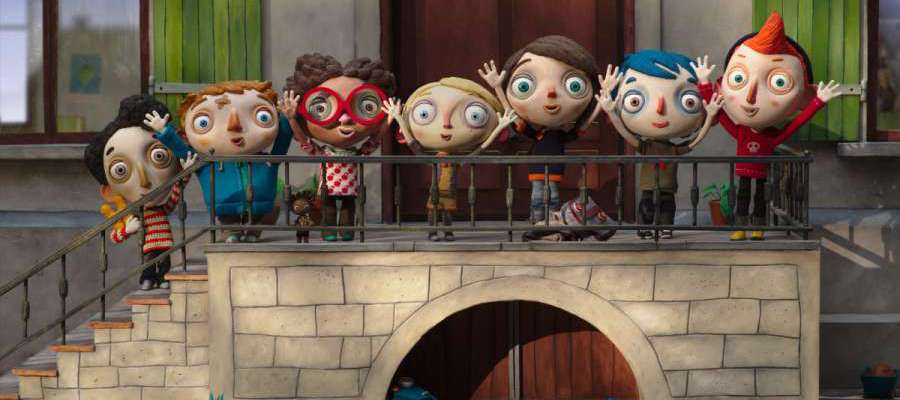
Kids In Love

Me Before You
A serviceable and relatively sincere weepie
Let’s start this with an admission. I am a crier. I have cried and will cry at everything and anything. An article on human kindness – I weep. An audition on a relatively television program – I sob. A particularly emotive song – I howl. Considering the nature of this film and what I had heard of the book I had the tissues at the ready. Literally I had taken a tissue out of the packet and tucked it into a jumper sleeve for easy access. Come the roll of the credits and the tissue had remained unused. I didn’t cry. This is not necessarily a criticism of the film – there were plenty of noses being blown and gentle sobbing echoed around the screen. Yet not a peep from me. Whether that is because I’m all cried out from recent weeks or whether the film didn’t have the emotional depth needed? Well, read on and see…
Two years ago William Traynor (Sam Claflin) was hit by a motorbike – leaving him paralysed from the neck-down. Will was once a man about town, living and hustling in London. The type of man all men envied and all women wanted. Now he is stuck back in his small-town home with his parents Camilla (Janet McTeer) and Steven (Charles Dance). Concerned by his desperately low spirits she decides to hire a carer/companion who can brighten up his lonely existence. Enter Louisa Clark (Emilia Clarke) who has just lost her job at the local cafe. Aged 26 she has never left her small town home, a place which she either loves too much or is too scared to leave. Her family rely on her as she brings in the only income so this job is perfect for her! Except she has zero experience as a carer. Having always been outshone by her younger sister, single mother Katrina (Jenna Coleman), or patronised by her long-term boyfriend Patrick (Matthew Lewis), Louisa is a woman not living life to its fullest. Maybe Will, a man who can no longer enjoy life, is the perfect person to help her live hers?
Having not read the book I cannot comment on the success of the transition of book to screen, although Twitter would suggest it is faithful. The story itself is relatively predictable, with little surprise, though this is not necessarily a bad thing as the story itself is told rather well. The pacing is solid with the growing bond between Louisa and Will is believable.The supporting cast are impeccably stereotypical and two-dimensional. Roll call for romantic tragedy archetypes – we have present: jealous and moody boyfriend who ‘doesn’t understand or appreciate’ how amazing his girlfriend is. Overly concerned mother and withdrawn father. Know-it-all younger sibling full of great advice. Friendly Australian nurse who steals most of the scenes he is in… (Side note: how can I get my own Nathan, Stephen Peacocke..?)
The main cast themselves are solid. Claflin does well with his role as a man who feels he has little reason to live. He provides his character with just enough spark to hint at the man Will once was. His bond with Clarke’s character is well-established and there is plenty of charisma between them. It’s Clarke’s performance that particularly stands out, with her facial expressions providing an earnest authenticity to her character. Although her character is essentially a 2016 small-town England Manic Pixie Dream Girl (her ‘quirky’ clothes and shoes used to denote her character as opposed to providing her with any genuine character traits) she is remarkably likeable. Her eyebrow acting is, as my secondary school students would say, on point – managing to show so much with them knitted in concern.
There’s enough here to watch and enjoy with a glass of wine. It doesn’t reinvent the wheel but if you’re a fan of such films as The Fault In Our Stars or Me, Earl and the Dying Girl then you’ll enjoy this.

 Charlotte Sometimes